
MSI PRO B650-S WiFi V1 Motherboard, ATX - Supports AMD Ryzen 9000/8000 / 7000 Series Processors, AM5 - DDR5 Memory Boost 6000+MHz/OC, 2 x PCIe 4.0 x16, 2 x M.2 Gen4, Wi-Fi 6E
Want the best price and purchase timing?
Our AI advisor analyzes real-time pricing across all channels to find you the best deal.
AI Verdict
This is an AM5 ATX motherboard with a 12-phase VRM, Wi-Fi 6E, and DDR5 7200+MHz support, best for Ryzen 5 or 7 builds.
This motherboard is a strong contender for mid-range AM5 builds, especially with Ryzen 5 or Ryzen 7 CPUs, offering Wi-Fi 6E, 2.5Gbps LAN, and 7200+MHz DDR5 support. However, its VRM design with discrete MOSFETs means it's not ideal for top-tier Ryzen 9 processors under heavy, sustained loads.
If you plan on running a Ryzen 9 CPU or need more robust VRM performance, look for boards with integrated power stages or a higher phase count with better cooling.
Regret Score™
Medium RiskLower is better — measures purchase-regret risk from real buyer complaints, review credibility, and product maturity
Issues discovered after purchase
Critically weak dimension
Amazon rating vs actual quality
Chance this product isn't for you
Pros
- Supports DDR5 memory up to 7200+ MHz (OC) across four DIMM slots for high-speed RAM configurations.
- Features Wi-Fi 6E and 2.5Gbps LAN for fast and stable network connectivity.
- Includes a USB 3.2 Gen 2x2 Type-C port on the rear, offering 20Gbps data transfer speeds.
- Equipped with two M.2 Gen4 x4 64Gbps slots, with the primary slot featuring Shield Frozr cooling.
- The 12 Duet Rail Power System VRM with 7W/mK MOSFET thermal pads handles Ryzen 5 and Ryzen 7 CPUs without throttling.
- Offers dual PCIe 4.0 x16 slots, with the primary slot reinforced with Steel Armor.
Cons
- The VRM uses discrete MOSFETs, which can lead to higher temperatures and potential thermal limits when paired with Ryzen 9 CPUs.
- Some users have reported issues with non-CPU USB 3.0 ports failing, requiring a CMOS reset.
- Lacks a rear clear CMOS button, making troubleshooting more inconvenient.
- The secondary PCIe x16 slot operates at PCIe 4.0 x4 speeds, not full x16.
- Only two M.2 slots are available, which might be limiting for extensive storage expansion.
Dimension Scores
The 12 Duet Rail Power System with 7W/mK MOSFET thermal pads is adequate for Ryzen 5 and 7, but discrete MOSFETs limit its performance with Ryzen 9 CPUs.
It includes Wi-Fi 6E, Bluetooth 5.3, 2.5Gbps LAN, a 20Gbps USB-C port, and M.2 Shield Frozr, which are above average for its price band.
Offers two PCIe 4.0 x16 slots (one full, one x4 electrical), two M.2 Gen4 slots, and four SATA 6G ports, providing solid but not extensive expansion.
Users report straightforward BIOS updates and stable performance, indicating a user-friendly and functional BIOS.
Best For
- Building a mid-range AM5 system with a Ryzen 5 or Ryzen 7 processor.
- Users needing integrated Wi-Fi 6E and 2.5Gbps wired networking.
- Configurations utilizing high-speed DDR5 memory up to 7200+ MHz.
- Setups requiring a 20Gbps USB-C port for fast external storage.
Not Recommended For
- High-end builds with Ryzen 9 processors that demand maximum VRM stability under sustained load.
- Users who frequently clear CMOS and prefer a dedicated external button.
- Systems requiring more than two M.2 NVMe drives for storage.
Watch Out For
- The VRM's discrete MOSFET design means a Ryzen 9 7950X at stock settings can push the board close to thermal limits.
- Some users experienced all non-CPU USB 3.0 ports stopping functionality, only resolved by clearing the CMOS.
- There's no clear CMOS button on the rear I/O, so you'll need to open your case for a reset.
- The secondary PCIe x16 slot is electrically x4, limiting bandwidth for a second high-performance GPU or expansion card.
Full Specifications
| RAM | DDR5 |
| ASIN | B0FBTKLKGJ |
| Brand | msi |
| Series | MSI PRO B650-S WIFI |
| Platform | Windows 11 |
| CPU Model | AMD Ryzen 7 |
| Processor | amd_ryzen_7 |
| CPU Socket | Socket AM5 |
| Model Name | MSI PRO B650-S WIFI |
| Item Weight | 3.24 pounds |
| Chipset Type | AMD B650 |
| Manufacturer | MSI |
| Memory Speed | 7200 MHz |
| Item model number | PRO B650-S WiFi |
| Compatible Devices | Personal Computer |
| Memory Clock Speed | 7200 MHz |
| Package Dimensions | 13.5 x 10.5 x 2.5 inches |
| Compatible Processors | Ryzen 7000 Series |
| RAM Memory Technology | DDR5 |
What Buyers Say
This board gets a lot of praise for being straightforward to set up, especially with Ryzen 7000 series CPUs, and people seem to like the built-in Wi-Fi 6E and Bluetooth 5.3. However, if you're thinking about a Ryzen 9, be aware that the VRM design with discrete MOSFETs can run hot under heavy loads, potentially limiting your CPU's full potential. There are also some scattered reports of USB ports acting up and needing a CMOS reset, which is a pain since there's no external button for it.
“Man, this board was a breeze to get my 7700X running, Wi-Fi's solid, but I'm kinda worried if I ever upgrade to a Ryzen 9, heard it gets toasty. And seriously, no clear CMOS button? Annoying!”
Common Praise
- Easy to set up and get running with Ryzen 7000 series processors.
- Reliable Wi-Fi 6E and Bluetooth 5.3 connectivity.
- Straightforward BIOS update process.
- Handles Ryzen 5 and Ryzen 7 CPUs without thermal throttling.
- Offers a good number of USB ports for various peripherals.
Common Complaints
- VRM temperatures can get high with Ryzen 9 CPUs under sustained load.
- Non-CPU USB 3.0 ports occasionally stop working, requiring a CMOS reset.
- Lack of a clear CMOS button on the rear I/O panel.
- The secondary PCIe x16 slot is only electrically x4.
Ownership Tips
- The discrete MOSFETs in the VRM mean that while it works, it's not as efficient at heat dissipation as boards with integrated power stages.
- BIOS updates are generally smooth, but it's always a good idea to have a USB stick ready for Q-Flash.
- The lack of a rear clear CMOS button can be a real hassle if you're tinkering with overclocks or have stability issues.
- The 2.5Gbps LAN is a noticeable upgrade if your network supports it, providing faster transfers than standard Gigabit Ethernet.
Frequently Asked Questions
Does this motherboard support Ryzen 9000 series processors?
Yes, the MSI PRO B650-S WiFi V1 supports AMD Ryzen 9000, 8000, and 7000 Series Desktop Processors with the AM5 socket.
What is the maximum RAM speed supported?
This motherboard supports DDR5 memory with overclocked speeds up to 7200+ MHz.
Does it have Wi-Fi and Bluetooth?
Yes, it comes with integrated Wi-Fi 6E and Bluetooth 5.3 for wireless connectivity.
How many M.2 slots are available for storage?
The motherboard features two M.2 Gen4 x4 64Gbps slots, with the primary slot including an M.2 Shield Frozr heatsink.
Is this motherboard suitable for a Ryzen 9 CPU?
While it technically supports Ryzen 9 CPUs, the VRM's discrete MOSFET design might lead to higher temperatures and potential thermal throttling under heavy loads, making it less ideal for sustained Ryzen 9 performance.
Buying Guide
When picking a motherboard, you're essentially choosing the backbone of your PC. It needs to match your CPU socket, support your RAM type and speed, and have enough slots for your graphics card and storage. Don't just look at the price; consider the power delivery (VRM) if you're planning on a powerful CPU or overclocking, as well as the connectivity options like Wi-Fi and USB ports you'll actually use.
Socket AM5
This is the physical connection for your AMD Ryzen 7000, 8000, or 9000 series CPU. If your CPU isn't AM5, it won't fit this board, like trying to put a square peg in a round hole.
DDR5 Memory
This specifies the type of RAM the board uses. DDR5 is the newer, faster standard compared to DDR4. You can't mix and match; if your board uses DDR5, you need DDR5 RAM sticks.
VRM (Voltage Regulator Module)
Think of the VRM as the power plant for your CPU. A stronger VRM with better cooling means your CPU gets stable power, especially under heavy loads or when overclocked, preventing performance drops or instability. This board's 12-phase VRM is good for mid-range CPUs but can struggle with top-tier Ryzen 9s.
PCIe 4.0 x16
This is the slot where your graphics card goes. PCIe 4.0 offers twice the bandwidth of PCIe 3.0, which is important for modern high-end graphics cards to perform at their best. The 'x16' means it has the full number of data lanes for maximum speed.
Alternatives
If this board doesn't quite fit, look for motherboards with integrated power stages for VRM, more M.2 slots if you need extensive NVMe storage, or a rear clear CMOS button for easier troubleshooting.
You Might Also Like

JetKVM KVM Over IP ATX Extension Board, ATX Power Control Board- Only for Jet KVM Accessories Boot from Shutdown, Crash Recovery
$0-$49This is an ATX form factor power control board designed for JetKVM accessories, enabling remote PC power state management and simultaneous front panel button use.
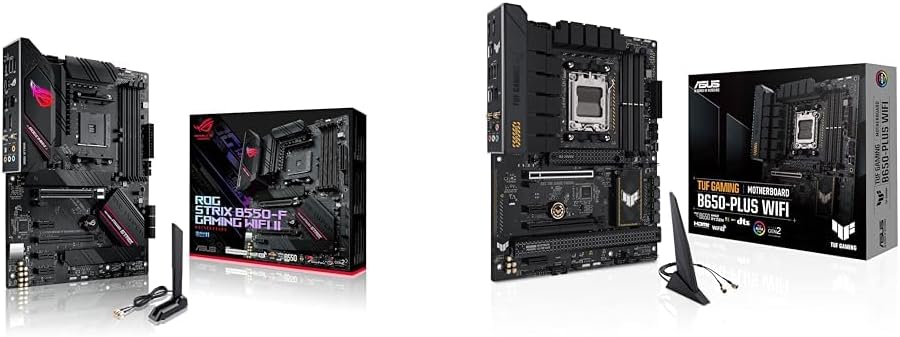
Asus ROG Strix B550-F Gaming WiFi II AMD AM4 (3rd Gen Ryzen) ATX Motherboard & TUF Gaming B650-PLUS WiFi Socket AM5 (LGA 1718) Ryzen 7000 ATX Gaming Motherboard
$150-$299This bundle offers two ATX motherboards: the ROG Strix B550-F Gaming WiFi II for AM4 Ryzen 3000/5000 CPUs with DDR4 RAM, and the TUF Gaming B650-PLUS WiFi for AM5 Ryzen 7000 CPUs with DDR5 RAM.

Game Motherboard Fit for ASROCK B650E PG-ITX WiFi B650 AM5 Motherboard Support Ryzen 7800X3D 7600/X 7950X 7700/X CPU 2xDDR5 128GB Hyper M.2 Mini-ITX
Price range unavailableThis KUETFBVC motherboard listing presents highly contradictory specifications, including a BGA 1023 socket and AMD 480 chipset, making it unsuitable for any modern Ryzen AM5 CPU.

Asus ROG Strix B550-F Gaming WiFi II AMD AM4 (3rd Gen Ryzen) ATX Gaming Motherboard (PCIe 4.0,WiFi 6E, 2.5Gb LAN, BIOS Flashback, HDMI 2.1, Addressable Gen 2 RGB Header and Aura Sync)
This is a premium-feeling AM4 board with beefy VRMs and WiFi 6E, perfect for squeezing the last drop of performance out of a Ryzen 5000 series CPU.