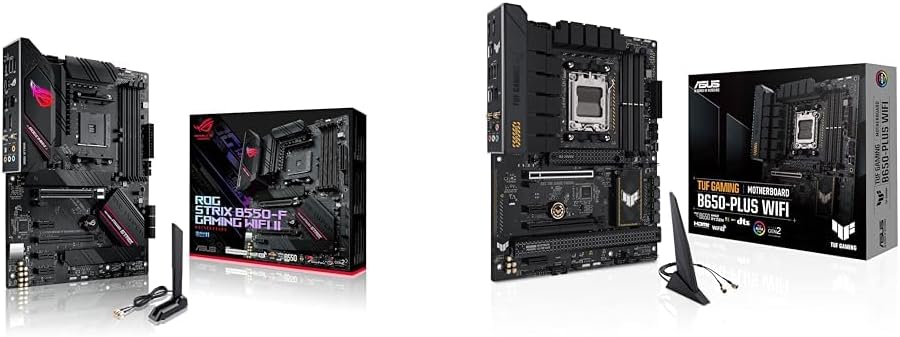
Asus ROG Strix B550-F Gaming WiFi II AMD AM4 (3rd Gen Ryzen) ATX Motherboard & TUF Gaming B650-PLUS WiFi Socket AM5 (LGA 1718) Ryzen 7000 ATX Gaming Motherboard
Want the best price and purchase timing?
Our AI advisor analyzes real-time pricing across all channels to find you the best deal.
AI Verdict
This bundle offers two ATX motherboards: the ROG Strix B550-F Gaming WiFi II for AM4 Ryzen 3000/5000 CPUs with DDR4 RAM, and the TUF Gaming B650-PLUS WiFi for AM5 Ryzen 7000 CPUs with DDR5 RAM.
This bundle is a situational fit because it provides two distinct motherboards catering to different CPU generations: the ROG Strix B550-F Gaming WiFi II for AM4 Ryzen 3000/5000 CPUs with DDR4, and the TUF Gaming B650-PLUS WiFi for AM5 Ryzen 7000 CPUs with DDR5. It's not a single solution but rather a choice between two platforms, making it suitable only if you specifically need one of these two configurations.
If you need a single, unified platform for future upgrades beyond Ryzen 7000, look for an AM5 motherboard with PCIe 5.0 for both GPU and M.2 slots, and a more robust rear I/O configuration.
Regret Score™
Medium RiskLower is better — measures purchase-regret risk from real buyer complaints, review credibility, and product maturity
Issues discovered after purchase
Critically weak dimension
Amazon rating vs actual quality
Chance this product isn't for you
Pros
- ROG Strix B550-F Gaming WiFi II features on-board WiFi 6E (802.11ax) and Intel 2.5 Gb Ethernet for fast networking.
- ROG Strix B550-F Gaming WiFi II includes BIOS Flashback, allowing BIOS updates without a CPU installed.
- TUF Gaming B650-PLUS WiFi supports PCIe 5.0 for one M.2 slot, enabling future-proof storage speeds.
- Both motherboards feature 12+2 teamed power stages for stable power delivery to the CPU.
- TUF Gaming B650-PLUS WiFi has an integrated I/O shield for easier installation.
- ROG Strix B550-F Gaming WiFi II provides dual M.2 slots for high-speed NVMe storage.
Cons
- ROG Strix B550-F Gaming WiFi II has user reports of problematic WiFi drivers and faulty WiFi cards, requiring troubleshooting.
- TUF Gaming B650-PLUS WiFi has a limited number of rear Type-A USB ports, with only two fast Type-C ports.
- TUF Gaming B650-PLUS WiFi may not have enough space between x16 slots for a 3-slot GPU, potentially obstructing the lower slot.
- The software suite (Ai Suite 3) for the TUF Gaming B650-PLUS WiFi is described as basic and may not retain settings.
- The Bluetooth driver on the ROG Strix B550-F Gaming WiFi II can error, requiring a power cycle to resolve.
Dimension Scores
Both motherboards feature 12+2 teamed power stages, with the B650-PLUS WiFi also having 8+4 ProCool sockets, providing robust and stable power for high-end CPUs.
The ROG Strix B550-F Gaming WiFi II offers WiFi 6E, Bluetooth 5.2, and HDMI 2.1, while the TUF Gaming B650-PLUS WiFi includes PCIe 5.0 M.2 support and an integrated I/O shield.
The ROG Strix B550-F Gaming WiFi II has PCIe 4.0 and dual M.2 slots, and the TUF Gaming B650-PLUS WiFi offers PCIe 5.0 for one M.2 slot and three total M.2 slots.
Both boards include BIOS Flashback, and the BIOS interfaces are generally user-friendly, though the B650's overclocking UI can be inconsistent and its Ai Suite 3 software is basic.
Best For
- Building a high-performance AM4 gaming PC with a Ryzen 3000 or 5000 series CPU (ROG Strix B550-F Gaming WiFi II).
- Upgrading to a Ryzen 7000 series CPU with DDR5 memory (TUF Gaming B650-PLUS WiFi).
- Users who need robust power delivery for demanding CPUs on either AM4 or AM5 platforms.
- PC builders who prioritize fast wired and wireless networking with WiFi 6E (ROG Strix B550-F Gaming WiFi II).
Not Recommended For
- Users expecting a single motherboard solution for both AM4 and AM5 CPUs, as this is a bundle of two distinct boards.
- Builders needing extensive rear Type-A USB connectivity on the AM5 platform (TUF Gaming B650-PLUS WiFi).
- Users who want a guaranteed Intel WiFi solution on the AM5 board, as the TUF B650-PLUS WiFi might use MediaTek.
Watch Out For
- The ROG Strix B550-F Gaming WiFi II has user reports of the WiFi card and aerial being faulty, leading to poor wireless performance even with correct drivers.
- Some users of the ROG Strix B550-F Gaming WiFi II experienced Bluetooth driver errors that required unplugging the power supply and holding the power button for 30 seconds to fix.
- The TUF Gaming B650-PLUS WiFi's BIOS overclocking UI can be overly basic or overly advanced, lacking a middle ground for novice overclockers.
- A 3-slot GPU installed in the top PCIe x16 slot on the TUF Gaming B650-PLUS WiFi will be right against the lower x16 slot, potentially hindering airflow or access.
- The TUF Gaming B650-PLUS WiFi's bundled Ai Suite 3 software is reported to be basic and may not remember user settings.
Full Specifications
| RAM | DDR4 |
| ASIN | B0CX5G6RY2 |
| Brand | ASUS |
| Series | ROG Strix B550-F Gaming WiFi II, TUF Gaming B650-PLUS WiFi |
| CPU Socket | Socket TR4 |
| Model Name | ROG Strix B550-F Gaming WiFi II, TUF Gaming B650-PLUS WiFi |
| Chipset Type | B550, B650 |
| Manufacturer | ASUS |
| Compatible Devices | Personal Computer |
| Compatible Processors | AMD 3rd Generation Ryzen |
| RAM Memory Technology | DDR4 |
| Memory Slots Available | 4 |
| Graphics Card Interface | PCI Express |
| Main Power Connector Type | ATX |
What Buyers Say
This bundle is a bit of a mixed bag, offering two distinct motherboards for different AMD platforms. The ROG Strix B550-F Gaming WiFi II is a solid choice for AM4 builds, but some users have reported frustrating issues with its WiFi and Bluetooth drivers. The TUF Gaming B650-PLUS WiFi for AM5 is praised for its robust power delivery and PCIe 5.0 M.2 support, but its rear USB port configuration and software could be better. The biggest takeaway is that you're essentially choosing between an older, mature platform (AM4) and a newer, still-evolving one (AM5), each with its own quirks.
“Honestly, I just needed a motherboard that worked for my old Ryzen 5000, and the B550-F does the job, but man, that WiFi was a headache to get working right out of the box. The B650 looks cool for my next build, but I'm a bit nervous about the USB ports.”
Common Praise
- ROG Strix B550-F Gaming WiFi II has a reinforced PCIe slot for heavy GPUs.
- TUF Gaming B650-PLUS WiFi's integrated I/O panel makes installation easier.
- Both motherboards have 12+2 teamed power stages that handle demanding CPUs without issue.
- BIOS Flashback on both boards is a convenient feature for CPU compatibility updates.
- ROG Strix B550-F Gaming WiFi II's Intel 2.5 Gb Ethernet provides stable wired connections.
- TUF Gaming B650-PLUS WiFi offers PCIe 5.0 M.2 support for future fast storage.
Common Complaints
- ROG Strix B550-F Gaming WiFi II users experienced faulty WiFi cards and drivers, leading to poor wireless performance.
- Bluetooth drivers on the ROG Strix B550-F Gaming WiFi II sometimes error, requiring a full power cycle to reset.
- The TUF Gaming B650-PLUS WiFi has few rear Type-A USB ports, forcing reliance on Type-C or front panel headers.
- The TUF Gaming B650-PLUS WiFi's software (Ai Suite 3) is basic and doesn't consistently save settings.
- Some ASUS boards, including the TUF B650-PLUS WiFi, have been associated with coil whine.
- The TUF Gaming B650-PLUS WiFi's layout can make it difficult to fit a 3-slot GPU without blocking other slots.
Ownership Tips
- The ROG Strix B550-F Gaming WiFi II's BIOS can feel a bit cluttered, making it harder to find specific settings quickly.
- After a few months, the TUF Gaming B650-PLUS WiFi's PBO setting might not be enabled by default, requiring manual adjustment for optimal CPU performance.
- The B550-F Gaming WiFi II's audio drivers need to be specifically downloaded from ASUS, otherwise, the audio can crackle.
- The TUF Gaming B650-PLUS WiFi's 2.5Gb LAN is Realtek, which some users might prefer over Intel or vice-versa, but it's not specified in the main product highlights.
- The RGB lighting on the ROG Strix B550-F Gaming WiFi II is subtle, with an etched pattern on heatsinks and a light-up ROG logo on the I/O shroud.
Frequently Asked Questions
What CPUs are compatible with each motherboard in this bundle?
The ROG Strix B550-F Gaming WiFi II is compatible with AMD Ryzen 3000, 5000, and 4000 G-series desktop processors (AM4 socket). The TUF Gaming B650-PLUS WiFi is compatible with AMD Ryzen 7000 Series desktop processors (AM5 socket).
What type of RAM does each motherboard support?
The ROG Strix B550-F Gaming WiFi II supports DDR4 RAM. The TUF Gaming B650-PLUS WiFi exclusively supports DDR5 RAM.
Does either motherboard have WiFi 6E?
The ROG Strix B550-F Gaming WiFi II features on-board WiFi 6E (802.11ax). The TUF Gaming B650-PLUS WiFi supports WiFi 6.
Do these motherboards have BIOS Flashback?
Yes, both the ROG Strix B550-F Gaming WiFi II and the TUF Gaming B650-PLUS WiFi include a BIOS Flashback feature.
What kind of Ethernet port do these motherboards have?
The ROG Strix B550-F Gaming WiFi II has an Intel 2.5 Gb Ethernet port. The TUF Gaming B650-PLUS WiFi has a Realtek 2.5 Gb Ethernet port.
How many M.2 slots are on each board?
The ROG Strix B550-F Gaming WiFi II has dual M.2 slots. The TUF Gaming B650-PLUS WiFi has three M.2 slots, with one supporting PCIe Gen 5.
Buying Guide
When looking at motherboards, you're essentially picking the foundation for your PC. You need to match the CPU socket (AM4 or AM5) and RAM type (DDR4 or DDR5) to your processor and memory. Think about what kind of connectivity you need now and in the near future, like USB ports, M.2 slots for fast storage, and network speeds. Don't get swayed by features you won't use, but also don't skimp on essentials for your build. This bundle gives you a choice between two different generations, so decide which CPU platform you're building for first.
CPU Socket (AM4 vs. AM5)
This is like the car engine mount; it dictates which generation of AMD Ryzen processors you can use. AM4 is for older Ryzen CPUs (3000/5000 series) and uses DDR4 RAM, while AM5 is for the newer Ryzen 7000 series and requires DDR5 RAM. You can't mix and match.
RAM Type (DDR4 vs. DDR5)
This is your computer's short-term memory. DDR4 is older and generally cheaper, while DDR5 is newer, faster, and more expensive. The motherboard's socket determines which type you need, so if you pick an AM5 board, you're locked into DDR5.
PCIe 4.0 vs. PCIe 5.0
This is how fast your graphics card and fastest storage drives (M.2 SSDs) can talk to the rest of your system. PCIe 4.0 is plenty fast for most current GPUs and SSDs. PCIe 5.0 is even faster, but currently, only a few high-end SSDs can fully utilize it, and GPUs aren't bottlenecked by PCIe 4.0 yet. It's more about future-proofing for your M.2 storage.
VRM & Power Stages
This is the power delivery system for your CPU. More and higher-quality power stages mean your CPU gets cleaner, more stable power, especially important for high-core-count processors or if you plan on overclocking. It's like having a more robust power supply for a demanding appliance.
Alternatives
If you need a single AM5 motherboard with more rear USB Type-A ports and consistently refined software, look for boards with a higher USB Type-A count and documented better software experiences. If you're staying on AM4 but want to avoid potential WiFi issues, consider a board with a different WiFi module or a non-WiFi version paired with a separate PCIe WiFi card.
You Might Also Like

JetKVM KVM Over IP ATX Extension Board, ATX Power Control Board- Only for Jet KVM Accessories Boot from Shutdown, Crash Recovery
$0-$49This is an ATX form factor power control board designed for JetKVM accessories, enabling remote PC power state management and simultaneous front panel button use.

Game Motherboard Fit for ASROCK B650E PG-ITX WiFi B650 AM5 Motherboard Support Ryzen 7800X3D 7600/X 7950X 7700/X CPU 2xDDR5 128GB Hyper M.2 Mini-ITX
Price range unavailableThis KUETFBVC motherboard listing presents highly contradictory specifications, including a BGA 1023 socket and AMD 480 chipset, making it unsuitable for any modern Ryzen AM5 CPU.

Asus ROG Strix B550-F Gaming WiFi II AMD AM4 (3rd Gen Ryzen) ATX Gaming Motherboard (PCIe 4.0,WiFi 6E, 2.5Gb LAN, BIOS Flashback, HDMI 2.1, Addressable Gen 2 RGB Header and Aura Sync)
This is a premium-feeling AM4 board with beefy VRMs and WiFi 6E, perfect for squeezing the last drop of performance out of a Ryzen 5000 series CPU.

Element14 Raspberry Pi 3 B+ Motherboard
The Raspberry Pi 3 B+ is a $35-tier single-board computer perfect for 1080p media centers, Pi-Hole setups, and retro gaming, provided you supply a strict 2.5A power source.