
Micro Center AMD Ryzen 5 5500 Desktop Processor with ASUS TUF Gaming A520M-PLUS (WiFi) AM4 microATX Motherboard (M.2 Support, 802.11ac Wi-Fi, DisplayPort, HDMI)
Want the best price and purchase timing?
Our AI advisor analyzes real-time pricing across all channels to find you the best deal.
AI Verdict
This is an AM4 combo with a 6-core Ryzen 5 5500 and an A520M mATX motherboard, offering DDR4-4400 support and 802.11ac Wi-Fi for budget-conscious gamers.
This combo is a situational fit because it pairs a capable 6-core Ryzen 5 5500 with an entry-level A520 chipset motherboard. While it offers integrated Wi-Fi and DDR4-4400 support, the PCIe 3.0 limitation for both GPU and M.2 storage can be a bottleneck for newer components.
If you need PCIe 4.0 support for a faster GPU or NVMe SSD, look for a motherboard with an AMD B550 chipset or newer.
Regret Score™
High RiskLower is better — measures purchase-regret risk from real buyer complaints, review credibility, and product maturity
Issues discovered after purchase
Critically weak dimension
Amazon rating vs actual quality
Chance this product isn't for you
Pros
- The AMD Ryzen 5 5500 processor features 6 cores and 12 threads, with a 4.2GHz Max Boost clock, suitable for gaming and multitasking.
- The ASUS TUF Gaming A520M-PLUS motherboard includes 802.11ac Wi-Fi, providing wireless connectivity without needing an extra adapter.
- The motherboard supports DDR4 memory up to 128GB at 4400 MHz (OC), allowing for fast RAM configurations.
- It comes with a Wraith Stealth Cooler for the Ryzen 5 5500, so you don't need to buy one separately.
- The motherboard offers a BIOS FlashBack button, simplifying BIOS updates without a CPU installed.
- The TUF Gaming engineering includes military-grade components and TUF LANGuard for enhanced durability and network protection.
Cons
- The A520 chipset limits the system to PCIe 3.0 for both the graphics card slot and M.2 storage, even though the Ryzen 5 5500 CPU supports PCIe 4.0.
- The Ryzen 5 5500 does not include integrated graphics, requiring a discrete graphics card for any display output.
- The A520 chipset generally offers more basic VRM designs compared to B550 motherboards, which might limit extreme overclocking stability.
- The 802.11ac Wi-Fi (Wi-Fi 5) is not the latest standard, with Wi-Fi 6 (802.11ax) offering faster speeds and better performance in congested environments.
- Some users have reported Bluetooth issues with similar setups.
Dimension Scores
The A520 chipset typically features a more basic VRM design, sufficient for the 65W Ryzen 5 5500 at stock speeds, but not ideal for sustained heavy loads or aggressive overclocking.
The motherboard includes 802.11ac Wi-Fi, M.2 support, and a BIOS FlashBack button, which are solid features for an A520 board, but lacks PCIe 4.0 and the latest Wi-Fi 6 standard.
It offers one PCIe 3.0 x16 slot, one M.2 slot, and four SATA 6Gb/s ports, which is standard for a microATX A520 board, but limited by the PCIe 3.0 bandwidth.
ASUS TUF Gaming motherboards generally have user-friendly UEFI BIOS interfaces and useful software utilities like Fan Xpert 2+ and Aura Sync RGB control, plus the BIOS FlashBack feature.
Best For
- Building a budget-focused 1080p gaming PC with a discrete GPU.
- Users needing integrated Wi-Fi for a compact mATX build.
- A secondary PC for light gaming and general productivity tasks.
- First-time PC builders looking for a pre-matched CPU and motherboard combo.
Not Recommended For
- Users planning to utilize PCIe 4.0 GPUs or NVMe SSDs at their full speed.
- Enthusiasts aiming for extreme CPU overclocking.
- Anyone needing integrated graphics for troubleshooting or basic display output.
Watch Out For
- The A520 chipset restricts the primary PCIe x16 slot and M.2 slot to PCIe 3.0 speeds, meaning a PCIe 4.0 GPU or NVMe SSD will run at reduced performance.
- The Ryzen 5 5500 lacks integrated graphics, so you absolutely need a separate graphics card to get any video output.
- The included 802.11ac Wi-Fi module might experience 'some Bluetooth issues' according to an expert review, potentially leading to connectivity drops or pairing problems.
- The motherboard's VRM design, typical for an A520 board, might not handle sustained heavy loads or aggressive overclocking as well as higher-end chipsets.
Full Specifications
| ASIN | B0DWJJ417R |
| Brand | Micro Center |
| Platform | Windows 10 |
| CPU Model | Ryzen 5 |
| CPU Socket | Socket AM4 |
| Model Name | 5500ASUTUFGAMA520MPLWF |
| Item Weight | 4.6 pounds |
| Chipset Type | AMD B450 |
| Manufacturer | MICRO CENTER |
| Item model number | 5500ASUTUFGAMA520MPLWF |
| Compatible Devices | Personal Computer |
| Memory Clock Speed | 4400 MHz |
| Package Dimensions | 13.89 x 12.64 x 6.89 inches |
| Compatible Processors | Ryzen 5000 Series/ 4000 G-Series/ 3000 Series Desktop Processors |
| RAM Memory Technology | DDR4 |
What Buyers Say
This Micro Center combo, featuring the Ryzen 5 5500 and an ASUS TUF Gaming A520M-PLUS Wi-Fi motherboard, is positioned as a budget-friendly gaming option. An expert review highlights its built-in Wi-Fi and TUF Gaming durability as positives, noting stable 350Mbps Wi-Fi 5 speeds during testing. However, the same review points out the limitation to PCIe 3.0 and potential Bluetooth issues. The Ryzen 5 5500's 6 cores and 12 threads provide solid performance for gaming and multitasking, but the lack of integrated graphics means a discrete GPU is mandatory.
“Look, if you're building a cheap gaming PC and you already have a graphics card, this combo is fine, but don't expect crazy fast SSDs or a future-proof GPU slot, it's all PCIe 3.0 here.”
Common Praise
- Built-in 802.11ac Wi-Fi provides wireless connectivity out of the box.
- The ASUS TUF Gaming motherboard features military-grade components and TUF LANGuard for durability.
- The Ryzen 5 5500 offers 6 cores and 12 threads, delivering strong performance for its price point.
- Supports DDR4-4400 (OC) memory, allowing for faster RAM speeds.
- The included Wraith Stealth Cooler means no extra cooler purchase is needed.
Common Complaints
- The A520 chipset limits all PCIe lanes to Gen 3, preventing PCIe 4.0 GPUs and NVMe SSDs from reaching their full potential.
- The Ryzen 5 5500 CPU lacks integrated graphics, requiring a separate graphics card for any display output.
- An expert review mentioned 'some Bluetooth issues' with the 802.11ac Wi-Fi module.
- The A520 chipset's power delivery might not be robust enough for aggressive CPU overclocking.
Ownership Tips
- You'll immediately notice the PCIe 3.0 limitation if you try to install a newer Gen 4 NVMe SSD, as its speeds will be capped.
- The included Wraith Stealth cooler is adequate for the Ryzen 5 5500 at stock speeds, but it can get a bit noisy under heavy load.
- Setting up the Wi-Fi and Bluetooth drivers might require a wired internet connection first, as is common with new builds.
- The mATX form factor makes it easy to fit into smaller cases, which is a plus for compact builds.
Frequently Asked Questions
Does this combo support PCIe 4.0?
No, while the Ryzen 5 5500 CPU supports PCIe 4.0, the ASUS TUF Gaming A520M-PLUS motherboard's A520 chipset limits all PCIe lanes, including the primary GPU slot and M.2 slot, to PCIe 3.0 speeds.
Does the Ryzen 5 5500 have integrated graphics?
No, the AMD Ryzen 5 5500 Desktop Processor does not include integrated graphics. You will need a separate, discrete graphics card to connect to a display.
What kind of RAM should I use with this motherboard?
The motherboard supports DDR4 RAM up to 128GB, with speeds up to 4400 MHz (OC). For optimal performance, aim for a dual-channel kit with a speed of 3200MHz or 3600MHz.
Does this motherboard have Wi-Fi and Bluetooth?
Yes, the ASUS TUF Gaming A520M-PLUS (WiFi) motherboard includes 802.11ac Wi-Fi. It also supports Bluetooth, though an expert review noted 'some Bluetooth issues'.
Can I overclock the Ryzen 5 5500 with this motherboard?
The Ryzen 5 5500 is unlocked for overclocking. While the A520 chipset generally has more basic power delivery, light overclocking might be possible, but don't expect extreme results compared to B550 or X570 boards.
Is an M.2 SSD supported?
Yes, the motherboard has one M.2 Socket 3 with M Key, supporting NVMe SSDs at PCIe 3.0 x4 speeds (up to 32Gb/s).
Buying Guide
When buying a CPU and motherboard combo like this, you need to understand that the motherboard's chipset dictates a lot of the system's capabilities, not just the CPU. For example, even if your CPU supports a newer standard like PCIe 4.0, the motherboard's older chipset (like A520 here) will limit it to PCIe 3.0. This impacts how fast your graphics card and NVMe storage can communicate with the rest of your system. Also, always check if the CPU has integrated graphics; if not, you absolutely need a separate graphics card.
Chipset (AMD A520)
Think of the chipset as the motherboard's traffic controller. The A520 is a budget chipset, meaning it handles essential functions but doesn't support the latest, fastest connections like PCIe 4.0. This limits the speed of your graphics card and M.2 SSD, even if those components are capable of faster speeds.
PCIe 3.0 vs. PCIe 4.0
This is like the number of lanes on a highway. PCIe 4.0 is a wider, faster highway than PCIe 3.0. If your motherboard only supports PCIe 3.0, even a PCIe 4.0 graphics card or NVMe SSD will be forced to use the slower, narrower PCIe 3.0 lanes, reducing its maximum performance.
Ryzen 5 5500 (No Integrated Graphics)
Some CPUs have a built-in graphics chip, letting you plug your monitor directly into the motherboard. The Ryzen 5 5500 doesn't have this, so you absolutely need a separate, dedicated graphics card to get any picture on your screen. Without one, your PC won't display anything.
Alternatives
If you need PCIe 4.0 support for a faster graphics card or NVMe SSD, look for a combo with an AMD B550 chipset motherboard. If you need integrated graphics for a non-gaming build or troubleshooting, consider a Ryzen G-series CPU (e.g., Ryzen 5 5600G).
You Might Also Like

JetKVM KVM Over IP ATX Extension Board, ATX Power Control Board- Only for Jet KVM Accessories Boot from Shutdown, Crash Recovery
$0-$49This is an ATX form factor power control board designed for JetKVM accessories, enabling remote PC power state management and simultaneous front panel button use.
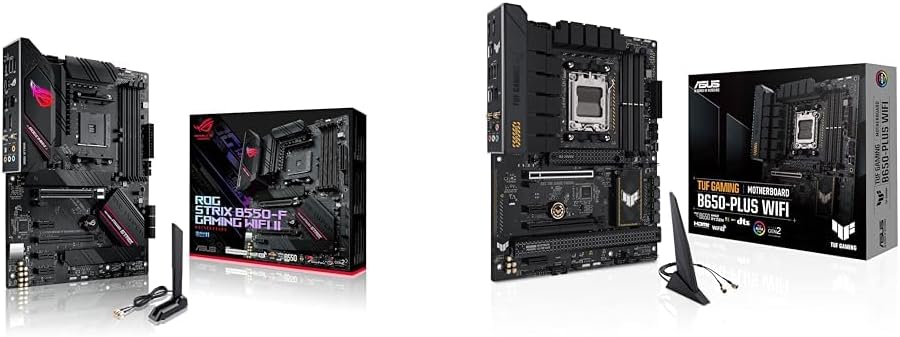
Asus ROG Strix B550-F Gaming WiFi II AMD AM4 (3rd Gen Ryzen) ATX Motherboard & TUF Gaming B650-PLUS WiFi Socket AM5 (LGA 1718) Ryzen 7000 ATX Gaming Motherboard
$150-$299This bundle offers two ATX motherboards: the ROG Strix B550-F Gaming WiFi II for AM4 Ryzen 3000/5000 CPUs with DDR4 RAM, and the TUF Gaming B650-PLUS WiFi for AM5 Ryzen 7000 CPUs with DDR5 RAM.

Game Motherboard Fit for ASROCK B650E PG-ITX WiFi B650 AM5 Motherboard Support Ryzen 7800X3D 7600/X 7950X 7700/X CPU 2xDDR5 128GB Hyper M.2 Mini-ITX
Price range unavailableThis KUETFBVC motherboard listing presents highly contradictory specifications, including a BGA 1023 socket and AMD 480 chipset, making it unsuitable for any modern Ryzen AM5 CPU.

Asus ROG Strix B550-F Gaming WiFi II AMD AM4 (3rd Gen Ryzen) ATX Gaming Motherboard (PCIe 4.0,WiFi 6E, 2.5Gb LAN, BIOS Flashback, HDMI 2.1, Addressable Gen 2 RGB Header and Aura Sync)
This is a premium-feeling AM4 board with beefy VRMs and WiFi 6E, perfect for squeezing the last drop of performance out of a Ryzen 5000 series CPU.