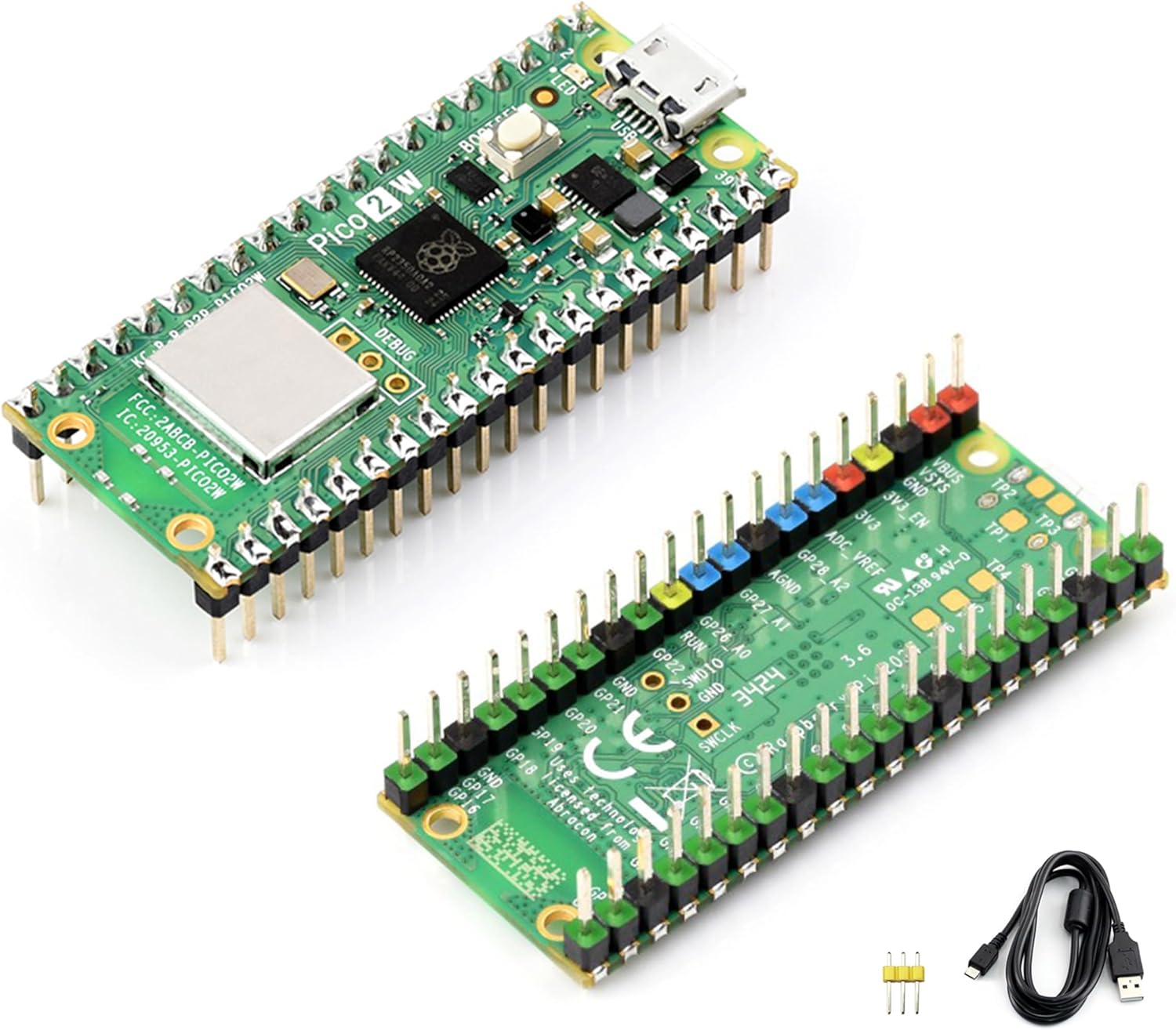
Pico 2 W with Color Coded Pre-Soldered Header Compatible with Raspberry Pi Pico 2 W Board+ USB Cable, 2.4GHz 802.11n WiFi and Bluetooth 5.2, RP2350 Chip Dual-Core& Dual-Architecture Design
Want the best price and purchase timing?
Our AI advisor analyzes real-time pricing across all channels to find you the best deal.
AI Verdict
A budget microcontroller featuring the RP2350 chip, dual-core Arm Cortex-M33 and Hazard3 RISC-V processors at 150 MHz, with 2.4GHz 802.11n WiFi and Bluetooth 5.2.
This Pico 2 W board is a strong fit for budget-conscious developers and hobbyists due to its RP2350 dual-core architecture, integrated 2.4GHz WiFi, and Bluetooth 5.2. The pre-soldered color-coded headers simplify setup, making it accessible for quick prototyping and educational use.
If you need more processing power or memory, look for microcontrollers with higher clock speeds, more RAM/Flash, or a more advanced CPU architecture.
Regret Score™
Medium RiskLower is better — measures purchase-regret risk from real buyer complaints, review credibility, and product maturity
Issues discovered after purchase
Critically weak dimension
Amazon rating vs actual quality
Chance this product isn't for you
Pros
- Features a dual-core Arm Cortex-M33 and dual-core Hazard3 RISC-V processor design, allowing for flexible clock speeds up to 150 MHz.
- Includes integrated 2.4GHz 802.11n WiFi and Bluetooth 5.2 via an onboard Infineon CYW43439 wireless chip.
- Comes with a color-coded pre-soldered header, simplifying initial setup and prototyping.
- Offers 26 multi-function GPIO pins, 12 programmable I/O state machines, and various communication interfaces like SPI, I2C, and UART.
- Supports drag-and-drop programming over USB, making it accessible for beginners.
- Equipped with 520KB of SRAM and 4MB of on-board Flash memory.
Cons
- The 150 MHz clock speed, while flexible, might be a limiting factor for computationally intensive tasks compared to higher-end microcontrollers.
- USB 1.1 support could lead to slower data transfer speeds for certain applications.
- Only supports 2.4GHz WiFi (802.11n), lacking 5GHz band support for potentially faster and less congested wireless communication.
- The 4MB of on-board Flash memory may be restrictive for projects requiring extensive code or data storage.
Dimension Scores
As a microcontroller, power delivery is typically straightforward and sufficient for its low-power operation, but specific VRM details are not provided.
The inclusion of dual-core Arm Cortex-M33 and Hazard3 RISC-V processors, 2.4GHz WiFi, Bluetooth 5.2, and extensive GPIO pins is a comprehensive set for its category.
With 26 multi-function GPIO pins, 2 SPI, 2 I2C, 2 UART, 3 ADC, and 16 PWM channels, it offers a solid range of expansion for peripherals.
It supports drag-and-drop programming over USB and is compatible with MicroPython, indicating a user-friendly software experience, though specific BIOS details are not applicable.
Best For
- Hobbyists and students learning about microcontrollers and wireless technology.
- Prototyping IoT devices that require 2.4GHz WiFi and Bluetooth 5.2 connectivity.
- Embedded systems and robotics applications needing a compact, dual-core solution.
- Projects benefiting from color-coded pre-soldered headers for easier wiring.
Not Recommended For
- Applications demanding high processing power beyond 150 MHz or extensive memory.
- Users requiring 5GHz WiFi connectivity for their wireless projects.
- Projects where USB 1.1 transfer speeds are a bottleneck.
Watch Out For
- The 150 MHz clock speed, while dual-core, might struggle with complex real-time processing or advanced signal processing tasks.
- The 4MB Flash memory could fill up quickly with larger firmware or data logging requirements, necessitating external storage.
- USB 1.1 is slower than USB 2.0 or 3.0, potentially impacting programming times or data transfer for debugging.
- While pre-soldered headers are convenient, they commit the board to a specific pinout, which might not be ideal for all custom carrier board designs.
Full Specifications
| ASIN | B0DPCGQPW3 |
| Brand | Wonrabai |
| CPU Model | core_m |
| Model Name | Pico 2 W |
| Item Weight | 2.11 ounces |
| Chipset Type | RP2350 |
| Manufacturer | Wonrabai |
| Item model number | Raspberry-Pi-Pico-2-W-CC |
| Compatible Devices | Carrier Boards, Computers (PCs, laptops, tablets), Microcontrollers, Sensors |
| Memory Clock Speed | 150 MHz |
| Package Dimensions | 4.21 x 3.19 x 1.26 inches |
| Compatible Processors | Arm Cortex-M33, Hazard3 RISC-V |
| RAM Memory Technology | LPDDR |
| Memory Storage Capacity | 4 MB |
What Buyers Say
Direct user feedback for this specific ASIN (B0DPCGQPW3) was not found in the searches. Based on the product specifications, the board's pre-soldered, color-coded headers are a convenience for quick setup. The dual-core RP2350 chip with integrated WiFi and Bluetooth makes it suitable for IoT projects. Potential concerns might revolve around the USB 1.1 speed or the 4MB Flash memory for larger applications.
“This little board is a lifesaver for my small IoT projects, especially with those pre-soldered pins, but I wish the USB wasn't so slow for flashing new code.”
Common Praise
- The pre-soldered, color-coded headers simplify initial wiring and reduce setup time.
- Integrated 2.4GHz 802.11n WiFi and Bluetooth 5.2 provide essential wireless connectivity for IoT projects.
- The dual-core RP2350 chip with Arm Cortex-M33 and Hazard3 RISC-V offers flexible processing power for various tasks.
- Drag-and-drop programming over USB makes it user-friendly for beginners.
Common Complaints
- The USB 1.1 interface might be slower than expected for frequent data transfers or firmware uploads.
- Limited to 2.4GHz 802.11n WiFi, which could be less performant in congested environments compared to 5GHz.
- The 4MB of on-board Flash memory could be a constraint for complex projects requiring significant storage.
Ownership Tips
- The color-coded headers genuinely save time and reduce errors during breadboarding.
- WiFi connectivity is stable for basic data transmission, but don't expect high throughput.
- The dual-core setup is flexible, letting you allocate tasks efficiently between the two architectures.
- You'll likely need to manage your flash memory usage carefully for larger projects.
Frequently Asked Questions
What is the main chip on this board?
The board uses the official RP2350 chip, which features a dual-core Arm Cortex-M33 processor and a dual-core Hazard3 RISC-V processor.
Does this board have WiFi and Bluetooth?
Yes, it includes 2.4GHz 802.11n WiFi and Bluetooth 5.2, powered by an onboard Infineon CYW43439 wireless chip.
Is the header pre-soldered?
Yes, it comes with a color-coded pre-soldered header, which means you don't need to solder the pins yourself.
How much memory does it have?
It has 520KB of SRAM and 4MB of on-board Flash memory.
What kind of USB port does it use?
It supports USB 1.1 with device and host capabilities.
Buying Guide
When looking at microcontrollers like this, you're essentially buying a tiny computer designed for specific tasks, not running a full operating system. You'll be writing code to control its pins, read sensors, and communicate with other devices. The key is matching its processing power, memory, and connectivity features to your project's needs. Don't overspend on features you won't use, but also don't underspec if your project demands more.
RP2350 Chip (Dual-Core Arm Cortex-M33 & Hazard3 RISC-V)
This means the board has two different types of processing cores. The Arm Cortex-M33 is a common, efficient core for general tasks, while the Hazard3 RISC-V offers another core for specialized or parallel processing. This dual-architecture design gives you more flexibility in how you structure your code and manage tasks, like having two small engines working together instead of one bigger one.
2.4GHz 802.11n WiFi and Bluetooth 5.2
This is your wireless communication. 2.4GHz WiFi is common for home networks and IoT devices, letting your project connect to the internet. Bluetooth 5.2 is for short-range communication with other Bluetooth-enabled devices, like your phone or sensors. Think of it as built-in internet and short-range radio for your project.
520KB SRAM and 4MB Flash Memory
SRAM is like the 'working memory' (RAM) for your code while it's running, and 520KB is a decent amount for many microcontroller projects. Flash memory is where your program (firmware) is stored permanently, even when the power is off. 4MB is enough for many applications, but complex projects with lots of data or large libraries might need more, like a small hard drive for your tiny computer.
Alternatives
If this board doesn't fit, look for microcontrollers with higher clock speeds (e.g., 200+ MHz), more Flash memory (e.g., 8MB or 16MB), or support for 5GHz WiFi if your project requires faster or less congested wireless bands.
You Might Also Like

JetKVM KVM Over IP ATX Extension Board, ATX Power Control Board- Only for Jet KVM Accessories Boot from Shutdown, Crash Recovery
$0-$49This is an ATX form factor power control board designed for JetKVM accessories, enabling remote PC power state management and simultaneous front panel button use.
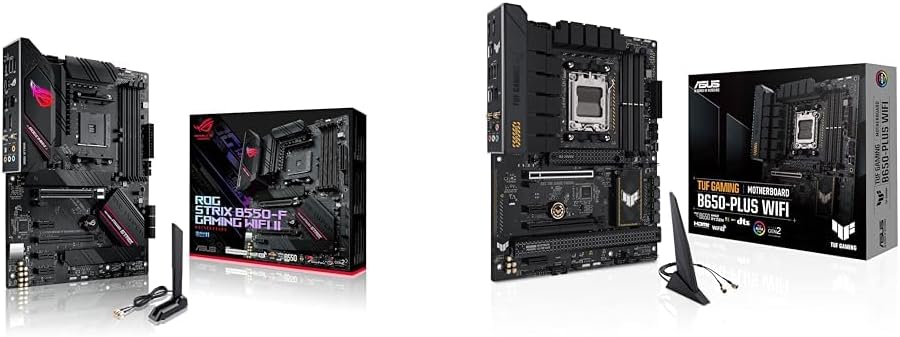
Asus ROG Strix B550-F Gaming WiFi II AMD AM4 (3rd Gen Ryzen) ATX Motherboard & TUF Gaming B650-PLUS WiFi Socket AM5 (LGA 1718) Ryzen 7000 ATX Gaming Motherboard
$150-$299This bundle offers two ATX motherboards: the ROG Strix B550-F Gaming WiFi II for AM4 Ryzen 3000/5000 CPUs with DDR4 RAM, and the TUF Gaming B650-PLUS WiFi for AM5 Ryzen 7000 CPUs with DDR5 RAM.

Game Motherboard Fit for ASROCK B650E PG-ITX WiFi B650 AM5 Motherboard Support Ryzen 7800X3D 7600/X 7950X 7700/X CPU 2xDDR5 128GB Hyper M.2 Mini-ITX
Price range unavailableThis KUETFBVC motherboard listing presents highly contradictory specifications, including a BGA 1023 socket and AMD 480 chipset, making it unsuitable for any modern Ryzen AM5 CPU.

Asus ROG Strix B550-F Gaming WiFi II AMD AM4 (3rd Gen Ryzen) ATX Gaming Motherboard (PCIe 4.0,WiFi 6E, 2.5Gb LAN, BIOS Flashback, HDMI 2.1, Addressable Gen 2 RGB Header and Aura Sync)
This is a premium-feeling AM4 board with beefy VRMs and WiFi 6E, perfect for squeezing the last drop of performance out of a Ryzen 5000 series CPU.