
ASUS ROG Maximus Z890 Hero Intel® Z890 LGA 1851 ATX Motherboard, Advanced AI PC-Ready, 22+2+1+2 Stages, DDR5, WiFi 7, 3X PCIe® 5.0 M.2, Thunderbolt™ 4, USB Type-C®, AI Overclocking/Cooling/Networking
Want the best price and purchase timing?
Our AI advisor analyzes real-time pricing across all channels to find you the best deal.
AI Verdict
This is an ATX Intel Z890 motherboard with 22+2+1+2 power stages, DDR5 support, three PCIe 5.0 M.2 slots, and WiFi 7, built for high-end Intel Core Ultra Series 2 systems.
The ASUS ROG Maximus Z890 Hero is a strong fit for high-performance builds centered around Intel Core Ultra Processors (Series 2). Its 22+2+1+2 power stages and extensive PCIe 5.0 M.2 support cater directly to users demanding maximum power delivery and cutting-edge storage speeds. The inclusion of WiFi 7 and dual Thunderbolt 4 ensures comprehensive high-speed connectivity for advanced setups.
If you don't need the extreme power delivery or multiple PCIe 5.0 M.2 slots, look for a Z890 board with fewer power stages and fewer PCIe 5.0 M.2 slots to save money.
Regret Score™
Very Low RiskLower is better — measures purchase-regret risk from real buyer complaints, review credibility, and product maturity
Issues discovered after purchase
Critically weak dimension
Amazon rating vs actual quality
Chance this product isn't for you
Pros
- Robust power delivery with 22(110A)+1(90A)+2(90A)+2(80A) power stages ensures stability for high-end CPUs and overclocking.
- Extensive M.2 storage options, featuring three PCIe 5.0 M.2 slots and three PCIe 4.0 M.2 slots.
- Supports DDR5 RAM with stable XMP I profiles, even at speeds up to 8000MT/s, without constant errors.
- Includes onboard WiFi 7 and dual Thunderbolt 4 USB Type-C ports for cutting-edge connectivity.
- Intuitive and stable BIOS, combined with AI Overclocking and AI Cooling II, simplifies performance tuning.
- Features excellent M.2 SSD cooling, effectively managing temperatures for PCIe Gen 5 drives.
Cons
- The high price point means diminishing returns on performance compared to less expensive alternatives.
- Lacks 10Gbps Ethernet, which some users expect on a motherboard in this price bracket, offering only 2.5Gb and 5Gb Ethernet.
- M.2 lane sharing can occur, potentially reducing GPU bandwidth if multiple M.2 slots are fully populated.
- The rear I/O USB port selection, while numerous, might feel limited in variety or quantity for the price to some users.
- Its ATX form factor and large heatsinks are not suitable for compact or low-profile PC builds.
Dimension Scores
The 22(110A)+1(90A)+2(90A)+2(80A) power stages with ProCool II connectors and premium components provide robust and stable power for extreme overclocking.
It includes advanced AI Overclocking/Cooling/Networking, NitroPath DRAM Technology, NPU Boost, and Polymo Lighting II, offering a comprehensive suite of high-end features.
With three PCIe 5.0 M.2 slots, three PCIe 4.0 M.2 slots, a PCIe 5.0 x16 slot, SlimSAS connector, and four SATA 6Gb/s ports, it offers extensive storage and expansion capabilities.
Users report an intuitive and stable BIOS that simplifies overclocking, complemented by AI Advisor and AI Cooling II software for performance management.
Best For
- Enthusiasts building with Intel Core Ultra Processors (Series 2) who plan to overclock.
- Users requiring extensive high-speed storage with multiple PCIe 5.0 M.2 SSDs.
- Anyone needing top-tier connectivity, including WiFi 7 and Thunderbolt 4 peripherals.
- Builders prioritizing system stability and advanced thermal management for high-performance components.
Not Recommended For
- Budget-conscious builders looking for cost-effective Z890 solutions.
- Small form factor PC builds due to its ATX size and large cooling components.
- Users who specifically require onboard 10Gbps Ethernet for their network setup.
Watch Out For
- No 10Gbps Ethernet is included, despite the motherboard's premium price point, which some users find to be a significant omission.
- Populating all M.2 slots can lead to PCIe lane sharing, potentially reducing the x16 bandwidth to the primary graphics card.
- The rear I/O, while featuring two Thunderbolt 4 ports, five USB 10Gbps ports, and four USB 5Gbps ports, has been described by some as feeling limited for a board in this price category.
- The ATX form factor and substantial heatsinks mean it won't fit in smaller cases, restricting build options to larger enclosures.
Full Specifications
| RAM | DDR5 |
| ASIN | B0DGWWRTPV |
| Brand | ASUS |
| Color | BLACK |
| Series | ROG MAXIMUS Z890 HERO |
| Platform | Windows 11 |
| CPU Socket | LGA 1851 |
| Model Name | ROG MAXIMUS Z890 HERO |
| Item Weight | 8.05 pounds |
| Chipset Type | Intel Z890 |
| Manufacturer | ASUS |
| Memory Speed | 320 MHz |
| Item model number | ROG MAXIMUS Z890 HERO |
| Compatible Devices | Personal Computer |
| Memory Clock Speed | 320 MHz |
| Product Dimensions | 14.6 x 4.4 x 12.2 inches |
| Compatible Processors | Intel® Core™ Ultra Processors(series 2) |
| RAM Memory Technology | DDR5 |
| Item Dimensions LxWxH | 14.6 x 4.4 x 12.2 inches |
| Memory Storage Capacity | 192 GB |
What Buyers Say
Users consistently report this board handles high-speed DDR5 RAM with XMP profiles without issues, a common pain point on other platforms. The robust VRM design and extensive cooling for M.2 drives are frequently highlighted, allowing for stable performance even under heavy loads with high-end CPUs and Gen 5 SSDs. While the price is a recurring point of discussion, the ease of setup with features like Q-Release for GPU and M.2 Q-Latches is appreciated.
“This board finally let my 8000MT/s RAM run without constant errors, and the M.2 cooling is no joke, but man, it cost a fortune and still no 10 gigabit LAN? Seriously?”
Common Praise
- DDR5 XMP I profiles work instantly and stably, even with 8000MT/s RAM, without constant errors.
- The robust VRM design and thermal management keep high-end CPUs cool under heavy load.
- Excellent cooling for all six M.2 SSD slots, effectively managing temperatures for PCIe Gen 5 drives.
- The intuitive and stable BIOS simplifies overclocking and system tuning.
- Q-Release features for the GPU and M.2 drives make installation and upgrades easier.
- Extensive high-speed connectivity, including WiFi 7 and dual Thunderbolt 4 ports, is a major plus.
Common Complaints
- The high price point makes it a luxury item with diminishing returns on performance for most users.
- The absence of 10Gbps Ethernet is a missed opportunity for a board in this premium category.
- The rear I/O USB port selection, while technically comprehensive, feels limited in perceived value for the cost.
- M.2 lane sharing can impact GPU bandwidth if all six M.2 slots are fully populated.
Ownership Tips
- The large heatsinks mean you'll need a full ATX tower; it won't fit in compact cases.
- Performing a BIOS update early in the build process is recommended to ensure optimal compatibility and stability.
- The M.2 Q-Latch mechanism is toolless but requires a specific outward motion to operate effectively.
- Even with the advanced cooling, high-performance Gen 5 SSDs can still generate significant heat, though the board manages it well.
Frequently Asked Questions
What CPUs does this motherboard support?
This motherboard is designed for Intel Core Ultra Processors (Series 2) and uses the LGA 1851 socket.
What type of RAM does it use?
It supports DDR5 RAM, with overclocked speeds capable of reaching up to 9200+ MT/s.
Does this motherboard have WiFi 7?
Yes, it includes onboard WiFi 7 with an ASUS WiFi Q-Antenna for advanced wireless connectivity.
How many M.2 slots are on this board?
The motherboard features six M.2 slots in total: three supporting PCIe 5.0 and three supporting PCIe 4.0.
Are there Thunderbolt ports on this motherboard?
Yes, the rear I/O panel includes two Thunderbolt 4 USB Type-C ports.
Buying Guide
When buying a motherboard, you're essentially choosing the foundation for your PC. It dictates what CPU you can use (socket type), what RAM (DDR generation and speed), and how many expansion cards and storage drives you can connect. For a high-end board like this, you're paying for advanced power delivery to handle overclocking, extensive connectivity, and features that simplify system tuning.
Socket (LGA 1851)
This is the physical connection for your CPU. Think of it like a specific car engine needing a specific car chassis. LGA 1851 means it only works with Intel Core Ultra Processors (Series 2).
Power Stages (22+2+1+2)
These are like the power lines feeding your CPU. More stages, especially with high amperage, mean more stable and cleaner power delivery, crucial for pushing high-end CPUs and overclocking without instability.
PCIe 5.0 M.2 Slots
These are super-fast slots for your SSDs. Imagine a highway; PCIe 5.0 is the newest, widest, and fastest version, allowing your storage to read and write data at incredible speeds, but only if your SSD also supports PCIe 5.0.
WiFi 7 & Thunderbolt 4
These are your high-speed wireless and wired external connections. WiFi 7 is the latest wireless standard for faster internet, and Thunderbolt 4 is a versatile port for connecting external drives, displays, or docking stations with very high bandwidth.
Alternatives
If you don't plan on extreme overclocking or don't need multiple PCIe 5.0 M.2 drives, look for a Z890 chipset board with fewer power stages and fewer PCIe 5.0 M.2 slots. If you need 10Gbps Ethernet, check other high-end Z890 options that explicitly list it.
You Might Also Like

JetKVM KVM Over IP ATX Extension Board, ATX Power Control Board- Only for Jet KVM Accessories Boot from Shutdown, Crash Recovery
$0-$49This is an ATX form factor power control board designed for JetKVM accessories, enabling remote PC power state management and simultaneous front panel button use.
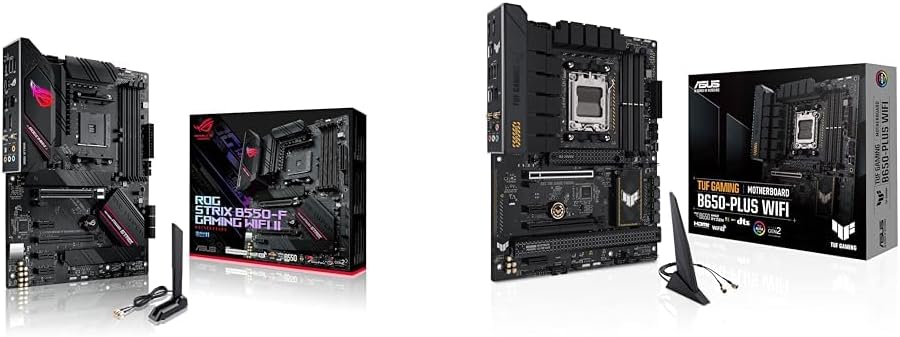
Asus ROG Strix B550-F Gaming WiFi II AMD AM4 (3rd Gen Ryzen) ATX Motherboard & TUF Gaming B650-PLUS WiFi Socket AM5 (LGA 1718) Ryzen 7000 ATX Gaming Motherboard
$150-$299This bundle offers two ATX motherboards: the ROG Strix B550-F Gaming WiFi II for AM4 Ryzen 3000/5000 CPUs with DDR4 RAM, and the TUF Gaming B650-PLUS WiFi for AM5 Ryzen 7000 CPUs with DDR5 RAM.

Game Motherboard Fit for ASROCK B650E PG-ITX WiFi B650 AM5 Motherboard Support Ryzen 7800X3D 7600/X 7950X 7700/X CPU 2xDDR5 128GB Hyper M.2 Mini-ITX
Price range unavailableThis KUETFBVC motherboard listing presents highly contradictory specifications, including a BGA 1023 socket and AMD 480 chipset, making it unsuitable for any modern Ryzen AM5 CPU.

Asus ROG Strix B550-F Gaming WiFi II AMD AM4 (3rd Gen Ryzen) ATX Gaming Motherboard (PCIe 4.0,WiFi 6E, 2.5Gb LAN, BIOS Flashback, HDMI 2.1, Addressable Gen 2 RGB Header and Aura Sync)
This is a premium-feeling AM4 board with beefy VRMs and WiFi 6E, perfect for squeezing the last drop of performance out of a Ryzen 5000 series CPU.