
GIGABYTE X870 Eagle WIFI7 AMD AM5 LGA 1718 Motherboard, ATX, DDR5, 4X M.2, PCIe 5.0, USB4, WIFI7, 2.5GbE LAN, EZ-Latch, 5-Year Warranty
Want the best price and purchase timing?
Our AI advisor analyzes real-time pricing across all channels to find you the best deal.
AI Verdict
This ATX AMD X870 motherboard with 14+2+2 power delivery and WIFI7 is for builders prioritizing next-gen connectivity over extreme overclocking.
This GIGABYTE X870 Eagle WIFI7 motherboard is a strong fit for users building a modern AM5 system who want cutting-edge connectivity like WIFI7, 2.5GbE LAN, and dual USB4 ports. Its PCIe 5.0 support for both GPU and M.2 SSDs provides excellent future-proofing for next-gen components.
If you need more robust power delivery for extreme overclocking or additional PCIe lanes without compromise, look for motherboards with a 16+2+2 or higher power phase design and explicit lane allocation details.
Regret Score™
Low RiskLower is better — measures purchase-regret risk from real buyer complaints, review credibility, and product maturity
Issues discovered after purchase
Critically weak dimension
Amazon rating vs actual quality
Chance this product isn't for you
Pros
- Supports AMD Ryzen 7000, 8000, and 9000 series processors on Socket AM5, offering broad CPU compatibility for current and future builds.
- Features PCIe 5.0 for both graphics cards and M.2 SSDs, providing maximum bandwidth for the latest components.
- Includes WIFI7 and 2.5GbE LAN, delivering fast wireless and wired networking capabilities.
- Equipped with dual USB4 ports, offering 40 Gbps transfer speeds for high-bandwidth external devices.
- Comes with a 5-year warranty, exceeding the standard warranty period for many motherboards.
- DIY-friendly features like M.2 EZ-Latch and PCIe EZ-Latch simplify component installation.
Cons
- Using more than two M.2 SSDs can reduce the GPU's PCIe lane allocation to x8, potentially impacting graphics performance.
- The 14+2+2 power phase design is on the lower end for an X870 chipset, which might limit extreme overclocking potential.
- Only provides HDMI output for integrated graphics, lacking a DisplayPort option.
- Some users have reported issues with USB, Bluetooth, and Wi-Fi on X870 boards, though not specifically tied to this model.
- Gigabyte's mid-range AM5 motherboards, including this one, use a 6-layer PCB, which is standard but not premium.
Dimension Scores
The 14+2+2 power phase design is adequate for most users but is on the lower end for an X870 chipset, limiting extreme overclocking potential.
It includes WIFI7, 2.5GbE LAN, dual USB4, PCIe 5.0, and EZ-Latch features, offering a comprehensive and modern set of connectivity options.
With PCIe 5.0 for GPU and M.2, plus three M.2 slots, it offers strong expansion, though lane sharing with M.2s can impact GPU bandwidth.
The BIOS is generally praised for being clean and easy to navigate, but some users have reported issues with specific AGESA updates for newer CPUs.
Best For
- Building an AM5 system with a Ryzen 7000, 8000, or 9000 series CPU and DDR5 RAM.
- Users needing high-speed networking with WIFI7 and 2.5GbE LAN.
- Workloads involving large file transfers or external high-speed storage via USB4.
- Future-proofing a build with PCIe 5.0 for both GPU and M.2 storage.
Not Recommended For
- Enthusiasts pushing extreme CPU overclocks requiring more robust power delivery.
- Users who frequently utilize more than two M.2 SSDs and a high-end GPU simultaneously.
- Budget-conscious builders who don't require WIFI7, USB4, or PCIe 5.0 for their current needs.
Watch Out For
- The motherboard's lane allocation means installing more than two M.2 SSDs can force your PCIe 5.0 x16 GPU slot to run at x8 mode.
- Some users have experienced issues with USB and wireless connectivity on X870 platforms, so be prepared to troubleshoot if you encounter similar problems.
- The BIOS version F3f for the 9800X3D reportedly had issues on a similar Gigabyte X870 board, suggesting potential early BIOS instability for new CPUs.
- The absence of a DisplayPort for integrated graphics means you're limited to HDMI if you're not using a discrete GPU.
Full Specifications
| RAM | DDR5 |
| ASIN | B0DGVMYTW6 |
| Brand | GIGABYTE |
| Color | EAGLE |
| Series | X870 EAGLE WIFI7 |
| Platform | Windows 10, Windows 11 |
| CPU Model | Ryzen 7 |
| Processor | ryzen_7 |
| CPU Socket | Socket AM5 |
| Model Name | X870 EAGLE WIFI7 |
| Item Weight | 3.94 pounds |
| Chipset Type | AMD X870 |
| Manufacturer | GIGABYTE |
| Memory Speed | 5600 MHz |
| Item model number | X870 EAGLE WIFI7 |
| Compatible Devices | Personal Computer |
| Memory Clock Speed | 5600 MHz |
| Product Dimensions | 13.2 x 10.6 x 3.1 inches |
| Compatible Processors | AMD Ryzen 7000 series, AMD Ryzen 8000 series, AMD Ryzen 9000 series |
| RAM Memory Technology | DDR5 |
| Item Dimensions LxWxH | 13.2 x 10.6 x 3.1 inches |
| Number of USB 2.0 Ports | 4 |
What Buyers Say
This Gigabyte X870 Eagle WIFI7 board is a bit of a mixed bag; it's got all the latest bells and whistles like WIFI7 and USB4, which people are definitely noticing. However, there's chatter about potential lane sharing issues if you load up all the M.2 slots, which could throttle your GPU. Some early adopters have also hit snags with USB and wireless stability, and BIOS updates for new CPUs seem to be a point of concern. It feels like a board that's pushing new tech but might have some growing pains.
“Man, this board has all the new stuff like WIFI7 and USB4, which is cool, but I heard if I use all my M.2s my GPU gets choked, that's kinda annoying. Still, it looks slick and the BIOS was easy enough for me.”
Common Praise
- The BIOS is easy to navigate and well-designed, with EXPO and PBO support working out of the box.
- The inclusion of WIFI7 and 2.5GbE LAN provides very fast network speeds.
- Dual USB4 ports offer blazing-fast 40 Gbps transfer speeds for external devices.
- The M.2 EZ-Latch and PCIe EZ-Latch features make component installation straightforward.
- The board's overall design is clean and well laid out, looking good in a windowed case.
Common Complaints
- Using more than two M.2 SSDs can reduce the GPU's PCIe lane speed to x8.
- Some users have reported general issues with USB, Bluetooth, and Wi-Fi on X870 motherboards.
- The 14+2+2 power design is considered less robust for extreme overclocking compared to higher-end boards.
- Early BIOS versions might have compatibility issues or bugs with newer CPUs like the 9800X3D.
- Only having HDMI for integrated graphics output, without DisplayPort, is a limitation.
Ownership Tips
- The 5-year warranty provides a longer period of coverage than many competitors, offering peace of mind.
- The EZ-Latch system for M.2 drives and PCIe slots genuinely simplifies the build process, especially for frequent component swaps.
- While the 14+2+2 power delivery is not top-tier, it's sufficient for running even high-end CPUs like the Ryzen 9950X without issues under normal loads.
- The lack of DisplayPort for integrated graphics can be a minor inconvenience if you ever need to troubleshoot without a discrete GPU.
- The aesthetic is understated with a matte black finish and subtle accents, avoiding overly aggressive 'gamer' aesthetics.
Frequently Asked Questions
Does this motherboard support AMD Ryzen 9000 series processors?
Yes, this motherboard is designed to support AMD Ryzen 9000, 8000, and 7000 series processors on the AM5 socket.
What type of RAM does this motherboard use?
It uses DDR5 RAM and has four DIMM slots with support for AMD EXPO profiles.
How many M.2 slots does this motherboard have?
The motherboard features three M.2 slots for high-speed NVMe storage.
Does this motherboard have Wi-Fi 7?
Yes, it comes with integrated WIFI7 for the latest wireless networking standards.
Will using all M.2 slots affect my graphics card performance?
Yes, using more than two M.2 SSDs can cause the primary PCIe 5.0 x16 slot for your GPU to operate at x8 speeds.
Buying Guide
When you're picking a motherboard, think of it as the central nervous system for your PC. It connects everything: your CPU, RAM, graphics card, and storage. You need to make sure it supports your chosen CPU socket, like AM5 for this board, and the type of RAM you want, which is DDR5 here. Don't get caught up in every single spec; focus on what you actually need for your planned components and how you'll use your PC.
Socket AM5
This tells you which AMD CPUs the board works with. AM5 is the latest socket for AMD Ryzen processors, meaning it supports the current and upcoming generations like the Ryzen 7000, 8000, and 9000 series. It's like knowing if a car takes gasoline or diesel – you can't mix and match.
PCIe 5.0
This is the speed of the connections for your graphics card and some M.2 SSDs. PCIe 5.0 is the newest and fastest standard, offering double the bandwidth of PCIe 4.0. Think of it as a wider highway for data; your high-end graphics card or super-fast SSD can move information quicker, though for most gaming, PCIe 4.0 is still plenty fast.
WIFI7 & 2.5GbE LAN
These are your internet connections. WIFI7 is the absolute latest wireless standard, offering faster speeds and better performance in congested networks. 2.5GbE LAN is a wired connection that's 2.5 times faster than standard Gigabit Ethernet. If you have a fast internet connection or transfer large files over your local network, these features will make a noticeable difference.
USB4
USB4 is a high-speed port, similar to Thunderbolt, that can transfer data at up to 40 Gbps. This is crucial if you plan to use external SSDs for video editing, connect high-resolution displays, or daisy-chain multiple peripherals. It's like having a super-fast express lane for your external devices.
Alternatives
If you don't need the absolute latest in networking or USB4, look for a B650E or B850 chipset motherboard with PCIe 5.0 support to save money. If you plan on using many M.2 drives and a high-end GPU, prioritize boards with more dedicated PCIe lanes to avoid bandwidth sharing.
You Might Also Like

JetKVM KVM Over IP ATX Extension Board, ATX Power Control Board- Only for Jet KVM Accessories Boot from Shutdown, Crash Recovery
$0-$49This is an ATX form factor power control board designed for JetKVM accessories, enabling remote PC power state management and simultaneous front panel button use.
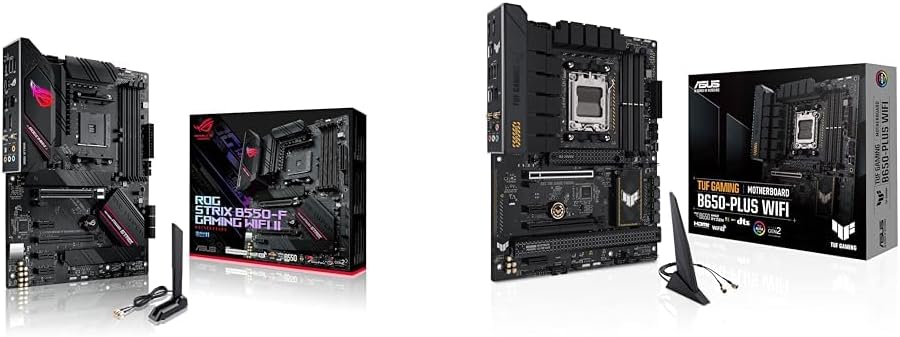
Asus ROG Strix B550-F Gaming WiFi II AMD AM4 (3rd Gen Ryzen) ATX Motherboard & TUF Gaming B650-PLUS WiFi Socket AM5 (LGA 1718) Ryzen 7000 ATX Gaming Motherboard
$150-$299This bundle offers two ATX motherboards: the ROG Strix B550-F Gaming WiFi II for AM4 Ryzen 3000/5000 CPUs with DDR4 RAM, and the TUF Gaming B650-PLUS WiFi for AM5 Ryzen 7000 CPUs with DDR5 RAM.

Game Motherboard Fit for ASROCK B650E PG-ITX WiFi B650 AM5 Motherboard Support Ryzen 7800X3D 7600/X 7950X 7700/X CPU 2xDDR5 128GB Hyper M.2 Mini-ITX
Price range unavailableThis KUETFBVC motherboard listing presents highly contradictory specifications, including a BGA 1023 socket and AMD 480 chipset, making it unsuitable for any modern Ryzen AM5 CPU.

Asus ROG Strix B550-F Gaming WiFi II AMD AM4 (3rd Gen Ryzen) ATX Gaming Motherboard (PCIe 4.0,WiFi 6E, 2.5Gb LAN, BIOS Flashback, HDMI 2.1, Addressable Gen 2 RGB Header and Aura Sync)
This is a premium-feeling AM4 board with beefy VRMs and WiFi 6E, perfect for squeezing the last drop of performance out of a Ryzen 5000 series CPU.