
ASUS TUF Gaming X870-PLUS WiFi AMD AM5 X870 ATX Motherboard, 16+2+1, 80A SPS Power Stages, DDR5, PCIe 5.0 Ready, Four M.2 Slots, Wi-Fi 7, 2.5Gb LAN, HDMI, USB4® 40Gbps, SATA 6 Gbps, USB 20Gbps Type-C
Want the best price and purchase timing?
Our AI advisor analyzes real-time pricing across all channels to find you the best deal.
AI Verdict
This ATX AM5 X870 motherboard with 16+2+1 80A power stages and Wi-Fi 7 is for builders needing robust power and extensive PCIe 5.0 storage.
This motherboard is a strong contender for users prioritizing PCIe 5.0 storage and high-speed connectivity like Wi-Fi 7 and USB4 40Gbps. However, its limited SATA ports and potential PCIe lane sharing with M.2 slots mean it's not a universal fit for every build, especially those needing many traditional storage drives or multiple PCIe expansion cards.
If you need more SATA ports or guaranteed full PCIe x16 bandwidth with all M.2 slots populated, look for boards with more dedicated lanes or a different chipset configuration.
Regret Score™
Low RiskLower is better — measures purchase-regret risk from real buyer complaints, review credibility, and product maturity
Issues discovered after purchase
Critically weak dimension
Amazon rating vs actual quality
Chance this product isn't for you
Pros
- Features 16+2+1, 80A SPS power stages for stable power delivery to high-core-count CPUs.
- Includes two USB4® 40Gbps ports and a front USB 20Gbps Type-C port with PD fast charge support for rapid data transfer and device charging.
- Offers four M.2 slots, with two supporting PCIe 5.0, enabling high-speed storage configurations.
- Equipped with Wi-Fi 7 and Realtek 2.5Gb Ethernet for advanced wireless and wired networking.
- Supports DDR5 memory up to 8000+ MT/s (OC) for high-frequency RAM performance.
- Integrates DIY-friendly features like PCIe Slot Q-Release, M.2 Q-Latch, and BIOS Flashback Button.
Cons
- Only provides two SATA 6Gb/s ports, which is limited for users with multiple SATA drives.
- Utilizing all four M.2 slots can reduce the primary PCIe x16 slot to x8 bandwidth and disable the second PCIe slot.
- Lacks traditional 4-pin RGB headers, only supporting addressable RGB.
- VRM heatsinks are smaller compared to some competing X870 boards, potentially leading to more heat saturation on the PCB.
Dimension Scores
The 16+2+1, 80A SPS power stages and 8-layer PCB provide robust and stable power delivery for high-core-count AMD Ryzen CPUs.
It includes Wi-Fi 7, dual USB4 40Gbps, AI Overclocking, and DIY-friendly features like Q-Release and Q-Latch, offering a modern suite of capabilities.
While offering four M.2 slots (two PCIe 5.0) and a PCIe 5.0 x16 slot, the limited two SATA ports and potential PCIe lane sharing with M.2s are drawbacks.
The UEFI BIOS offers user-friendly configuration, and ASUS AI solutions like AI Cooling II and AI Networking II simplify system management.
Best For
- Building a high-performance AMD Ryzen 9000/8000/7000 system with multiple PCIe 5.0 NVMe SSDs.
- Users who require Wi-Fi 7 and dual USB4 40Gbps connectivity for external devices.
- Enthusiasts looking to leverage AI Overclocking and advanced power delivery for CPU tuning.
Not Recommended For
- Budget-conscious builders who prioritize cost over cutting-edge features like Wi-Fi 7 or dual USB4 ports.
- Users with numerous SATA storage devices, due to the limited two SATA ports.
Watch Out For
- The primary PCIe x16 slot bandwidth can be halved to x8 if certain M.2 slots are populated, impacting GPU performance.
- Installing an SSD in the fourth M.2 slot may disable the second PCIe slot entirely.
- The motherboard only has two SATA 6Gb/s ports, which is a significant limitation for users with multiple hard drives or SATA SSDs.
- Some users report the $309.99 MSRP feels high for a TUF series board, especially when compared to other X870 options with similar features.
Full Specifications
| RAM | DDR5 |
| ASIN | B0DGB8Q19Y |
| Brand | ASUS |
| Color | BLACK |
| Series | TUF GAMING X870-PLUS WIFI |
| Platform | Windows 10, Windows 11 |
| Batteries | 1 12V batteries required. |
| CPU Model | Ryzen 7 |
| Processor | ryzen_7 |
| CPU Socket | Socket AM5 |
| Model Name | TUF GAMING X870-PLUS WIFI |
| Item Weight | 2.9 pounds |
| Chipset Type | AMD X870 |
| Manufacturer | ASUS |
| Memory Speed | 160 MHz |
| Hardware Platform | x86_64 |
| Item model number | TUF GAMING X870-PLUS WIFI |
| Compatible Devices | Personal Computer |
| Memory Clock Speed | 160 MHz |
| Product Dimensions | 2.7 x 13.9 x 10.8 inches |
| Compatible Processors | AMD Ryzen™ 9000 & 8000 & 7000 Series |
| RAM Memory Technology | DDR5 |
| Item Dimensions LxWxH | 2.7 x 13.9 x 10.8 inches |
What Buyers Say
The biggest head-scratcher with this board is the trade-off between M.2 expansion and PCIe lane availability; using all four M.2 slots can cut your main GPU slot to x8 or disable another PCIe slot entirely. Users also point out the surprisingly low count of only two SATA ports, which feels like a miss for a board in this price range. Despite these compromises, the board packs a punch with Wi-Fi 7 and dual USB4 40Gbps ports, making it a connectivity powerhouse. The DIY features like PCIe Slot Q-Release and M.2 Q-Latch are consistently highlighted as genuinely useful for builds.
“Man, this board has all the new fancy stuff like Wi-Fi 7 and USB4, but only two SATA ports? Seriously? My old build had more! And the PCIe lanes get weird if I use all my M.2s. It's fast, but I gotta plan my storage carefully.”
Common Praise
- The 16+2+1, 80A power stages deliver stable power, even for demanding AMD processors.
- The inclusion of Wi-Fi 7 provides cutting-edge wireless networking speeds.
- Dual USB4 40Gbps ports offer extremely fast external device connectivity.
- DIY features like PCIe Slot Q-Release and M.2 Q-Latch simplify the building process.
- The 8-layer PCB design contributes to system stability and overclocking headroom.
Common Complaints
- The limited number of two SATA 6Gb/s ports is a frequent point of frustration for users with multiple storage drives.
- PCIe lane sharing issues mean populating all M.2 slots can reduce GPU bandwidth or disable other PCIe slots.
- The absence of older 4-pin RGB headers limits compatibility with some legacy RGB devices.
- Some reviewers feel the MSRP is a bit high given the compromises in SATA ports and PCIe lane allocation.
Ownership Tips
- The Q-Release button for the PCIe slot is a game-changer when swapping graphics cards, no more wrestling with tiny clips.
- The M.2 Q-Latch makes installing NVMe drives incredibly simple, no tiny screws to lose.
- The Wi-Fi 7 antenna is easy to snap into place, a small but appreciated detail.
- You'll need to be mindful of your storage strategy; two SATA ports fill up fast if you have a mix of drives.
- The AI Overclocking features actually provide a noticeable performance bump without hours of manual tweaking.
Frequently Asked Questions
What CPUs are compatible with this motherboard?
It's compatible with AMD Ryzen™ 9000, 8000, and 7000 Series Desktop Processors for the AM5 socket.
Does this motherboard support PCIe 5.0?
Yes, it features a PCIe 5.0 x16 slot for graphics cards and two M.2 slots that support PCIe 5.0 SSDs.
How many M.2 slots does it have?
There are four M.2 slots available, with two of them supporting PCIe 5.0 speeds.
What kind of Wi-Fi connectivity does it offer?
It comes with Wi-Fi 7 for the latest and fastest wireless networking standards.
Can I use integrated graphics with this board?
Yes, it includes an HDMI™ port, allowing you to use integrated graphics from compatible AMD Ryzen™ processors.
Does it have USB4 ports?
Yes, it features dual USB4® 40Gbps Type-C® ports on the rear I/O.
Buying Guide
When you're looking at motherboards, especially for a new AMD Ryzen build, you need to think about what you're actually plugging into it. Don't just look at the big numbers. Consider how many storage drives you have, what kind of graphics card you're running, and if you need the absolute latest in wireless tech. This board has a lot of cutting-edge stuff, but sometimes that comes with trade-offs in other areas.
16+2+1, 80A SPS Power Stages
This refers to the power delivery system for your CPU. More phases and higher amperage (80A here) mean your CPU gets cleaner, more stable power, especially important if you're running a high-end Ryzen chip or planning to overclock it. Think of it like a robust electrical grid for your processor.
PCIe 5.0 Ready (for x16 slot and two M.2 slots)
PCIe 5.0 is the latest and fastest connection standard for graphics cards and NVMe SSDs. If you're buying a top-tier GPU or a blazing-fast new SSD, you'll want this to get the most out of them. It's like having the widest, fastest highway for your components to communicate.
Wi-Fi 7
This is the newest wireless standard, offering faster speeds and lower latency than previous Wi-Fi versions. If your router also supports Wi-Fi 7, you'll get the best possible wireless performance for gaming or streaming, like upgrading from a local road to a superhighway for your internet connection.
Dual USB4® 40Gbps ports
These are incredibly fast USB-C ports, capable of 40 Gigabits per second. They're useful for connecting high-speed external storage, docking stations, or even external GPUs. It's like having a dedicated express lane for your most data-intensive external devices.
Alternatives
If you need more than two SATA ports or want to avoid any potential PCIe lane sharing issues with M.2 drives, look for motherboards with a higher SATA port count or a chipset design that offers more dedicated PCIe lanes for all slots.
You Might Also Like

JetKVM KVM Over IP ATX Extension Board, ATX Power Control Board- Only for Jet KVM Accessories Boot from Shutdown, Crash Recovery
$0-$49This is an ATX form factor power control board designed for JetKVM accessories, enabling remote PC power state management and simultaneous front panel button use.
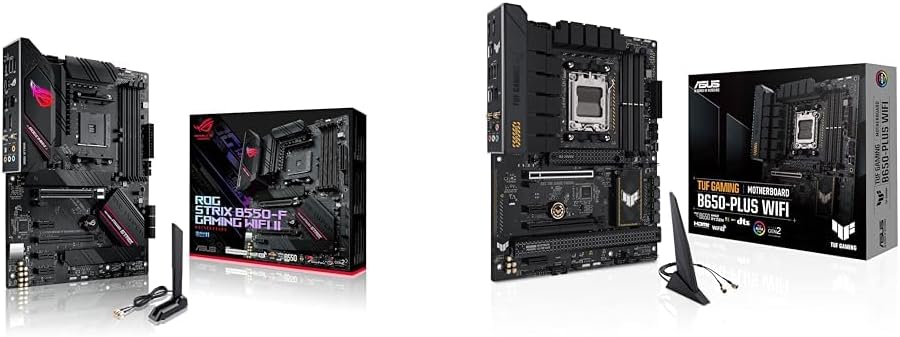
Asus ROG Strix B550-F Gaming WiFi II AMD AM4 (3rd Gen Ryzen) ATX Motherboard & TUF Gaming B650-PLUS WiFi Socket AM5 (LGA 1718) Ryzen 7000 ATX Gaming Motherboard
$150-$299This bundle offers two ATX motherboards: the ROG Strix B550-F Gaming WiFi II for AM4 Ryzen 3000/5000 CPUs with DDR4 RAM, and the TUF Gaming B650-PLUS WiFi for AM5 Ryzen 7000 CPUs with DDR5 RAM.

Game Motherboard Fit for ASROCK B650E PG-ITX WiFi B650 AM5 Motherboard Support Ryzen 7800X3D 7600/X 7950X 7700/X CPU 2xDDR5 128GB Hyper M.2 Mini-ITX
Price range unavailableThis KUETFBVC motherboard listing presents highly contradictory specifications, including a BGA 1023 socket and AMD 480 chipset, making it unsuitable for any modern Ryzen AM5 CPU.

Asus ROG Strix B550-F Gaming WiFi II AMD AM4 (3rd Gen Ryzen) ATX Gaming Motherboard (PCIe 4.0,WiFi 6E, 2.5Gb LAN, BIOS Flashback, HDMI 2.1, Addressable Gen 2 RGB Header and Aura Sync)
This is a premium-feeling AM4 board with beefy VRMs and WiFi 6E, perfect for squeezing the last drop of performance out of a Ryzen 5000 series CPU.