
ASRock Phantom Gaming X870E Nova WiFi Socket AM5 AMD Ryzen X870 DDR5 DIMMs 8200 MHz 256 GB ATX Motherboard USB4
Want the best price and purchase timing?
Our AI advisor analyzes real-time pricing across all channels to find you the best deal.
AI Verdict
This ATX Socket AM5 motherboard with an AMD X870E chipset and 20+2+1 power phases is for builders needing extensive PCIe Gen5 and M.2 storage without lane sharing compromises.
This motherboard is a strong fit for users building a high-end AM5 system who need extensive PCIe Gen5 storage, robust power delivery, and advanced connectivity like USB4 and WiFi 7. Its 20+2+1 power phase design and five M.2 slots (including one Gen5) cater to demanding applications and future upgrades.
If you need more than four SATA ports or a more user-friendly BIOS for fan control, look for motherboards that explicitly advertise these features.
Regret Score™
Medium RiskLower is better — measures purchase-regret risk from real buyer complaints, review credibility, and product maturity
Issues discovered after purchase
Critically weak dimension
Amazon rating vs actual quality
Chance this product isn't for you
Pros
- Features a 20+2+1 power phase design with 110A SPS, providing robust power delivery for high-end CPUs.
- Includes five M.2 slots (one Gen5x4, three Gen4x4, one Gen3x2) with no lane sharing affecting the primary PCIe Gen5x16 slot or USB4 ports.
- Offers dual USB4 Type-C ports (40 Gbps) with DisplayPort passthrough and 15W PD 3.0 fast charging.
- Equipped with 5GbE LAN and WiFi 7 (802.11be) for high-speed networking.
- Comes with a PCIe EZ Release button for simplified graphics card removal.
- Integrated Dr. Debug Display and onboard power/reset buttons assist with troubleshooting.
Cons
- Only the primary M.2 slot has a tool-less heatsink and dual thermal pads; the other four require a screwdriver and use single thermal pads.
- The secondary PCIe Gen3x16 slot (electrically x2) shares bandwidth with the M2_5 slot, disabling it if M2_5 is populated.
- The UEFI/BIOS interface is described as feeling dated and lacks advanced fan control options found in some competitors.
- Limited to four SATA ports, which might be insufficient for users with many older storage drives.
- VRM heatsinks are not interlinked, and the main heatsink is partially covered by a shroud.
Dimension Scores
The 20+2+1 power phase design with 110A SPS and a concealed MOS FAN provides exceptional power delivery and cooling.
Includes high-end features like dual USB4 Type-C, 5GbE LAN, WiFi 7, and a PCIe EZ Release button, placing it above average for its category.
Offers five M.2 slots (one Gen5) and a primary PCIe Gen5x16 slot without lane sharing, but is limited by only four SATA ports and a secondary PCIe slot that shares bandwidth with an M.2.
While functional with EXPO/XMP support and debug features, the UEFI is noted as feeling dated and lacking advanced fan control tools compared to competitors.
Best For
- High-performance gaming builds requiring multiple PCIe Gen5 NVMe drives and a powerful GPU.
- Workstations needing extensive high-speed storage and robust CPU power delivery for demanding tasks.
- Users who prioritize future-proofing with mandatory PCIe Gen5, USB4, and WiFi 7 connectivity.
- Enthusiasts who frequently swap GPUs and appreciate quality-of-life features like the PCIe EZ Release button.
Not Recommended For
- Budget-conscious builders who don't need the full X870E feature set.
- Users with numerous SATA-based storage devices due to the limited four SATA ports.
- Those who prefer a highly refined and modern BIOS/UEFI interface with extensive fan tuning options.
Watch Out For
- The secondary PCIe Gen3x16 slot (electrically x2) becomes unusable if the M2_5 slot is occupied, limiting expansion options.
- Only one of the five M.2 heatsinks is tool-less; the other four require a screwdriver for installation or removal.
- The BIOS/UEFI lacks advanced fan control tools, making precise fan curve adjustments less intuitive.
- Despite having a concealed 'MOS FAN' for VRM cooling, the VRM heatsinks are not interlinked, potentially impacting overall thermal dissipation efficiency.
Full Specifications
| ASIN | B0DFZQJFC1 |
| Brand | ASRock |
| Platform | Windows 10, Windows 11 |
| Batteries | 1 CR2032 batteries required. |
| CPU Model | Ryzen 7 |
| CPU Socket | Socket AM5 |
| Model Name | X870E NOVA WIFI |
| Item Weight | 2.2 pounds |
| Chipset Type | AMD X870E |
| Manufacturer | ASRock |
| Item model number | X870E NOVA WIFI |
| Compatible Devices | Personal Computer |
| Memory Clock Speed | 8200 MHz |
| Compatible Processors | AMD Ryzen 7000 Series Processors, AMD Ryzen 8000 Series Processors, AMD Ryzen 9000 Series Processors |
| RAM Memory Technology | DDR5 |
What Buyers Say
This ASRock X870E Nova WiFi motherboard is consistently praised for its robust power delivery and extensive M.2 storage options, often highlighted as a strong value for an X870E board. Users appreciate the inclusion of dual USB4 ports and WiFi 7, making it a future-proof choice for many. However, some builders find the BIOS interface less refined than competitors, and the limited number of SATA ports is a recurring point of contention. The PCIe EZ Release button is a small but frequently mentioned convenience.
“Man, this board is loaded for the price, those USB4 ports are clutch and my 9900X just flies, but seriously, ASRock, update that BIOS UI already, it's like stepping back in time. And only four SATA? Come on.”
Common Praise
- The 20+2+1 power phase design keeps PCB temperatures very cool, even under heavy loads.
- Five M.2 slots, including one Gen5, provide ample high-speed storage without compromising GPU performance.
- Dual USB4 Type-C ports offer fast data transfer and display output capabilities.
- The PCIe EZ Release button makes removing large graphics cards significantly easier.
- Integrated 5GbE LAN and WiFi 7 deliver top-tier networking performance.
- The Dr. Debug display and onboard buttons are helpful for troubleshooting initial builds.
Common Complaints
- Only the top M.2 slot has a tool-less heatsink; the others require a screwdriver.
- The BIOS/UEFI feels outdated and lacks detailed fan control options found on other boards.
- The secondary PCIe slot's bandwidth is reduced or disabled if the fifth M.2 slot is used.
- Only four SATA ports are available, which can be restrictive for users with multiple hard drives or SSDs.
- VRM heatsinks are not linked, and a shroud covers part of the main heatsink, which some users see as a design flaw.
Ownership Tips
- The Dr. Debug display can be configured to turn off after boot, preventing a constant display of codes or temperatures.
- Memory slots are spaced far enough to accommodate large CPU coolers without interference, even with tall RAM heat sinks.
- The concealed 'MOS FAN' for VRM cooling is generally quiet and only noticeable at full speed settings in the BIOS.
- The board's 8-layer PCB and 2 Oz copper design contribute to its perceived durability and stability.
Frequently Asked Questions
What CPUs are compatible with this motherboard?
It supports AMD Ryzen 7000, 8000, and 9000 Series Processors for Socket AM5.
What is the maximum RAM speed and capacity supported?
The motherboard supports DDR5 DIMMs up to 8200 MHz (overclocked) with a maximum capacity of 256 GB across four slots.
Does this motherboard have WiFi and what standard is it?
Yes, it includes a WiFi 7 (802.11be) module for advanced wireless connectivity.
How many M.2 slots does it have and what are their speeds?
It features five M.2 slots: one PCIe Gen5x4, three PCIe Gen4x4, and one PCIe Gen3x2.
Are there any issues with M.2 slots sharing bandwidth with other components?
The primary PCIe Gen5x16 slot and USB4 ports do not share lanes with the M.2 slots. However, the M2_5 slot shares its bus with the secondary PCIe Gen3x16 slot, disabling the PCIe slot if M2_5 is populated.
Buying Guide
When you're looking at motherboards like this, you're essentially picking the central nervous system for your PC. It dictates what CPU you can use, how much and what type of RAM you can install, and how many fast storage drives and expansion cards you can add. Don't just look at the flashy features; consider how many USB ports you actually need, if you plan on using multiple high-speed NVMe drives, and if you'll be pushing your CPU with heavy overclocking.
Chipset (AMD X870E)
The chipset is like the motherboard's traffic controller. The 'E' in X870E means it's a top-tier chipset, guaranteeing PCIe Gen5 support for both your graphics card and at least one M.2 SSD, plus mandatory USB4. This ensures you get the fastest connections for your most critical components now and in the near future.
20+2+1 Power Phase Design
This refers to the power delivery system for your CPU. More phases, especially with high amperage (like 110A SPS), means cleaner, more stable power to your processor, which is crucial for high-end CPUs, overclocking, and maintaining system stability under heavy loads, preventing performance bottlenecks.
DDR5 DIMMs 8200 MHz 256 GB
This tells you the type, speed, and maximum capacity of RAM it supports. DDR5 is the latest generation, offering faster speeds than DDR4. 8200 MHz is a very high overclocked speed, meaning it can handle extremely fast memory kits, and 256 GB is a massive amount, suitable for professional workloads or extreme multitasking.
Dual USB4 Type-C
These are incredibly fast, multi-purpose ports. USB4 offers 40 Gbps bandwidth, which is great for external SSDs, high-resolution displays (via DisplayPort passthrough), or connecting other high-bandwidth peripherals. It's like having a super-highway for data and video.
Alternatives
If this board offers more features than you need, look for motherboards with an AMD B850 chipset for a more budget-friendly option, or if you need more SATA ports, search for boards that explicitly list six or more SATA 6Gbps connectors.
You Might Also Like

JetKVM KVM Over IP ATX Extension Board, ATX Power Control Board- Only for Jet KVM Accessories Boot from Shutdown, Crash Recovery
$0-$49This is an ATX form factor power control board designed for JetKVM accessories, enabling remote PC power state management and simultaneous front panel button use.
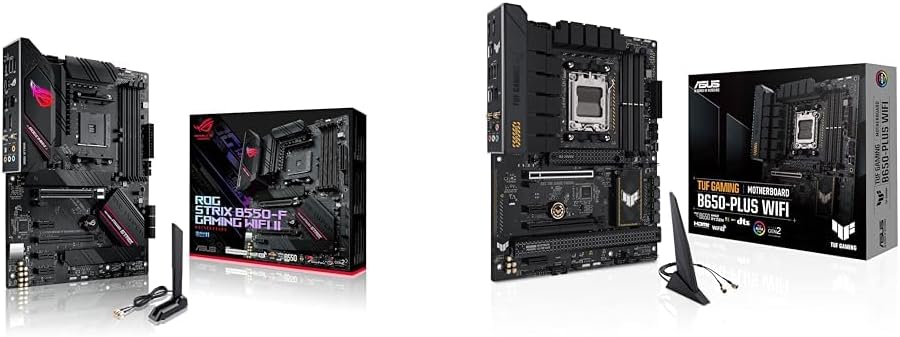
Asus ROG Strix B550-F Gaming WiFi II AMD AM4 (3rd Gen Ryzen) ATX Motherboard & TUF Gaming B650-PLUS WiFi Socket AM5 (LGA 1718) Ryzen 7000 ATX Gaming Motherboard
$150-$299This bundle offers two ATX motherboards: the ROG Strix B550-F Gaming WiFi II for AM4 Ryzen 3000/5000 CPUs with DDR4 RAM, and the TUF Gaming B650-PLUS WiFi for AM5 Ryzen 7000 CPUs with DDR5 RAM.

Game Motherboard Fit for ASROCK B650E PG-ITX WiFi B650 AM5 Motherboard Support Ryzen 7800X3D 7600/X 7950X 7700/X CPU 2xDDR5 128GB Hyper M.2 Mini-ITX
Price range unavailableThis KUETFBVC motherboard listing presents highly contradictory specifications, including a BGA 1023 socket and AMD 480 chipset, making it unsuitable for any modern Ryzen AM5 CPU.

Asus ROG Strix B550-F Gaming WiFi II AMD AM4 (3rd Gen Ryzen) ATX Gaming Motherboard (PCIe 4.0,WiFi 6E, 2.5Gb LAN, BIOS Flashback, HDMI 2.1, Addressable Gen 2 RGB Header and Aura Sync)
This is a premium-feeling AM4 board with beefy VRMs and WiFi 6E, perfect for squeezing the last drop of performance out of a Ryzen 5000 series CPU.