
Element14 Raspberry Pi 3 B+ Motherboard
Want the best price and purchase timing?
Our AI advisor analyzes real-time pricing across all channels to find you the best deal.
AI Verdict
The Raspberry Pi 3 B+ is a $35-tier single-board computer perfect for 1080p media centers, Pi-Hole setups, and retro gaming, provided you supply a strict 2.5A power source.
The 1.4GHz CPU and 5GHz Wi-Fi make it a highly capable board for dedicated, single-task projects like media streaming or IoT hubs. The 1GB RAM limit and USB 2.0 bottleneck mean it falls flat if you try to use it as a daily desktop or a high-speed file server.
If you need USB 3.0 speeds or more than 1GB of RAM for desktop use, step up to the Raspberry Pi 4 Model B.
Regret Score™
Medium RiskLower is better — measures purchase-regret risk from real buyer complaints, review credibility, and product maturity
Issues discovered after purchase
Critically weak dimension
Amazon rating vs actual quality
Chance this product isn't for you
Pros
- 1.4GHz quad-core BCM2837B0 processor handles 1080p video playback without the stuttering seen on older Pi models
- Dual-band 802.11ac Wi-Fi chip is shielded and delivers reliable 5GHz connections right out of the box
- New metal heat spreader on the CPU significantly reduces thermal throttling compared to the bare plastic chip on the Pi 3B
- Ethernet port upgraded to support Gigabit protocols, hitting real-world speeds around 300 Mbps
- Retains the exact same form factor and port layout as the Pi 2 and Pi 3, meaning old cases and HATs still fit perfectly
Cons
- Ethernet and all four USB ports share a single USB 2.0 bus, severely bottlenecking external drive speeds
- Requires a strict 5V/2.5A power supply; standard phone chargers will trigger an undervoltage warning and throttle performance
- MicroSD slot is now a friction-based push-pull design instead of spring-loaded, making card removal frustrating in tight cases
- Only 1GB of LPDDR2 RAM, which struggles heavily with JavaScript-dense modern web browsing
Dimension Scores
Improved over the 3B, but highly sensitive to minor voltage drops and requires a strict 2.5A supply.
Adding dual-band 5GHz Wi-Fi and Bluetooth 4.2 makes headless connectivity vastly more reliable.
The 40-pin GPIO and CSI/DSI ports offer massive flexibility, but the shared USB 2.0 bus limits external storage.
Raspbian OS and the massive community support make troubleshooting and software installation effortless.
Best For
- Network-wide ad blocking using Pi-Hole on a wired Ethernet connection
- Retro gaming consoles running RetroPie for PS1 and SNES emulation
- Headless home automation hubs running Home Assistant
Not Recommended For
- Desktop PC replacements for heavy web browsing with multiple tabs
- High-speed NAS setups, due to the shared USB 2.0 bus capping transfer rates
Watch Out For
- Undervoltage throttling: If you use a standard 1A or 1.5A phone charger, you will get a persistent lightning bolt icon on your screen and the CPU will throttle. You absolutely need a dedicated 5V/2.5A power supply.
- Old OS boot failures: You cannot just swap an old SD card from a Pi 3B into this board. The new CPU requires updated bootcode, so you must flash the latest version of Raspbian or NOOBS.
- Shared bandwidth bottleneck: The 'Gigabit' Ethernet port shares the internal USB 2.0 bus with the four USB ports, meaning your maximum network speed hard-caps at 300 Mbps, and drops further if you plug in USB drives.
- Friction-fit SD slot: The spring-loaded MicroSD slot from older models is gone. The new push-pull slot requires you to grab the tiny lip of the SD card with your fingernails to pull it out.
Full Specifications
| RAM | 1 GB LPDDR2 |
| ASIN | B07BDR5PDW |
| Brand | Raspberry Pi |
| Series | Raspberry Pi 3 Model B+ |
| Voltage | 5 Volts |
| Platform | Linux |
| CPU Model | A-Series |
| Processor | 1.4 GHz a_series |
| CPU Socket | Broadcom BCM2837BO 64 bit ARMv8 QUAD Core A53 64bt |
| Department | All Ages |
| Model Name | Raspberry Pi 3 Model B+ |
| Item Weight | 0.035 ounces |
| Chipset Type | Cortex-A53 |
| Manufacturer | Element14 |
| Memory Speed | 1.4 GHz |
| Wireless Type | 802.11ac, 802.11bgn |
| Processor Brand | Broadcom |
| Card Description | Integrated |
| Operating System | Raspberry Pi OS (based on Debian Linux) |
| Item model number | Raspberry Pi 3 Model B+ |
| Compatible Devices | Cameras, Monitors, Keyboards, Mice, Speakers, Touchscreen Displays |
| Memory Clock Speed | 1.4 GHz |
| Product Dimensions | 3.54 x 2.36 x 0.79 inches |
| Computer Memory Type | DDR2 SDRAM |
| Hard Drive Interface | Ethernet |
| Number of Processors | 4 |
| Compatible Processors | Broadcom BCM2837BO, ARMv8 |
| RAM Memory Technology | LPDDR2 |
| Graphics Card Ram Size | 1 |
| Item Dimensions LxWxH | 3.54 x 2.36 x 0.79 inches |
| Number of USB 2.0 Ports | 4 |
| Number of USB 3.0 Ports | 3 |
| Hard Drive Rotational Speed | 0.01 |
| Standing screen display size | 0.01 |
| Is Discontinued By Manufacturer | No |
What Buyers Say
The biggest shock for most upgraders is that their old phone chargers no longer cut it—the 3 B+ is notoriously power-hungry and will throw a lightning bolt warning if it doesn't get a strict 2.5 Amps. The addition of 5GHz Wi-Fi finally makes wireless streaming and headless setups reliable without a dongle. The new metal heat spreader on the CPU is a massive hit, keeping temperatures low enough that many run it without a fan. The switch to a friction-fit MicroSD slot has annoyed plenty of people who struggle to pull cards out of tight cases. It's a rock-solid board for Pi-Hole or RetroPie, but the 1GB RAM limit keeps it from being a true desktop replacement.
“Great little board for my pi-hole but seriously buy the official power supply, I spent three days trying to figure out why it kept freezing only to realize my old ipad charger was causing undervoltage throttling.”
Common Praise
- 5GHz Wi-Fi connects instantly and doesn't drop out like the old 2.4GHz chip
- Metal heat spreader prevents the CPU from thermal throttling during heavy loads
- Fits perfectly into existing Pi 2 and Pi 3 cases without modification
- Network boot and USB boot work natively without needing to set OTP bits
Common Complaints
- Lightning bolt undervoltage warning appears constantly with standard USB chargers
- Push-pull MicroSD slot requires tweezers or long fingernails to remove the card
- Ethernet speeds cap at 300 Mbps because it shares the USB 2.0 bus
- 1GB of RAM severely bottlenecks web browsing with Chromium
Ownership Tips
- The polyfuse takes time to reset if you short a GPIO pin—if it dies, leave it unplugged for a day and it might come back to life.
- Running a 5V fan directly off the GPIO pins can sometimes trigger the undervoltage warning if your power supply is borderline.
- You can easily run this completely headless over Wi-Fi by dropping a wpa_supplicant.conf file onto the boot partition before first boot.
Frequently Asked Questions
Why am I getting a lightning bolt icon in the top right corner?
That is the undervoltage warning. Your power supply isn't delivering a stable 5V/2.5A, which causes the Pi to throttle its CPU speed to prevent crashing.
Will my old Raspberry Pi 3 case fit the 3 B+?
Yes. The port layout, mounting holes, and dimensions are identical to the Pi 3 Model B and Pi 2.
Why won't my Pi 3 B+ boot with my old SD card?
The 3 B+ uses a newer Broadcom BCM2837B0 chip that requires updated firmware. You need to flash the latest version of NOOBS or Raspbian onto your SD card.
Does this support 4K video output?
No. The full-size HDMI port maxes out at 1080p resolution at 60Hz. You need a Pi 4 for 4K support.
Is the Ethernet actually Gigabit speed?
Technically yes, it uses a Gigabit controller, but it is routed through the internal USB 2.0 bus. Your actual maximum throughput will be around 300 Mbps.
Buying Guide
When buying a Raspberry Pi 3 B+, your power supply is just as important as the board itself. Don't try to recycle an old phone charger; you need a dedicated 5.1V/2.5A brick or you will experience random crashes and slow performance. Remember that you also need to buy a MicroSD card and a case separately, as this is just the bare motherboard. If you plan to use this for network storage, keep your expectations in check—the USB ports and Ethernet share the same internal pipeline, so file transfers won't be lightning fast.
1.4GHz ARMv8 CPU
Think of this as the engine. It's fast enough to emulate classic Super Nintendo games or play 1080p video, but it will struggle if you try to open 10 tabs in a web browser.
Shared USB 2.0 Bus
Imagine a four-lane highway merging into a single lane. The Ethernet port and all four USB ports have to share one internal connection, which limits how fast data can move.
40-pin GPIO Header
These are the metal spikes on the edge of the board. They let you wire up physical electronics like LED lights, temperature sensors, or motors directly to the computer.
Alternatives
If you need true Gigabit Ethernet, USB 3.0 ports for fast external drives, or more than 1GB of RAM for desktop use, search for the newer generation of single-board computers with 4GB or 8GB memory options.
You Might Also Like

JetKVM KVM Over IP ATX Extension Board, ATX Power Control Board- Only for Jet KVM Accessories Boot from Shutdown, Crash Recovery
$0-$49This is an ATX form factor power control board designed for JetKVM accessories, enabling remote PC power state management and simultaneous front panel button use.
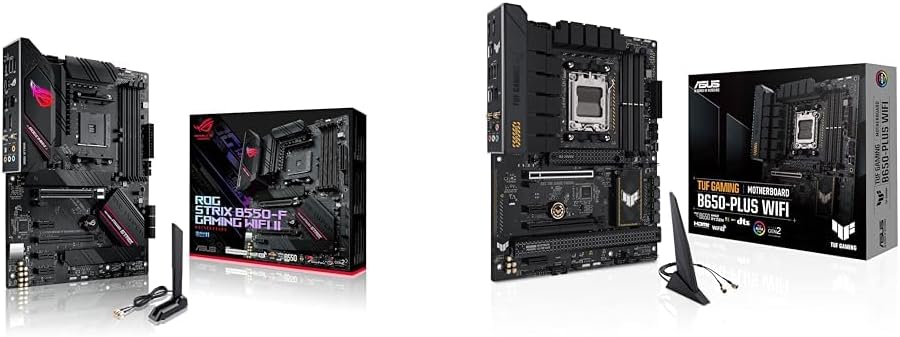
Asus ROG Strix B550-F Gaming WiFi II AMD AM4 (3rd Gen Ryzen) ATX Motherboard & TUF Gaming B650-PLUS WiFi Socket AM5 (LGA 1718) Ryzen 7000 ATX Gaming Motherboard
$150-$299This bundle offers two ATX motherboards: the ROG Strix B550-F Gaming WiFi II for AM4 Ryzen 3000/5000 CPUs with DDR4 RAM, and the TUF Gaming B650-PLUS WiFi for AM5 Ryzen 7000 CPUs with DDR5 RAM.

Game Motherboard Fit for ASROCK B650E PG-ITX WiFi B650 AM5 Motherboard Support Ryzen 7800X3D 7600/X 7950X 7700/X CPU 2xDDR5 128GB Hyper M.2 Mini-ITX
Price range unavailableThis KUETFBVC motherboard listing presents highly contradictory specifications, including a BGA 1023 socket and AMD 480 chipset, making it unsuitable for any modern Ryzen AM5 CPU.

Asus ROG Strix B550-F Gaming WiFi II AMD AM4 (3rd Gen Ryzen) ATX Gaming Motherboard (PCIe 4.0,WiFi 6E, 2.5Gb LAN, BIOS Flashback, HDMI 2.1, Addressable Gen 2 RGB Header and Aura Sync)
This is a premium-feeling AM4 board with beefy VRMs and WiFi 6E, perfect for squeezing the last drop of performance out of a Ryzen 5000 series CPU.