
MSI PRO B650-S WiFi ProSeries Motherboard (AMD Ryzen 9000/8000/7000 Series Processors, AM5, DDR5, PCIe 4.0, M.2 Slots, SATA 6Gb/s, USB 3.2 Gen 2, HDMI/DP, Wi-Fi 6E, Bluetooth 5.3, 2.5Gbps LAN, ATX)
Want the best price and purchase timing?
Our AI advisor analyzes real-time pricing across all channels to find you the best deal.
AI Verdict
This is an AM5 B650 motherboard with DDR5 7200+MHz (OC) memory support and Wi-Fi 6E, suited for Ryzen 7000/8000/9000 series processors.
This motherboard is a situational fit because it offers a compelling feature set for its entry-plus price band, including DDR5 7200+MHz (OC) support and Wi-Fi 6E. However, recurring user reports of XMP instability and USB port issues mean it requires users to be prepared for potential troubleshooting and BIOS updates to achieve full stability.
If stability with high-speed DDR5 XMP profiles and flawless USB connectivity are paramount, look for motherboards with more robust VRM designs and a stronger track record in user reviews for those specific features.
Regret Score™
Medium RiskLower is better — measures purchase-regret risk from real buyer complaints, review credibility, and product maturity
Issues discovered after purchase
Critically weak dimension
Amazon rating vs actual quality
Chance this product isn't for you
Pros
- Supports DDR5 memory up to 7200+MHz (OC) in dual channel mode.
- Features a 12+2 Duet Rail Power System with dual 8-pin CPU power connectors for stable power delivery.
- Includes 2.5G LAN and Wi-Fi 6E with Bluetooth 5.3 for upgraded network connectivity.
- Equipped with two PCIe 4.0 x16 slots and two PCIe 4.0 M.2 slots for fast storage and graphics.
- Constructed with a 6-layer PCB made by 2oz thickened copper for durability.
- Offers a USB 3.2 Gen 2x2 Type-C port with 20Gbps transfer speeds.
Cons
- Users report instability with XMP profiles, particularly at 6400MHz, leading to system crashes and blue screens.
- Multiple reports indicate issues with USB 3.2 Gen 1 ports not functioning or being flaky, especially with iDevices.
- Some users experience inconsistent Wi-Fi performance and driver issues.
- The VRM cooling system, while present, can struggle under heavy loads according to some reviews.
- BIOS updates are often necessary for stability and CPU compatibility, and the process can be challenging for some.
Dimension Scores
The 12+2 Duet Rail Power System with dual 8-pin CPU power connectors is adequate for most AM5 CPUs, but some users report it can struggle under sustained heavy loads with high-end processors.
It includes Wi-Fi 6E, Bluetooth 5.3, 2.5G LAN, DDR5 7200+MHz (OC) support, and a USB 3.2 Gen 2x2 20Gbps Type-C port, which are strong features for its price point.
With two PCIe 4.0 x16 slots, two PCIe 4.0 M.2 slots, and four SATA 6G ports, it offers solid expansion for graphics and storage.
Users frequently report the need for BIOS updates for stability and CPU compatibility, and the BIOS interface is described as not the most user-friendly.
Best For
- Budget-conscious PC builders targeting AMD Ryzen 7000 series CPUs.
- Users needing integrated Wi-Fi 6E and 2.5G LAN without a higher-tier chipset.
- Systems utilizing DDR5 memory up to 7200+MHz (OC) for productivity tasks.
- Builds with up to two PCIe 4.0 NVMe SSDs for fast storage.
Not Recommended For
- Users who require consistent stability with high-speed XMP DDR5 profiles without extensive troubleshooting.
- Anyone relying heavily on multiple USB 3.2 Gen 1 ports for critical peripherals.
- Enthusiasts pushing high-end Ryzen 9000 series CPUs to their absolute limits under sustained heavy loads, due to potential VRM thermal limitations.
Watch Out For
- XMP profiles, especially at 6400MHz, frequently cause system instability, leading to crashes and blue screens with 'MEMORY_MANAGEMENT' or 'IRQL NOT LESS OR EQUAL' errors.
- USB 3.2 Gen 1 ports on the rear I/O have been reported as non-functional or flaky, with some users experiencing issues with iDevices.
- BIOS updates are often critical for initial stability and CPU compatibility, and some users report difficulties with the flashing process or encountering red/yellow debug lights.
- Some buyers have reported receiving open-box products with missing accessories, or even damaged components like a broken PCIe clip or non-functional main NVMe slot.
- Inconsistent Wi-Fi 6E performance has been noted, with some users experiencing driver issues or unreliable connectivity.
Full Specifications
| RAM | DDR5 |
| ASIN | B0CQHS7PLL |
| Brand | msi |
| Color | Black |
| Series | PRO B650-S |
| Platform | Windows 11 |
| CPU Model | AMD Ryzen 7 |
| Processor | amd_ryzen_7 |
| CPU Socket | Socket AM5 |
| Model Name | PRO B650-S |
| Item Weight | 3.19 pounds |
| Chipset Type | AMD B650 |
| Manufacturer | MSI |
| Memory Speed | 7200 MHz |
| Wireless Type | Bluetooth |
| Item model number | B650SWIFI |
| Compatible Devices | Personal Computer |
| Memory Clock Speed | 7200 MHz |
| Product Dimensions | 12.76 x 10.55 x 2.76 inches |
| Compatible Processors | Supports AMD Ryzen 7000 Series Desktop Processors |
| RAM Memory Technology | DDR5 |
| Item Dimensions LxWxH | 12.76 x 10.55 x 2.76 inches |
| Number of USB 2.0 Ports | 12 |
What Buyers Say
Many users find this motherboard requires significant attention to BIOS updates and settings to achieve stability, especially concerning DDR5 XMP profiles. Several reports highlight issues with USB ports and inconsistent Wi-Fi performance, which can be frustrating during initial setup and daily use. While the feature set for the price is appealing, the recurring stability and connectivity problems suggest a less 'plug and play' experience than some might expect.
“Man, this board was a headache to get stable with my RAM, kept crashing until I messed with the BIOS for hours, and half my USBs don't even work right.”
Common Praise
- The board offers a good selection of ports for its price.
- Installation was straightforward for many users, assuming RAM was installed in correct slots.
- The inclusion of Wi-Fi 6E and 2.5G LAN is appreciated for network connectivity.
- It supports high DDR5 memory speeds up to 7200+MHz (OC).
Common Complaints
- XMP profiles, particularly at 6400MHz, cause system instability, crashes, and blue screens.
- USB 3.2 Gen 1 ports often do not work or are unreliable, affecting peripherals and iDevices.
- Inconsistent Wi-Fi 6E performance and driver issues are reported.
- BIOS updates are frequently required for basic functionality and CPU compatibility, and the process can be difficult.
- Some users received open-box or damaged products, including broken PCIe clips or non-functional M.2 slots.
Ownership Tips
- Expect to update the BIOS immediately upon installation for improved stability and CPU compatibility.
- Be prepared to manually adjust DDR5 memory timings if XMP profiles cause instability.
- Some users report random boot issues, especially after cold starts, sometimes requiring multiple restarts or BIOS flashes.
- Check all USB ports upon setup, as some Gen 1 ports may be non-functional or unreliable.
- The Wi-Fi performance can be inconsistent, so a wired connection might be preferred for critical tasks.
Frequently Asked Questions
Does this motherboard support AMD Ryzen 9000 series processors?
Yes, the MSI PRO B650-S WiFi ProSeries Motherboard supports AMD Ryzen 9000, 8000, and 7000 Series Desktop Processors with the AM5 socket.
What is the maximum DDR5 memory speed supported?
It supports DDR5 memory up to 7200+MHz when overclocked (OC) in dual-channel mode.
Does it have Wi-Fi and Bluetooth?
Yes, it comes with Wi-Fi 6E and Bluetooth 5.3 for wireless connectivity.
Are BIOS updates necessary for new CPUs?
Yes, for newer CPUs like the Ryzen 5 7500F, a BIOS update may be necessary out of the box. The motherboard has a Flash BIOS button for updating without a CPU installed.
How many M.2 slots does it have?
The motherboard features two M.2 slots, both supporting PCIe 4.0 x4 speeds.
What kind of USB ports are available?
It has a variety of USB ports, including a USB 3.2 Gen 2x2 Type-C (20Gbps) on the rear, multiple USB 3.2 Gen 2 (10Gbps) Type-A, and USB 3.2 Gen 1 (5Gbps) Type-A ports.
Buying Guide
When you're picking a motherboard, think of it as the central nervous system for your PC. It dictates what CPU you can use, how fast your memory can run, and how many drives and expansion cards you can connect. Don't just look at the price; consider the specific features you need, like the number and type of USB ports, network connectivity, and how well it handles high-speed RAM. A cheaper board might save you money upfront, but it could lead to frustrating stability issues or limit your future upgrade options.
Socket AM5
This is the CPU socket type, and it tells you which AMD Ryzen processors are compatible. AM5 is for the latest Ryzen 7000, 8000, and 9000 series CPUs, meaning you're getting current-generation performance and future upgrade potential within this socket generation.
DDR5
This refers to the type of RAM (Random Access Memory) the motherboard uses. DDR5 is the newest standard, offering higher speeds and more bandwidth than older DDR4, which translates to faster overall system responsiveness, especially in demanding applications and games.
PCIe 4.0
PCIe (Peripheral Component Interconnect Express) is how components like graphics cards and NVMe SSDs connect to the motherboard. PCIe 4.0 offers twice the bandwidth of PCIe 3.0, meaning your graphics card can communicate faster with the CPU and your NVMe SSDs can achieve much higher read/write speeds, reducing loading times and improving data transfer.
Alternatives
If this board doesn't fit, look for motherboards with a more robust VRM design for better high-end CPU stability, or those with a proven track record of stable DDR5 XMP support and reliable USB connectivity in user reviews.
You Might Also Like

JetKVM KVM Over IP ATX Extension Board, ATX Power Control Board- Only for Jet KVM Accessories Boot from Shutdown, Crash Recovery
$0-$49This is an ATX form factor power control board designed for JetKVM accessories, enabling remote PC power state management and simultaneous front panel button use.
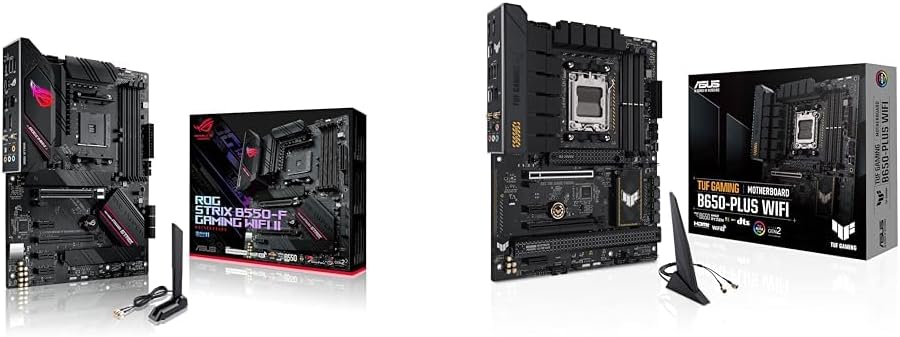
Asus ROG Strix B550-F Gaming WiFi II AMD AM4 (3rd Gen Ryzen) ATX Motherboard & TUF Gaming B650-PLUS WiFi Socket AM5 (LGA 1718) Ryzen 7000 ATX Gaming Motherboard
$150-$299This bundle offers two ATX motherboards: the ROG Strix B550-F Gaming WiFi II for AM4 Ryzen 3000/5000 CPUs with DDR4 RAM, and the TUF Gaming B650-PLUS WiFi for AM5 Ryzen 7000 CPUs with DDR5 RAM.

Game Motherboard Fit for ASROCK B650E PG-ITX WiFi B650 AM5 Motherboard Support Ryzen 7800X3D 7600/X 7950X 7700/X CPU 2xDDR5 128GB Hyper M.2 Mini-ITX
Price range unavailableThis KUETFBVC motherboard listing presents highly contradictory specifications, including a BGA 1023 socket and AMD 480 chipset, making it unsuitable for any modern Ryzen AM5 CPU.

Asus ROG Strix B550-F Gaming WiFi II AMD AM4 (3rd Gen Ryzen) ATX Gaming Motherboard (PCIe 4.0,WiFi 6E, 2.5Gb LAN, BIOS Flashback, HDMI 2.1, Addressable Gen 2 RGB Header and Aura Sync)
This is a premium-feeling AM4 board with beefy VRMs and WiFi 6E, perfect for squeezing the last drop of performance out of a Ryzen 5000 series CPU.