
ASUS Prime H510M-E LGA1200 (Intel® 11th/10th Gen) Micro-ATX Motherboard (PCIe 4.0,M.2 Slot, 1Gb LAN, DP,HDMI, D-Sub, USB 3.2 Gen 1, COM Header, TPM Header, 4K@60Hz)
Want the best price and purchase timing?
Our AI advisor analyzes real-time pricing across all channels to find you the best deal.
AI Verdict
This Micro-ATX LGA 1200 motherboard with an Intel H510 chipset and two DDR4 RAM slots is for basic 10th/11th Gen Intel builds needing PCIe 4.0 for a GPU and a single 32Gbps M.2 slot.
This motherboard is a situational fit for users building a basic LGA 1200 system on a tight budget. While it supports 10th/11th Gen Intel CPUs and PCIe 4.0 for a GPU, its limited RAM slots, basic VRM, and single PCIe 3.0 M.2 slot mean it quickly hits its performance ceiling for anything beyond entry-level use cases.
If you need more RAM capacity, better VRM for higher-tier CPUs, or faster M.2 storage, look for motherboards with four DIMM slots, a B560 or Z590 chipset, and M.2 slots explicitly supporting PCIe 4.0 x4.
Regret Score™
Very High RiskLower is better — measures purchase-regret risk from real buyer complaints, review credibility, and product maturity
Issues discovered after purchase
Critically weak dimension
Amazon rating vs actual quality
Chance this product isn't for you
Pros
- Supports 10th and 11th Gen Intel Core processors on the LGA 1200 socket, offering CPU upgrade flexibility.
- Features a PCIe 4.0 x16 slot for graphics cards when paired with an 11th Gen Intel CPU.
- Includes a 32Gbps M.2 slot for NVMe SSDs, enabling faster storage than SATA drives.
- Equipped with Intel 1Gb Ethernet (I219-V) for stable wired network connectivity.
- Offers DisplayPort 1.4, HDMI 2.0 (with 11th Gen CPU), and D-Sub video outputs for varied display connections.
- Comes with ASUS's 5X Protection III, including LANGuard and SafeSlot Core, for hardware durability.
Cons
- Only has two DDR4 DIMM slots, limiting total RAM capacity to 64GB and dual-channel configurations.
- The single M.2 slot operates at PCIe 3.0 x4 (32Gbps), not full PCIe 4.0 speeds, and shares bandwidth with a SATA port.
- Features only one 4-pin CPU fan header and one 4-pin chassis fan header, restricting cooling fan setup without splitters.
- Integrated audio quality is reported as not suitable for high-end headsets, suggesting a need for an external DAC for discerning users.
- Limited rear USB connectivity with only two USB 3.2 Gen 1 Type-A and two USB 2.0 ports.
Dimension Scores
As an entry-level H510 board, the VRM is basic with minimal or no heatsinks, suitable only for lower-power 10th/11th Gen Intel CPUs without overclocking.
It includes essential features like PCIe 4.0 for GPU (with 11th Gen CPU), a 32Gbps M.2 slot, and Intel 1Gb LAN, but lacks advanced connectivity or cooling options.
With only two DDR4 DIMM slots, one PCIe x16, two PCIe x1, and four SATA ports (one shared with M.2), expansion is severely limited compared to higher-end chipsets.
The UEFI BIOS is reported as easy to navigate, and ASUS's Armoury Crate and AI Suite provide useful driver management and system monitoring tools.
Best For
- Building an entry-level office PC with an integrated graphics CPU for basic productivity tasks.
- A budget-conscious system for light gaming with a discrete GPU and an 11th Gen Intel Core processor.
- A secondary PC or media server where minimal expansion and high-end features aren't required.
- Users who prioritize a low initial cost for a functional LGA 1200 platform.
Not Recommended For
- Enthusiast PC builds requiring extensive overclocking or high-power CPUs due to basic VRM design.
- Systems needing multiple high-speed NVMe drives or extensive SATA storage configurations.
- Users demanding premium audio quality directly from the motherboard's integrated solution.
Watch Out For
- The M.2 slot shares bandwidth with the SATA6G_2 port; installing an M.2 SATA device means the SATA6G_2 port becomes unusable.
- Only 11th Gen Intel processors support HDMI 2.0 for 4K@60Hz; 10th Gen CPUs are limited to HDMI 1.4 at 4K@30Hz.
- Some users reported issues with Windows 11 installation, indicating potential compatibility hurdles or specific BIOS settings needed.
- The board provides only two 4-pin fan headers (one for CPU, one for chassis), which is restrictive for managing multiple case fans.
- The M.2 slot is limited to PCIe 3.0 x4 speeds (32Gbps), so it won't fully utilize faster PCIe 4.0 NVMe SSDs.
Full Specifications
| ASIN | B0CFX9Q5TX |
| Brand | ASUS |
| Platform | Windows 10 |
| CPU Model | Core i5-11600 |
| CPU Socket | LGA 1200 |
| Model Name | Prime H510M-E |
| Item Weight | 1.79 pounds |
| Chipset Type | Intel H510 |
| Manufacturer | ASUS |
| Item model number | ASUS Prime H510M-E |
| Compatible Devices | Personal Computer |
| Memory Clock Speed | 4600 MHz |
| Product Dimensions | 2.13 x 10.4 x 10.75 inches |
| Compatible Processors | 10th Generation Intel Core |
| RAM Memory Technology | DRAM |
What Buyers Say
The biggest takeaway from user feedback is that this H510M-E is a barebones board, often recommended to be skipped in favor of slightly more featured models like the H510M-A. Users frequently point out its limited fan headers and the M.2 slot's PCIe 3.0 speed, despite the board's PCIe 4.0 GPU support. The integrated audio is consistently noted as adequate for basic use but not for anyone serious about sound. It's a functional foundation, but don't expect any frills or extensive upgrade paths.
“Look, I just needed something cheap to get my i3-10100F running for a basic work PC, and this does the job, but seriously, only two fan headers? My case sounds like a jet engine now and I can't even add more fans without a splitter. And the audio, don't even get me started, my old headphones sound like they're underwater.”
Common Praise
- Supports 10th and 11th Gen Intel processors, making it compatible with a range of budget CPUs.
- Includes a PCIe 4.0 slot for modern graphics cards when using an 11th Gen CPU.
- The BIOS is straightforward and easy to navigate for basic setup.
- ASUS software like Armoury Crate simplifies driver and utility updates.
- Features a 32Gbps M.2 slot for faster storage than traditional SATA SSDs.
Common Complaints
- Only two 4-pin fan headers (one CPU, one chassis) severely limit cooling fan configurations.
- The M.2 slot is PCIe 3.0 x4 (32Gbps), not the faster PCIe 4.0, despite the board supporting PCIe 4.0 for the GPU.
- Integrated audio quality is considered insufficient for high-end headphones or serious audio use.
- Limited number of USB ports, especially on the rear I/O, restricts peripheral connectivity.
- The M.2 slot shares bandwidth with a SATA port, potentially disabling one SATA port if an M.2 SATA drive is used.
Ownership Tips
- The single M.2 slot fills up quickly, and if you use a SATA M.2, you lose a SATA port, which can be a pain for storage expansion.
- Managing cable routing for cooling can be tricky with only one chassis fan header, often requiring extra purchases like fan splitters.
- Updating the BIOS can be crucial for optimal performance, especially with 11th Gen CPUs, but Armoury Crate makes it less painful.
- If you're using an older 10th Gen CPU, remember your HDMI output will be limited to 4K@30Hz, not 60Hz.
Frequently Asked Questions
Does this motherboard support Intel 12th Gen CPUs?
No, this motherboard uses the LGA 1200 socket, which is compatible with 10th and 11th Gen Intel Core processors only.
Can I install two graphics cards on this board?
No, the ASUS Prime H510M-E only has one PCIe 4.0/3.0 x16 slot for a graphics card.
What is the maximum RAM speed supported?
The motherboard supports DDR4 memory up to 4600 MHz through overclocking, but native speeds for 11th Gen Intel CPUs are 2933 MHz and 2666 MHz for most 10th Gen CPUs.
Does this motherboard have Wi-Fi or Bluetooth?
No, built-in Wi-Fi and Bluetooth are not listed in the specifications for this model. You would need to add a separate Wi-Fi/Bluetooth adapter.
Is the M.2 slot compatible with both NVMe and SATA SSDs?
Yes, the M.2 slot supports both PCIe 3.0 x4 NVMe and SATA mode SSDs, but using a SATA M.2 drive will disable one of the SATA 6Gb/s ports.
Buying Guide
When you're looking at a budget motherboard like this H510M-E, you need to understand that you're getting the absolute essentials. Don't expect a ton of ports, fancy cooling, or robust power delivery for overclocking. It's designed to get a system up and running with compatible 10th or 11th Gen Intel CPUs, especially those with lower core counts and power requirements. Pay close attention to the number of fan headers and the type of M.2 slot, as these are often the first compromises on cheaper boards.
LGA 1200 Socket
This socket dictates which Intel CPUs you can use. LGA 1200 means you're limited to 10th and 11th Generation Intel Core processors, so you can't drop in a newer 12th, 13th, or 14th Gen chip. It's like a specific key for a specific lock.
Intel H510 Chipset
The chipset is the motherboard's control center. The H510 is Intel's entry-level option, meaning it has fewer features, fewer high-speed lanes, and less robust power delivery compared to B560 or Z590 chipsets. Think of it as the 'standard' trim level on a car – it gets you where you need to go, but without the premium features.
PCIe 4.0 for GPU, PCIe 3.0 for M.2
This is a bit confusing. While the main slot for your graphics card supports the faster PCIe 4.0 standard (with an 11th Gen CPU), the M.2 slot for your SSD is limited to the older, slower PCIe 3.0. This means your graphics card can run at full speed, but a super-fast PCIe 4.0 NVMe SSD won't reach its maximum potential on this board. It's like having a highway for your car, but a slower side road for your truck.
Alternatives
If you need more RAM slots, better VRM for higher-end CPUs, or full PCIe 4.0 support for both GPU and M.2 storage, look for motherboards with an Intel B560 or Z590 chipset.
You Might Also Like

JetKVM KVM Over IP ATX Extension Board, ATX Power Control Board- Only for Jet KVM Accessories Boot from Shutdown, Crash Recovery
$0-$49This is an ATX form factor power control board designed for JetKVM accessories, enabling remote PC power state management and simultaneous front panel button use.
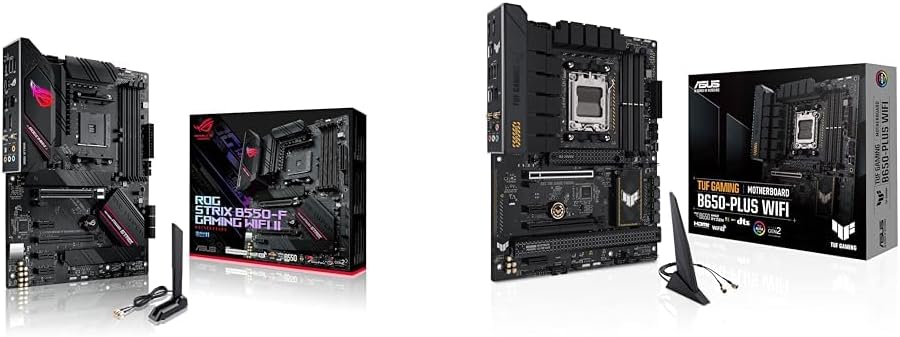
Asus ROG Strix B550-F Gaming WiFi II AMD AM4 (3rd Gen Ryzen) ATX Motherboard & TUF Gaming B650-PLUS WiFi Socket AM5 (LGA 1718) Ryzen 7000 ATX Gaming Motherboard
$150-$299This bundle offers two ATX motherboards: the ROG Strix B550-F Gaming WiFi II for AM4 Ryzen 3000/5000 CPUs with DDR4 RAM, and the TUF Gaming B650-PLUS WiFi for AM5 Ryzen 7000 CPUs with DDR5 RAM.

Game Motherboard Fit for ASROCK B650E PG-ITX WiFi B650 AM5 Motherboard Support Ryzen 7800X3D 7600/X 7950X 7700/X CPU 2xDDR5 128GB Hyper M.2 Mini-ITX
Price range unavailableThis KUETFBVC motherboard listing presents highly contradictory specifications, including a BGA 1023 socket and AMD 480 chipset, making it unsuitable for any modern Ryzen AM5 CPU.

Asus ROG Strix B550-F Gaming WiFi II AMD AM4 (3rd Gen Ryzen) ATX Gaming Motherboard (PCIe 4.0,WiFi 6E, 2.5Gb LAN, BIOS Flashback, HDMI 2.1, Addressable Gen 2 RGB Header and Aura Sync)
This is a premium-feeling AM4 board with beefy VRMs and WiFi 6E, perfect for squeezing the last drop of performance out of a Ryzen 5000 series CPU.