
ASUS Prime B760M-A AX LGA 1700(Intel® 12th&13th Gen) microATX Motherboard (PCIe® 4.0, 2xM.2 Slots, DDR5,Realtek 2.5 Gb LAN,WiFi 6, DP,Rear USB 3.2 Gen 2, Front USB 3.2 Gen 1 Type-C®)
Want the best price and purchase timing?
Our AI advisor analyzes real-time pricing across all channels to find you the best deal.
AI Verdict
The ASUS Prime B760M-A AX is a no-frills microATX board that gives budget builders DDR5 and Wi-Fi 6 without paying for extreme overclocking features they won't use.
This board makes sense if you're pairing a locked Core i5 with DDR5 and need built-in Wi-Fi 6 on a strict budget. The single 8-pin CPU power and lack of debug LEDs make it a risky choice for high-end chips or novice builders who might need troubleshooting help.
If you plan to run a Core i7/i9 or want easier troubleshooting, upgrade to the ASUS TUF Gaming B760M-Plus WiFi for better VRMs and Q-LED debug lights.
Regret Score™
Medium RiskLower is better — measures purchase-regret risk from real buyer complaints, review credibility, and product maturity
Issues discovered after purchase
Critically weak dimension
Amazon rating vs actual quality
Chance this product isn't for you
Pros
- Supports DDR5 memory up to 7200 MHz via AEMP II profiles
- Includes built-in Wi-Fi 6 and Bluetooth 5.2 so you don't need a separate PCIe card
- Features a Realtek 2.5Gb Ethernet port for high-speed wired networking
- Provides two PCIe 4.0 M.2 slots for fast NVMe storage expansion
- Front panel USB 3.2 Gen 1 Type-C header supports modern PC cases
Cons
- Lacks onboard Q-LED debug lights, making boot failures incredibly frustrating to diagnose
- Only features a single 8-pin CPU power connector, limiting power delivery for high-end i9 chips
- No PCIe 5.0 support for future-proofing next-gen graphics cards
- DDR5 memory compatibility is notoriously finicky unless you stick strictly to the QVL list
Dimension Scores
A single 8-pin CPU connector and basic heatsinks limit this to mid-range, locked processors.
Wi-Fi 6, 2.5Gb LAN, and front Type-C are great, but the lack of debug LEDs is a major omission.
Two PCIe 4.0 M.2 slots and a PCIe 4.0 x16 slot are perfectly average for a budget microATX board.
The ASUS UEFI remains intuitive, and AEMP II makes tuning non-XMP DDR5 memory straightforward.
Best For
- Budget-conscious 12th or 13th Gen Core i5 gaming builds inside a compact microATX case
- Home office setups needing reliable Wi-Fi 6 and Bluetooth without extra dongles
- First-time builders who want DDR5 speeds without paying the Z790 chipset premium
Not Recommended For
- Enthusiasts trying to heavily overclock a Core i7 or i9 processor
- Builders who need more than two M.2 NVMe storage drives
Watch Out For
- No debug LEDs — if your PC doesn't boot, you get zero visual indicators to tell you if it's a RAM, CPU, or GPU issue.
- Bluetooth devices won't pair out of the box — you have to manually download the ASUS Bluetooth driver on another device or via Ethernet first.
- Strict RAM preferences — multiple users report boot failures with Corsair and G.Skill DDR5 kits that aren't explicitly on the ASUS QVL.
Full Specifications
| RAM | DDR5 |
| ASIN | B0BZTB5LKJ |
| Brand | ASUS |
| Color | BLACK |
| Series | PRIME B760M-A AX |
| Platform | No Operating System |
| CPU Socket | LGA 1700 |
| Model Name | PRIME B760M-A AX |
| Item Weight | 2 pounds |
| Chipset Type | Intel B760 |
| Manufacturer | ASUS |
| Memory Speed | 7000 MHz |
| Wireless Type | 802.11a/b/g/n/ac, 802.11ax |
| Item model number | PRIME B760M-A AX |
| Compatible Devices | Personal Computer |
| Memory Clock Speed | 7000 MHz |
| Product Dimensions | 10.83 x 10.35 x 2.58 inches |
| Compatible Processors | 14th, 13th and 12th Gen Intel processors |
| RAM Memory Technology | DDR5 |
| Item Dimensions LxWxH | 10.83 x 10.35 x 2.58 inches |
| Memory Storage Capacity | 64 GB |
| Number of USB 2.0 Ports | 4 |
What Buyers Say
The biggest shock for new builders is the complete lack of Q-LED debug lights, leaving you totally blind if the system refuses to post. Users frequently report that DDR5 memory training can be incredibly stubborn, often requiring multiple reseats or strict adherence to the QVL to get a display output. Buyers love the inclusion of Wi-Fi 6 and 2.5Gb Ethernet at this price point, noting that network speeds are rock solid once drivers are installed. The board layout is praised for being easy to work with in cramped microATX cases, though the single 8-pin CPU power connector limits upgrade paths. It serves as a functional foundation for budget builds, provided you don't run into initial hardware conflicts.
“Works great once it's running, but getting my DDR5 RAM to post without any debug lights to tell me what was wrong took three hours of my life I'm never getting back.”
Common Praise
- Wi-Fi 6 module delivers fast, stable wireless speeds right away
- Front panel USB-C header is perfectly placed for modern microATX cases
- ASUS BIOS interface is easy to navigate for setting memory profiles
- Included M.2 heatsink keeps the primary NVMe drive temperatures in check
Common Complaints
- Zero onboard diagnostic LEDs make troubleshooting a nightmare
- Extremely picky about DDR5 RAM brands and speeds
- Bluetooth refuses to pair devices until the proprietary ASUS driver is manually installed
- Only one CPU 8-pin power connector restricts high-end processor upgrades
Ownership Tips
- You must download the Bluetooth driver directly from ASUS; Windows Update often fails to find it.
- Memory training on the first boot can take several minutes, making you think the board is dead.
- The primary M.2 slot shares bandwidth directly with the CPU, so populate it first before using the secondary slot.
Frequently Asked Questions
Does this motherboard support 14th Gen Intel CPUs?
Yes, it supports 14th Gen processors, but you will likely need to update the BIOS first using a 12th or 13th Gen chip.
Why isn't my Bluetooth finding any devices?
Windows doesn't always install the correct driver automatically. You need to download the specific ASUS Bluetooth driver from their support page to make devices discoverable.
Can I overclock my CPU on this board?
No, the B760 chipset does not support CPU core overclocking. You can only overclock your DDR5 memory using XMP or AEMP II profiles.
How many M.2 SSDs can I install?
You can install exactly two PCIe 4.0 M.2 NVMe drives. Both slots support up to 64 Gbps transfer speeds.
Does it have debug LEDs to help if the PC won't post?
No, this board completely lacks Q-LEDs or a built-in buzzer, which makes diagnosing RAM or CPU boot failures very difficult.
Buying Guide
When buying a budget B760 motherboard, you are trading enthusiast features for a lower price. This board won't let you overclock your processor, and it cuts costs by removing troubleshooting tools like debug LEDs. You need to be absolutely certain your exact DDR5 RAM kit is on the ASUS Qualified Vendor List (QVL), or you might face a blank screen on your first boot. It's a solid choice for a 'set it and forget it' Core i5 build, but it requires patience during the initial setup.
B760 Chipset
Think of this as the motherboard's traffic controller. The B-series means it's a mid-range controller that handles fast memory and standard gaming needs, but locks you out of tinkering with the CPU's core speed.
MicroATX Form Factor
This is the physical size of the board. It's shorter than a standard ATX board, meaning it fits in smaller, cheaper PC cases, but gives you fewer slots to plug in extra capture cards or sound cards.
Q-LED / Debug Lights (Missing)
These are tiny lights that act like a car's 'check engine' light, telling you exactly which part is failing if the PC won't turn on. Without them, you have to guess what's broken.
Alternatives
If you want easier troubleshooting and better power delivery for high-end CPUs, look for a B760 or Z790 motherboard that specifically advertises 'Q-LED debug lights' and a '12+1 power stage' design.
You Might Also Like

JetKVM KVM Over IP ATX Extension Board, ATX Power Control Board- Only for Jet KVM Accessories Boot from Shutdown, Crash Recovery
$0-$49This is an ATX form factor power control board designed for JetKVM accessories, enabling remote PC power state management and simultaneous front panel button use.
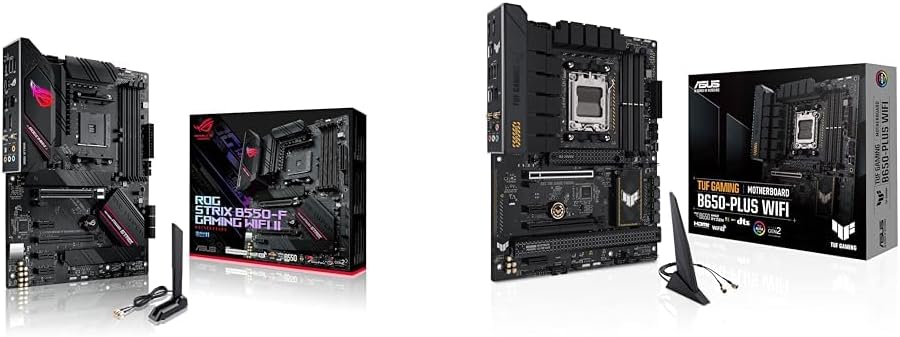
Asus ROG Strix B550-F Gaming WiFi II AMD AM4 (3rd Gen Ryzen) ATX Motherboard & TUF Gaming B650-PLUS WiFi Socket AM5 (LGA 1718) Ryzen 7000 ATX Gaming Motherboard
$150-$299This bundle offers two ATX motherboards: the ROG Strix B550-F Gaming WiFi II for AM4 Ryzen 3000/5000 CPUs with DDR4 RAM, and the TUF Gaming B650-PLUS WiFi for AM5 Ryzen 7000 CPUs with DDR5 RAM.

Game Motherboard Fit for ASROCK B650E PG-ITX WiFi B650 AM5 Motherboard Support Ryzen 7800X3D 7600/X 7950X 7700/X CPU 2xDDR5 128GB Hyper M.2 Mini-ITX
Price range unavailableThis KUETFBVC motherboard listing presents highly contradictory specifications, including a BGA 1023 socket and AMD 480 chipset, making it unsuitable for any modern Ryzen AM5 CPU.

Asus ROG Strix B550-F Gaming WiFi II AMD AM4 (3rd Gen Ryzen) ATX Gaming Motherboard (PCIe 4.0,WiFi 6E, 2.5Gb LAN, BIOS Flashback, HDMI 2.1, Addressable Gen 2 RGB Header and Aura Sync)
This is a premium-feeling AM4 board with beefy VRMs and WiFi 6E, perfect for squeezing the last drop of performance out of a Ryzen 5000 series CPU.