
ASUS TUF GAMING B760-PLUS WIFI Intel B760 LGA 1700 ATX motherboard, Ready for 14th, 13th & 12th Gen Intel® Core CPU, 12+1+1 Stages, PCIe 5.0, 3x M.2, DDR5, 2.5G, USB 3.2 Type-C®, Thunderbolt 4™, USB4®
Want the best price and purchase timing?
Our AI advisor analyzes real-time pricing across all channels to find you the best deal.
AI Verdict
This is a rugged, no-nonsense LGA 1700 board for mid-range DDR5 builds, perfect if you want stable power delivery for a 13th or 14th Gen Intel chip without paying Z790 prices.
The B760 chipset and 12+1 power stages provide exactly what a locked i5 or i7 processor needs to hit max boost clocks. You get DDR5 support and a PCIe 5.0 slot for future-proofing, skipping the premium tax of Z790 overclocking features you wouldn't use anyway.
If you plan to manually overclock an unlocked 'K' series processor, step up to an ASUS TUF Z790 board instead.
Regret Score™
Very Low RiskLower is better — measures purchase-regret risk from real buyer complaints, review credibility, and product maturity
Issues discovered after purchase
Critically weak dimension
Amazon rating vs actual quality
Chance this product isn't for you
Pros
- 12+1 DrMOS power stages easily handle power-hungry chips like the i9-13900K without thermal throttling.
- Includes three PCIe 4.0 M.2 slots, and all of them come with included metal heatsinks.
- Features a PCIe 5.0 x16 slot for future GPU upgrades.
- Q-DIMM single-tab RAM slots make swapping memory sticks easy when a massive GPU blocks the bottom latches.
- Pre-installed I/O shield saves you from forgetting to install it before screwing down the board.
Cons
- The massive VRM heatsinks crowd the CPU socket, making it a tight squeeze to mount large AIO pump heads like the NZXT Kraken Z73.
- The secondary PCIe slots are stuck on Gen 3 speeds, limiting bandwidth for modern capture cards.
- The PCIe release latch is buried under the primary slot, requiring a plastic tool to release thick RTX 40-series cards.
- Only features an 8+4 pin CPU power connector setup instead of the dual 8-pins found on competing boards.
Dimension Scores
12+1 DrMOS stages easily handle an i9-13900K at stock settings without overheating.
WiFi 6, 2.5G LAN, and an integrated I/O shield are great, but the lack of a quick-release PCIe button hurts.
You get three PCIe 4.0 M.2 slots, but the secondary PCIe slots being limited to Gen 3 is a letdown for a modern board.
The ASUS UEFI remains intuitive for setting XMP profiles and adjusting fan curves.
Best For
- Mid-range gaming rigs using locked Intel 13th or 14th Gen processors like the i5-13400F or i7-14700F.
- Builders who need three high-speed M.2 storage drives for massive game libraries.
- Users who want built-in WiFi 6 and 2.5Gb Ethernet without buying extra expansion cards.
Not Recommended For
- Overclockers who need a Z790 chipset to manually tune CPU core multipliers.
- Builders using massive air coolers or bulky AIO blocks that clash with the oversized VRM heatsinks.
Watch Out For
- VRM heatsink clearance — the metal blocks around the CPU socket are massive, meaning you will scrape your knuckles trying to plug in the top-left CPU fan header or mount wide pump blocks.
- Trapped GPUs — the PCIe release latch is a standard plastic tab, not an extended button. You need a plastic spudger to press it down if you install a 3-slot graphics card.
- Gen 3 bottleneck — if you install a high-end capture card or a second GPU, the bottom x16 physical slot only runs at PCIe 3.0 x4 speeds.
- Boot loop glitch — multiple owners report the board getting stuck on a 'cannot startup repair' screen, forcing a manual boot drive selection in the BIOS Advanced Options.
Full Specifications
| RAM | DDR5 |
| ASIN | B0BZT9KYNB |
| Brand | ASUS |
| Color | BLACK |
| Series | TUF GAMING B760-PLUS WIFI |
| Platform | Windows 10 |
| CPU Model | Pentium |
| Processor | pentium |
| CPU Socket | LGA 1700 |
| Model Name | TUF GAMING B760-PLUS WIFI |
| Item Weight | 3.08 pounds |
| Chipset Type | Intel B760 |
| Manufacturer | ASUS |
| Memory Speed | 2133 MHz |
| Wireless Type | 802.11a/b/g/n/ac, 802.11ax |
| Item model number | TUF GAMING B760-PLUS WIFI |
| Compatible Devices | Personal Computer |
| Memory Clock Speed | 2133 MHz |
| Product Dimensions | 12.01 x 9.61 x 9.6 inches |
| Compatible Processors | Intel Celeron, Intel Pentium Gold |
| RAM Memory Technology | DDR5 |
| Item Dimensions LxWxH | 12.01 x 9.61 x 9.6 inches |
| Number of USB 2.0 Ports | 4 |
What Buyers Say
The massive VRM heatsinks are a double-edged sword; they keep power delivery under control even with an i9 processor, but they make plugging in the 8-pin CPU power cable a nightmare for anyone with large hands. The inclusion of three M.2 slots with pre-installed thermal guards saves buyers money on aftermarket heatsinks. The biggest frustration is the standard PCIe latch, which gets completely swallowed by modern 3-slot GPUs. You get rock-solid stability and a six-layer PCB, just expect a few scraped knuckles during assembly.
“Solid board that handles my 13900k perfectly but trying to get my GPU out of the pcie slot made me want to rip my hair out because the latch is buried under the heatsink.”
Common Praise
- 12+1 power stages keep VRM temperatures well within safe limits during heavy rendering workloads.
- Pre-installed I/O shield lines up perfectly with standard ATX cases.
- All three M.2 slots include metal heatsinks and thermal pads out of the box.
- WiFi 6 connection maxes out gigabit internet speeds without dropping packets during gaming.
Common Complaints
- The PCIe release tab is impossible to reach with a finger once an RTX 4070 or larger is seated.
- VRM heatsinks crowd the CPU socket, making AIO pump installation frustrating.
- Secondary PCIe slots are restricted to Gen 3 speeds.
- Some units experience a boot glitch requiring manual drive selection in the advanced startup menu.
Ownership Tips
- The bottom two M.2 slots share a single piece of metal for a heatsink, meaning you have to expose both drives to change one.
- The Bluetooth range drops significantly if you don't screw in the included shark-fin WiFi antenna.
- A handful of users reported sudden blue screens linked to RAM slot failures after several months of daily use.
Frequently Asked Questions
Does this board support 14th Gen Intel CPUs out of the box?
Yes, but you must flash the BIOS to the latest version using a USB drive before a 14th Gen chip will post.
Can I use my old DDR4 RAM with this motherboard?
No. This specific model only accepts DDR5 memory. ASUS sells a separate D4 version of this exact board if you want to keep your DDR4 sticks.
Where are the fan headers located?
There are two chassis fan headers on the bottom left, the CPU fan header is at the top right, and the AIO pump header sits at the top left next to the VRM heatsink.
Does it have Bluetooth?
Yes, the included Intel AX201 WiFi 6 module also provides built-in Bluetooth 5.2 for wireless controllers and headphones.
How many M.2 SSDs can I install?
You can install three PCIe 4.0 M.2 NVMe drives. The top slot has its own heatsink, while the bottom two slots share a single long metal plate.
Buying Guide
You are paying for a six-layer PCB and DDR5 support without the premium of Z790 overclocking features. The B760 chipset restricts manual CPU core multiplier adjustments, so pair this with a locked processor like an i5-13400F or i7-14700. Pay close attention to your CPU cooler dimensions, as the chunky metal blocks around the CPU socket fight for space with dual-tower air coolers like the Noctua NH-D15.
B760 Chipset
Think of it as the motherboard's traffic controller. It dictates that you can run DDR5 RAM at 7200 MT/s, but locks you out of manually turning up the CPU's core speed like a Z790 board allows.
12+1 DrMOS Power Stages
This is the electrical plumbing feeding your processor. More stages mean the electrical load is spread out, preventing the board from overheating when a 250W CPU demands maximum power.
PCIe 5.0 x16 Slot
This is the main metal-reinforced slot for your graphics card. While no current GPUs fully saturate PCIe 5.0 bandwidth yet, having it means your board is ready for the next two generations of video cards.
Alternatives
If you need to manually overclock your CPU core multipliers, search for a Z790 motherboard. If you want to reuse your old memory sticks to save $100, look for the DDR4 version of this exact board.
You Might Also Like

JetKVM KVM Over IP ATX Extension Board, ATX Power Control Board- Only for Jet KVM Accessories Boot from Shutdown, Crash Recovery
$0-$49This is an ATX form factor power control board designed for JetKVM accessories, enabling remote PC power state management and simultaneous front panel button use.
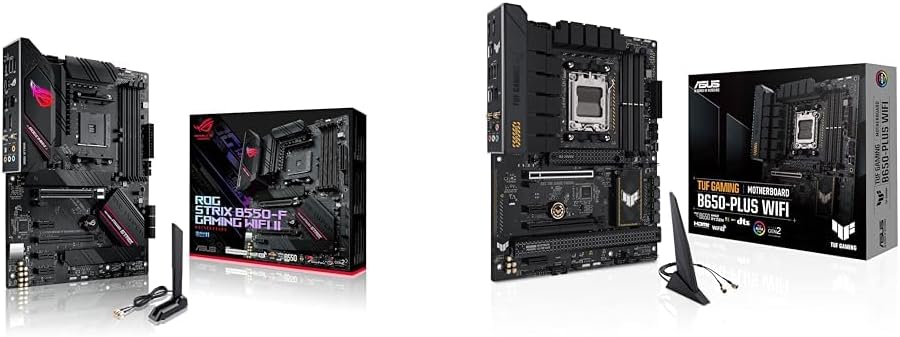
Asus ROG Strix B550-F Gaming WiFi II AMD AM4 (3rd Gen Ryzen) ATX Motherboard & TUF Gaming B650-PLUS WiFi Socket AM5 (LGA 1718) Ryzen 7000 ATX Gaming Motherboard
$150-$299This bundle offers two ATX motherboards: the ROG Strix B550-F Gaming WiFi II for AM4 Ryzen 3000/5000 CPUs with DDR4 RAM, and the TUF Gaming B650-PLUS WiFi for AM5 Ryzen 7000 CPUs with DDR5 RAM.

Game Motherboard Fit for ASROCK B650E PG-ITX WiFi B650 AM5 Motherboard Support Ryzen 7800X3D 7600/X 7950X 7700/X CPU 2xDDR5 128GB Hyper M.2 Mini-ITX
Price range unavailableThis KUETFBVC motherboard listing presents highly contradictory specifications, including a BGA 1023 socket and AMD 480 chipset, making it unsuitable for any modern Ryzen AM5 CPU.

Asus ROG Strix B550-F Gaming WiFi II AMD AM4 (3rd Gen Ryzen) ATX Gaming Motherboard (PCIe 4.0,WiFi 6E, 2.5Gb LAN, BIOS Flashback, HDMI 2.1, Addressable Gen 2 RGB Header and Aura Sync)
This is a premium-feeling AM4 board with beefy VRMs and WiFi 6E, perfect for squeezing the last drop of performance out of a Ryzen 5000 series CPU.