
GIGABYTE B550 UD AC (rev. 1.2) AMD AM4 ATX Motherboard, Supports Ryzen 5000/4000/3000 Processors, DDR4, 10+3 Power Phase, 2X M.2, PCIe 4.0, USB-C, WiFi, GbE LAN, PCIe 4.0, Q-Flash Plus, RGB Fusion
Want the best price and purchase timing?
Our AI advisor analyzes real-time pricing across all channels to find you the best deal.
AI Verdict
This is a solid, no-frills AM4 board that nails the basics for a Ryzen 5000 gaming build, as long as you don't need Wi-Fi 6 or extra PCIe x4 slots.
It delivers exactly what a standard gaming PC needs with its 10+3 power phases and PCIe 4.0 support for the primary GPU and NVMe drive. The lack of PCIe x4 expansion slots and older Wi-Fi 5 standard mean it struggles to support complex setups with capture cards or high-speed NAS networks.
If you need faster networking or more expansion, look for a B550 board that upgrades you to Wi-Fi 6, 2.5GbE, and better PCIe slot layouts.
Regret Score™
Medium RiskLower is better — measures purchase-regret risk from real buyer complaints, review credibility, and product maturity
Issues discovered after purchase
Critically weak dimension
Amazon rating vs actual quality
Chance this product isn't for you
Pros
- 10+3 phase digital power design easily handles 65W and 105W Ryzen 5000 CPUs without overheating
- Q-Flash Plus lets you update the BIOS via USB before installing your CPU or RAM
- Includes two M.2 slots, with the primary slot supporting full PCIe 4.0 x4 speeds
- Integrated I/O shield saves time and prevents the classic mistake of forgetting it during case assembly
Cons
- Stuck on older Wi-Fi 5 (802.11ac) and Gigabit LAN instead of the faster Wi-Fi 6 and 2.5GbE found on newer boards
- The four secondary PCIe slots are all x1, meaning you can't install a secondary x4 capture card or 10Gb network card
- Gigabyte's RGB Fusion 2.0 software is notoriously clunky and frustrating to sync with third-party fans
- Large 3-slot graphics cards will block access to several of the SATA ports
Dimension Scores
10+3 phase design is plenty for a 5800X3D or 5900X, though overkill for the 5600X most people pair it with.
Includes the basics like Q-Flash Plus and an integrated I/O shield, but stuck on Wi-Fi 5 and 1GbE LAN.
One PCIe 4.0 x16 slot is fine, but having four x1 slots instead of a usable x4 slot severely limits add-in cards.
The BIOS is functional, but Gigabyte's RGB Fusion and Control Center software are widely criticized for being buggy and unintuitive.
Best For
- First-time PC builders pairing a Ryzen 5 5600X or 5700X with a mid-range GPU
- Budget-conscious gamers who need built-in wireless connectivity out of the box
- Upgraders moving from older AM4 boards who want PCIe 4.0 storage speeds without paying the X570 tax
Not Recommended For
- Streamers or creators who need multiple high-bandwidth PCIe slots for capture cards
- Users with high-speed home networks who need 2.5GbE or Wi-Fi 6/6E
Watch Out For
- Bluetooth dropouts — multiple users report their wireless mice and keyboards randomly disconnecting, requiring a Windows toggle or full power cycle to fix
- Limited fan headers — you only get three system fan headers, so you'll absolutely need a fan splitter or dedicated hub if your case has four or more fans
- Revision roulette — make sure you download the BIOS for 'rev. 1.2' specifically, as flashing the rev. 1.0 or 1.1 BIOS will fail or cause boot loops
- GPU clearance issues — installing a thick 3-slot graphics card will completely cover the lower PCIe x1 slots and make plugging in SATA cables a nightmare
Full Specifications
| RAM | DDR4 |
| ASIN | B0BTQ3SVFR |
| Brand | GIGABYTE |
| Series | B550 UD AC |
| Platform | Windows 11 |
| CPU Model | Ryzen 5 |
| Processor | ryzen_5 |
| CPU Socket | Socket AM4 |
| Model Name | B550 UD AC |
| Item Weight | 2.72 pounds |
| Chipset Type | AMD B550 |
| Manufacturer | GIGABYTE |
| Memory Speed | 3200 MHz |
| Wireless Type | 802.11a/b/g/n/ac |
| Item model number | B550 UD AC |
| Compatible Devices | Personal Computer |
| Memory Clock Speed | 3200 MHz |
| Product Dimensions | 10.62 x 3.14 x 13.18 inches |
| Compatible Processors | AMD 3rd Generation Ryzen |
| RAM Memory Technology | DDR4 |
| Item Dimensions LxWxH | 10.62 x 3.14 x 13.18 inches |
| Number of USB 2.0 Ports | 4 |
What Buyers Say
The most recurring theme in owner reviews is how easy this board makes a budget Ryzen build, largely thanks to the integrated I/O shield and Q-Flash Plus. Buyers love the stable power delivery when pairing it with chips like the 5600X or 5800X3D. The biggest headaches come from the networking and layout; the Wi-Fi 5 module occasionally drops Bluetooth connections, and thick GPUs block the SATA ports. You'll also see frequent complaints about Gigabyte's RGB software refusing to sync properly with case fans.
“Great board for the price and handles my 5700x perfectly, but the bluetooth drops my mouse every few days and the gigabyte rgb software is absolute garbage.”
Common Praise
- Q-Flash Plus works flawlessly for updating the BIOS without a CPU installed
- 10+3 power phases keep VRM temperatures well under control during heavy gaming
- Integrated I/O shield makes case installation significantly less frustrating
- Top M.2 slot hits full advertised speeds on Gen 4 NVMe drives
Common Complaints
- Bluetooth randomly drops connection to wireless keyboards and mice
- Only has PCIe x1 slots below the GPU, making it impossible to add a 10GbE card
- RGB Fusion 2.0 software is clunky and often fails to detect ARGB fans
- Large graphics cards block access to the SATA ports on the right edge
Ownership Tips
- The Bluetooth module can sometimes disappear from Windows entirely, requiring you to unplug the power supply for 30 seconds to reset it
- You will likely need a fan splitter cable, as the board only has three system fan headers
- If you enable XMP and get boot loops, manually setting the RAM voltage to 1.35V usually stabilizes it
- The bottom M.2 slot shares bandwidth with the SATA ports, so read the manual before plugging in hard drives
Frequently Asked Questions
Does this support Ryzen 5000 out of the box?
Yes, rev 1.2 boards ship with a BIOS that supports Ryzen 5000 series CPUs. If it doesn't boot, you can use the Q-Flash Plus button on the back to update it via USB.
Can I use a capture card in the bottom slots?
No, the four bottom slots are all PCIe 3.0 x1. Most internal capture cards require a PCIe x4 slot to function.
Does it have Bluetooth?
Yes, it includes Bluetooth 4.2 alongside the Wi-Fi 5 module. Some owners report occasional signal drops with wireless peripherals.
How many M.2 SSDs can I install?
You can install two. The top slot runs at PCIe 4.0 speeds directly to the CPU, while the bottom slot runs at PCIe 3.0 speeds through the chipset.
Are the Wi-Fi antennas included?
Yes, the box includes a standard Gigabyte external antenna that screws into the rear I/O panel.
Buying Guide
When buying an AM4 motherboard this late in its lifecycle, you are looking for stability and value. The B550 chipset gives you PCIe 4.0 for your main graphics card and primary SSD, which is all a standard gaming PC needs. Pay close attention to the networking specs and USB ports, as budget boards often cut costs by using older Wi-Fi 5 or omitting high-speed USB-C. Make sure your case has enough airflow, and plan your fan connections ahead of time since entry-level boards limit the number of fan headers.
10+3 Power Phases
Think of power phases like lanes on a highway delivering electricity to your CPU. More lanes mean smoother, cooler power delivery, which prevents your processor from throttling during heavy gaming.
PCIe 4.0 x16 Slot
This is the main slot for your graphics card. PCIe 4.0 offers double the bandwidth of 3.0, ensuring modern GPUs can send and receive data without a bottleneck.
Q-Flash Plus
This lets you update the motherboard's core software using just a USB stick and a power supply. It's a lifesaver if the board ships with an older version that doesn't recognize your new CPU.
Alternatives
If you need faster networking or plan to use internal capture cards, look for a B550 board that explicitly advertises Wi-Fi 6, 2.5Gb Ethernet, and at least one PCIe x4 expansion slot.
You Might Also Like

JetKVM KVM Over IP ATX Extension Board, ATX Power Control Board- Only for Jet KVM Accessories Boot from Shutdown, Crash Recovery
$0-$49This is an ATX form factor power control board designed for JetKVM accessories, enabling remote PC power state management and simultaneous front panel button use.
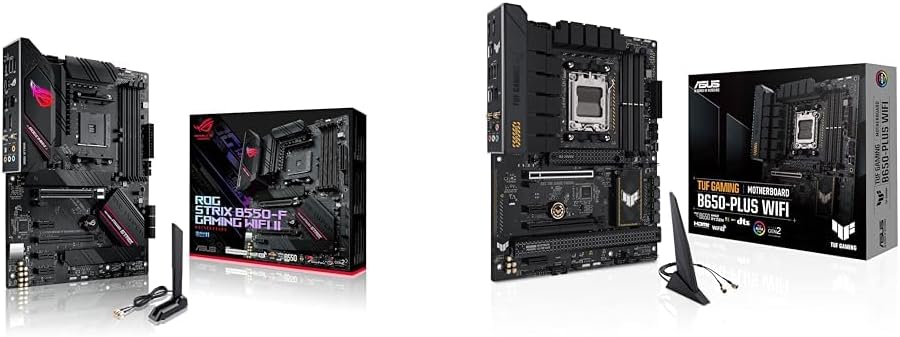
Asus ROG Strix B550-F Gaming WiFi II AMD AM4 (3rd Gen Ryzen) ATX Motherboard & TUF Gaming B650-PLUS WiFi Socket AM5 (LGA 1718) Ryzen 7000 ATX Gaming Motherboard
$150-$299This bundle offers two ATX motherboards: the ROG Strix B550-F Gaming WiFi II for AM4 Ryzen 3000/5000 CPUs with DDR4 RAM, and the TUF Gaming B650-PLUS WiFi for AM5 Ryzen 7000 CPUs with DDR5 RAM.

Game Motherboard Fit for ASROCK B650E PG-ITX WiFi B650 AM5 Motherboard Support Ryzen 7800X3D 7600/X 7950X 7700/X CPU 2xDDR5 128GB Hyper M.2 Mini-ITX
Price range unavailableThis KUETFBVC motherboard listing presents highly contradictory specifications, including a BGA 1023 socket and AMD 480 chipset, making it unsuitable for any modern Ryzen AM5 CPU.

Asus ROG Strix B550-F Gaming WiFi II AMD AM4 (3rd Gen Ryzen) ATX Gaming Motherboard (PCIe 4.0,WiFi 6E, 2.5Gb LAN, BIOS Flashback, HDMI 2.1, Addressable Gen 2 RGB Header and Aura Sync)
This is a premium-feeling AM4 board with beefy VRMs and WiFi 6E, perfect for squeezing the last drop of performance out of a Ryzen 5000 series CPU.