
ASUS Prime B760M-A D4 Intel® B760 (LGA 1700)(13th and 12th Gen) mATX Motherboard, PCIe 4.0, 2xM.2 Slots,2.5Gb LAN, DisplayPort,Dual HDMI,Rear USB 3.2 Gen 2, Front 1 Type-C®, Aura Sync
Want the best price and purchase timing?
Our AI advisor analyzes real-time pricing across all channels to find you the best deal.
AI Verdict
This is a budget-friendly mATX board for 12th or 13th Gen i3 and i5 builds, but the weak 6-phase VRMs will choke an i7 or i9.
This board makes sense if you are pairing it with a locked 65W processor like the i5-13400 and standard DDR4-3200 RAM. The 6-phase VRM design simply cannot handle the power draw of K-series chips, leading to massive performance drops in heavy workloads.
If you plan to run an i7-13700K or i9, upgrade to a Z790 board with at least a 12+1 DrMOS power stage design.
Regret Score™
High RiskLower is better — measures purchase-regret risk from real buyer complaints, review credibility, and product maturity
Issues discovered after purchase
Critically weak dimension
Amazon rating vs actual quality
Chance this product isn't for you
Pros
- Keeps build costs down by reusing older DDR4 memory instead of forcing a DDR5 upgrade
- Includes a Realtek 2.5Gb Ethernet port for faster local network transfers
- Features three display outputs (two HDMI, one DisplayPort) for multi-monitor setups using integrated graphics
- Provides a front-panel USB 3.2 Gen 1 Type-C header, which is often missing on sub-$100 boards
Cons
- The 6-phase VRM lacks DrMOS and will thermally throttle high-wattage CPUs like the i7-14700K
- RAM compatibility is extremely picky, with multiple users reporting XMP profiles stuck at 2133 MT/s on newer BIOS versions
- No dedicated debug LEDs; you have to decode fast or slow blinks from your case's power button LED to troubleshoot POST failures
Dimension Scores
The 6-phase non-DrMOS design struggles to deliver sustained power to anything above an i5.
Includes 2.5Gb LAN and a front USB-C header, which is solid for a sub-$100 price tag.
Offers two PCIe 4.0 M.2 slots, but only the top slot includes a thermal guard.
Recent BIOS updates have introduced XMP instability, forcing users to manually tune memory or downgrade.
Best For
- Budget 1080p gaming rigs paired with a 65W CPU like the i5-12400F
- Office workstations utilizing Intel integrated graphics across two or three monitors
- Upgraders wanting to carry over their existing 3200MHz DDR4 RAM kits
Not Recommended For
- Anyone running an Intel Core i7 or i9 processor that draws over 125 watts
- Memory overclockers pushing past standard 3200 MT/s XMP profiles
Watch Out For
- BIOS updates can break RAM compatibility — users report BIOS version 1220 locking 3000 MT/s kits to 2133 MT/s, requiring a downgrade to version 0807.
- The Q-LED troubleshooting system relies on the front panel power LED blinking at 4Hz to indicate RAM errors, which is confusing if you didn't wire the front panel perfectly.
- Only the primary M.2 slot gets a heatsink, leaving your secondary NVMe drive exposed to case temperatures.
Full Specifications
| RAM | DDR4 |
| ASIN | B0BR8S9KTT |
| Brand | ASUS |
| Series | PRIME B760M-A D4 |
| Platform | Windows 10 |
| CPU Model | Pentium |
| Processor | pentium |
| CPU Socket | LGA 1700 |
| Model Name | PRIME B760M-A D4 |
| Item Weight | 2.2 pounds |
| Chipset Type | Intel B760 |
| Manufacturer | ASUS |
| Memory Speed | 4.6 GHz |
| Item model number | PRIME B760M-A D4 |
| Compatible Devices | Personal Computer |
| Memory Clock Speed | 4.6 GHz |
| Product Dimensions | 10.8 x 10.4 x 2 inches |
| Compatible Processors | Intel Celeron, Intel Pentium Gold |
| RAM Memory Technology | DDR4 |
| Item Dimensions LxWxH | 10.8 x 10.4 x 2 inches |
| Number of USB 2.0 Ports | 4 |
What Buyers Say
The biggest headache buyers face is getting their RAM to run at advertised speeds. Multiple forum threads highlight that updating to the latest BIOS often breaks XMP profiles, locking memory to a sluggish 2133 MT/s. Buyers pairing this with an i5-12400F or i3-12100 report a smooth, cheap build process. Those who tried dropping an i7 or i9 into the LGA 1700 socket quickly realized the barebones VRM heatsinks cause severe thermal throttling under load.
“Updated the bios to 1220 and now my 3200mhz ram is stuck at 2133, asus support just blamed my ram even though it worked fine yesterday.”
Common Praise
- Reusing old DDR4 memory saves $50-$100 on a new build
- The 2.5Gb Ethernet port maxes out gigabit home internet connections
- Three display outputs allow triple-monitor office setups without buying a dedicated GPU
- Front panel USB-C header connects perfectly to modern budget cases
Common Complaints
- BIOS version 1220 and 1402 disable XMP profiles for unsupported RAM kits
- Cinebench scores drop by 30% when using high-end 13th Gen CPUs due to VRM throttling
- The Q-LED power button blinking system is much harder to read than standard motherboard debug LEDs
- The secondary M.2 slot lacks a heatsink and sits directly under the GPU exhaust
Ownership Tips
- Downgrading the BIOS to version 0807 often fixes the 2133 MT/s memory lock issue.
- The board defaults to aggressive power limits; you must manually adjust PL1/PL2 in the BIOS to get full performance from an i5.
- If your PC fails to POST, watch the power button LED — fast blinks mean you need to reseat your RAM.
Frequently Asked Questions
Will this board bottleneck an i7-14700K?
Yes. The basic 6-phase VRM will overheat and throttle the CPU. Users report Cinebench R23 scores dropping from 35,000 down to 24,000 due to power limits.
Does it support DDR5 memory?
No. This specific D4 model only accepts DDR4 memory up to 128GB across four slots.
Why is my RAM stuck at 2133 MHz?
This board has known XMP compatibility bugs on certain BIOS versions. You may need to manually set the DRAM voltage to 1.35V or roll back to an older BIOS like 0807.
Does it have built-in WiFi?
No. You will need to use the Realtek 2.5Gb Ethernet port or buy a separate PCIe WiFi card.
How do I read the Q-LED error codes?
The board flashes your case's power button LED. A fast 4Hz blink means no RAM detected, while a slow blink indicates a VGA issue.
Buying Guide
You are buying a strict budget board designed for low-wattage CPUs. Do not pair this with any Intel processor ending in 'K' — the power delivery system will overheat and slow down your chip to protect itself. Check the ASUS QVL (Qualified Vendor List) for memory before buying your RAM, as this board is notoriously picky about which DDR4 kits it allows to run at full speed.
6-Phase VRM
Think of this as the pipe delivering electricity to your CPU. A 6-phase pipe is narrow, meaning power-hungry chips like an i7 will get starved and slow down.
DDR4 Support
This board uses the older, cheaper memory standard. You cannot physically insert newer DDR5 RAM sticks into these slots.
mATX Form Factor
This is a shorter board than a standard ATX, meaning it fits in smaller cases but gives you fewer slots for capture cards or sound cards.
Alternatives
If you are running an Intel Core i7 or i9, search for a Z790 motherboard with a 12+1 or higher power phase design and dedicated VRM heatsinks.
You Might Also Like

JetKVM KVM Over IP ATX Extension Board, ATX Power Control Board- Only for Jet KVM Accessories Boot from Shutdown, Crash Recovery
$0-$49This is an ATX form factor power control board designed for JetKVM accessories, enabling remote PC power state management and simultaneous front panel button use.
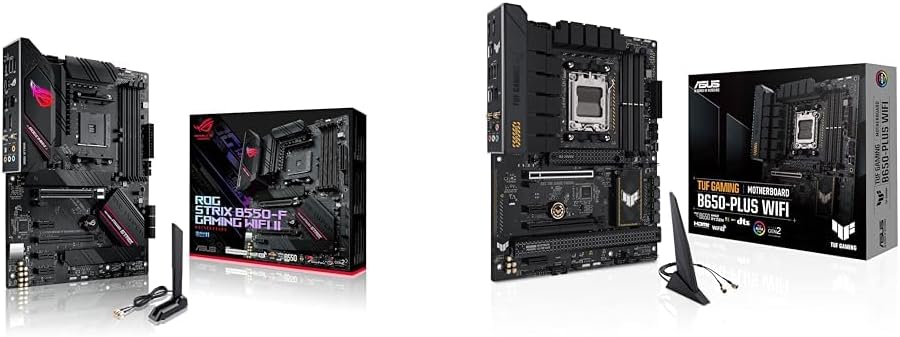
Asus ROG Strix B550-F Gaming WiFi II AMD AM4 (3rd Gen Ryzen) ATX Motherboard & TUF Gaming B650-PLUS WiFi Socket AM5 (LGA 1718) Ryzen 7000 ATX Gaming Motherboard
$150-$299This bundle offers two ATX motherboards: the ROG Strix B550-F Gaming WiFi II for AM4 Ryzen 3000/5000 CPUs with DDR4 RAM, and the TUF Gaming B650-PLUS WiFi for AM5 Ryzen 7000 CPUs with DDR5 RAM.

Game Motherboard Fit for ASROCK B650E PG-ITX WiFi B650 AM5 Motherboard Support Ryzen 7800X3D 7600/X 7950X 7700/X CPU 2xDDR5 128GB Hyper M.2 Mini-ITX
Price range unavailableThis KUETFBVC motherboard listing presents highly contradictory specifications, including a BGA 1023 socket and AMD 480 chipset, making it unsuitable for any modern Ryzen AM5 CPU.

Asus ROG Strix B550-F Gaming WiFi II AMD AM4 (3rd Gen Ryzen) ATX Gaming Motherboard (PCIe 4.0,WiFi 6E, 2.5Gb LAN, BIOS Flashback, HDMI 2.1, Addressable Gen 2 RGB Header and Aura Sync)
This is a premium-feeling AM4 board with beefy VRMs and WiFi 6E, perfect for squeezing the last drop of performance out of a Ryzen 5000 series CPU.