
ASRock B760 Pro RSD4 LGA1700 ATX Motherboard - Supports 14th/13th/12th Gen Intel Core, DDR4 5333+ (OC), Dual M.2 PCIe Gen4, 2.5G LAN, USB 3.2 Gen2 Type-C, HDMI/DP, Nahimic Audio
Want the best price and purchase timing?
Our AI advisor analyzes real-time pricing across all channels to find you the best deal.
AI Verdict
This is a budget-friendly ATX board for builders who want to drop a 12th or 13th-gen Intel i5 into a new rig while reusing their old DDR4 RAM.
This board makes sense if you are strictly trying to save money by carrying over a DDR4 kit for a mid-range i5 build. The 7+1+1 VRM setup and lack of PCIe 5.0 mean it chokes on high-end hardware, and the missing Wi-Fi adds hidden costs if you need wireless.
If you plan to run an i7 or i9, look for a Z790 board with at least a 12+1+1 power phase design and DDR5 support.
Regret Score™
Medium RiskLower is better — measures purchase-regret risk from real buyer complaints, review credibility, and product maturity
Issues discovered after purchase
Critically weak dimension
Amazon rating vs actual quality
Chance this product isn't for you
Pros
- Lets you reuse existing DDR4 memory while upgrading to LGA1700 processors
- Includes three M.2 slots for storage expansion, with two running at full PCIe Gen4x4 speeds
- Features a 2.5 Gigabit LAN port for high-speed wired networking out of the box
- Front panel USB-C header supports 10Gbps speeds for modern PC cases
Cons
- The 7+1+1 power phase design can thermal throttle if you pair it with power-hungry i7 or i9 chips
- The third M.2 slot is capped at PCIe Gen4x2, cutting high-end SSD speeds in half
- Uses the older Realtek ALC897 audio codec, which lacks the clarity of modern ALC1220 chips
- Rear I/O only has one 5Gbps USB-C port, limiting fast external storage options
Dimension Scores
The 7+1+1 phase design is strictly budget-tier and struggles with high-wattage CPUs.
The 2.5G LAN and front USB-C are nice, but the ALC897 audio and lack of Wi-Fi drag it down.
Three M.2 slots and four SATA ports offer good storage, though the third M.2 is half-speed.
Standard ASRock interface, but bugs require CMOS clears to fix iGPU settings.
Best For
- Budget builders pairing an Intel Core i5-12400F or 13600K with existing DDR4 memory
- Wired network setups that can take advantage of the Dragon 2.5G LAN
- Multi-drive storage setups utilizing the four SATA ports and three M.2 slots
Not Recommended For
- Overclockers pushing an Intel Core i9-13900K or 14900K to its limits
- Audiophiles plugging high-impedance wired headphones directly into the motherboard
Watch Out For
- The third M.2 slot runs at half speed (Gen4x2) — putting your primary boot drive here will bottleneck its performance.
- You need to manually enable 'IGPU Multi-Monitor' in the BIOS and sometimes clear the CMOS just to get the integrated graphics port working.
- There is no built-in Wi-Fi or Bluetooth out of the box; you have to buy a separate M.2 Key E module and install it yourself.
- The rear USB-C port is only Gen1 (5Gbps), so you won't get maximum transfer speeds on external SSDs unless you use the front panel Gen2 header.
Full Specifications
| ASIN | B0BQWRCYNX |
| Brand | ASRock |
| Language | English |
| Platform | Windows 10 |
| Batteries | 1 C batteries required. |
| CPU Model | Core i3 |
| CPU Socket | LGA 1700 |
| Model Name | B760 PRO RS/D4 |
| Item Weight | 2.2 pounds |
| Chipset Type | Intel B760 |
| Manufacturer | ASRock |
| Item model number | B760 PRO RS/D4 |
| Compatible Devices | Personal Computer |
| Memory Clock Speed | 2133 MHz |
| Product Dimensions | 1.1 x 9.7 x 6.5 inches |
| Compatible Processors | 12th Gen Intel Core, 13th Gen Intel Core, 14th Gen Intel Core |
| RAM Memory Technology | DDR4 |
What Buyers Say
People buy this board to salvage their old DDR4 RAM while stepping up to Intel's 12th or 13th-gen platform. The setup process trips up a lot of builders, especially the BIOS hiding the integrated graphics settings until a hard CMOS reset. Storage expansion gets high marks since three M.2 slots are rare at this price, even if one is half-speed. The biggest regret comes from builders who tried to pair it with an i7 or i9 and hit VRM thermal limits during heavy rendering tasks.
“Bought this to keep my old DDR4 kit for a 13600k build, it works fine but the audio crackles and I had to clear the CMOS just to get my second monitor working on the iGPU.”
Common Praise
- Saves $100+ on a build by allowing reuse of DDR4 memory kits
- The 2.5G LAN port maxes out gigabit fiber connections without needing an add-in card
- Includes a pre-installed I/O shield, which is rare for motherboards under $150
- Front panel USB 3.2 Gen2 Type-C header connects perfectly to modern cases
Common Complaints
- The Realtek ALC897 audio chip causes static and crackling in wired headphones
- The third M.2 slot cuts NVMe read/write speeds in half due to the Gen4x2 limit
- Rear I/O feels empty with only one 5Gbps USB-C port
- XMP profiles for RAM over 3600MHz frequently fail to post
Ownership Tips
- The top VRM heatsink is tall and interferes with some dual-tower air coolers.
- ASRock's Polychrome RGB software is clunky and often fails to sync with Corsair or G.Skill RAM.
- Boot times are unusually long until you disable memory training in the BIOS.
Frequently Asked Questions
Can I use an Intel Core i9 on this motherboard?
Yes, the LGA1700 socket physically supports it. The 7+1+1 power phases will likely thermal throttle under heavy multi-core loads, so stick to an i5 or non-K i7.
Does this board support PCIe 5.0 graphics cards?
No, the top x16 slot is PCIe 4.0. This won't bottleneck current GPUs like the RTX 4090, but it lacks future-proofing for next-gen cards.
Why isn't my integrated graphics port working?
You have to enter the BIOS, navigate to Advanced Chipset Configuration, and enable 'IGPU Multi-Monitor'. Some builders report needing a CMOS reset before the option appears.
Does this motherboard come with Wi-Fi?
No. It has an empty M.2 Key E slot specifically for a Wi-Fi card, but you must purchase the module and antennas separately.
Can I put a Gen4 NVMe SSD in any of the three slots?
You can, but the third slot (M.2_3) only runs at Gen4x2 speeds. Put your fastest drives in the top two slots to get full Gen4x4 performance.
Buying Guide
You are buying this board for one specific reason: to use an Intel 12th, 13th, or 14th-gen processor without paying the DDR5 tax for new memory. It handles mid-range chips like the i5-13600K perfectly fine. The power delivery system will choke if you drop an i9 in there. Pay close attention to your storage layout, as the bottom M.2 slot is significantly slower than the top two. If you need Wi-Fi, factor in the extra $25 for an M.2 Key E kit, because this board only does wired networking out of the box.
7+1+1 Power Phase (VRM)
This is the electrical plumbing that feeds power to your CPU. A 7-phase setup is like a garden hose—fine for an i5, but an i9 needs a firehose or it will overheat and slow down.
PCIe Gen4x2 M.2 Slot
The 'x2' means it only has two data lanes instead of the standard four. It acts like a two-lane highway instead of four, cutting your SSD's maximum speed exactly in half.
M.2 Key E
This is a tiny, specialized slot meant only for a Wi-Fi/Bluetooth card. It saves space, but you have to buy the card and route the antenna wires yourself.
Alternatives
If you want to push a high-end CPU, search for a Z790 motherboard with at least a 12-phase VRM. If you want better future-proofing, look for a B760 board that supports DDR5 memory and PCIe 5.0.
You Might Also Like

JetKVM KVM Over IP ATX Extension Board, ATX Power Control Board- Only for Jet KVM Accessories Boot from Shutdown, Crash Recovery
$0-$49This is an ATX form factor power control board designed for JetKVM accessories, enabling remote PC power state management and simultaneous front panel button use.
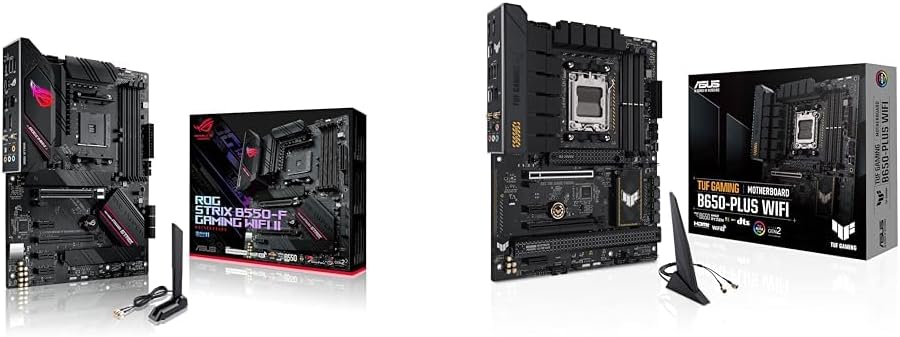
Asus ROG Strix B550-F Gaming WiFi II AMD AM4 (3rd Gen Ryzen) ATX Motherboard & TUF Gaming B650-PLUS WiFi Socket AM5 (LGA 1718) Ryzen 7000 ATX Gaming Motherboard
$150-$299This bundle offers two ATX motherboards: the ROG Strix B550-F Gaming WiFi II for AM4 Ryzen 3000/5000 CPUs with DDR4 RAM, and the TUF Gaming B650-PLUS WiFi for AM5 Ryzen 7000 CPUs with DDR5 RAM.

Game Motherboard Fit for ASROCK B650E PG-ITX WiFi B650 AM5 Motherboard Support Ryzen 7800X3D 7600/X 7950X 7700/X CPU 2xDDR5 128GB Hyper M.2 Mini-ITX
Price range unavailableThis KUETFBVC motherboard listing presents highly contradictory specifications, including a BGA 1023 socket and AMD 480 chipset, making it unsuitable for any modern Ryzen AM5 CPU.

Asus ROG Strix B550-F Gaming WiFi II AMD AM4 (3rd Gen Ryzen) ATX Gaming Motherboard (PCIe 4.0,WiFi 6E, 2.5Gb LAN, BIOS Flashback, HDMI 2.1, Addressable Gen 2 RGB Header and Aura Sync)
This is a premium-feeling AM4 board with beefy VRMs and WiFi 6E, perfect for squeezing the last drop of performance out of a Ryzen 5000 series CPU.