
ASUS ROG Strix B650E-I Gaming WiFi AMD B650 AM5 Ryzen™ Desktop 9000 8000 & 7000 mini-ITX mITX Motherboard, 10+2 Power Stages, DDR5, 2X M.2 Slot, PCIe® 5.0, 2.5G LAN, WiFi 6E, USB 3.2 Gen 2x2 Type-C
Want the best price and purchase timing?
Our AI advisor analyzes real-time pricing across all channels to find you the best deal.
AI Verdict
This is an overpowered, feature-packed ITX board built for high-end SFF rigs, but you will need patience to tune out the coil whine and dial in the BIOS.
The hardware specs are top-tier for a Mini-ITX AM5 build, giving you PCIe 5.0 and a 10+2 VRM that handles any Ryzen 7000 or 9000 chip. The software and acoustic bugs require manual BIOS tuning to fix coil whine and memory training hangs. You are paying a premium for features that demand hands-on troubleshooting.
If you just want a plug-and-play ITX board for a 65W CPU, drop down to an ASRock B650I Lightning WiFi and save $100.
Regret Score™
Low RiskLower is better — measures purchase-regret risk from real buyer complaints, review credibility, and product maturity
Issues discovered after purchase
Critically weak dimension
Amazon rating vs actual quality
Chance this product isn't for you
Pros
- 10+2 power stages easily handle a 170W Ryzen 9 7950X without VRM thermal throttling.
- Includes a PCIe 5.0 x16 slot and a PCIe 5.0 M.2 slot for future GPU and SSD upgrades.
- Rear I/O features a dedicated BIOS FlashBack button, saving you if a memory overclock fails.
- Packs two M.2 slots onto a tiny 6.7-inch Mini-ITX footprint.
- ALC4080 audio codec with a Savitech amplifier drives high-impedance headphones directly from the front panel.
Cons
- Severe VRM coil whine reported by dozens of users, sounding like a scratching hard drive when moving the mouse.
- Rebooting from Windows often hangs on an orange DRAM light unless you update to BIOS version 1809 or newer.
- Thick M.2 thermal pads cause the top NVMe drive to bend slightly when the heatsink is screwed down.
- Boot times exceed 45 seconds on older BIOS versions unless Memory Context Restore is manually enabled.
Dimension Scores
10+2 power stages with an 8-pin ProCool connector easily maxes out a 170W 7950X in an ITX footprint.
Packs WiFi 6E, ALC4080 audio, and BIOS FlashBack, but loses points for the widespread coil whine lottery.
One PCIe 5.0 x16 slot and two M.2 slots hit the physical limit for Mini-ITX, though only one M.2 is Gen 5.
Early BIOS versions are plagued by reboot hangs and slow memory training, requiring immediate manual updates.
Best For
- Cramming a Ryzen 7 7800X3D and an RTX 4090 into a sub-10L case like the FormD T1.
- SFF builders who want PCIe 5.0 storage speeds without stepping up to the $400 X670E-I.
- Overclockers who need robust 10+2 phase power delivery in a Mini-ITX form factor.
Not Recommended For
- Budget builders using a Ryzen 5 7600 who do not need PCIe 5.0 bandwidth.
- Anyone building a silent PC who refuses to manually tweak CPU C-states to fix coil whine.
Watch Out For
- Coil whine is a massive gamble — you might need to disable C-States or switch CPU Core Voltage to Manual Mode in the BIOS to silence the buzzing.
- The orange DRAM light will haunt you on reboots if you run older firmware; flash the BIOS via USB before installing your OS.
- The pre-installed M.2 thermal pad is too thick for some single-sided SSDs, causing the drive PCB to physically bend when you tighten the heatsink.
- Memory training on AM5 takes forever out of the box; expect your first boot to sit on a black screen for up to two minutes.
Full Specifications
| RAM | DDR5 |
| ASIN | B0BP9LJBP8 |
| Brand | ASUS |
| Color | BLACK |
| Series | ROG STRIX B650E-I GAMING WIFI |
| Platform | Windows 10 |
| CPU Model | Ryzen 7 |
| Processor | ryzen_7 |
| CPU Socket | Socket AM5 |
| Model Name | ROG STRIX B650E-I GAMING WIFI |
| Item Weight | 1.01 pounds |
| Chipset Type | AMD B650 |
| Manufacturer | ASUS |
| Memory Speed | 2133 MHz |
| Wireless Type | 802.11a/b/g/n/ac, 802.11ax |
| Item model number | ROG STRIX B650E-I GAMING WIFI |
| Compatible Devices | Personal Computer |
| Memory Clock Speed | 2133 MHz |
| Product Dimensions | 8.74 x 7.17 x 3.62 inches |
| Compatible Processors | AMD Ryzen™ 7000 Series |
| RAM Memory Technology | DDR5 |
| Item Dimensions LxWxH | 8.74 x 7.17 x 3.62 inches |
| Number of USB 2.0 Ports | 2 |
What Buyers Say
The acoustic experience dominates user discussions, with dozens of buyers complaining about a cricket-like coil whine that reacts to mouse movements. Firmware stability is the second most discussed topic, as early BIOS versions caused the system to hang on an orange DRAM light during simple Windows restarts. Buyers praise the physical build quality and the sheer amount of connectivity ASUS crammed onto a 6.7-inch square. Once the BIOS is updated and voltages are tweaked to silence the VRM, owners report rock-solid performance even with 170W CPUs. The inclusion of a dedicated BIOS FlashBack button saved many builds when memory EXPO profiles failed.
“Great board on paper but the coil whine sounds like a 1990s hard drive scratching every time I move my mouse, and I had to flash the bios 3 times just to get it to restart without hanging on the yellow ram light.”
Common Praise
- 10+2 VRM handles the Ryzen 7 7800X3D without breaking a sweat or requiring active VRM cooling.
- BIOS FlashBack button allows firmware updates without needing an older CPU installed.
- Rear I/O is packed with eight USB ports, including a 20Gbps Type-C port.
- Q-Latch system lets you install M.2 drives without tiny, easily lost screws.
Common Complaints
- Loud coil whine from the CPU area that changes pitch when scrolling web pages.
- System refuses to POST on warm reboots, forcing a hard power cycle.
- Thick M.2 thermal pads cause the NVMe drive to bend under the heatsink pressure.
- Bluetooth module randomly disappears from Windows Device Manager until the power supply is unplugged.
Ownership Tips
- The coil whine sometimes disappears after a few weeks of use, or can be mitigated by undervolting the CPU.
- Enabling EXPO for 6000MHz RAM works fine, but you must enable Memory Context Restore or you will wait a minute for every boot.
- The Bluetooth disappearing bug requires completely draining the motherboard capacitors by unplugging the PSU and holding the power button.
Frequently Asked Questions
Why does my motherboard make a scratching noise when I move my mouse?
That is VRM coil whine, a widely reported issue on this specific board. You can usually reduce it by going into the BIOS, navigating to AI Tweaker, and setting CPU Core Voltage to Manual Mode or disabling C-States.
Why does my PC hang on an orange light when I restart Windows?
The orange Q-LED indicates a memory training failure during warm reboots. Updating your BIOS to version 1809 or newer fixes this specific restart bug.
Do I need a 9000-series compatible BIOS out of the box?
Yes, if you are installing a Ryzen 9000 CPU, you must use the rear BIOS FlashBack button to update the firmware before the system will POST.
Does the M.2 heatsink fit double-sided SSDs?
It fits, but the included thermal pad is very thick. Users report that tightening the heatsink fully can bend the SSD, so you might need to buy a thinner 1mm thermal pad.
How long does this board take to boot?
Out of the box, AM5 memory training can push boot times past 60 seconds. Enabling Memory Context Restore in the BIOS cuts this down to around 15 seconds.
Buying Guide
Mini-ITX AM5 boards force you to pay a premium for high-density engineering. You are buying this specific model to get PCIe 5.0 readiness for future GPUs and SSDs in a tiny case. Be prepared to act as your own IT support, as you will need to flash the BIOS immediately via USB to fix memory training bugs. If you are sensitive to high-pitched noises, the VRM design on this board has a known history of coil whine that requires BIOS voltage tweaks to suppress.
10+2 Power Stages
Think of power stages like lanes on a highway delivering electricity to your CPU. More lanes mean the power delivery stays cooler, which is critical when cramming a hot chip like a Ryzen 9 into a tiny, airflow-restricted case.
PCIe 5.0 x16 Slot
This is the connection for your graphics card. While no current GPU maxes out PCIe 4.0, having 5.0 means this motherboard will not bottleneck the graphics cards released five years from now.
BIOS FlashBack
This lets you update the motherboard's brain using just a USB stick and a power supply. It is a lifesaver if you buy a new 9000-series CPU that the factory firmware does not recognize yet.
Alternatives
If you want to save money and do not care about PCIe 5.0, search for a B650I board with PCIe 4.0 and an 8+2+1 VRM. If you need dual USB4 ports and an external audio DAC, look at the ultra-premium X670E-I tier.
You Might Also Like

JetKVM KVM Over IP ATX Extension Board, ATX Power Control Board- Only for Jet KVM Accessories Boot from Shutdown, Crash Recovery
$0-$49This is an ATX form factor power control board designed for JetKVM accessories, enabling remote PC power state management and simultaneous front panel button use.
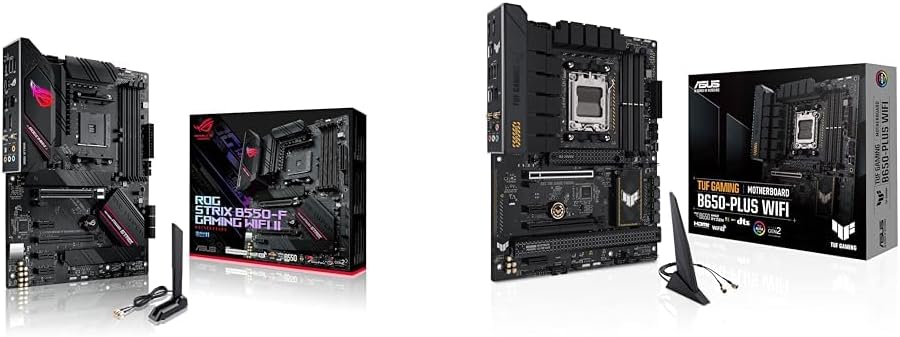
Asus ROG Strix B550-F Gaming WiFi II AMD AM4 (3rd Gen Ryzen) ATX Motherboard & TUF Gaming B650-PLUS WiFi Socket AM5 (LGA 1718) Ryzen 7000 ATX Gaming Motherboard
$150-$299This bundle offers two ATX motherboards: the ROG Strix B550-F Gaming WiFi II for AM4 Ryzen 3000/5000 CPUs with DDR4 RAM, and the TUF Gaming B650-PLUS WiFi for AM5 Ryzen 7000 CPUs with DDR5 RAM.

Game Motherboard Fit for ASROCK B650E PG-ITX WiFi B650 AM5 Motherboard Support Ryzen 7800X3D 7600/X 7950X 7700/X CPU 2xDDR5 128GB Hyper M.2 Mini-ITX
Price range unavailableThis KUETFBVC motherboard listing presents highly contradictory specifications, including a BGA 1023 socket and AMD 480 chipset, making it unsuitable for any modern Ryzen AM5 CPU.

Asus ROG Strix B550-F Gaming WiFi II AMD AM4 (3rd Gen Ryzen) ATX Gaming Motherboard (PCIe 4.0,WiFi 6E, 2.5Gb LAN, BIOS Flashback, HDMI 2.1, Addressable Gen 2 RGB Header and Aura Sync)
This is a premium-feeling AM4 board with beefy VRMs and WiFi 6E, perfect for squeezing the last drop of performance out of a Ryzen 5000 series CPU.