
MSI MAG B650 Tomahawk WiFi Gaming Motherboard (AMD Ryzen 9000/8000/7000 Series Processors, AM5, DDR5, PCIe 4.0, M.2, SATA 6Gb/s, USB 3.2 Gen 2, HDMI/DP, Wi-Fi 6E, Bluetooth 5.3, 2.5Gbps LAN, ATX)
Want the best price and purchase timing?
Our AI advisor analyzes real-time pricing across all channels to find you the best deal.
AI Verdict
This stealthy, all-black B650 board delivers flagship-tier 80A power delivery for high-end Ryzen chips, provided you're willing to tweak the BIOS to fix AM5's notoriously slow boot times.
The MAG B650 Tomahawk WiFi offers the 14+2+1 VRM quality and 20Gbps USB connectivity of a $300+ board for significantly less. It perfectly matches high-end Ryzen 7000 and 8000 series CPUs, provided you don't care about PCIe 5.0 storage speeds.
If you absolutely need PCIe 5.0 for future GPU or SSD upgrades, look for a B650E or X670E motherboard instead.
Regret Score™
Low RiskLower is better — measures purchase-regret risk from real buyer complaints, review credibility, and product maturity
Issues discovered after purchase
Critically weak dimension
Amazon rating vs actual quality
Chance this product isn't for you
Pros
- 14+2+1 phase VRM with 80A power stages easily handles a 170W Ryzen 9 7950X without overheating
- Includes three PCIe 4.0 M.2 slots, all covered by MSI's Shield Frozr heatsinks
- Rear I/O features a 20Gbps USB 3.2 Gen 2x2 Type-C port
- Stealthy, all-black 6-layer PCB design with zero built-in RGB lighting
- Features both 2.5Gbps Realtek LAN and Wi-Fi 6E for high-speed networking
Cons
- Zero PCIe 5.0 support for either the primary x16 GPU slot or M.2 storage
- Out-of-the-box boot times exceed 60 seconds due to DDR5 memory training
- The MediaTek RZ616 Wi-Fi module drops connections frequently on default Windows drivers
- Lacks onboard power/reset buttons and a POST code LED display for troubleshooting
Dimension Scores
14+2+1 80A power stages easily handle a 170W Ryzen 9 7950X without thermal throttling.
Includes Wi-Fi 6E, 2.5GbE LAN, and 20Gbps USB-C, but lacks a POST code display.
Three M.2 slots provide ample storage, but the lack of PCIe 5.0 limits future bandwidth.
MSI's BIOS is easy to navigate, but early versions struggled heavily with EXPO stability and 90-second boot times.
Best For
- High-end Ryzen 7 7800X3D or Ryzen 9 builds where VRM thermals matter
- Stealthy, blackout PC builds that want to avoid RGB lighting
- Users who need three M.2 NVMe drives without buying aftermarket heatsinks
Not Recommended For
- Plug-and-play builders who refuse to update BIOS or tweak memory settings
- Future-proofers wanting PCIe 5.0 bandwidth for next-gen GPUs and SSDs
Watch Out For
- Boot times take over a minute out of the box — you must enable 'Memory Context Restore' in the BIOS to get it under 20 seconds.
- Wi-Fi and Bluetooth will randomly disconnect until you manually download the latest MediaTek drivers from MSI's website; Windows Update won't fix it.
- Enabling EXPO for 6000MHz RAM on the factory BIOS often causes the board to fail POST — flash the latest BIOS before touching memory speeds.
Full Specifications
| RAM | DDR5 |
| ASIN | B0BHCCNSRH |
| Brand | msi |
| Color | Information Not Available |
| Series | MAG |
| Platform | Windows 11 |
| CPU Model | AMD Ryzen 7 |
| Processor | amd_ryzen_7 |
| CPU Socket | Socket AM5 |
| Model Name | MAG |
| Item Weight | 1 pounds |
| Chipset Type | AMD B650 |
| Manufacturer | MSI |
| Memory Speed | 7600 MHz |
| Wireless Type | Bluetooth |
| Processor Brand | MSI |
| Item model number | MS-B650TOMAHAWKWIFI |
| Compatible Devices | Personal Computer |
| Memory Clock Speed | 7600 MHz |
| Product Dimensions | 12 x 9.6 x 2.5 inches |
| Compatible Processors | AMD Ryzen 8000/ 7000 |
| RAM Memory Technology | DDR5 |
| Item Dimensions LxWxH | 12 x 9.6 x 2.5 inches |
| Number of USB 2.0 Ports | 2 |
What Buyers Say
Setup requires patience, as early BIOS versions and default Windows drivers cause immediate headaches. Buyers consistently praise the 6-layer PCB and Extended Heatsink Design that keep VRM temperatures icy even with 170W Ryzen 9 chips. The forums are flooded with complaints about agonizingly slow 60-to-90-second boot times and dropped Wi-Fi connections out of the box. Once users update the BIOS, install the correct MediaTek drivers, and enable Memory Context Restore, the board transforms into a rock-solid foundation. The all-black, RGB-free aesthetic is also a massive hit for stealth builds.
“Took me two days of flashing BIOS and tweaking memory context restore to get it to boot under a minute, but now it runs my 7800X3D flawlessly and looks stealthy as hell.”
Common Praise
- 14+2+1 power delivery keeps VRM temperatures extremely low under heavy multi-core loads
- Included M.2 Shield Frozr heatsinks on all three slots save money on aftermarket coolers
- All-black, stealthy design looks incredibly clean in non-RGB builds
- Rear I/O is packed with USB ports, including a 20Gbps Type-C
Common Complaints
- Boot times exceed one minute until specific BIOS settings are changed
- Wi-Fi and Bluetooth connections drop frequently on the default Windows drivers
- Enabling EXPO on older BIOS versions causes blue screens or failure to POST
- MSI Center software is bloated and frequently overrides manual fan curves
Ownership Tips
- You must update both the Wi-Fi and Bluetooth drivers simultaneously from MSI's site, or the connection drops will persist.
- Disabling MSI Center and using a third-party app like Fan Control is highly recommended by the community.
- The top M.2 slot shares bandwidth with the CPU, while the bottom two route through the chipset.
Frequently Asked Questions
Why does my PC take so long to boot with this motherboard?
AM5 motherboards do extensive DDR5 memory training on every boot. To fix this, go into the BIOS and enable 'Memory Context Restore' and 'Power Down Enable', which drops boot times from ~90 seconds to ~20 seconds.
Does this board support the Ryzen 7 7800X3D?
Yes, the AM5 socket and 14+2+1 VRM setup easily handle the 7800X3D. Just ensure you update to the latest BIOS for the best stability and EXPO compatibility.
Are there any PCIe 5.0 slots?
No. Both the primary x16 GPU slot and all three M.2 slots are limited to PCIe 4.0 speeds.
Why does my Wi-Fi keep dropping?
The default Windows drivers for the included MediaTek RZ616 Wi-Fi chip are notoriously unstable. Download the latest Wi-Fi and Bluetooth drivers directly from MSI's support page to fix the drops.
Does it have RGB lighting?
The board itself has zero integrated RGB lighting, making it great for blackout builds. It does include standard 5V ARGB and 12V RGB headers if you want to plug in your own lighted fans or strips.
Buying Guide
When buying an AM5 motherboard, you are paying for the power delivery, the number of M.2 slots, and the rear USB ports. This board skips the 'future-proof' PCIe 5.0 tech to keep the price down, which is a smart trade-off since no current GPUs even use PCIe 5.0. Be prepared to do a little software housekeeping on day one — updating the BIOS and drivers is mandatory, not optional, if you want a stable system.
14+2+1 VRM (80A)
Think of the VRM like the plumbing that delivers electricity to your CPU. A 14-phase 80A system is like a massive water main — it ensures even the most power-hungry processors get stable, cool power without overheating the board.
PCIe 4.0 vs 5.0
PCIe is the highway your data travels on. While PCIe 5.0 is the newest, fastest highway, current graphics cards and most affordable SSDs are still built for the PCIe 4.0 speed limit, making 4.0 perfectly fine for today's builds.
Wi-Fi 6E
This adds a new 6GHz band to your wireless connection, acting like an exclusive VIP lane that avoids interference from your neighbors' older Wi-Fi routers.
Alternatives
If you want PCIe 5.0 support for future upgrades, search for a 'B650E' or 'X670E' motherboard. If you want a smaller footprint, look for a 'Micro-ATX B650' board.
You Might Also Like

JetKVM KVM Over IP ATX Extension Board, ATX Power Control Board- Only for Jet KVM Accessories Boot from Shutdown, Crash Recovery
$0-$49This is an ATX form factor power control board designed for JetKVM accessories, enabling remote PC power state management and simultaneous front panel button use.
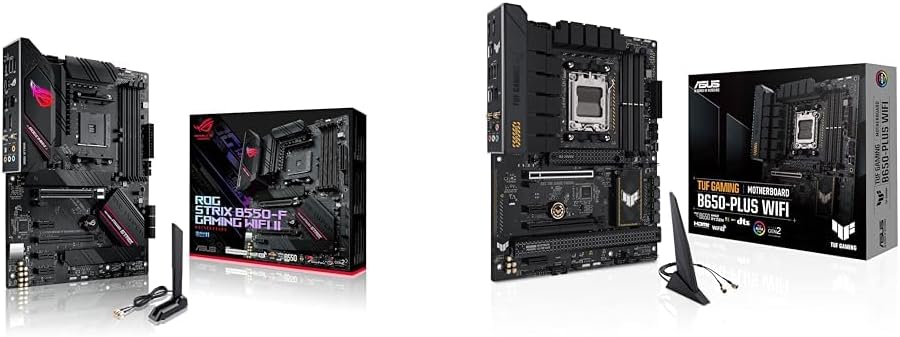
Asus ROG Strix B550-F Gaming WiFi II AMD AM4 (3rd Gen Ryzen) ATX Motherboard & TUF Gaming B650-PLUS WiFi Socket AM5 (LGA 1718) Ryzen 7000 ATX Gaming Motherboard
$150-$299This bundle offers two ATX motherboards: the ROG Strix B550-F Gaming WiFi II for AM4 Ryzen 3000/5000 CPUs with DDR4 RAM, and the TUF Gaming B650-PLUS WiFi for AM5 Ryzen 7000 CPUs with DDR5 RAM.

Game Motherboard Fit for ASROCK B650E PG-ITX WiFi B650 AM5 Motherboard Support Ryzen 7800X3D 7600/X 7950X 7700/X CPU 2xDDR5 128GB Hyper M.2 Mini-ITX
Price range unavailableThis KUETFBVC motherboard listing presents highly contradictory specifications, including a BGA 1023 socket and AMD 480 chipset, making it unsuitable for any modern Ryzen AM5 CPU.

Asus ROG Strix B550-F Gaming WiFi II AMD AM4 (3rd Gen Ryzen) ATX Gaming Motherboard (PCIe 4.0,WiFi 6E, 2.5Gb LAN, BIOS Flashback, HDMI 2.1, Addressable Gen 2 RGB Header and Aura Sync)
This is a premium-feeling AM4 board with beefy VRMs and WiFi 6E, perfect for squeezing the last drop of performance out of a Ryzen 5000 series CPU.