
MSI PRO B650M-A WiFi ProSeries Motherboard (AMD Ryzen 9000/8000/7000 Series Processors, AM5, DDR5, PCIe 4.0, M.2, SATA 6Gb/s, USB 3.2 Gen 2, HDMI/DP, Wi-Fi 6E, Bluetooth 5.3, 2.5Gbps LAN, mATX)
Want the best price and purchase timing?
Our AI advisor analyzes real-time pricing across all channels to find you the best deal.
AI Verdict
A no-nonsense, budget-friendly AM5 micro-ATX board that handles any Ryzen 7000 chip perfectly, provided you update the BIOS immediately to fix the agonizingly slow factory boot times.
This board delivers fantastic value for standard Ryzen 7000 builds, but its quirky PCIe slot placement makes it a tight squeeze for modern, massive GPUs. If you have a 2-slot card and update the BIOS immediately, it provides a rock-solid foundation.
If you have a 3-slot GPU, look for a micro-ATX board with the primary PCIe x16 slot in the top position, or upgrade to a full ATX case and a standard ATX motherboard.
Regret Score™
Medium RiskLower is better — measures purchase-regret risk from real buyer complaints, review credibility, and product maturity
Issues discovered after purchase
Critically weak dimension
Amazon rating vs actual quality
Chance this product isn't for you
Pros
- Handles 64GB of DDR5-6000 CL30 RAM flawlessly once EXPO is enabled
- 8-phase 55A VRM easily pushes a Ryzen 7800X3D or 7900X without thermal throttling
- Top PCIe x16 slot is shifted down one slot, giving massive dual-tower CPU coolers extra clearance
- Includes a built-in M.2 Shield Frozr heatsink for the primary Gen 4 NVMe drive
- EZ Debug LEDs (CPU/DRAM/VGA/BOOT) make troubleshooting failed POSTs incredibly simple
Cons
- Second M.2 slot lacks a heatsink and sits directly underneath the GPU exhaust zone
- Lowered PCIe x16 slot means 3-slot GPUs will choke against the bottom of most micro-ATX cases
- Included Wi-Fi antennas are rigid sticks that block access to the rear USB ports
- MSI Center bloatware auto-installs via BIOS by default unless you manually disable it
Dimension Scores
The 8-phase 55A SPS setup isn't top-tier, but it easily handles a 7900X without breaking a sweat.
Includes Wi-Fi 6E and a 2.5Gbps LAN, but lacks a pre-installed I/O shield and a second M.2 heatsink.
The lowered primary PCIe slot severely limits GPU thickness in mATX cases, and there's no PCIe Gen 5 support.
The BIOS interface is clean, but the sneaky MSI Center auto-install and early AM5 boot time bugs hold it back.
Best For
- Budget-conscious builders pairing a Ryzen 5 7600 or Ryzen 7 7800X3D with a dual-slot GPU
- Users with massive air coolers like the Noctua NH-D15 who need extra PCIe clearance
- First-time AM5 builders who want simple EZ Debug LEDs for troubleshooting
Not Recommended For
- Micro-ATX builds using massive 3-slot or 4-slot graphics cards
- Overclockers trying to push DDR5 memory past 6000MHz
- Anyone needing a PCIe Gen 5 M.2 slot for future storage upgrades
Watch Out For
- Out-of-the-box boot times can exceed 60 seconds due to DDR5 memory training — you must update the BIOS and enable 'Memory Context Restore'.
- The top PCIe x16 slot is in the second position, meaning thick GPUs will sit dangerously close to your power supply shroud.
- The second M.2 slot doesn't include a thermal pad or heatsink, so you need to buy an aftermarket one if you add a second drive.
- The BIOS prompts you to install 'MSI Center' on your first Windows boot — disable this setting immediately to avoid system-hogging bloatware.
Full Specifications
| RAM | DDR5 |
| ASIN | B0BHBZRW66 |
| Brand | msi |
| Series | PRO |
| Voltage | 28 Volts |
| Language | Italian |
| Platform | Windows 11 |
| Batteries | 1 AAAA batteries required. |
| CPU Model | AMD Ryzen 7 |
| Processor | amd_ryzen_7 |
| CPU Socket | Socket AM5 |
| Model Name | PRO |
| Item Weight | 2 pounds |
| Chipset Type | AMD B650 |
| Manufacturer | MSI |
| Memory Speed | 7200 MHz |
| Wireless Type | Bluetooth |
| Item model number | B650M-A WIFI |
| Compatible Devices | Personal Computer |
| Memory Clock Speed | 7200 MHz |
| Product Dimensions | 9.6 x 9.6 x 2.5 inches |
| Number of Processors | 1 |
| Compatible Processors | AMD Ryzen 8000/ 7000 |
| RAM Memory Technology | DDR5 |
| Item Dimensions LxWxH | 9.6 x 9.6 x 2.5 inches |
| Number of USB 2.0 Ports | 2 |
What Buyers Say
The biggest shock for new buyers is the agonizingly slow boot time out of the box, with the system sitting on a black screen for over a minute while the CPU and RAM debug lights glow ominously. Once you flash the latest BIOS and toggle Memory Context Restore, it transforms into a snappy, reliable workhorse. Builders love the extra clearance for bulky CPU coolers, but heavily criticize the lowered PCIe slot that forces thick graphics cards to suffocate against the bottom of micro-ATX cases. It requires a bit of initial tweaking, but rewards you with rock-solid stability once dialed in.
“Thought I got a dead board because the red and yellow lights stayed on for a full minute on first boot, but after a BIOS update and turning on memory context restore, this thing runs my 7800X3D flawlessly.”
Common Praise
- Easily handles 6000MHz CL30 RAM profiles via EXPO with zero crashes
- Lowered PCIe slot means you don't have to remove your massive CPU air cooler to reach the GPU release latch
- VRM heatsinks are surprisingly beefy for a budget board and keep temperatures well under 60°C
- EZ Debug LEDs save hours of guesswork when troubleshooting first-time POST failures
Common Complaints
- Factory BIOS versions take 45-60 seconds just to reach the Windows login screen
- 3-slot graphics cards sit millimeters away from the bottom case fans, ruining GPU thermals
- The rigid stick Wi-Fi antennas block your fingers from easily unplugging USB cables
- No integrated I/O shield makes installation feel cheap and outdated
Ownership Tips
- You must manually disable the 'MSI Driver Utility Installer' in the BIOS, otherwise it prompts you to install bloatware every time you boot Windows.
- The second M.2 slot gets blasted with hot air from the GPU, so buying a $10 aftermarket heatsink is mandatory for your secondary drive.
- If you ever clear the CMOS, your boot times will revert to 60+ seconds until it finishes retraining the memory.
Frequently Asked Questions
Why does my PC take a minute to boot up?
AM5 motherboards do DDR5 memory training on startup. Update to the latest BIOS and enable 'Memory Context Restore' and 'Power Down Enable' to drop boot times to around 15 seconds.
Will this board bottleneck a Ryzen 7 7800X3D?
Not at all. The 8-phase 55A VRM is more than capable of maxing out a 7800X3D or even a 7900X without overheating.
Does it support DDR5-7200 RAM?
While the spec sheet claims 7200MHz support, real users report instability above 6000MHz. Stick to a 6000MHz CL30 EXPO kit for the best plug-and-play experience.
Are the red and yellow lights on the motherboard bad?
Those are the EZ Debug LEDs for CPU and RAM. They stay lit during the memory training process on boot, which is normal. If they stay on forever and the PC doesn't post, you have a hardware issue.
Do I need to buy a Wi-Fi card?
No, it has Wi-Fi 6E and Bluetooth 5.3 built-in. Just screw the two included antennas into the gold ports on the rear I/O panel.
Buying Guide
When buying an AM5 motherboard, the chipset dictates your features, but the physical layout dictates your sanity. Because this is a micro-ATX board with a lowered graphics card slot, you need to measure your case and your GPU carefully. If your GPU is thicker than two slots, it will likely choke for air against the bottom of your case. You also need to be comfortable updating the BIOS via a USB stick on day one, as early AM5 software was notoriously buggy with memory training.
8-Phase 55A VRM
Think of the VRM as the engine that delivers power to your CPU. 55 Amps isn't a massive V8, but it's a highly efficient V6 that easily powers high-end chips like the 7800X3D without overheating.
Memory Context Restore
DDR5 memory likes to 're-learn' its settings every time you turn on the PC, taking up to a minute. This BIOS setting tells the motherboard to remember the settings from last time, dropping boot times to 15 seconds.
PCIe 4.0 x16
This is the highway your graphics card uses to talk to the CPU. While PCIe 5.0 exists, no modern GPU actually needs it yet, making PCIe 4.0 perfectly fine for the next several years.
Alternatives
If you have a massive 3-slot graphics card, look for a micro-ATX board with the primary PCIe slot in the top position, or step up to a standard ATX B650 board if your case allows it.
You Might Also Like

JetKVM KVM Over IP ATX Extension Board, ATX Power Control Board- Only for Jet KVM Accessories Boot from Shutdown, Crash Recovery
$0-$49This is an ATX form factor power control board designed for JetKVM accessories, enabling remote PC power state management and simultaneous front panel button use.
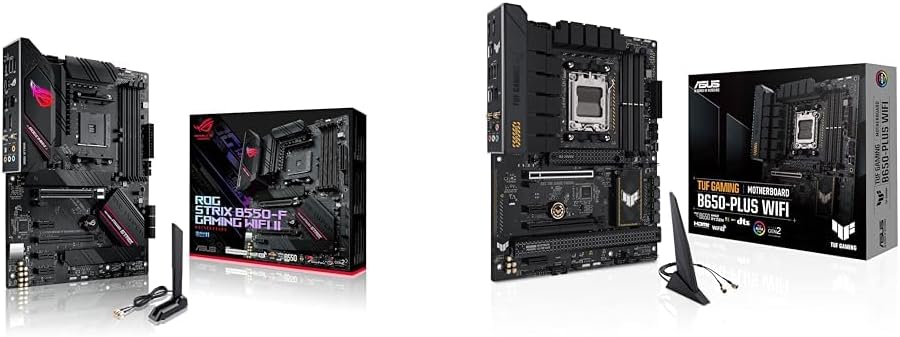
Asus ROG Strix B550-F Gaming WiFi II AMD AM4 (3rd Gen Ryzen) ATX Motherboard & TUF Gaming B650-PLUS WiFi Socket AM5 (LGA 1718) Ryzen 7000 ATX Gaming Motherboard
$150-$299This bundle offers two ATX motherboards: the ROG Strix B550-F Gaming WiFi II for AM4 Ryzen 3000/5000 CPUs with DDR4 RAM, and the TUF Gaming B650-PLUS WiFi for AM5 Ryzen 7000 CPUs with DDR5 RAM.

Game Motherboard Fit for ASROCK B650E PG-ITX WiFi B650 AM5 Motherboard Support Ryzen 7800X3D 7600/X 7950X 7700/X CPU 2xDDR5 128GB Hyper M.2 Mini-ITX
Price range unavailableThis KUETFBVC motherboard listing presents highly contradictory specifications, including a BGA 1023 socket and AMD 480 chipset, making it unsuitable for any modern Ryzen AM5 CPU.

Asus ROG Strix B550-F Gaming WiFi II AMD AM4 (3rd Gen Ryzen) ATX Gaming Motherboard (PCIe 4.0,WiFi 6E, 2.5Gb LAN, BIOS Flashback, HDMI 2.1, Addressable Gen 2 RGB Header and Aura Sync)
This is a premium-feeling AM4 board with beefy VRMs and WiFi 6E, perfect for squeezing the last drop of performance out of a Ryzen 5000 series CPU.