
GIGABYTE B650 AORUS Elite AX (AM5/LGA 1718/ AMD B650/ATX/ 5-Year Warranty/DDR5/ M.2/ PCIe 5.0/USB 3.2 Gen2X2 Type-C/WiFi 6E/2.5GbE LAN/Q-Flash Plus/EZ-Latch/Gaming Motherboard)
Want the best price and purchase timing?
Our AI advisor analyzes real-time pricing across all channels to find you the best deal.
AI Verdict
This is a heavy-duty ATX board built for high-end Ryzen 7 and 9 chips, offering massive USB connectivity and toolless M.2 slots if you can tolerate Gigabyte's buggy software.
The 14+2+1 VRM setup and 8-layer PCB easily handle flagship AM5 chips like the 7800X3D without breaking a sweat. You get 11 rear USB ports and three M.2 slots with screwless latches, making the actual physical build process painless.
If you need a PCIe 5.0 x16 slot to future-proof for next-gen GPUs, step up to a B650E or X670E motherboard.
Regret Score™
Low RiskLower is better — measures purchase-regret risk from real buyer complaints, review credibility, and product maturity
Issues discovered after purchase
Critically weak dimension
Amazon rating vs actual quality
Chance this product isn't for you
Pros
- 14+2+1 phase 70A VRM handles a fully loaded Ryzen 9 7950X without thermal throttling
- 11 rear USB-A ports and 1 USB-C port eliminate the need for external hubs
- EZ-Latch system allows toolless installation for all three M.2 SSDs
- 8-layer PCB with double copper runs cooler and reduces electrical interference
- Q-Flash Plus button flashes the BIOS using just a power supply and USB stick
Cons
- Gigabyte Control Center software frequently breaks Windows sleep states and causes boot hangs
- Revision 1.0 boards use a MediaTek MT7922 WiFi chip that drops connections
- Primary PCIe x16 slot is limited to Gen 4 speeds, lacking Gen 5 GPU support
- Cold boots with 6000MHz EXPO RAM enabled can hang on the red DRAM light for over 60 seconds
Dimension Scores
The 14+2+1 70A power stages easily max out a 7950X without thermal throttling.
Includes EZ-Latch M.2, 11 rear USB ports, and Q-Flash Plus, but loses points for the WiFi chip revision lottery.
Three M.2 slots is excellent, but the primary PCIe x16 slot is restricted to Gen 4 speeds.
Gigabyte Control Center is notoriously buggy and recent BIOS updates have locked users out of the UEFI.
Best For
- High-end AM5 gaming builds utilizing a Ryzen 7 7800X3D or 9800X3D
- Peripheral-heavy setups requiring 10+ rear USB connections
- Storage-dense rigs utilizing multiple Gen 4 and Gen 5 NVMe drives
Not Recommended For
- Compact Micro-ATX or Mini-ITX case builds
- Budget Ryzen 5 7600 systems where a $120 board provides identical performance
Watch Out For
- Updating the BIOS through the Gigabyte Control Center Windows app frequently bricks the board — always use a USB drive and Q-Flash in the UEFI.
- The board has a WiFi revision lottery. Rev 1.0 uses a flaky MediaTek chip, while Rev 1.1 gets the vastly superior Intel AX210.
- Recent BIOS versions like F33 freeze at the AORUS splash screen when pressing DEL, forcing users to roll back to F30 to access the UEFI.
- If the board refuses to POST after a hardware change, you have to hold the power button for 10 seconds to force the backup BIOS to load.
Full Specifications
| RAM | DDR5 |
| ASIN | B0BH7GTY9C |
| Brand | GIGABYTE |
| Color | Black |
| Series | B650 AORUS ELITE AX |
| Platform | Windows 11 |
| CPU Model | Ryzen 7 |
| Processor | ryzen_7 |
| CPU Socket | Socket AM5 |
| Model Name | B650 AORUS ELITE AX |
| Item Weight | 4.35 pounds |
| Chipset Type | AMD B650 |
| Manufacturer | GIGABYTE |
| Memory Speed | 6666 MHz |
| Processor Brand | AMD |
| Item model number | B650 AORUS ELITE AX |
| Compatible Devices | Personal Computer |
| Memory Clock Speed | 6666 MHz |
| Product Dimensions | 13.18 x 10.62 x 3.14 inches |
| Compatible Processors | AMD Ryzen 7000 Series, AMD Ryzen 8000 Series, AMD Ryzen 9000 Series |
| RAM Memory Technology | DDR5 |
| Item Dimensions LxWxH | 13.18 x 10.62 x 3.14 inches |
| Number of USB 2.0 Ports | 2 |
What Buyers Say
The hardware itself is built like a tank, featuring an 8-layer PCB and massive VRM heatsinks that keep a 7800X3D ice cold. The physical build process gets high marks thanks to the integrated I/O shield and EZ-Latch M.2 system that eliminates tiny screws. The software experience is a completely different story. Buyers constantly complain about the Gigabyte Control Center bricking sleep states and BIOS updates causing random POST failures.
“The board itself is a beast and handles my 7800X3D perfectly but DO NOT use the gigabyte windows app to update your bios unless you want to spend 3 hours clearing CMOS and crying.”
Common Praise
- 14+2+1 VRM handles 7950X overclocks without thermal throttling
- EZ-Latch system makes installing M.2 drives completely toolless
- 11 rear USB-A ports eliminate the need for external hubs
- Q-Flash Plus allows BIOS updates without a CPU or RAM installed
Common Complaints
- Gigabyte Control Center software causes Windows sleep and wake failures
- Rev 1.0 boards ship with a MediaTek WiFi chip that drops connections
- Cold boots with 6000MHz EXPO RAM can hang on the red DRAM light
- Recent F33 BIOS update freezes the system when pressing DEL to enter UEFI
Ownership Tips
- Enabling Memory Context Restore in BIOS is mandatory to fix 60+ second boot times.
- The magnetic WiFi antenna base is strong enough to mount sideways on a steel case.
- If the board refuses to POST, holding the power button for 10 seconds forces the backup BIOS to load.
- Front panel audio headers are jammed in the bottom left corner, requiring a long cable stretch.
Frequently Asked Questions
Why is my PC taking over a minute to boot?
AM5 memory training takes time on cold boots. Enable 'Memory Context Restore' in the BIOS to drop boot times down to 15 seconds.
Do I need an older CPU installed to update the BIOS for a 9000-series chip?
No. The Q-Flash Plus button on the rear I/O lets you flash the BIOS using just a USB stick and your power supply.
Does this motherboard have coil whine?
A small batch of users report a high-pitched whining noise near the VRM heatsinks during idle or low-power modes. It is not a widespread defect, but it happens enough to mention.
What WiFi chip does this board use?
It depends on the box revision. Rev 1.0 uses MediaTek, Rev 1.1 uses Intel AX210, and Rev 1.2 uses Realtek.
Will this fit in a Micro-ATX case?
No. This is a full ATX motherboard measuring 12 by 9.6 inches. You need the B650M version for smaller cases.
Buying Guide
You are paying for premium power delivery and massive connectivity, not flashy RGB. The 14-phase VRM is overkill for a Ryzen 5, so only buy this if you plan to run a Ryzen 7 or 9. Skip the Gigabyte desktop software entirely and do all your fan tuning and BIOS updates directly in the UEFI. Check the box for the revision number—you want Rev 1.1 for the Intel WiFi chip.
14+2+1 Phase VRM
Think of VRMs as the water pipes delivering electricity to your CPU. More phases mean cleaner, more stable power, preventing crashes when your CPU boosts to max speed.
PCIe 5.0 M.2 Slot
This is a dedicated lane for the fastest future SSDs, letting you load massive game worlds in seconds, though current Gen 4 drives won't max it out.
Q-Flash Plus
It's a rescue button. If a BIOS update fails or you buy a next-gen CPU that the board doesn't recognize yet, you can update the firmware using just a thumb drive.
Alternatives
If you want a PCIe 5.0 slot for your graphics card, search for a B650E or X670E motherboard. If you are building in a smaller case, look for a Micro-ATX B650M board.
You Might Also Like

JetKVM KVM Over IP ATX Extension Board, ATX Power Control Board- Only for Jet KVM Accessories Boot from Shutdown, Crash Recovery
$0-$49This is an ATX form factor power control board designed for JetKVM accessories, enabling remote PC power state management and simultaneous front panel button use.
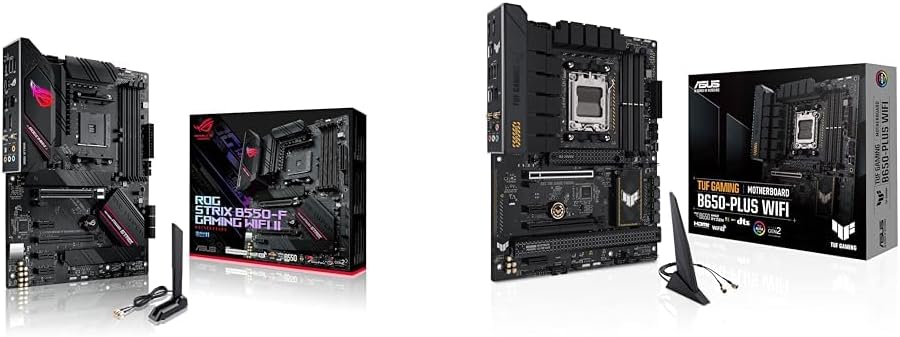
Asus ROG Strix B550-F Gaming WiFi II AMD AM4 (3rd Gen Ryzen) ATX Motherboard & TUF Gaming B650-PLUS WiFi Socket AM5 (LGA 1718) Ryzen 7000 ATX Gaming Motherboard
$150-$299This bundle offers two ATX motherboards: the ROG Strix B550-F Gaming WiFi II for AM4 Ryzen 3000/5000 CPUs with DDR4 RAM, and the TUF Gaming B650-PLUS WiFi for AM5 Ryzen 7000 CPUs with DDR5 RAM.

Game Motherboard Fit for ASROCK B650E PG-ITX WiFi B650 AM5 Motherboard Support Ryzen 7800X3D 7600/X 7950X 7700/X CPU 2xDDR5 128GB Hyper M.2 Mini-ITX
Price range unavailableThis KUETFBVC motherboard listing presents highly contradictory specifications, including a BGA 1023 socket and AMD 480 chipset, making it unsuitable for any modern Ryzen AM5 CPU.

Asus ROG Strix B550-F Gaming WiFi II AMD AM4 (3rd Gen Ryzen) ATX Gaming Motherboard (PCIe 4.0,WiFi 6E, 2.5Gb LAN, BIOS Flashback, HDMI 2.1, Addressable Gen 2 RGB Header and Aura Sync)
This is a premium-feeling AM4 board with beefy VRMs and WiFi 6E, perfect for squeezing the last drop of performance out of a Ryzen 5000 series CPU.