
GIGABYTE B650M AORUS Elite AX (AM5/ LGA 1718/ AMD B650/ Micro-ATX/ 5-Year Warranty/ DDR5/ 2* M.2/ PCIe 5.0/ USB 3.2 Gen2X2 Type-C/Intel 2.5GbE LAN/Q-Flash Plus/EZ-Latch/Gaming Motherboard)
Want the best price and purchase timing?
Our AI advisor analyzes real-time pricing across all channels to find you the best deal.
AI Verdict
A rock-solid micro-ATX board with overkill power delivery for Ryzen 7000/9000 CPUs, perfect for compact builds if you don't mind a budget audio codec and potential early boot quirks.
This board packs 12+2+2 phase power delivery and 12 rear USB ports into a micro-ATX footprint, making it ideal for powerful small-form-factor rigs. The VRM setup means you can drop in a Ryzen 9 7950X without thermal throttling. The two M.2 slots limit storage hoarding, so it fits best in gaming-focused builds rather than massive media servers.
If you need more than two NVMe drives or premium onboard audio, step up to a full ATX B650E or X670E motherboard.
Regret Score™
Low RiskLower is better — measures purchase-regret risk from real buyer complaints, review credibility, and product maturity
Issues discovered after purchase
Critically weak dimension
Amazon rating vs actual quality
Chance this product isn't for you
Pros
- 12+2+2 phase VRM easily handles flagship CPUs like the Ryzen 9 7950X without overheating
- Rear I/O is stacked with 12 USB ports, including a 20Gbps USB-C
- Includes a PCIe 5.0 M.2 slot for next-gen storage speeds
- 8-layer PCB with 2oz copper keeps board temperatures impressively low
- Q-Flash Plus allows BIOS updates without needing a CPU or RAM installed
Cons
- Uses the bottom-tier Realtek ALC897 audio codec instead of a premium option
- Only features two M.2 slots, limiting future storage expansion
- Primary PCIe x16 slot is limited to Gen 4, not Gen 5
- Multiple user reports of noticeable VRM coil whine under load, especially on rev 1.0 boards
Dimension Scores
12+2+2 60A power stages easily handle a fully loaded 7950X without breaking a sweat.
Packs 12 rear USB ports and Wi-Fi 6E, but gets dragged down by the budget ALC897 audio codec.
Standard for mATX, but being limited to two M.2 slots and a Gen 4 GPU slot restricts future-proofing.
The BIOS interface is intuitive, but early memory training bugs and CMOS clearing quirks frustrate new builders.
Best For
- Compact micro-ATX gaming builds in cases like the Thermaltake Tower 200 or Jonsbo D32
- Users pairing high-end AM5 CPUs like the 7800X3D with heavy multi-core workloads
- Builders who need massive rear USB connectivity without buying a USB hub
Not Recommended For
- Audiophiles relying on motherboard audio to drive high-impedance headphones
- Data hoarders who need more than two NVMe SSDs
Watch Out For
- Initial memory training takes forever—the red DRAM light might stay on for up to a minute on first boot, making you think it's broken.
- Using BIOS Flashback doesn't clear the CMOS, which causes RAM detection failures until you manually short the CMOS pins.
- The Wi-Fi and Ethernet drivers can be unstable out of the box; you need to download the latest Realtek or Intel drivers directly from the manufacturer.
- The M.2 slots sit directly under the primary PCIe slot, which restricts airflow and limits how thick your SSD heatsink can be.
Full Specifications
| RAM | DDR5 |
| ASIN | B0BH6XND27 |
| Brand | GIGABYTE |
| Series | B650M AORUS ELITE AX |
| Platform | Windows 11 |
| CPU Socket | Socket AM5 |
| Model Name | B650M AORUS ELITE AX |
| Item Weight | 3.7 pounds |
| Chipset Type | AMD B650 |
| Manufacturer | GIGABYTE |
| Memory Speed | 4800 MHz |
| Wireless Type | 802.11ax |
| Item model number | B650M AORUS ELITE AX |
| Compatible Devices | Personal Computer |
| Memory Clock Speed | 4800 MHz |
| Product Dimensions | 10.62 x 10.55 x 2.67 inches |
| RAM Memory Technology | DDR5 |
| Item Dimensions LxWxH | 10.62 x 10.55 x 2.67 inches |
| Memory Storage Capacity | 128 GB |
| Number of USB 2.0 Ports | 4 |
What Buyers Say
The biggest shock for most buyers is the initial boot sequence—the red DRAM light stays on so long during memory training that many assume their board is dead. Once past the initial setup, performance is rock solid, with the 8-layer PCB and VRMs running ice cold even under heavy Ryzen 9 loads. The sheer number of rear USB ports is a massive hit for peripheral-heavy setups. The budget ALC897 audio codec remains a sore spot, and the VRM coil whine lottery is a real gamble depending on which hardware revision you receive.
“Thought my board was DOA because the red DRAM light stayed on for 3 minutes, but once it finally booted it's been an absolute tank for my 7800X3D.”
Common Praise
- VRM heatsinks keep temperatures incredibly low even with a 7950X
- 12 rear USB ports eliminate the need for external hubs
- EZ-Latch system makes removing large GPUs much less painful
- Sleek aesthetic with minimal RGB appeals to stealth builds
Common Complaints
- Budget Realtek ALC897 audio sounds flat compared to older premium boards
- Noticeable VRM coil whine when moving the mouse or under CPU load
- Network drops requiring manual driver updates to fix
- Only two M.2 slots available for storage
Ownership Tips
- Boot times remain around 20-30 seconds even after memory training, which is typical for AM5 but feels slow.
- The top M.2 slot placement means your SSD bakes under the GPU exhaust.
- You have to manually short the CMOS pins if a BIOS update fails; the flashback button doesn't clear it.
- Disabling 'Memory Context Restore' in BIOS fixes random blue screens but makes boot times longer.
Frequently Asked Questions
Does this board support PCIe 5.0 for graphics cards?
No. The primary PCIe x16 slot is Gen 4. Only the top M.2 storage slot supports PCIe 5.0.
Why is my red DRAM light stuck on during the first boot?
AM5 motherboards take a long time to train DDR5 memory. Leave it alone for up to 5 minutes; if it still fails, try booting with just one stick in the A2 slot.
Does the B650M Aorus Elite AX have coil whine?
It's a known lottery. Many users report a high-pitched whine from the VRMs under load, particularly on the older revision 1.0 boards, though rev 1.2 and 1.3 seem to have improved this.
Will this fit in a standard ATX case?
Yes, micro-ATX boards fit perfectly in standard ATX cases, though it will look a bit short and leave empty space at the bottom.
How do I fix the Wi-Fi dropping randomly?
Users report that updating to the latest BIOS and installing the newest drivers directly from Realtek or Intel resolves the connection drops.
Buying Guide
When buying an AM5 micro-ATX board, you are trading expansion slots for a smaller footprint. This specific board prioritizes raw power delivery and USB connectivity over premium audio and storage capacity. You need to be prepared for a stressful first boot while the DDR5 memory trains, and you must verify which hardware revision you receive, as later versions fixed early coil whine issues. If you just want a plug-and-play gaming foundation for a 7800X3D, this is a powerhouse.
12+2+2 Phase VRM
Think of VRMs as the fuel pumps for your processor. More phases mean the power is delivered smoothly and the components don't overheat, letting you run power-hungry CPUs without crashing.
PCIe 5.0 M.2 Slot
This is the highway for your main storage drive. PCIe 5.0 doubles the speed limit of the previous generation, meaning future SSDs will load massive game worlds almost instantly.
Micro-ATX Form Factor
It's a shorter motherboard. You get the same CPU and RAM performance as a full-size board, but you lose the bottom half, meaning fewer slots for extra hard drives or capture cards.
Alternatives
If you need more than two M.2 slots or better onboard audio, look for a full-size ATX B650 motherboard. If you want PCIe 5.0 for your graphics card, you'll need to search for a B650E or X670E chipset.
You Might Also Like

JetKVM KVM Over IP ATX Extension Board, ATX Power Control Board- Only for Jet KVM Accessories Boot from Shutdown, Crash Recovery
$0-$49This is an ATX form factor power control board designed for JetKVM accessories, enabling remote PC power state management and simultaneous front panel button use.
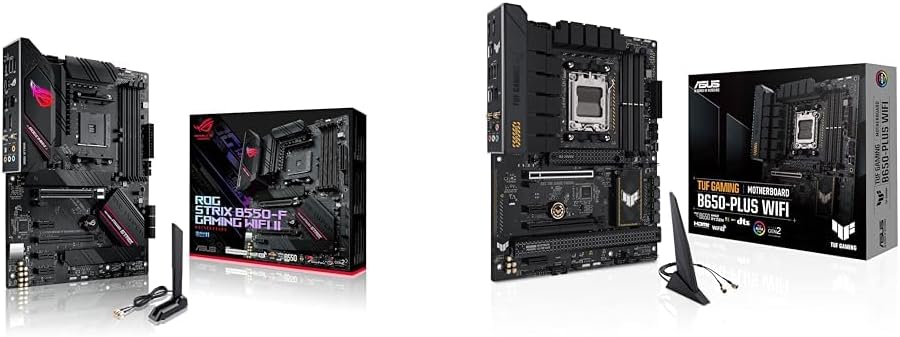
Asus ROG Strix B550-F Gaming WiFi II AMD AM4 (3rd Gen Ryzen) ATX Motherboard & TUF Gaming B650-PLUS WiFi Socket AM5 (LGA 1718) Ryzen 7000 ATX Gaming Motherboard
$150-$299This bundle offers two ATX motherboards: the ROG Strix B550-F Gaming WiFi II for AM4 Ryzen 3000/5000 CPUs with DDR4 RAM, and the TUF Gaming B650-PLUS WiFi for AM5 Ryzen 7000 CPUs with DDR5 RAM.

Game Motherboard Fit for ASROCK B650E PG-ITX WiFi B650 AM5 Motherboard Support Ryzen 7800X3D 7600/X 7950X 7700/X CPU 2xDDR5 128GB Hyper M.2 Mini-ITX
Price range unavailableThis KUETFBVC motherboard listing presents highly contradictory specifications, including a BGA 1023 socket and AMD 480 chipset, making it unsuitable for any modern Ryzen AM5 CPU.

Asus ROG Strix B550-F Gaming WiFi II AMD AM4 (3rd Gen Ryzen) ATX Gaming Motherboard (PCIe 4.0,WiFi 6E, 2.5Gb LAN, BIOS Flashback, HDMI 2.1, Addressable Gen 2 RGB Header and Aura Sync)
This is a premium-feeling AM4 board with beefy VRMs and WiFi 6E, perfect for squeezing the last drop of performance out of a Ryzen 5000 series CPU.