
ASUS Prime B660-PLUS D4 LGA 1700(Intel 12th Gen) ATX Motherboard(PCIe 4.0, DDR4,3xM.2 Slots, 2.5Gb LAN, Rear USB 3.2 Gen 2x2 Type-C, Front USB 3.2 Gen 1 Type-C, Thunderbolt 4 Header Support)
Want the best price and purchase timing?
Our AI advisor analyzes real-time pricing across all channels to find you the best deal.
AI Verdict
This barebones ATX board is strictly for entry-level i3 or non-K i5 builds, as its weak power delivery will severely throttle anything more demanding like an i7.
This board only makes sense if you are strictly using a 65W processor like the i5-12400F and already own DDR4 memory. Pushing higher-wattage CPUs overloads the basic 8-pin power delivery, and the BIOS struggles with automated RAM overclocking.
If you plan to use an i7-12700K or higher, upgrade to a board with a 12+1 or 14+1 power phase design for adequate VRM cooling.
Regret Score™
Medium RiskLower is better — measures purchase-regret risk from real buyer complaints, review credibility, and product maturity
Issues discovered after purchase
Critically weak dimension
Amazon rating vs actual quality
Chance this product isn't for you
Pros
- Includes three M.2 slots for storage expansion, though the third is limited to PCIe 4.0 x2 speeds.
- Rear I/O features a 20Gbps USB 3.2 Gen 2x2 Type-C port for fast external drives.
- 2.5Gb Ethernet comes standard for high-speed wired networking.
- Retains DDR4 memory support, allowing you to reuse existing 3200MHz RAM kits from older builds.
Cons
- Weak VRM cooling throttles an i7-12700 by 11% under heavy multi-core loads.
- Enabling XMP profiles causes boot loops for many users, forcing them to manually tune RAM timings.
- Using multiple monitors on the integrated graphics often results in a black screen before BIOS.
- Older SATA SSDs frequently disappear from the boot menu unless you manually enable CSM legacy mode.
Dimension Scores
Struggles to power anything above a 65W i5, throttling i7 chips by 11% in thermal tests.
Includes a 20Gbps USB-C port and 2.5Gb LAN, but lacks integrated Wi-Fi or a pre-installed I/O shield.
Offers three M.2 slots and four SATA ports, though the third M.2 is limited to x2 speeds.
Plagued by XMP memory training failures and integrated graphics multi-monitor boot bugs.
Best For
- Entry-level gaming rigs pairing an i3-12100F or i5-12400F with a mid-range GPU.
- Basic home office builds needing 2.5Gb LAN for fast NAS file transfers.
- Reusing an existing DDR4-3200 RAM kit when upgrading from an older Intel generation.
Not Recommended For
- Anyone running an Intel Core i7 or i9 processor that draws over 125 watts.
- Multi-monitor setups relying solely on Intel integrated graphics.
Watch Out For
- XMP instability is rampant — you will likely need to manually set your RAM to 2933MHz or 3000MHz to stop the constant boot loops.
- The third M.2 slot only runs at half speed (x2 bandwidth), so your 7000MB/s Gen4 drive will cap out around 3500MB/s.
- If you are migrating an older Windows install on a SATA SSD, the board won't see the drive until you dig into the BIOS and enable legacy CSM mode.
- The VRM heatsinks are purely cosmetic for high-end chips; TechSpot testing showed it physically cannot supply enough sustained power for a 12700K without thermal throttling.
Full Specifications
| RAM | DDR4 |
| ASIN | B09NWDQ1TH |
| Brand | ASUS |
| Series | PRIME B660-PLUS D4 |
| Platform | Windows 10 |
| CPU Model | Pentium |
| Processor | pentium |
| CPU Socket | LGA 1700 |
| Model Name | PRIME B660-PLUS D4 |
| Item Weight | 2.31 pounds |
| Chipset Type | Intel B660 |
| Manufacturer | ASUS |
| Memory Speed | 3866 MHz |
| Item model number | PRIME B660-PLUS D4 |
| Compatible Devices | 12th Gen Intel Core |
| Memory Clock Speed | 3866 MHz |
| Product Dimensions | 13 x 10.5 x 2.25 inches |
| Compatible Processors | Intel Celeron, Intel Pentium Gold |
| RAM Memory Technology | DDR4 |
| Item Dimensions LxWxH | 13 x 10.5 x 2.25 inches |
| Number of USB 2.0 Ports | 4 |
What Buyers Say
The biggest headache buyers face is getting this board to boot properly on day one. Forums are flooded with complaints about XMP profiles causing infinite boot loops, forcing people to manually tune their DDR4 memory just to reach Windows. Another massive hurdle is drive recognition, as older SATA SSDs vanish from the BIOS until users manually toggle legacy CSM settings. Surviving the initial setup yields a stable system for a 65W i5-12400F, but dropping an i7 into this socket causes the VRMs to overheat and throttle CPU performance.
“Spent 4 hours trying to figure out why my PC wouldn't post, turns out the board hates my Corsair RAM's XMP profile and I had to manually type in the timings just to install Windows.”
Common Praise
- 2.5Gb Ethernet port maxes out gigabit fiber connections without dropping packets.
- Rear 20Gbps USB-C port transfers large video files to external SSDs in seconds.
- Physical layout leaves plenty of clearance between the CPU socket and the top PCIe slot for massive air coolers.
- Runs completely stable once paired with a low-wattage i3 or i5 processor.
Common Complaints
- Enabling XMP for 3200MHz RAM instantly causes a yellow DRAM error light and a boot loop.
- Plugging two monitors into the motherboard's HDMI and DisplayPort causes a black screen before the BIOS.
- VRM heatsinks get physically too hot to touch when running multi-core rendering tasks.
- Older Windows boot drives are invisible until digging through advanced BIOS menus to enable CSM.
Ownership Tips
- The lack of a pre-installed I/O shield means you have to be careful not to bend the metal prongs into the USB ports during case installation.
- BIOS updates over the last year have not fixed the multi-monitor iGPU bug, requiring a dedicated graphics card for dual screens.
- The top M.2 slot sits directly under the GPU exhaust, causing Gen4 drives to run 5-10 degrees hotter during gaming.
Frequently Asked Questions
Why is my PC stuck in a boot loop after enabling XMP?
The BIOS struggles with memory training on many 3200MHz+ kits. You need to boot in safe mode, disable XMP, and manually input your RAM timings and voltage.
Will this motherboard bottleneck an i7-12700K?
Yes. Hardware reviewers found the VRMs overheat under sustained multi-core loads, dropping the i7's performance by roughly 11%.
Why isn't my old SATA SSD showing up in the boot menu?
The board defaults to UEFI-only booting. You must go into the BIOS boot tab and enable CSM (Compatibility Support Module) to see legacy drives.
Can I use three NVMe SSDs at full speed?
No. While it has three M.2 slots, the bottom slot is wired for PCIe 4.0 x2, cutting maximum transfer speeds in half.
Does this board have built-in Wi-Fi or Bluetooth?
No. You will need to buy a separate PCIe Wi-Fi card or use the included 2.5Gb Ethernet port for internet.
Buying Guide
You are buying a barebones foundation for a basic PC, not a platform for high-end hardware. The power delivery system on this board is physically incapable of feeding high-wattage processors without overheating. You also need to be comfortable tinkering in the BIOS, because automated memory profiles and older storage drives often fail to work out of the box. Stick to 65W processors and be prepared to manually set your RAM speeds.
VRM (Voltage Regulator Module)
Think of this as the plumbing that delivers electricity to your CPU. This board has narrow pipes, so power-hungry chips like an i7 will literally starve and slow down to prevent a fire.
PCIe 4.0 x2 M.2 Slot
This is a speed limit for your storage. While standard slots use four lanes (x4) for maximum speed, this slot only uses two, cutting your expensive SSD's top speed in half.
XMP (Extreme Memory Profile)
This is a one-click factory overclock for your RAM. On this board, clicking it often crashes the PC, meaning you have to act as the mechanic and tune the engine yourself.
Alternatives
Search for a B660 or B760 motherboard with a '12+1' or higher power phase design and integrated Wi-Fi 6 if you plan to run an Intel Core i7.
You Might Also Like

JetKVM KVM Over IP ATX Extension Board, ATX Power Control Board- Only for Jet KVM Accessories Boot from Shutdown, Crash Recovery
$0-$49This is an ATX form factor power control board designed for JetKVM accessories, enabling remote PC power state management and simultaneous front panel button use.
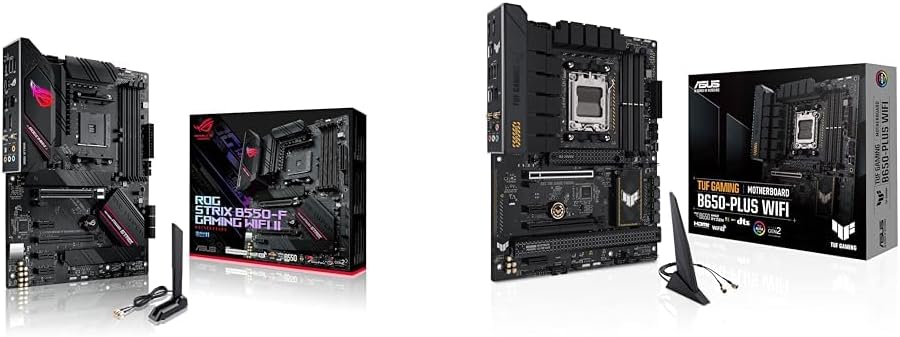
Asus ROG Strix B550-F Gaming WiFi II AMD AM4 (3rd Gen Ryzen) ATX Motherboard & TUF Gaming B650-PLUS WiFi Socket AM5 (LGA 1718) Ryzen 7000 ATX Gaming Motherboard
$150-$299This bundle offers two ATX motherboards: the ROG Strix B550-F Gaming WiFi II for AM4 Ryzen 3000/5000 CPUs with DDR4 RAM, and the TUF Gaming B650-PLUS WiFi for AM5 Ryzen 7000 CPUs with DDR5 RAM.

Game Motherboard Fit for ASROCK B650E PG-ITX WiFi B650 AM5 Motherboard Support Ryzen 7800X3D 7600/X 7950X 7700/X CPU 2xDDR5 128GB Hyper M.2 Mini-ITX
Price range unavailableThis KUETFBVC motherboard listing presents highly contradictory specifications, including a BGA 1023 socket and AMD 480 chipset, making it unsuitable for any modern Ryzen AM5 CPU.

Asus ROG Strix B550-F Gaming WiFi II AMD AM4 (3rd Gen Ryzen) ATX Gaming Motherboard (PCIe 4.0,WiFi 6E, 2.5Gb LAN, BIOS Flashback, HDMI 2.1, Addressable Gen 2 RGB Header and Aura Sync)
This is a premium-feeling AM4 board with beefy VRMs and WiFi 6E, perfect for squeezing the last drop of performance out of a Ryzen 5000 series CPU.