
ASUS ROG Strix B550-F Gaming WiFi II AMD Socket AM4 ATX DDR4 Motherboard
Want the best price and purchase timing?
Our AI advisor analyzes real-time pricing across all channels to find you the best deal.
AI Verdict
A rock-solid AM4 board with 12+2 power stages perfect for a 5800X3D, but the missing front USB-C header leaves modern case ports dead.
The 12+2 power stages and BIOS FlashBack make it an excellent foundation for maxing out the AM4 platform with a 5800X3D. The lack of a front USB-C header and the frustrating out-of-the-box Windows 11 WiFi driver experience make it a hassle for modern case swaps.
If your case has a front USB-C port, look for a board explicitly listing a 'USB 3.2 Gen 2 Type-C front panel header'.
Regret Score™
Low RiskLower is better — measures purchase-regret risk from real buyer complaints, review credibility, and product maturity
Issues discovered after purchase
Critically weak dimension
Amazon rating vs actual quality
Chance this product isn't for you
Pros
- 12+2 teamed power stages easily handle high-end chips like the Ryzen 9 5950X without VRM overheating
- Rear I/O includes a dedicated BIOS FlashBack button to update firmware via USB without a CPU installed
- SupremeFX 7.1 audio codec supports 32-bit/192kHz playback, outperforming standard ALC892 chips
- Includes 8 rear USB ports and a pre-installed I/O shield for easier case installation
Cons
- Zero front panel USB-C headers — your case's Type-C port will be a dead plug
- Windows 11 installation cannot detect the MediaTek WiFi 6E chip without manually loading drivers from a USB stick
- Installing a drive in the second M.2 slot permanently disables SATA ports 5 and 6
- Intel 2.5Gb Ethernet controller is prone to random dropouts requiring specific driver rollbacks
Dimension Scores
12+2 teamed power stages with large alloy heatsinks easily sustain maximum boost clocks on a 5950X.
Includes WiFi 6E, BIOS FlashBack, and SupremeFX audio, but loses points for omitting a front USB-C header.
Standard dual M.2 slots, but the second slot runs at PCIe 3.0 and disables two SATA ports when populated.
The ASUS UEFI remains highly intuitive for setting DOCP memory profiles, though Armoury Crate prompts can be intrusive.
Best For
- Upgrading to a Ryzen 7 5800X3D using the BIOS FlashBack feature
- High-airflow ATX builds utilizing the 6 onboard PWM fan headers
- Users needing high-quality onboard audio for high-impedance headphones
Not Recommended For
- PC cases featuring a front-panel USB Type-C port
- Plug-and-play Windows 11 setups without access to a second PC for downloading network drivers
Watch Out For
- No front USB-C header — you must buy a PCIe to USB-C internal adapter card to use your case's front Type-C port.
- Windows 11 lacks native MediaTek WiFi 6E drivers — you will be stuck at the network setup screen unless you download the drivers to a USB drive beforehand.
- Populating the bottom M.2 slot disables SATA ports 5 and 6, limiting you to four SATA drives if you use dual NVMe SSDs.
- The motherboard has an extra 4-pin CPU power connector, but you only need to plug in the primary 8-pin cable unless you are doing extreme liquid nitrogen overclocking.
Full Specifications
| RAM | 2.5 GB DDR4 |
| ASIN | B09LVQCMK4 |
| Brand | ASUS |
| Series | ROG STRIX B550-F GAMING |
| Language | English |
| Platform | Windows 11 |
| Batteries | 1 Lithium Ion batteries required. |
| CPU Model | Ryzen 3 |
| Processor | ryzen_3 |
| CPU Socket | Socket AM4 |
| Model Name | ROG STRIX B550-F GAMING |
| Item Weight | 2.92 pounds |
| Chipset Type | AMD B550 |
| Manufacturer | ASUS |
| Memory Speed | 2133 MHz |
| Wireless Type | 802.11ax |
| Flash Memory Size | 8 GB |
| Item model number | 90MB19V0-M0EAY0 |
| Compatible Devices | Personal Computer |
| Memory Clock Speed | 2133 MHz |
| Product Dimensions | 12.01 x 9.21 x 1.57 inches |
| Computer Memory Type | DIMM |
| Compatible Processors | AMD Ryzen 3000, AMD Ryzen 5000 series, AMD 4000 and 5000 G-series |
| RAM Memory Technology | DDR4 |
| Item Dimensions LxWxH | 12.01 x 9.21 x 1.57 inches |
| Number of USB 2.0 Ports | 1 |
| Standing screen display size | 75 |
What Buyers Say
The 12+2 power stages and massive VRM heatsinks easily handle top-tier AM4 CPUs like the 5800X3D. The BIOS FlashBack feature saves builders from needing an older CPU just to update the firmware. The most frequent complaint is the baffling omission of a front-panel USB-C header, leaving modern case ports completely dead. Network setup is another major pain point, as Windows 11 cannot detect the MediaTek WiFi 6E chip without manual driver installation via a USB stick.
“Great VRMs for my 5800X3D and it looks awesome, but seriously Asus, no front USB-C header on a modern board?!”
Common Praise
- BIOS FlashBack button on the rear I/O makes updating for Ryzen 5000 CPUs effortless
- 12+2 power stages keep VRM temperatures low even during heavy multi-core workloads
- SupremeFX audio codec drives high-impedance headphones noticeably better than budget boards
- Pre-installed I/O shield prevents the classic mistake of forgetting to install it before the motherboard
Common Complaints
- Zero front-panel USB-C headers means the Type-C port on modern cases does nothing
- Windows 11 setup requires a separate PC to download the MediaTek WiFi 6E drivers
- Using the second M.2 slot disables SATA ports 5 and 6
- Intel 2.5Gb Ethernet controller drops connection for some users, requiring driver rollbacks
Ownership Tips
- You must download the MediaTek WiFi 6E drivers to a USB stick before starting your Windows installation
- Disable the 'Download & Install Armoury Crate' option in the BIOS to prevent Asus bloatware from auto-installing
- The secondary PCIe x16 slot shares bandwidth with the x1 slots and drops to x1 speed if they are populated
Frequently Asked Questions
Does this board support Ryzen 5000 CPUs out of the box?
Yes, the 'II' revision comes with a Ryzen 5000-ready BIOS. If you get old stock, you can use the BIOS FlashBack button on the rear I/O to update it using just a USB stick and power supply.
Does it have a header for my case's front USB-C port?
No. It only features USB 3.2 Gen 1 and USB 2.0 internal headers. Your front USB-C port will be unusable unless you buy a separate PCIe adapter card.
Do I need to plug in both the 8-pin and 4-pin CPU power cables?
No. The primary 8-pin connector provides more than enough wattage for any AM4 processor, including the 5950X. The extra 4-pin is strictly for extreme competitive overclocking.
Why isn't my WiFi showing up during Windows installation?
Windows does not include native drivers for the onboard MediaTek WiFi 6E chip. You must download the driver on another computer, put it on a USB drive, and load it during setup.
Can I use both M.2 slots and all six SATA ports at the same time?
No. Installing an NVMe SSD in the second M.2 slot shares bandwidth with the chipset and completely disables SATA ports 5 and 6.
Buying Guide
When buying an AM4 motherboard this late in the platform's life, you are likely dropping in a high-end chip like the 5800X3D. You need strong power delivery to prevent throttling and a BIOS FlashBack button in case the board ships with outdated firmware. This board delivers on both fronts, but it relies on an older layout. That means it skips the internal USB-C header required to power the Type-C port on the front of most modern PC cases.
12+2 Power Stages (VRM)
Think of this as the engine's fuel delivery system. More stages mean cleaner, more stable electricity reaches your CPU, preventing crashes and overheating when running demanding games.
BIOS FlashBack
A physical button on the back that acts like a factory reset and update tool. It lets you install the latest motherboard software using just a USB stick, without needing a processor or RAM installed.
WiFi 6E
The newest wireless standard that opens up a 6GHz fast lane. If you have a matching router, it cuts through neighborhood wireless interference to give you lower ping in multiplayer games.
Alternatives
If you need your case's front USB-C port to work, search for AM4 boards that explicitly list a 'USB 3.2 Gen 2 Type-C front panel header' in their internal I/O specs.
You Might Also Like

JetKVM KVM Over IP ATX Extension Board, ATX Power Control Board- Only for Jet KVM Accessories Boot from Shutdown, Crash Recovery
$0-$49This is an ATX form factor power control board designed for JetKVM accessories, enabling remote PC power state management and simultaneous front panel button use.
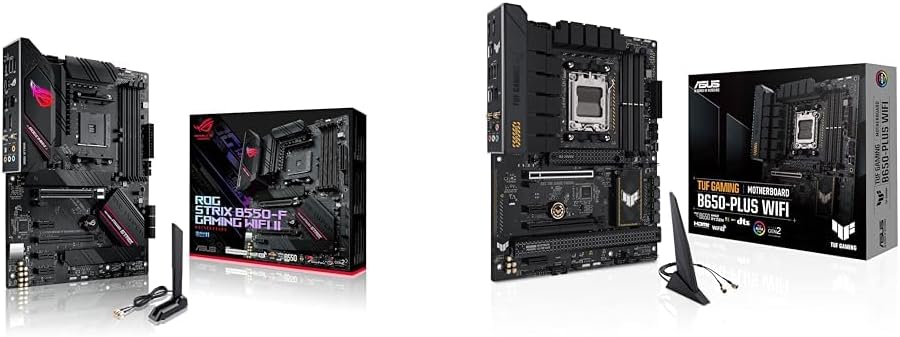
Asus ROG Strix B550-F Gaming WiFi II AMD AM4 (3rd Gen Ryzen) ATX Motherboard & TUF Gaming B650-PLUS WiFi Socket AM5 (LGA 1718) Ryzen 7000 ATX Gaming Motherboard
$150-$299This bundle offers two ATX motherboards: the ROG Strix B550-F Gaming WiFi II for AM4 Ryzen 3000/5000 CPUs with DDR4 RAM, and the TUF Gaming B650-PLUS WiFi for AM5 Ryzen 7000 CPUs with DDR5 RAM.

Game Motherboard Fit for ASROCK B650E PG-ITX WiFi B650 AM5 Motherboard Support Ryzen 7800X3D 7600/X 7950X 7700/X CPU 2xDDR5 128GB Hyper M.2 Mini-ITX
Price range unavailableThis KUETFBVC motherboard listing presents highly contradictory specifications, including a BGA 1023 socket and AMD 480 chipset, making it unsuitable for any modern Ryzen AM5 CPU.

Asus ROG Strix B550-F Gaming WiFi II AMD AM4 (3rd Gen Ryzen) ATX Gaming Motherboard (PCIe 4.0,WiFi 6E, 2.5Gb LAN, BIOS Flashback, HDMI 2.1, Addressable Gen 2 RGB Header and Aura Sync)
This is a premium-feeling AM4 board with beefy VRMs and WiFi 6E, perfect for squeezing the last drop of performance out of a Ryzen 5000 series CPU.