
ASUS Micro-ATX Motherboard (Intel H510 LGA 1200 with PCIe 4.0, 32Gbps M.2 Slot, Intel 1GB Ethernet, HDMI, D-Sub, USB 3.2 Gen 1 Type-A, SATA 6Gbps, COM Port and RGB Connector), Black
Want the best price and purchase timing?
Our AI advisor analyzes real-time pricing across all channels to find you the best deal.
AI Verdict
This is a barebones LGA 1200 motherboard for budget 10th or 11th Gen Intel builds. Buy it for a basic office PC, but skip it if you need multiple case fans.
This board strictly serves budget builders using older LGA 1200 processors. The single M.2 slot, bare VRMs, and single fan header severely limit upgrade paths, but it provides a functional foundation for a locked 65W CPU.
If you want to run an i5 or i7 with unlocked power limits, step up to a B560 motherboard with VRM heatsinks and four RAM slots.
Regret Score™
Very High RiskLower is better — measures purchase-regret risk from real buyer complaints, review credibility, and product maturity
Issues discovered after purchase
Critically weak dimension
Amazon rating vs actual quality
Chance this product isn't for you
Pros
- Supports PCIe 4.0 x16 for modern GPUs when paired with an 11th Gen Intel CPU
- Includes a 32Gbps M.2 slot for fast NVMe SSD storage
- ASUS UEFI BIOS provides a simple one-click toggle for RAM XMP profiles
- Micro-ATX form factor fits into compact 15-liter budget PC cases
Cons
- Features exactly one chassis fan header, requiring a splitter for multi-fan cases
- VRM lacks heatsinks and thermal throttles if you remove power limits on an i5-11400
- Installing a SATA-based M.2 drive completely disables the SATA6G_2 port
- Caps RAM speeds at 2666MHz when using 10th Gen Intel Core i3 or i5 processors
Dimension Scores
Bare VRMs without heatsinks struggle to handle anything beyond a locked 65W processor.
Lacks built-in Wi-Fi and only provides a single chassis fan header, though the 32Gbps M.2 slot is a plus.
Limited to two RAM slots, one M.2 slot, and plugging in a SATA M.2 disables one of the four SATA ports.
The ASUS UEFI remains intuitive and makes enabling XMP or adjusting fan curves straightforward.
Best For
- Basic home office PCs using 65W 10th or 11th Gen Intel Core i3 processors
- Ultra-budget 1080p gaming builds pairing an i5-11400F with an RTX 3060
- Compact Micro-ATX builds where physical case space is the primary constraint
Not Recommended For
- Overclocking or running unlocked K-series Intel processors
- Builds requiring multiple NVMe SSDs without using PCIe adapter cards
- Cases with three or more fans unless you buy a separate SATA-powered fan hub
Watch Out For
- The board only has one case fan header — you absolutely need to buy a $5 PWM fan splitter if your case has front and rear fans.
- Fresh Windows 10 installs often fail to recognize the Intel 1Gb Ethernet port, throwing a Code 10 error until you manually install LAN drivers from a USB drive.
- If you populate the M.2 slot with a SATA SSD instead of an NVMe drive, the second SATA port on the board gets permanently disabled.
- Removing the 65W power limit on 6-core CPUs like the i5-11400 will cause the bare VRMs to overheat and throttle your system.
Full Specifications
| ASIN : | B091D6L2M7 |
| Language : | English |
| Manufacturer : | ASUS Spain |
| Item model number : | 90MB17N0-M0EAY0 |
| Product Dimensions : | 7.99 x 8.9 x 4.09 inches; 1.65 Pounds |
| Date First Available : | September 29, 2021 |
What Buyers Say
The single chassis fan header catches almost every first-time builder off guard, forcing them to pause their build to order a splitter. Buyers consistently report rock-solid stability when pairing the board with 65W CPUs like the i3-10100 or i5-11400. Network driver issues plague fresh Windows 10 installs, requiring a secondary PC to download the Intel LAN drivers to a flash drive. The lack of VRM heatsinks means anyone trying to unlock CPU power limits quickly runs into thermal throttling.
“Great cheap board for my i3 office build but I spent an hour looking for a second fan header that doesn't exist, buy a splitter!”
Common Praise
- ASUS BIOS interface makes enabling XMP profiles a one-click process
- PCIe 4.0 support works flawlessly with 11th Gen CPUs and modern GPUs
- Micro-ATX dimensions easily clear bulky power supplies in compact cases
- Audio output is surprisingly clean thanks to dedicated PCB shielding layers
Common Complaints
- Only one system fan header exists on the entire board
- Windows 10 installer does not recognize the Ethernet port natively
- VRMs run extremely hot if you push a 6-core CPU past its base clock
- Using a SATA M.2 drive kills one of the standard SATA ports
Ownership Tips
- The I/O shield is flimsy and requires extra care to avoid bending the metal prongs into the USB ports.
- Boot times are incredibly fast once Windows is installed on an NVMe drive.
- The single green power LED on the board stays illuminated even when the PC is shut down.
Frequently Asked Questions
Is this motherboard compatible with the Intel Core i5-11400F?
Yes, it supports the i5-11400F out of the box. Leave the CPU at its default 65W power limit, as the board's VRMs get too hot if you unlock the power draw.
Can I install an RTX 3060 or 3060 Ti on this board?
Yes, the PCIe x16 slot runs an RTX 3060 perfectly. If you use an 11th Gen CPU, the slot runs at full PCIe 4.0 speeds.
How do I add a second M.2 SSD to this motherboard?
You cannot plug a second M.2 directly into the board. You must buy a PCIe-to-M.2 adapter card and install it in the small PCIe 3.0 x1 slot, or buy a standard 2.5-inch SATA SSD instead.
Does the ASUS PRIME H510M-K have built-in Wi-Fi or Bluetooth?
No, it only has a 1Gb Ethernet port. You need to buy a separate USB Wi-Fi dongle or a PCIe Wi-Fi card to connect wirelessly.
Why is my RAM stuck at 2666MHz even though I bought a 3200MHz kit?
The H510 chipset limits RAM speed based on your CPU. If you use a 10th Gen i3 or i5, the maximum supported speed is 2666MHz regardless of your RAM's XMP profile.
Buying Guide
You are buying a barebones foundation for an older LGA 1200 processor. This board gives you exactly what you need to make the PC turn on and nothing more. You must plan your cooling ahead of time because you only get one plug for case fans. Skip this board if you plan to upgrade to a high-end Core i7 or i9 later, as the bare power delivery system cannot handle the heat.
H510 Chipset
This is the brain of the motherboard. It is the entry-level version, meaning it restricts overclocking and limits how many USB ports and hard drives you can connect compared to B560 or Z590 boards.
LGA 1200 Socket
This is the physical slot for the processor. It only fits Intel 10th and 11th Generation CPUs. A newer 12th or 13th Gen Intel CPU will physically not fit in this socket.
Micro-ATX Form Factor
This dictates the physical size of the board. It is shorter than a standard ATX board, which saves space but sacrifices extra slots for capture cards or sound cards.
Alternatives
Search for a 'B560 Micro-ATX motherboard' if you need four RAM slots, built-in Wi-Fi, or VRM heatsinks to run an unlocked processor.
You Might Also Like

JetKVM KVM Over IP ATX Extension Board, ATX Power Control Board- Only for Jet KVM Accessories Boot from Shutdown, Crash Recovery
$0-$49This is an ATX form factor power control board designed for JetKVM accessories, enabling remote PC power state management and simultaneous front panel button use.
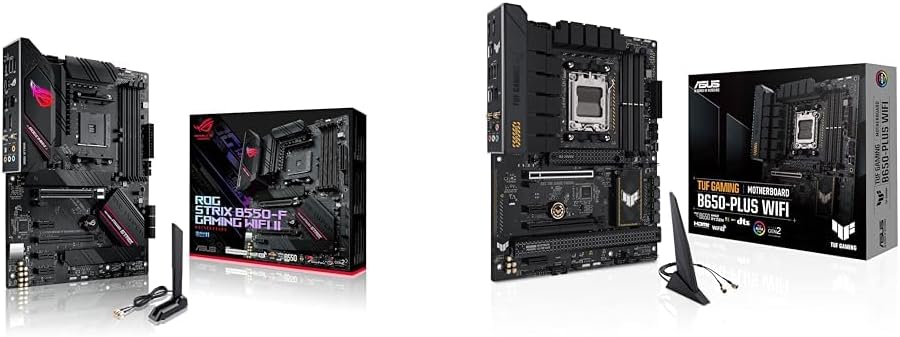
Asus ROG Strix B550-F Gaming WiFi II AMD AM4 (3rd Gen Ryzen) ATX Motherboard & TUF Gaming B650-PLUS WiFi Socket AM5 (LGA 1718) Ryzen 7000 ATX Gaming Motherboard
$150-$299This bundle offers two ATX motherboards: the ROG Strix B550-F Gaming WiFi II for AM4 Ryzen 3000/5000 CPUs with DDR4 RAM, and the TUF Gaming B650-PLUS WiFi for AM5 Ryzen 7000 CPUs with DDR5 RAM.

Game Motherboard Fit for ASROCK B650E PG-ITX WiFi B650 AM5 Motherboard Support Ryzen 7800X3D 7600/X 7950X 7700/X CPU 2xDDR5 128GB Hyper M.2 Mini-ITX
Price range unavailableThis KUETFBVC motherboard listing presents highly contradictory specifications, including a BGA 1023 socket and AMD 480 chipset, making it unsuitable for any modern Ryzen AM5 CPU.

Asus ROG Strix B550-F Gaming WiFi II AMD AM4 (3rd Gen Ryzen) ATX Gaming Motherboard (PCIe 4.0,WiFi 6E, 2.5Gb LAN, BIOS Flashback, HDMI 2.1, Addressable Gen 2 RGB Header and Aura Sync)
This is a premium-feeling AM4 board with beefy VRMs and WiFi 6E, perfect for squeezing the last drop of performance out of a Ryzen 5000 series CPU.