
GIGABYTE B550M DS3H AC Motherboard, Supports AMD AM4 Ryzen 5000 Processors, Micro-ATX, DDR4, Dual M.2, SATA 6Gb/s, Intel 802.11a/b/g/n/ac, Realtek GbE LAN, PCIe 4.0
Want the best price and purchase timing?
Our AI advisor analyzes real-time pricing across all channels to find you the best deal.
AI Verdict
This is a barebones Micro-ATX board that gets a Ryzen 5000 CPU and a PCIe 4.0 GPU running without extra frills, perfect for a budget 1080p gaming build.
The B550 chipset and PCIe 4.0 support make this a solid foundation for a Ryzen 5 5600 build. The weak 5+3 phase VRM and lack of USB-C mean it struggles to support high-core-count CPUs or modern case front panels.
Look for a board with a 10+2 phase VRM and an internal USB 3.2 Gen 2 Type-C header if you plan to run a Ryzen 7 5800X3D.
Regret Score™
Medium RiskLower is better — measures purchase-regret risk from real buyer complaints, review credibility, and product maturity
Issues discovered after purchase
Critically weak dimension
Amazon rating vs actual quality
Chance this product isn't for you
Pros
- Includes Q-Flash Plus button to update the BIOS via USB without needing an older CPU installed
- Top PCIe x16 slot and primary M.2 slot both support full PCIe 4.0 bandwidth for current-gen GPUs and SSDs
- Supports up to 128GB of DDR4 memory running at 4733 MHz via XMP
- Built-in Intel 802.11ac Wi-Fi module saves you from buying a separate PCIe wireless card
Cons
- Only provides three total fan headers (one CPU, two system), requiring splitters for standard ATX cases
- Rear I/O lacks any USB Type-C ports, offering only standard USB Type-A
- The 5+3 phase VRM hits 90°C under heavy load with Ryzen 9 processors, limiting overclocking headroom
- Wireless card is capped at Wi-Fi 5 speeds (433 Mbps) and older Bluetooth 4.2
Dimension Scores
The 5+3 phase design uses basic 4C10N/4C06N mosfets that reach 90°C under heavy Ryzen 9 loads.
Includes Q-Flash Plus and dual M.2 slots, but relies on older Wi-Fi 5 and Bluetooth 4.2 standards.
Provides one PCIe 4.0 x16 slot for the GPU, but the secondary M.2 slot is severely bottlenecked at PCIe 3.0 x2.
The Gigabyte BIOS interface is straightforward and the Q-Flash Plus feature works reliably without a CPU installed.
Best For
- First-time builders pairing a Ryzen 5 5600X with a mid-range GPU in a Micro-ATX case
- Living room media PCs relying on the built-in Wi-Fi 5 connection
- Upgrading an older AM4 system to PCIe 4.0 storage speeds
Not Recommended For
- Overclockers pushing 105W TDP chips like the Ryzen 9 5900X
- Cases with front-panel USB-C ports since there is no internal Type-C header
Watch Out For
- Out-of-the-box BIOS often doesn't support Ryzen 5000 series chips — you must download the latest BIOS to a FAT32 flash drive and use the Q-Flash button before booting.
- Only two system fan headers exist on the board — you need to buy Y-splitters or a fan hub to run three front intake fans.
- The secondary M.2 slot only runs at PCIe 3.0 x2 speeds, cutting the read/write performance of a Gen3 NVMe drive in half.
- The I/O shield is a flimsy separate metal plate, not pre-installed, meaning you have to snap it into the case before mounting the board.
Full Specifications
| RAM | DDR4 |
| ASIN | B08R5736B3 |
| Brand | GIGABYTE |
| Series | B550M DS3H AC |
| Platform | Windows |
| Batteries | 1 Lithium Ion batteries required. |
| CPU Model | Ryzen 3 |
| Processor | ryzen_3 |
| CPU Socket | Socket AM4 |
| Model Name | B550M DS3H AC |
| Item Weight | 2.09 pounds |
| Chipset Type | AMD B550 |
| Manufacturer | GIGABYTE |
| Memory Speed | 4733 MHz |
| Wireless Type | 802.11ac |
| Item model number | B550M DS3H AC |
| Compatible Devices | Personal Computer |
| Memory Clock Speed | 4733 MHz |
| Product Dimensions | 13.18 x 10.62 x 3.14 inches |
| Compatible Processors | AMD 3rd Generation Ryzen |
| RAM Memory Technology | DDR4 |
| Item Dimensions LxWxH | 13.18 x 10.62 x 3.14 inches |
| Number of USB 2.0 Ports | 2 |
What Buyers Say
The Q-Flash Plus feature saves countless builds, letting you flash the BIOS for Ryzen 5000 chips using just a thumb drive before installing any parts. The VRM heatsink is purely cosmetic for higher-end chips, with temperatures spiking past 90°C when running a Ryzen 7 5800X3D. Cable management gets messy quickly because the two system fan headers are clustered near the bottom edge. The built-in Wi-Fi 5 module maxes out at 433 Mbps, which forces heavy downloaders to run an Ethernet cable anyway.
“Spent 3 hours wondering why my 5600x wouldnt post until I realized I had to rename the bios file to GIGABYTE.bin on a fat32 usb drive, but after that it runs my games perfectly fine.”
Common Praise
- Q-Flash Plus updates the BIOS in five minutes without needing a CPU or RAM installed
- Top PCIe 4.0 slot handles heavy GPUs like the RX 6800 XT without bandwidth bottlenecks
- Included Wi-Fi antennas have long cables for easy desk placement
- Recognizes 3600 MHz DDR4 RAM kits instantly after enabling XMP in the BIOS
Common Complaints
- Only two system fan headers require buying splitters for standard three-fan cases
- Realtek ALC887 audio chip produces static crackling under heavy GPU loads
- Secondary M.2 slot disables SATA ports when populated and runs at half speed
- No integrated I/O shield makes installation feel cheap and requires extra care
Ownership Tips
- The Bluetooth 4.2 connection drops wireless headphones if you walk more than 10 feet away from the antennas
- The bottom PCIe x1 slot gets completely blocked if you install a standard two-slot graphics card
- Gigabyte's RGB Fusion software frequently fails to recognize 3-pin ARGB case fans after Windows wakes from sleep
Frequently Asked Questions
Do I need an older CPU to update the BIOS for a Ryzen 5000 chip?
No. You can use the Q-Flash Plus button on the rear I/O to flash the BIOS using just a USB stick and the power supply.
Does this board have Bluetooth?
Yes, it includes Bluetooth 4.2 built into the Intel Wi-Fi card.
Can I plug my case's front USB-C cable into this motherboard?
No. There is no internal USB Type-C header, only standard USB 3.2 Gen 1 and USB 2.0 headers.
How many M.2 SSDs can I install?
Two. The top slot supports PCIe 4.0 x4 speeds, while the bottom slot is limited to PCIe 3.0 x2.
Will this motherboard fit in a standard ATX mid-tower case?
Yes. It uses the Micro-ATX form factor, which mounts perfectly into standard ATX and Micro-ATX cases.
How many case fans can I connect directly to the board?
You can connect two case fans to the SYS_FAN headers and one CPU cooler to the CPU_FAN header.
Buying Guide
You are buying the absolute minimum required to get a modern AMD processor running. The B550 chipset gives you the PCIe 4.0 speeds you need for current graphics cards and fast SSDs. You sacrifice creature comforts like pre-installed I/O shields, USB-C ports, and extra fan headers to hit this tier. Plan your cooling setup carefully, as you will absolutely need fan splitters to run a standard intake/exhaust setup.
5+3 Phase VRM
Think of the VRM as the engine that pumps electricity to your processor. A 5+3 phase is a 4-cylinder engine — great for a standard Ryzen 5, but it will overheat if you try to tow a massive Ryzen 9.
PCIe 4.0 x16
This is the highway connecting your graphics card to the motherboard. Version 4.0 doubles the speed limit of the older 3.0 standard, ensuring your GPU never waits in traffic for data.
Q-Flash Plus
Motherboards often ship with old software that doesn't recognize new processors. This button lets you update the software using a USB stick, acting like a backdoor key so you don't need to borrow an older CPU just to turn the PC on.
Alternatives
Search for a B550 board with a '10+2 phase VRM', 'Wi-Fi 6', and an 'integrated I/O shield' if you plan to run a Ryzen 7 or 9 processor.
You Might Also Like

JetKVM KVM Over IP ATX Extension Board, ATX Power Control Board- Only for Jet KVM Accessories Boot from Shutdown, Crash Recovery
$0-$49This is an ATX form factor power control board designed for JetKVM accessories, enabling remote PC power state management and simultaneous front panel button use.
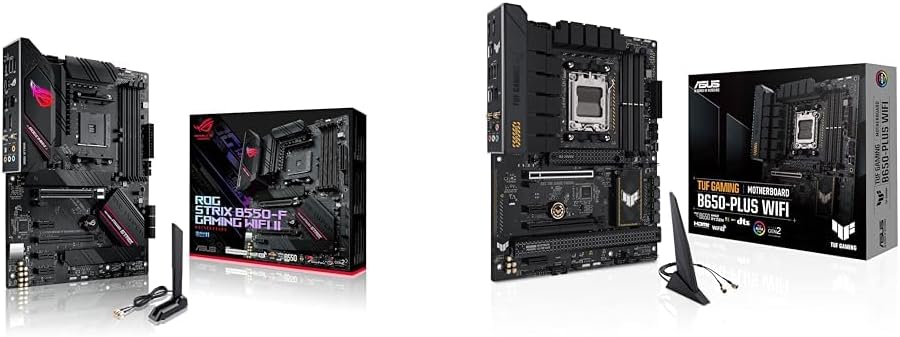
Asus ROG Strix B550-F Gaming WiFi II AMD AM4 (3rd Gen Ryzen) ATX Motherboard & TUF Gaming B650-PLUS WiFi Socket AM5 (LGA 1718) Ryzen 7000 ATX Gaming Motherboard
$150-$299This bundle offers two ATX motherboards: the ROG Strix B550-F Gaming WiFi II for AM4 Ryzen 3000/5000 CPUs with DDR4 RAM, and the TUF Gaming B650-PLUS WiFi for AM5 Ryzen 7000 CPUs with DDR5 RAM.

Game Motherboard Fit for ASROCK B650E PG-ITX WiFi B650 AM5 Motherboard Support Ryzen 7800X3D 7600/X 7950X 7700/X CPU 2xDDR5 128GB Hyper M.2 Mini-ITX
Price range unavailableThis KUETFBVC motherboard listing presents highly contradictory specifications, including a BGA 1023 socket and AMD 480 chipset, making it unsuitable for any modern Ryzen AM5 CPU.

Asus ROG Strix B550-F Gaming WiFi II AMD AM4 (3rd Gen Ryzen) ATX Gaming Motherboard (PCIe 4.0,WiFi 6E, 2.5Gb LAN, BIOS Flashback, HDMI 2.1, Addressable Gen 2 RGB Header and Aura Sync)
This is a premium-feeling AM4 board with beefy VRMs and WiFi 6E, perfect for squeezing the last drop of performance out of a Ryzen 5000 series CPU.