
MSI MPG AMD B550 Gaming Plus Socket AM4 ATX DDR4-SDRAM Motherboard
Want the best price and purchase timing?
Our AI advisor analyzes real-time pricing across all channels to find you the best deal.
AI Verdict
This is a rock-solid, no-frills AM4 board with a beefy 10+2+1 VRM setup that easily maxes out a Ryzen 5000 chip if you don't need Wi-Fi.
If you are building a fresh AM4 system or upgrading an older Ryzen rig on a strict budget, this board delivers the exact power delivery you need without charging for extras. It strips away Wi-Fi and premium audio to keep the price near $120, putting that budget into a 10+2+1 VRM setup that handles high-end chips.
If you need wireless connectivity or better onboard audio, step up to the MSI MAG B550 Tomahawk MAX WiFi.
Regret Score™
Low RiskLower is better — measures purchase-regret risk from real buyer complaints, review credibility, and product maturity
Issues discovered after purchase
Critically weak dimension
Amazon rating vs actual quality
Chance this product isn't for you
Pros
- 10+2+1 power phase design handles overclocked Ryzen 7 and 9 CPUs without VRM overheating.
- Pre-installed I/O shield saves you from the classic builder's mistake and fits perfectly against the case.
- Flash BIOS button lets you update for Ryzen 5000 series using just a USB stick and power supply.
- Includes 8 total fan headers, making it incredibly easy to wire up a high-airflow case.
- Features a front-panel USB Type-C header, which is often missing on boards at this $120 price point.
Cons
- Uses the older Realtek ALC892 audio codec instead of the newer ALC1200 found on the B550 Tomahawk.
- Zero built-in Wi-Fi or Bluetooth means you must buy a separate PCIe or USB adapter.
- The secondary M.2 slot is limited to PCIe 3.0 speeds and lacks a Frozr heatsink.
- MSI's Dragon Center software includes a LAN Manager that users report severely throttling upload speeds.
Dimension Scores
The 10+2+1 phase design is robust for the $120 price point and handles a Ryzen 9 5900X easily.
Includes a front Type-C header and Flash BIOS, but lacks Wi-Fi and uses an older ALC892 audio codec.
Standard ATX layout with two M.2 slots and plenty of PCIe slots, but only one M.2 slot supports Gen4 speeds.
The BIOS is clean and easy to navigate, but MSI's Dragon Center software is notoriously bloated and throttles network speeds.
Best For
- Budget-conscious gamers building a Ryzen 5600X or 5800X rig with a hardwired Ethernet connection.
- First-time PC builders who want foolproof features like EZ Debug LEDs and a pre-installed I/O shield.
- Upgraders moving from older B450 boards who want PCIe 4.0 support for a new GPU and NVMe drive.
Not Recommended For
- Anyone who needs wireless connectivity out of the box for Wi-Fi or Bluetooth peripherals.
- Audiophiles plugging high-impedance headphones directly into the motherboard's 3.5mm jacks.
Watch Out For
- The MSI Dragon Center software installs a LAN Manager by default that can throttle your upload speeds to 2mbps—disable it immediately.
- Boot times can feel sluggish; users report a 2-3 second delay after pressing the power button while the board stabilizes voltage and trains memory.
- The EZ Debug LED sometimes misreports memory errors as CPU errors, sending you on a wild goose chase if a RAM stick isn't seated perfectly.
- Only the top M.2 slot supports PCIe 4.0 and has a heatsink; if you buy two Gen4 drives, the second one gets bottlenecked at Gen3 speeds.
Full Specifications
| RAM | DDR4 |
| ASIN | B08B4V6H3N |
| Brand | msi |
| Series | MSI MPG B550 GAMING PLUS |
| Voltage | 1 Volts |
| Platform | Windows 10 |
| Batteries | 1 Lithium Ion batteries required. |
| CPU Socket | Socket AM4 |
| Model Name | MSI MPG B550 GAMING PLUS |
| Item Weight | 2.17 pounds |
| Chipset Type | AMD B550 |
| Manufacturer | MSI |
| Memory Speed | 4400 MHz |
| Wireless Type | 2.4 GHz Radio Frequency, 5 GHz Radio Frequency |
| Hardware Platform | MSI |
| Item model number | 007C56-003R |
| Compatible Devices | Personal Computer |
| Memory Clock Speed | 4400 MHz |
| Product Dimensions | 12.01 x 9.65 x 1.18 inches |
| Computer Memory Type | DDR4 SDRAM |
| Compatible Processors | Ryzen (Socket AM4) |
| RAM Memory Technology | DDR4 |
| Item Dimensions LxWxH | 12.01 x 9.65 x 1.18 inches |
| Memory Storage Capacity | 128 GB |
| Number of USB 2.0 Ports | 4 |
What Buyers Say
The most consistent theme across hundreds of reviews is how forgiving this board is for first-time builders, largely thanks to the pre-installed I/O shield and EZ Debug LEDs. Buyers frequently praise the VRM heatsinks, noting they keep temperatures well under control even when pushing a Ryzen 7 5800X. The biggest source of frustration is the MSI Dragon Center software, specifically the LAN Manager module that inexplicably throttles internet upload speeds until disabled. Many users also note a strange 2-3 second delay between pressing the case power button and the system actually posting, which MSI support claims is normal voltage stabilization. It is a workhorse board that trades luxury features for raw power delivery.
“Great board for the price and handles my 5800x perfectly, but for the love of god do NOT install the MSI LAN manager unless you want your upload speeds capped at 2mbps.”
Common Praise
- The Flash BIOS button works flawlessly for updating to Ryzen 5000 support without an older CPU.
- VRM heatsinks are massive and keep power delivery temps low even during heavy multi-core workloads.
- Having 8 fan headers spread around the edges makes cable management incredibly easy.
- The pre-installed I/O shield eliminates the frustration of forgetting to install it before screwing down the board.
Common Complaints
- MSI Dragon Center software is bloated and the LAN Manager actively ruins network speeds.
- The bottom M.2 slot lacks a heatsink and is limited to PCIe 3.0 speeds.
- No built-in Wi-Fi or Bluetooth is a hassle for users who use wireless controllers.
- The Realtek ALC892 audio is noticeably weaker than the audio on slightly more expensive boards.
Ownership Tips
- There is a noticeable 2-3 second delay after hitting the power button before the fans spin up and the board posts.
- The EZ Debug LED for the CPU will sometimes light up when the actual issue is a slightly unseated RAM stick.
- The RGB lighting on the chipset heatsink is very subtle and gets completely blocked if you install a large graphics card.
- You have to press the Flash BIOS button firmly and wait for the red light to stop flashing—it takes about 5 minutes.
Frequently Asked Questions
Does this support Ryzen 5000 series out of the box?
It depends on when the specific box was manufactured. If it doesn't, you can use the Flash BIOS button on the rear I/O to update it using just a USB stick and power supply.
Does this motherboard have Wi-Fi or Bluetooth?
No, it has neither. You must run an Ethernet cable or buy a separate PCIe Wi-Fi card if you need wireless internet.
Can I run two PCIe 4.0 M.2 SSDs on this board?
No. Only the top M.2 slot closest to the CPU supports PCIe 4.0. The bottom slot runs at PCIe 3.0 speeds.
What is the difference between this and the B550 Tomahawk?
The Tomahawk has a slightly better audio codec (ALC1200 vs ALC892), dual LAN ports, and a second M.2 heatsink. They perform identically in gaming.
Will this fit in a micro-ATX case?
No, this is a full-size ATX motherboard measuring 12 by 9.6 inches. You need a standard ATX mid-tower or full-tower case.
Why is my upload speed so slow after installing the MSI software?
MSI's Dragon Center includes a feature called LAN Manager that tries to prioritize gaming traffic but often breaks upload speeds. Turn it off in the software settings.
Buying Guide
When buying an AM4 motherboard today, you are investing in a dead platform, so you want maximum value. You don't need to overspend on X570 boards; a solid B550 like this gives you PCIe 4.0 for your main graphics card and primary SSD, which is all that matters for gaming. Pay attention to the networking and audio—this board cuts costs by omitting Wi-Fi and using an older audio chip. If your PC sits next to your router and you use a USB headset, you will never notice the difference, and you get to pocket the savings.
10+2+1 VRM Power Phases
Think of VRMs as the valves that control electricity flowing to your CPU. More phases mean the workload is spread out, keeping the board cooler and preventing crashes when your processor works hard.
PCIe 4.0 Support
This is the data highway between your motherboard, graphics card, and storage. PCIe 4.0 is twice as fast as 3.0, meaning faster load times for games installed on a Gen4 NVMe SSD.
Flash BIOS Button
Motherboards need software updates to recognize newer processors. This button lets you update the board using just a USB thumb drive, saving you from needing to borrow an older, compatible CPU just to get the system to turn on.
Alternatives
If you need built-in Wi-Fi and Bluetooth, or want a slightly better audio chip for high-end analog headphones, look for boards with 'WiFi' in the name or step up to the B550 Tomahawk tier.
You Might Also Like

JetKVM KVM Over IP ATX Extension Board, ATX Power Control Board- Only for Jet KVM Accessories Boot from Shutdown, Crash Recovery
$0-$49This is an ATX form factor power control board designed for JetKVM accessories, enabling remote PC power state management and simultaneous front panel button use.
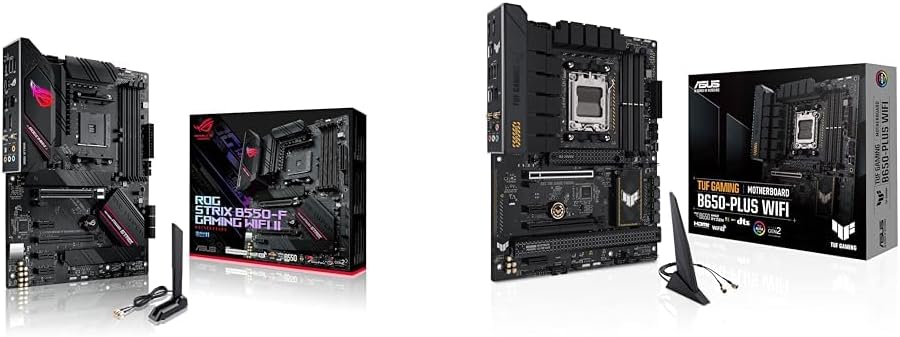
Asus ROG Strix B550-F Gaming WiFi II AMD AM4 (3rd Gen Ryzen) ATX Motherboard & TUF Gaming B650-PLUS WiFi Socket AM5 (LGA 1718) Ryzen 7000 ATX Gaming Motherboard
$150-$299This bundle offers two ATX motherboards: the ROG Strix B550-F Gaming WiFi II for AM4 Ryzen 3000/5000 CPUs with DDR4 RAM, and the TUF Gaming B650-PLUS WiFi for AM5 Ryzen 7000 CPUs with DDR5 RAM.

Game Motherboard Fit for ASROCK B650E PG-ITX WiFi B650 AM5 Motherboard Support Ryzen 7800X3D 7600/X 7950X 7700/X CPU 2xDDR5 128GB Hyper M.2 Mini-ITX
Price range unavailableThis KUETFBVC motherboard listing presents highly contradictory specifications, including a BGA 1023 socket and AMD 480 chipset, making it unsuitable for any modern Ryzen AM5 CPU.

Asus ROG Strix B550-F Gaming WiFi II AMD AM4 (3rd Gen Ryzen) ATX Gaming Motherboard (PCIe 4.0,WiFi 6E, 2.5Gb LAN, BIOS Flashback, HDMI 2.1, Addressable Gen 2 RGB Header and Aura Sync)
This is a premium-feeling AM4 board with beefy VRMs and WiFi 6E, perfect for squeezing the last drop of performance out of a Ryzen 5000 series CPU.