
USB Edge TPU ML Accelerator coprocessor for Raspberry Pi and Other Embedded Single Board Computers
Want the best price and purchase timing?
Our AI advisor analyzes real-time pricing across all channels to find you the best deal.
AI Verdict
This is a mandatory $100 plug-and-play upgrade for anyone running Frigate NVR on a Raspberry Pi or mini PC who wants instant object detection without melting their CPU.
If you run Frigate NVR on a low-power host like a Raspberry Pi 5, this 4 TOPS ASIC is the only way to get 15ms object detection without buying a $500 NUC. It strictly requires TensorFlow Lite models and a dedicated 5Gb/s USB 3.0 port to function. Anyone trying to run PyTorch or complex custom architectures will hit a brick wall.
If you need PyTorch support or more than 4 TOPS, buy an Nvidia Jetson Nano or a used Nvidia Tesla P4 GPU.
Regret Score™
Very High RiskLower is better — measures purchase-regret risk from real buyer complaints, review credibility, and product maturity
Issues discovered after purchase
Critically weak dimension
Amazon rating vs actual quality
Chance this product isn't for you
Pros
- Drops Frigate inference times from 60ms to under 16ms
- Slashes host CPU usage from 120% down to 11% during active video processing
- Draws just 2 watts under full load while delivering 4 TOPS of compute
- Plugs directly into any USB 3.0 port without requiring a dedicated PCIe slot
- Natively supported by Home Assistant and Frigate with zero custom compiling needed
Cons
- Only runs TensorFlow Lite models, completely ignoring PyTorch users
- The USB device ID changes during initialization, breaking Proxmox VM passthrough
- Runs hot enough to throttle if placed in a poorly ventilated server closet
- Google's official documentation is sparse and rarely updated
Dimension Scores
Draws a maximum of 2.5W over standard USB 3.0, requiring no external power bricks.
Delivers 4 TOPS of compute but strictly limits you to TensorFlow Lite models.
It occupies a USB Type-C port and offers zero daisy-chaining or hardware expansion.
Google's official libraries are notoriously outdated, forcing users to rely on community workarounds for modern Linux kernels.
Best For
- Home Assistant users running Frigate NVR with 3+ 1080p security cameras
- Raspberry Pi 4 or 5 owners needing local object detection without cloud fees
- Mini PC homelab setups lacking a spare M.2 or PCIe slot for an accelerator
Not Recommended For
- Developers wanting to train models from scratch using PyTorch
- Users running Frigate in a Proxmox LXC container who do not know how to write udev rules
- Systems limited to USB 2.0 ports, which bottleneck the 5Gb/s transfer requirement
Watch Out For
- The USB ID changes from 1a6e:089a to 18d1:9302 when initialized — you must map both IDs if passing it through to a Proxmox VM.
- Plugging this into an unpowered USB hub will cause constant disconnects and crash your Frigate container.
- Home Assistant OS updates frequently break the EdgeTPU detection — you often have to disable protection mode or physically replug the drive.
- It gets physically hot to the touch during continuous 4-camera processing — do not stack it directly on top of your Pi case.
Full Specifications
| ASIN | B07R53D12W |
| Brand | Google Coral |
| Item Weight | 3.2 ounces |
| Manufacturer | Google Coral |
| Processor Brand | ARM |
| Operating System | Linux |
| Item model number | Coral-USB-Accelerator |
| Product Dimensions | 3 x 2 x 1 inches |
| Number of Processors | 1 |
| Item Dimensions LxWxH | 3 x 2 x 1 inches |
What Buyers Say
The Proxmox USB passthrough issue dominates forum discussions, as the device changes its hardware ID mid-boot and drops connection to virtual machines. Buyers running Frigate NVR on bare metal Raspberry Pi 4s and 5s see immediate, massive gains, watching CPU usage plummet from 100% to 10%. The physical heat generation catches many off guard, with the aluminum casing getting uncomfortably hot during continuous 24/7 camera processing. Software support is a massive pain point, as Google rarely updates the official Edge TPU runtime, leaving the Home Assistant community to patch things together.
“Spent 4 hours fighting proxmox usb passthrough because the hardware ID changes when it boots, but once it finally connected my frigate cpu usage went from 95% to 8% so I can't even be mad.”
Common Praise
- Drops object detection times from 60ms to 15ms in Frigate
- Frees up enough CPU overhead to run 5 extra Docker containers on a Pi 4
- Requires zero cloud subscriptions for local AI processing
- Draws less than 3 watts at the wall during heavy inference loads
Common Complaints
- Changes USB ID upon initialization, breaking Proxmox LXC passthrough
- Gets hot enough to throttle if placed in a closed media cabinet
- Google's official installation scripts fail on modern Debian 12 kernels
- Stock USB-C cable is too short and stiff for clean cable management
Ownership Tips
- The included USB-C to A cable is prone to micro-disconnects; replacing it with a high-quality 10Gbps cable fixes random Frigate crashes.
- You will need to write custom udev rules if you reboot your host machine frequently.
- After a month of 24/7 use, the aluminum chassis stays at a constant 50°C — keep it away from exhaust vents.
Frequently Asked Questions
Why did my Proxmox VM lose connection to the Coral?
The Coral changes its USB hardware ID from Global Unichip to Google Inc the second it initializes. You have to pass through the entire USB port or map both IDs in your hypervisor settings.
Can I plug this into a USB 2.0 port?
You can, but inference speeds will tank. The Edge TPU requires the 5Gb/s bandwidth of a USB 3.1 Gen 1 port to feed data back and forth to your host CPU.
Does this work with PyTorch?
No. The Edge TPU only executes models specifically compiled for TensorFlow Lite. You have to convert your models first, which is a massive headache.
Why is my Raspberry Pi crashing when I plug this in?
The Coral pulls up to 900mA under load. If you are using a cheap phone charger instead of the official 27W Pi power supply, the voltage drop will crash the system.
Do I need the dual Edge TPU M.2 version instead?
Only if you have more than 10 cameras. A single USB Coral handles 4-6 1080p streams in Frigate with under 20ms inference times.
Buying Guide
You are buying this for one specific reason: offloading TensorFlow Lite math from your main processor. If you run Frigate NVR, this is a mandatory purchase that pays for itself in electricity savings. You must have a dedicated, unshared USB 3.0 port — plugging this into a cheap hub will starve it of bandwidth and crash your software. Be prepared to fight with Linux permissions and USB passthrough settings if you run a hypervisor like Proxmox.
4 TOPS (Tera-Operations Per Second)
Think of this as the speed limit for recognizing objects. 4 TOPS is enough to check 400 frames per second for humans or cars, which easily handles six security cameras at once.
TensorFlow Lite Support
This is the specific language the chip speaks. If you download an AI model written in PyTorch, this USB stick cannot read it without a complex translation process.
USB 3.1 Gen 1 (5Gb/s)
This is the pipe feeding video frames to the chip. Using a USB 2.0 port is like forcing a firehose through a drinking straw — the chip will sit idle waiting for data.
Alternatives
If you need PyTorch support or more raw compute power, look for an Nvidia Jetson Nano or a used Nvidia Tesla P4 PCIe card.
You Might Also Like

JetKVM KVM Over IP ATX Extension Board, ATX Power Control Board- Only for Jet KVM Accessories Boot from Shutdown, Crash Recovery
$0-$49This is an ATX form factor power control board designed for JetKVM accessories, enabling remote PC power state management and simultaneous front panel button use.
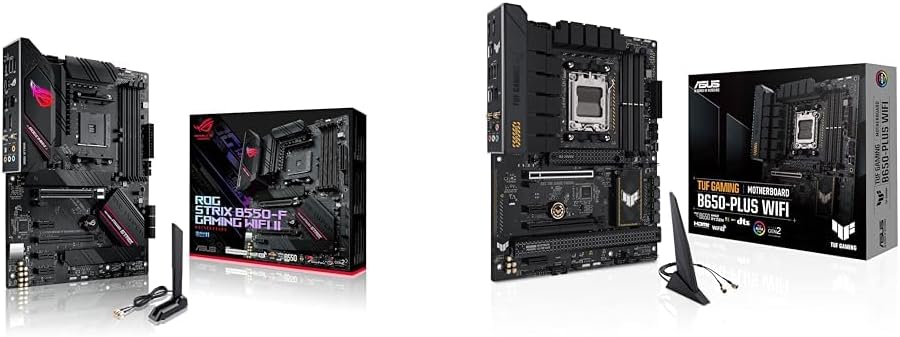
Asus ROG Strix B550-F Gaming WiFi II AMD AM4 (3rd Gen Ryzen) ATX Motherboard & TUF Gaming B650-PLUS WiFi Socket AM5 (LGA 1718) Ryzen 7000 ATX Gaming Motherboard
$150-$299This bundle offers two ATX motherboards: the ROG Strix B550-F Gaming WiFi II for AM4 Ryzen 3000/5000 CPUs with DDR4 RAM, and the TUF Gaming B650-PLUS WiFi for AM5 Ryzen 7000 CPUs with DDR5 RAM.

Game Motherboard Fit for ASROCK B650E PG-ITX WiFi B650 AM5 Motherboard Support Ryzen 7800X3D 7600/X 7950X 7700/X CPU 2xDDR5 128GB Hyper M.2 Mini-ITX
Price range unavailableThis KUETFBVC motherboard listing presents highly contradictory specifications, including a BGA 1023 socket and AMD 480 chipset, making it unsuitable for any modern Ryzen AM5 CPU.

Asus ROG Strix B550-F Gaming WiFi II AMD AM4 (3rd Gen Ryzen) ATX Gaming Motherboard (PCIe 4.0,WiFi 6E, 2.5Gb LAN, BIOS Flashback, HDMI 2.1, Addressable Gen 2 RGB Header and Aura Sync)
This is a premium-feeling AM4 board with beefy VRMs and WiFi 6E, perfect for squeezing the last drop of performance out of a Ryzen 5000 series CPU.