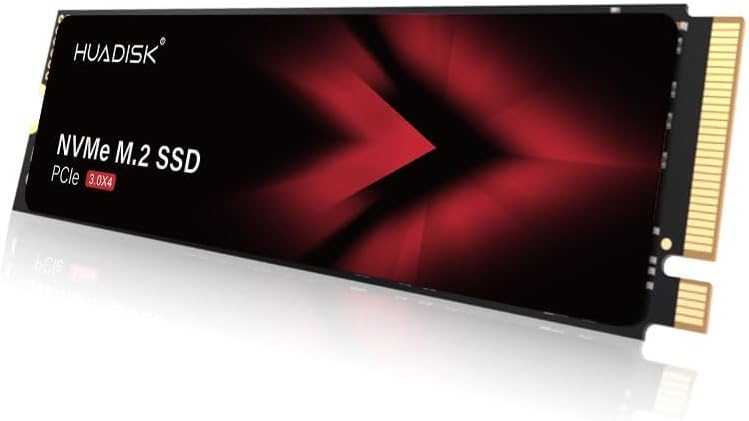
128GB M.2 2280 NVMe SSD, Gen3x4 Internal Solid State Drive, Up to 1700MB/s, M.2 2280 NVMe PCIe 3.0X4 SSD with Heatsink,3D NAND Flash,for Desktop and Laptop
Want the best price and purchase timing?
Our AI advisor analyzes real-time pricing across all channels to find you the best deal.
AI Verdict
A 128GB M.2 2280 NVMe PCIe 3.0x4 SSD with up to 1700MB/s read speed, best for basic system drives or light storage on a tight budget.
This 128GB NVMe SSD is a situational fit, offering PCIe 3.0x4 speeds up to 1700MB/s at a budget price. Its small capacity severely limits its utility for anything beyond a basic boot drive or minimal secondary storage, making it unsuitable for modern demanding applications or large file storage. It's a step up from SATA but far from high-performance NVMe.
If 128GB is too small, look for a 500GB or 1TB NVMe SSD to provide adequate space for an operating system, applications, and some personal files.
Regret Score™
Very High RiskLower is better — measures purchase-regret risk from real buyer complaints, review credibility, and product maturity
Issues discovered after purchase
Critically weak dimension
Amazon rating vs actual quality
Chance this product isn't for you
Pros
- Advertised read speeds up to 1700MB/s for faster system starts and app openings compared to SATA SSDs.
- Includes graphene layers for heat dissipation, aiming to reduce internal SSD temperature by up to 10°C (±).
- Features SMART health monitoring and TRIM optimization to extend drive lifespan.
- Offers plug-and-play compatibility with Windows 7 (with drivers), 8, 10, 11, and Linux systems.
- Backed by a 3-year limited warranty and lifetime tech support.
Cons
- 128GB capacity is very restrictive for modern operating systems, multiple applications, or any significant file storage.
- Actual write speeds are not explicitly stated in product specs, but user tests show around 1219 MB/s.
- As a budget brand, some users express general concerns about long-term reliability and quality control compared to established manufacturers.
- Does not come with pre-installed software for drive monitoring or management, which some users might prefer.
Dimension Scores
The advertised read speed of 1700MB/s is typical for a budget PCIe Gen3x4 drive, with user tests showing 1814 MB/s read and 1219 MB/s write.
While featuring SMART monitoring and wear leveling, general concerns exist for budget brands, and specific long-term user data for this ASIN is limited.
128GB is a very small capacity for modern computing needs, quickly becoming insufficient for an OS and even a few applications.
Offers broad compatibility with desktops and laptops supporting M.2 2280 NVMe PCIe 3.0x4, including various Windows versions and Linux.
Best For
- Boot drive for a very basic desktop PC or older laptop running a lightweight OS.
- Secondary drive for specific, small applications or documents in a system with primary storage.
- Budget-constrained system builds where any NVMe speed is an upgrade from a hard drive.
- Users needing a temporary or minimal storage solution for testing or specific projects.
Not Recommended For
- Primary drive for gaming, content creation, or professional applications due to limited capacity and moderate speeds.
- Users who frequently transfer large files or work with demanding software that requires sustained high write performance.
- Anyone expecting top-tier NVMe performance comparable to PCIe Gen4 drives or premium Gen3 models.
- Systems where long-term, mission-critical data storage is paramount without robust backup solutions.
Watch Out For
- The 128GB capacity fills up extremely fast; one user noted needing to constantly delete files after three months with a 128GB SSD.
- Some budget SSDs from less-known brands on platforms like AliExpress have been associated with spoofed capacities or early failures, though not specifically attributed to HUADISK.
- While advertised with a heatsink, a user test showed the drive reaching 67°C under load, close to its 70°C operating limit.
- The brand's origin from AliExpress might lead to potential warranty claim complexities or slower support compared to local brands.
Full Specifications
| ASIN | B0FFGW4L3H |
| Brand | HUADISK |
| Series | B0Ffgw4L3H |
| Hard Drive | 128 GB Solid State Drive |
| Item Weight | 0.634 ounces |
| Manufacturer | HUADISK |
| Hard Disk Size | 128 GB |
| Special Feature | Backward Compatible, TRIM Support |
| Installation Type | Internal Hard Drive |
| Item model number | B0Ffgw4L3H |
| Compatible Devices | Desktop |
| Package Dimensions | 3.9 x 2.4 x 0.67 inches |
| Hard Disk Interface | PCIE x 4 |
| Hard Drive Interface | PCIE x 4 |
| Hard Disk Description | Solid State Drive |
| Hard Disk Form Factor | 22 Millimeters |
| Connectivity Technology | NVMe |
| Digital Storage Capacity | 128 GB |
What Buyers Say
Specific user reviews for this exact ASIN (B0FFGW4L3H) were hard to pinpoint, but general feedback for HUADISK M.2 NVMe SSDs, including the 128GB model, suggests they deliver on advertised speeds for their price point. Users report speeds around 1814 MB/s read and 1219 MB/s write in tests. The inclusion of a heatsink is a plus, though temperatures can still reach 67°C under load. The main limitation is the 128GB capacity, which many find too small for anything beyond a minimal boot drive.
“Look, it's cheap and it works for my old laptop's OS, but seriously, 128GB is gone in a flash once Windows updates. Should've just spent a bit more for 256GB, live and learn!”
Common Praise
- Achieves or slightly exceeds advertised read speeds in user benchmarks, like 1814 MB/s.
- Installation is straightforward due to the M.2 2280 form factor.
- The graphene heatsink helps manage temperatures, keeping it below its 70°C limit during use.
- Provides a noticeable speed upgrade compared to traditional SATA drives for system responsiveness.
Common Complaints
- The 128GB capacity is quickly exhausted, requiring constant file management for many users.
- Concerns about the long-term durability and quality control for budget-tier, lesser-known brands are sometimes raised.
- Lack of dedicated software for drive health monitoring or management can be a minor inconvenience.
- Write speeds, while decent for the price, are not as high as read speeds and might be a bottleneck for heavy write tasks.
Ownership Tips
- The actual usable capacity after formatting is slightly less than 128GB, as expected.
- For a fresh OS install, it boots up fast, but installing even a few large applications eats up space quickly.
- The included heatsink is thin but seems to do its job, preventing thermal throttling during typical use.
- Performance feels snappier than the old SATA SSD it replaced, especially for basic tasks.
Frequently Asked Questions
What kind of speed can I expect from this SSD?
You can expect sequential read speeds up to 1700MB/s, as advertised. User tests have shown read speeds around 1814 MB/s and write speeds around 1219 MB/s.
Is 128GB enough storage for my computer?
128GB is generally only sufficient for a basic operating system and a few essential programs. For gaming, content creation, or storing many files, it will be very limiting.
Does this SSD come with a heatsink?
Yes, this M.2 NVMe SSD includes graphene layers for heat dissipation, designed to reduce its operating temperature by up to 10°C (±).
Is this compatible with laptops and desktops?
Yes, it is designed for universal compatibility, supporting both PCs and laptops with an M.2 2280 slot, and operating systems like Windows 7 (with drivers), 8, 10, 11, and Linux.
What is the warranty period for this product?
The product is covered by a 3-year limited warranty and includes lifetime technical support.
Buying Guide
When buying an M.2 NVMe SSD, you're looking for a significant speed boost over older hard drives or SATA SSDs. The key is balancing speed, capacity, and price. For a budget drive like this, understand that you're getting entry-level NVMe performance and a very small capacity, which dictates its best use case.
Capacity (128GB)
This is how much data you can store. 128GB is tiny by today's standards; think of it as just enough for your operating system and maybe one or two small programs, like a small closet for your clothes.
Interface (PCIe Gen3x4)
This determines the maximum speed the drive can achieve. PCIe Gen3x4 is much faster than older SATA connections, but not as fast as newer Gen4 or Gen5, like a highway with four lanes versus a two-lane road or a dirt path.
Form Factor (M.2 2280)
This refers to the physical size and shape of the SSD. M.2 2280 is a common stick-like shape that fits into most modern motherboards and laptops, ensuring it physically fits in your device.
Read Speed (Up to 1700MB/s)
This is how fast the drive can retrieve data. Higher read speeds mean your operating system boots faster, and applications load more quickly, like how quickly you can grab a book from a shelf.
Alternatives
If 128GB is too restrictive, look for NVMe SSDs with 500GB or 1TB capacity for more breathing room. For faster performance, consider drives with PCIe Gen4 interfaces, but be aware they will cost more.
You Might Also Like

Seagate IronWolf Pro SATA III 3.5" Internal NAS Hard Drive, 2-Pack - 8TB
$300-$599A 2-pack of 8TB 7200 RPM CMR internal hard drives with 256MB cache, built for 24/7 multi-bay NAS environments.

QNAP TS-453E-8G-US 4 Bay High-Performance Desktop NAS with Intel Celeron Quad-core Processor, 8 GB DDR4 RAM and Dual 2.5GbE (2.5G/1G/100M) Network Connectivity (Diskless)
$600+A 4-bay diskless NAS with an Intel Celeron J6412, 8GB DDR4 RAM, dual 2.5GbE, and M.2 NVMe slots for businesses needing long-term support.

Seagate Exos 28TB Internal Hard Drive HDD - 3.5 in CMR SATA 6Gb/s, 7200 RPM, 512MB Cache, 2.5M MTBF - ST28000NM000C (Renewed)
$300-$599This 28TB, 7200 RPM, 3.5-inch CMR SATA 6Gb/s renewed hard drive is for serious data hoarders needing massive capacity at a lower price point.

1TB G-Drive ArmorATD Rugged, Durable Portable External HDD, Up to 130MB/s, USB-C (5Gbps), USB 3.2 Gen 1 – SDPHE1G-001T
$50-$99A 1TB mechanical hard drive with a 130MB/s read speed and USB-C (5Gbps) connectivity, built for users needing rugged, portable storage for school or creative projects.