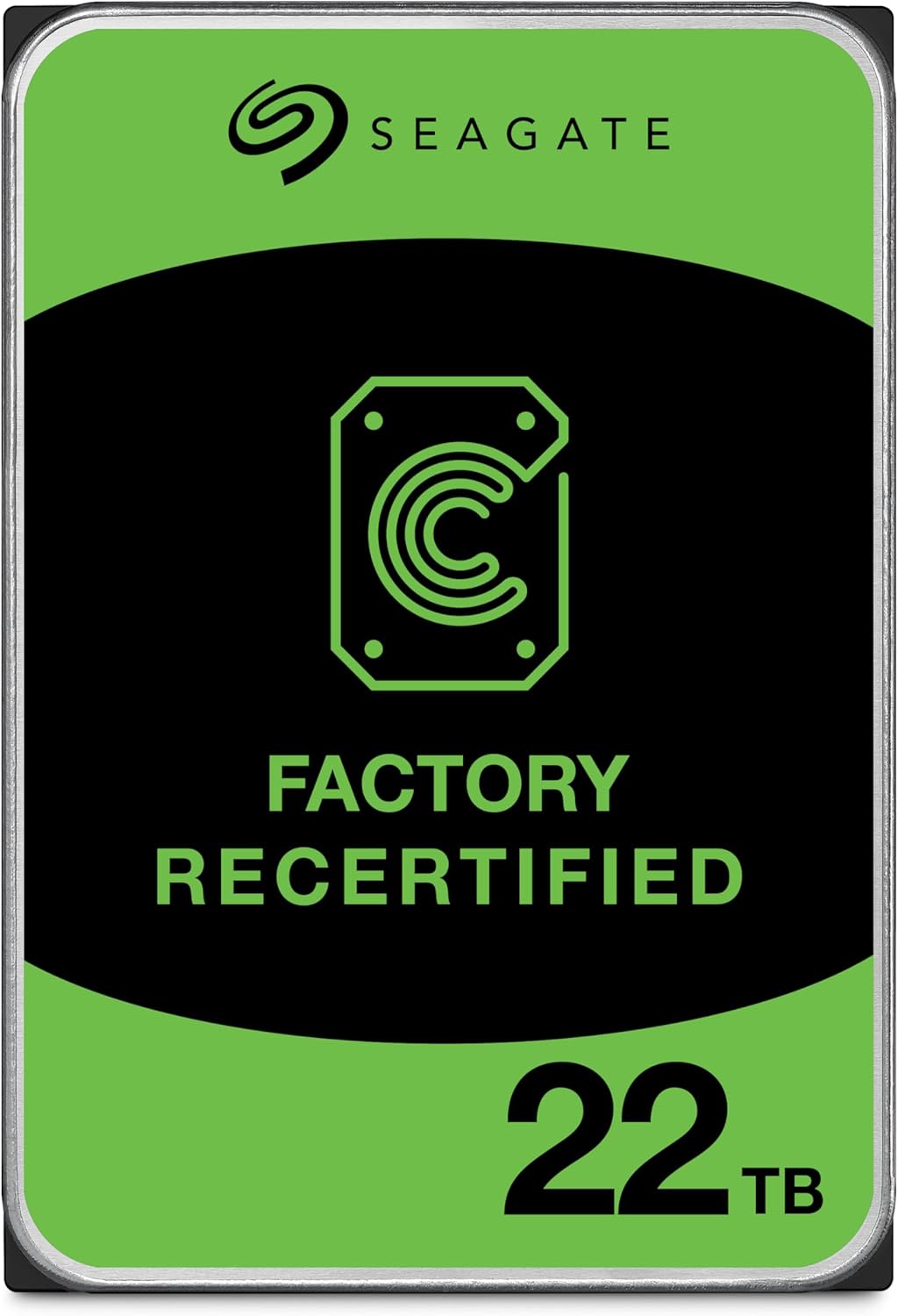
Seagate Exos 22TB SATA HDD 6Gb/s 7200RPM 3.5-inch Enterprise Hard Drive (ST22000NM000C) (Renewed)
Want the best price and purchase timing?
Our AI advisor analyzes real-time pricing across all channels to find you the best deal.
AI Verdict
This 22TB 7200RPM SATA-600 enterprise mechanical hard drive, offered as renewed, is for demanding cloud and scale-out data center applications needing massive capacity.
This 22TB renewed Seagate Exos drive is a situational fit, offering immense capacity and enterprise-grade features like 7200RPM and helium sealing for demanding storage needs. However, its renewed status introduces risks of DOA or early failure, making it less suitable for mission-critical applications without extensive pre-testing. The 2.5M-hr MTBF is solid, but the actual longevity of a renewed unit is a gamble.
If reliability is paramount for critical data, look for new enterprise drives with longer manufacturer warranties, or consider a new drive with a lower capacity to fit your budget.
Regret Score™
High RiskLower is better — measures purchase-regret risk from real buyer complaints, review credibility, and product maturity
Issues discovered after purchase
Critically weak dimension
Amazon rating vs actual quality
Chance this product isn't for you
Pros
- Offers a massive 22TB capacity in a single 3.5-inch form factor, maximizing storage density.
- Designed for enterprise-grade workloads with a 2.5M-hr MTBF rating, indicating high durability for continuous operation.
- Features a 7200RPM spindle speed and SATA 6Gb/s interface for fast data access within its category.
- Utilizes a helium-sealed design, contributing to lower power consumption and increased durability.
- Includes PowerBalance technology to optimize watts per terabyte for power efficiency in data centers.
Cons
- As a renewed product, there's a higher reported risk of Dead On Arrival (DOA) or early failure compared to new drives.
- Some users report the drive can be noisier than expected, which might be a concern for non-data center environments.
- Warranty coverage for renewed drives can be inconsistent, with some sellers offering only 3 months, creating uncertainty.
- Performance for large data transfers was found underwhelming by some users, despite its enterprise designation.
- Compatibility issues with certain external enclosures have been reported, requiring trial and error.
Dimension Scores
The 7200RPM spindle speed and SATA 6Gb/s interface provide above-average sequential read/write speeds for a mechanical hard drive, with reported initial writes around 240MB/s.
While the enterprise-grade design boasts a 2.5M-hr MTBF, its renewed status introduces uncertainty, with user reports of DOA and early failures balancing out its inherent durability.
At 22TB, this drive offers best-in-class capacity for a single 3.5-inch HDD, making it ideal for massive data storage needs.
It uses a standard 3.5-inch form factor and SATA-600 interface, ensuring broad compatibility with most desktop and server systems, though some external enclosure issues were noted.
Best For
- Cloud data centers requiring high-density storage for massive datasets.
- Massive scale-out data center applications needing reliable, high-capacity drives.
- High-capacity density RAID storage systems.
- Enterprise backup and restore operations (D2D, virtual tape).
Not Recommended For
- Primary boot drives for desktop PCs due to mechanical drive speed limitations.
- Users sensitive to drive noise in quiet home or office environments.
- Applications demanding SSD-level random access performance.
Watch Out For
- A significant number of customers have experienced drives that are dead on arrival, leading to immediate frustration.
- Users have reported drives failing after minimal usage, with one instance of a backup drive dying after just 12 months.
- The warranty situation is often unclear, with some renewed drives having little to no warranty, leaving buyers unsupported if issues arise.
- Some users noted that the 22TB drive registered as only 20TB when plugged in, indicating a potential capacity discrepancy or misunderstanding.
- There are complaints about the noise levels, with some finding it louder than anticipated, which can be a dealbreaker for certain setups.
Full Specifications
| ASIN | B0DFDTPR74 |
| Brand | Seagate |
| Color | Silver |
| Series | Exos |
| Hard Drive | 22 TB Mechanical Hard Disk |
| Item Weight | 1.85 pounds |
| Manufacturer | Seagate |
| Special Feature | Portable |
| Installation Type | Internal Hard Drive |
| Item model number | ST22000NM000C |
| Compatible Devices | Desktop |
| Package Dimensions | 8.78 x 6.06 x 3.03 inches |
| Hard Disk Interface | Serial ATA-600 |
| Hard Drive Interface | Serial ATA-600 |
| Hard Disk Description | Mechanical Hard Disk |
| Hard Disk Form Factor | 3.5 Inches |
| Connectivity Technology | SATA |
| Digital Storage Capacity | 22 TB |
| Hard Drive Rotational Speed | 7200 RPM |
What Buyers Say
The biggest takeaway from user feedback is the gamble you take with renewed drives; many report receiving Dead On Arrival units or experiencing failures within a year, even for backup purposes. While the 22TB capacity is a huge draw, the inconsistent warranty coverage and potential for unexpected noise levels are recurring concerns. Some users also found the performance for large transfers underwhelming, despite the enterprise branding. It seems you really need to run burn-in tests on these right away.
“Man, I needed this 22TB for my Plex server, but it was DOA right out of the box! So annoying, now I gotta deal with returns. Next time, I'm just buying new, even if it costs more.”
Common Praise
- The 22TB capacity is massive, allowing for huge amounts of data storage.
- Offers a low cost per terabyte compared to new drives, making large storage more accessible.
- The 7200RPM speed is quick for a mechanical drive, especially for sequential operations.
- Enterprise-grade features like helium sealing contribute to perceived durability and power efficiency.
Common Complaints
- Drives arriving Dead On Arrival (DOA) is a frequent and frustrating issue.
- Early failures, sometimes within months, even when used as backup drives.
- The noise level can be higher than expected, making it unsuitable for quiet environments.
- Unclear or short warranty periods for renewed products create anxiety about longevity.
- Some users reported the drive not showing the full 22TB, instead appearing as 20TB.
Ownership Tips
- You absolutely need to run extensive burn-in tests immediately upon receiving the drive to catch any early defects.
- Be prepared for potential noise; these aren't silent drives, especially under load.
- Double-check the actual reported capacity in your system, as some users found it less than advertised.
- Keep your packaging and purchase records handy, as warranty claims for renewed products can be a hassle.
- Consider the environment you're putting it in; the enterprise design means it's built for racks, not necessarily quiet home setups.
Frequently Asked Questions
Is this drive new or used?
This is a 'renewed' drive, meaning it's been inspected, tested, and restored to full working condition by Amazon Renewed. It is not a new, factory-sealed product.
What kind of warranty does this renewed drive come with?
Amazon Renewed typically provides a 90-day warranty. Some third-party sellers on platforms like Newegg might offer a 3-month replacement warranty for recertified Seagate drives.
Is this drive noisy?
User feedback is mixed; some find it noisier than expected for a hard drive, while others report acceptable noise levels. If quiet operation is crucial, this might be a concern.
Can I use this drive in my desktop computer?
Yes, it is compatible with desktop systems and uses a standard 3.5-inch form factor and SATA-600 interface. However, it's primarily designed for enterprise workloads, so it might be overkill for a typical desktop user.
What is the actual usable capacity of the 22TB drive?
While marketed as 22TB, some users have reported the drive registering as 20TB. This discrepancy is often due to how operating systems calculate storage versus how manufacturers market raw capacity.
Buying Guide
When you're looking at a renewed hard drive, especially one this big and enterprise-focused, you need to understand that you're trading off some certainty for a lower price. It's not a brand-new drive, so while it's been tested, the lifespan might be shorter, and the risk of issues like Dead On Arrival is higher. Think about where this drive is going to live and how critical the data on it will be. If it's for archiving or a RAID array where redundancy protects you, it's a different story than if it's your only copy of something important.
Capacity (22TB)
This number tells you how much data you can store. 22 terabytes is a massive amount, like having thousands of movies or millions of photos. It's crucial for data hoarders or large server applications.
Interface (Serial ATA-600)
This is how the drive connects to your computer or server. SATA-600 (or SATA III) is the standard connection for most modern systems, offering a theoretical maximum speed of 6 Gigabits per second. It's like the highway connecting your storage to the rest of your system.
RPM (7200RPM)
Revolutions Per Minute indicates how fast the platters inside the drive spin. Higher RPMs generally mean faster data access and transfer speeds for mechanical drives. 7200RPM is the faster end for consumer and enterprise HDDs, compared to 5400RPM drives.
Drive Type (Mechanical Hard Disk)
This means it uses spinning platters and read/write heads, unlike Solid State Drives (SSDs) which use flash memory. HDDs offer much larger capacities for less money but are significantly slower and more prone to mechanical failure than SSDs.
Alternatives
If you need absolute speed for frequently accessed data, look for SSDs with NVMe interfaces. For maximum reliability and a new warranty, search for new enterprise-grade HDDs with a 5-year manufacturer warranty, even if it means a higher price per terabyte.
You Might Also Like

Seagate IronWolf Pro SATA III 3.5" Internal NAS Hard Drive, 2-Pack - 8TB
$300-$599A 2-pack of 8TB 7200 RPM CMR internal hard drives with 256MB cache, built for 24/7 multi-bay NAS environments.

QNAP TS-453E-8G-US 4 Bay High-Performance Desktop NAS with Intel Celeron Quad-core Processor, 8 GB DDR4 RAM and Dual 2.5GbE (2.5G/1G/100M) Network Connectivity (Diskless)
$600+A 4-bay diskless NAS with an Intel Celeron J6412, 8GB DDR4 RAM, dual 2.5GbE, and M.2 NVMe slots for businesses needing long-term support.

Seagate Exos 28TB Internal Hard Drive HDD - 3.5 in CMR SATA 6Gb/s, 7200 RPM, 512MB Cache, 2.5M MTBF - ST28000NM000C (Renewed)
$300-$599This 28TB, 7200 RPM, 3.5-inch CMR SATA 6Gb/s renewed hard drive is for serious data hoarders needing massive capacity at a lower price point.

1TB G-Drive ArmorATD Rugged, Durable Portable External HDD, Up to 130MB/s, USB-C (5Gbps), USB 3.2 Gen 1 – SDPHE1G-001T
$50-$99A 1TB mechanical hard drive with a 130MB/s read speed and USB-C (5Gbps) connectivity, built for users needing rugged, portable storage for school or creative projects.