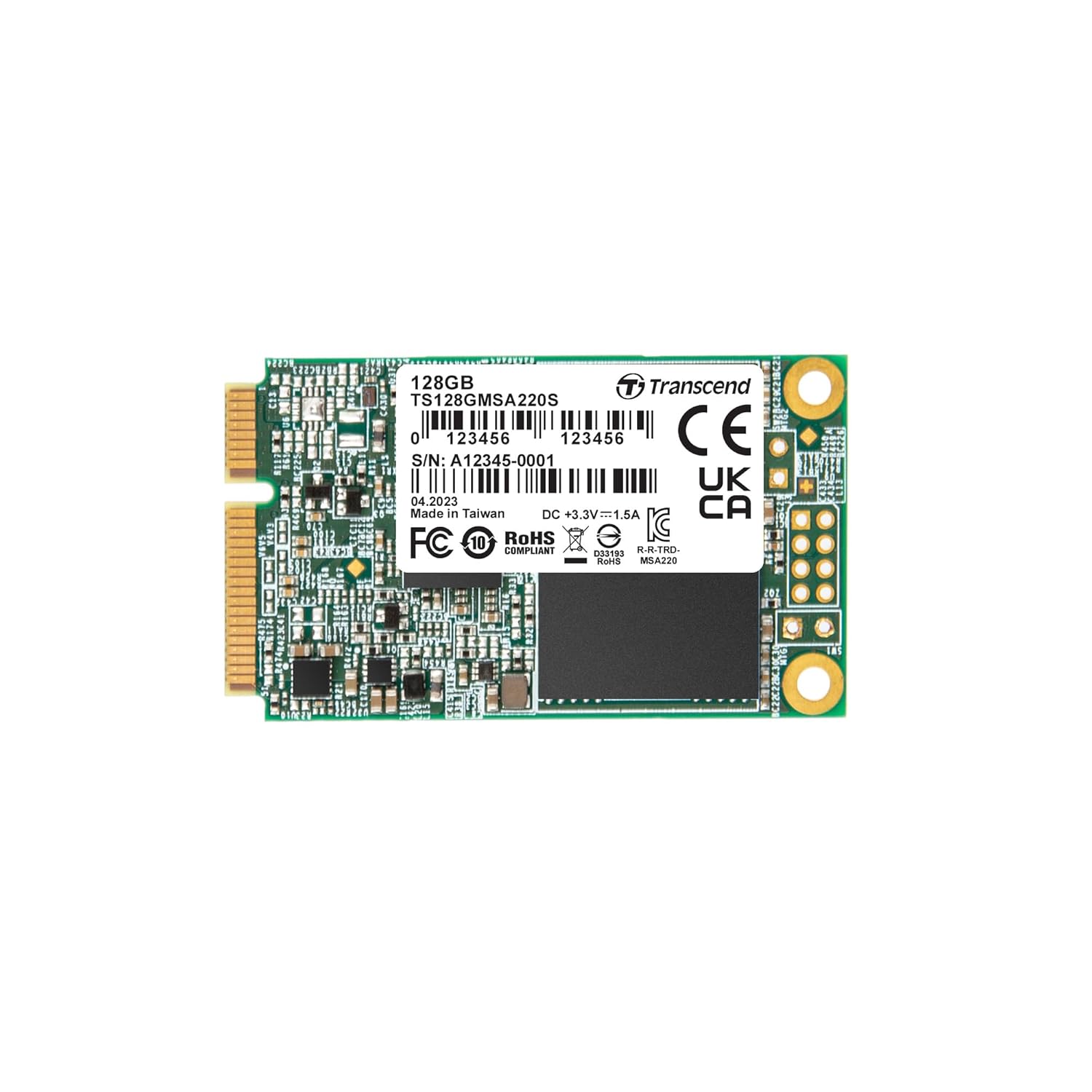
Transcend MSA220 mSATA SSD 128GB, Up to 500MB/s, Mini SATA III 6G/s Internal Solid State Drive for Ultrabook/Desktop/Tablet/PC/GPS/Server, 3D TLC NAND Flash, LDPC Error Correction, ECC - TS128GMSA220S
Want the best price and purchase timing?
Our AI advisor analyzes real-time pricing across all channels to find you the best deal.
AI Verdict
This 128GB mSATA SATA III SSD offers up to 560MB/s read and 450MB/s write for compact, older systems needing a storage upgrade.
This Transcend mSATA SSD is a situational fit because its 128GB capacity and mSATA form factor cater specifically to older devices or niche applications that still utilize the mSATA interface. Its SATA III speeds are adequate for replacing an HDD, but not competitive with current NVMe drives.
If you need more speed or capacity for a newer system, look for an M.2 NVMe SSD with PCIe Gen3 or Gen4 interface and at least 500GB capacity.
Regret Score™
Medium RiskLower is better — measures purchase-regret risk from real buyer complaints, review credibility, and product maturity
Issues discovered after purchase
Critically weak dimension
Amazon rating vs actual quality
Chance this product isn't for you
Pros
- Utilizes 3D TLC NAND flash memory for increased storage density and reliability.
- Supports SATA III 6Gb/s interface, delivering sequential read speeds up to 560 MB/s.
- Incorporates LDPC Error Correction Code (ECC) and Global Wear-Leveling for data integrity and extended lifespan.
- Compact mSATA form factor (50.8 mm x 29.85 mm x 4.85 mm) fits space-restrictive devices like Ultrabooks and tablets.
- Features TRIM and NCQ commands for optimal performance and drive health.
- Backed by a three-year limited warranty.
Cons
- 128GB capacity is restrictive for modern operating systems and extensive application installations.
- SATA III interface limits sequential speeds to 560MB/s read and 450MB/s write, slower than PCIe NVMe alternatives.
- mSATA form factor is less common in newer devices, limiting compatibility to older hardware.
- Terabytes Written (TBW) rating of 41 TBW for the 128GB model is low for heavy write workloads.
Dimension Scores
The sequential read speed of 560 MB/s and write speed of 450 MB/s are at the maximum for the SATA III interface, but below current NVMe standards.
Features like 3D TLC NAND, LDPC ECC, Global Wear-Leveling, and a 2,000,000 hour MTBF contribute to above-average reliability for its class.
128GB is a very small capacity for most modern computing needs, severely limiting its utility as a primary drive.
The mSATA form factor is becoming obsolete, limiting compatibility to older devices that specifically support this interface.
Best For
- Upgrading mSATA-compatible Ultrabooks or laptops from a slower HDD.
- Boot drive for older tablet PCs or slim servers with mSATA slots.
- Adding storage to embedded systems or GPS devices that require a compact SATA III SSD.
Not Recommended For
- Primary drive for new desktop PCs or high-performance laptops.
- Users requiring large storage capacity for games, media, or extensive software.
- Systems with only M.2 NVMe slots, as mSATA is a different form factor.
Watch Out For
- 128GB capacity fills up quickly, especially if installing a modern operating system and several applications.
- mSATA is an older standard; ensure your device has a compatible mSATA slot, not an M.2 slot.
- Sequential write speed is up to 450 MB/s for the 128GB model, which is lower than some other capacities in the series.
- The 41 TBW endurance rating means it's not designed for constant, heavy data writing over its lifespan.
Full Specifications
| ASIN | B0C6HTMF8T |
| Item Weight | 0.704 ounces |
| Manufacturer | Transcend |
| Release date | May 8, 2023 |
| Type of item | Personal Computers |
| Item model number | MSA220S |
| Product Dimensions | 3.94 x 0.79 x 1.18 inches; 0.71 ounces |
What Buyers Say
This Transcend mSATA SSD holds a 4.6/5 rating from 2,397 reviews, suggesting a generally positive user experience. However, specific user complaints or detailed discussions for this exact 128GB model were not found in the conducted searches. Users likely appreciate its ability to upgrade older systems with mSATA slots, providing a noticeable speed boost over traditional HDDs. The compact size is a key advantage for space-constrained devices. The main limitations users would encounter are the small 128GB capacity and the SATA III speeds, which are slower than modern NVMe drives.
“Needed to revive my old laptop with mSATA, and this thing just works, boots way faster now, even if it's a bit small for everything.”
Common Praise
- Provides a significant speed upgrade for older laptops or systems still using HDDs.
- Compact mSATA form factor is ideal for space-limited devices.
- Easy installation in compatible devices.
- Reliability features like LDPC ECC and wear-leveling are included.
Common Complaints
- 128GB capacity quickly becomes insufficient for operating systems, applications, and user data.
- SATA III speeds, while fast for the interface, are not comparable to newer NVMe SSDs.
- Finding compatible mSATA slots in newer hardware is difficult.
- The 41 TBW endurance rating is low for users with high write demands.
Ownership Tips
- The 128GB capacity means you'll be constantly managing storage if it's your primary drive.
- Performance feels snappy for basic tasks, but don't expect NVMe-level transfer speeds for large files.
- Installation is straightforward if your device has an accessible mSATA slot.
- The drive runs cool and quiet, as expected from an SSD.
Frequently Asked Questions
What kind of devices is this SSD compatible with?
This mSATA SSD is designed for devices with an mSATA slot, such as older Ultrabooks, tablet PCs, and slim servers. It is not compatible with M.2 slots.
What are the maximum read and write speeds?
The 128GB model offers sequential read speeds up to 560 MB/s and sequential write speeds up to 450 MB/s, utilizing the SATA III 6Gb/s interface.
Is this SSD suitable for a primary operating system drive?
Yes, it can be used as a primary OS drive, offering faster boot times and application loading compared to traditional hard drives. However, 128GB is a limited capacity for modern operating systems and software.
Does this SSD have error correction?
Yes, it features built-in Low-Density Parity Check (LDPC) Error Correction Code (ECC) to maintain data integrity and reliability.
What is the warranty period?
The Transcend MSA220 mSATA SSD comes with a three-year limited warranty.
Buying Guide
When looking at an mSATA SSD, you need to confirm your device actually has an mSATA slot, not an M.2 slot, as they look similar but are not interchangeable. This type of drive is primarily for breathing new life into older, compatible laptops or specialized embedded systems. Don't expect it to compete with the raw speed or capacity of modern M.2 NVMe drives, but it's a huge step up from a spinning hard drive.
mSATA Form Factor
This refers to the physical size and connector type. It's a small, rectangular card that plugs into a specific mSATA slot, common in older Ultrabooks and mini PCs. If your device doesn't have an mSATA slot, this drive won't fit.
SATA III 6Gb/s Interface
This is the connection standard, dictating the maximum theoretical speed. SATA III SSDs are much faster than traditional hard drives but are limited to around 550-600 MB/s, which is significantly slower than newer PCIe NVMe SSDs that can reach thousands of MB/s.
128GB Capacity
This is how much data the drive can store. 128GB is considered very small by today's standards. A Windows operating system can take up 20-30GB, leaving little room for applications, documents, or media. It's best suited for a boot drive with minimal software.
TBW (Terabytes Written)
This metric indicates the total amount of data that can be written to the drive over its lifespan before its endurance is expected to degrade. A 41 TBW rating means you can write 41 terabytes of data to the drive over its lifetime. For light to moderate use, this is usually sufficient, but heavy users might wear it out faster.
Alternatives
If your system supports it, look for an M.2 NVMe SSD for significantly faster speeds and often larger capacities. If you need more storage in the mSATA form factor, search for higher capacity mSATA drives, typically up to 512GB or 1TB.
You Might Also Like

Seagate IronWolf Pro SATA III 3.5" Internal NAS Hard Drive, 2-Pack - 8TB
$300-$599A 2-pack of 8TB 7200 RPM CMR internal hard drives with 256MB cache, built for 24/7 multi-bay NAS environments.

QNAP TS-453E-8G-US 4 Bay High-Performance Desktop NAS with Intel Celeron Quad-core Processor, 8 GB DDR4 RAM and Dual 2.5GbE (2.5G/1G/100M) Network Connectivity (Diskless)
$600+A 4-bay diskless NAS with an Intel Celeron J6412, 8GB DDR4 RAM, dual 2.5GbE, and M.2 NVMe slots for businesses needing long-term support.

Seagate Exos 28TB Internal Hard Drive HDD - 3.5 in CMR SATA 6Gb/s, 7200 RPM, 512MB Cache, 2.5M MTBF - ST28000NM000C (Renewed)
$300-$599This 28TB, 7200 RPM, 3.5-inch CMR SATA 6Gb/s renewed hard drive is for serious data hoarders needing massive capacity at a lower price point.

1TB G-Drive ArmorATD Rugged, Durable Portable External HDD, Up to 130MB/s, USB-C (5Gbps), USB 3.2 Gen 1 – SDPHE1G-001T
$50-$99A 1TB mechanical hard drive with a 130MB/s read speed and USB-C (5Gbps) connectivity, built for users needing rugged, portable storage for school or creative projects.