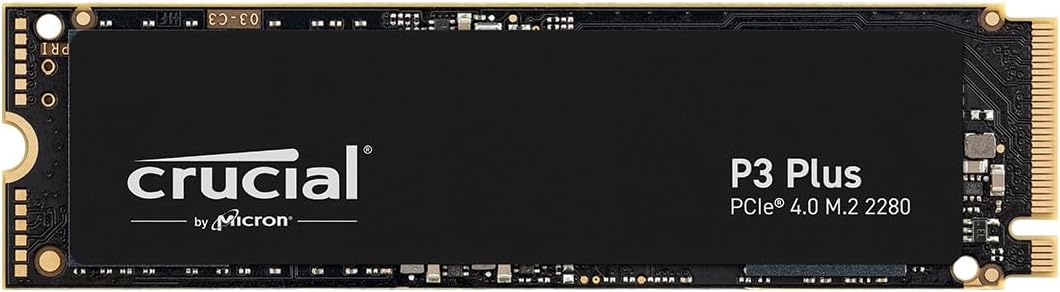
Crucial P3 Plus PCIe Gen4 NVMe 2TB SSD, Up to 5,000MB/s Read, Laptop & Desktop (PC) Compatible, Solid State Drive – CT2000P3SSD8
Want the best price and purchase timing?
Our AI advisor analyzes real-time pricing across all channels to find you the best deal.
AI Verdict
This 2TB PCIe Gen4 NVMe M.2 2280 SSD with 5,000MB/s read and 4,200MB/s write is for home users needing affordable, fast storage for everyday tasks.
This 2TB PCIe Gen4 NVMe M.2 2280 SSD offers 5,000MB/s read speeds, making it a noticeable upgrade for everyday computing and gaming. Its QLC NAND and DRAM-less design mean it's not built for sustained heavy workloads, but for typical home use, it provides a cost-effective performance boost.
If you need higher endurance and more consistent performance under heavy loads, look for drives with TLC NAND and a dedicated DRAM cache.
Regret Score™
Low RiskLower is better — measures purchase-regret risk from real buyer complaints, review credibility, and product maturity
Issues discovered after purchase
Critically weak dimension
Amazon rating vs actual quality
Chance this product isn't for you
Pros
- Achieves sequential read speeds up to 5,000MB/s and write speeds up to 4,200MB/s.
- Offers a spacious 2TB capacity for essential applications and media.
- Backward compatible with PCIe Gen3 systems, allowing for broader upgrade options.
- Includes Acronis True Image cloning software and a one-month Adobe Creative Cloud All-Apps subscription.
- Built with Micron 3D NAND, rated for over 1.5 million hours MTTF.
- Frequently available at a lower cost per gigabyte compared to other PCIe 4.0 SSDs.
Cons
- Uses QLC NAND, resulting in a lower endurance rating of 440 TBW for the 2TB model.
- Lacks a dedicated DRAM cache, relying on Host Memory Buffer (HMB) which can affect sustained write performance.
- Performance in PCMark 10 benchmarks and durability ratings are on the lower side for a PCIe 4.0 drive.
- Can experience performance drops when the pseudo-SLC cache is saturated during large file transfers or game installations.
Dimension Scores
The drive delivers its advertised sequential read speeds up to 5,000MB/s and write speeds up to 4,200MB/s, which is above average for a budget PCIe Gen4 drive.
While rated for 1.5 million hours MTTF, its 440 TBW endurance for 2TB is on the lower side compared to many other PCIe 4.0 SSDs, especially those with TLC NAND.
A 2TB capacity is generous for a single drive, providing ample space for an operating system, multiple games, and extensive media libraries for home users.
The M.2 2280 form factor and PCIe Gen4 NVMe interface are standard for modern systems, and its backward compatibility with Gen3 offers broad upgrade potential.
Best For
- Desktops and laptops needing a primary or secondary drive for faster bootups and app launches.
- Home users storing a large library of games and media files.
- Systems upgrading from a SATA SSD or older PCIe Gen3 NVMe drive.
- Budget-conscious builders looking for a PCIe Gen4 drive without needing top-tier performance.
Not Recommended For
- Professional content creators or users with frequent, sustained large file transfers.
- Workstations requiring maximum endurance for heavy write workloads.
- Users expecting consistent peak performance under extreme multitasking scenarios.
Watch Out For
- The 2TB model has an endurance rating of 440 TBW, which is below the 600 TBW per TB often seen in TLC drives, meaning it might wear out faster with heavy write usage.
- Being a DRAM-less QLC drive, its write speeds can drop significantly after the pseudo-SLC cache is exhausted, which can be noticeable during large game installations or file copies.
- Some users reported major stutters and 100% drive usage in demanding applications like DCS World, indicating it struggles with intense I/O operations.
Full Specifications
| ASIN | B0B25ML2FH |
| Brand | Crucial |
| Color | Black |
| Series | Crucial P3 Plus NVMe SSD |
| Voltage | 1.1 Volts |
| Language | English |
| Batteries | 1 AAAA batteries required. |
| Hard Drive | 2 TB Solid State Drive |
| Item Weight | 0.222 ounces |
| Manufacturer | Crucial |
| Special Feature | Hardware Encryption |
| Flash Memory Size | 2 TB |
| Hardware Platform | Linux, Mac, PC |
| Installation Type | Internal Hard Drive |
| Item model number | CT2000P3PSSD8 |
| Compatible Devices | This drive is compatible with desktops & laptops that accept PCIe NVMe Gen 4.0 drives |
| Product Dimensions | 3.15 x 0.09 x 0.87 inches |
| Hard Disk Interface | NVMe |
| Computer Memory Type | DIMM |
| Hard Drive Interface | NVMe |
| Hard Disk Description | Solid State Drive |
| Hard Disk Form Factor | 2.5 Inches |
| Item Dimensions LxWxH | 3.15 x 0.09 x 0.87 inches |
| Connectivity Technology | NVMe |
| Digital Storage Capacity | 2 TB |
| Standing screen display size | 16 Inches |
| Is Discontinued By Manufacturer | No |
What Buyers Say
Many users highlight the Crucial P3 Plus 2TB as a cost-effective entry into PCIe Gen4 speeds, often noting its value for the capacity. While it hits its advertised sequential read/write numbers, some point out that its real-world performance for heavy, sustained tasks can be less consistent due to its QLC NAND and DRAM-less design. The included software bundle is a recurring positive mention. It's frequently recommended for general use and gaming, but with caveats for professional workloads.
“Look, for the money, this 2TB drive is fast enough for my games and Windows, but if you're moving huge video files all day, you probably need something else, cause it slows down sometimes.”
Common Praise
- The drive offers a lot of storage (2TB) for its price point.
- Sequential read and write speeds meet the advertised 5,000MB/s and 4,200MB/s.
- It makes a noticeable difference for system boot times and application loading compared to older drives.
- The inclusion of Acronis True Image for cloning is a helpful bonus for upgrades.
- It's a viable option for a secondary game drive due to its capacity and decent read speeds.
Common Complaints
- The QLC NAND and DRAM-less design lead to lower endurance (440 TBW) than many competing drives.
- Write speeds can drop significantly during large, sustained file transfers once the SLC cache is full.
- Some users experienced performance stutters or 100% drive usage in very demanding applications.
- It's often seen as a 'budget' PCIe 4.0 drive, with some suggesting slightly more expensive alternatives offer better overall performance and longevity.
Ownership Tips
- The drive runs cool enough without a dedicated heatsink in most desktop setups, but a heatsink is still a good idea for sustained heavy use or in laptops.
- Initial setup and cloning with the included Acronis software is straightforward, making the upgrade process easy.
- For everyday tasks like browsing, office work, and casual gaming, the performance difference from higher-end drives is barely noticeable.
- Monitoring the drive's health with SMART tools shows the TBW counter increasing, reminding you of its QLC endurance limitations.
- The actual usable capacity after formatting is slightly less than 2TB, which is standard for all storage devices.
Frequently Asked Questions
Is this SSD compatible with PCIe Gen3 motherboards?
Yes, the Crucial P3 Plus is backward compatible with PCIe Gen3 slots, though it will operate at Gen3 speeds.
What is the endurance rating (TBW) for the 2TB version?
The 2TB Crucial P3 Plus has an endurance rating of 440 Terabytes Written (TBW).
Does this SSD have DRAM?
No, this is a DRAM-less SSD. It uses Host Memory Buffer (HMB) technology to utilize a portion of your system's RAM for caching.
Is this SSD suitable for gaming?
For most gaming scenarios, it's perfectly fine. Load times are generally similar across NVMe drives, and the P3 Plus's read speeds are sufficient. However, very large game installations might see slower write speeds once the cache fills.
What is QLC NAND and why does it matter?
QLC (Quad-Level Cell) NAND stores more data per cell than TLC (Triple-Level Cell) NAND, which helps keep costs down and allows for higher capacities. However, it typically results in lower write endurance and can have slower write speeds after its cache is full.
Buying Guide
When you're looking at NVMe SSDs, don't just chase the highest numbers. For most people, the difference between a 5,000MB/s drive and a 7,000MB/s drive won't be noticeable in daily use. What matters more is the type of NAND flash (QLC vs. TLC) and whether it has a DRAM cache, especially if you plan on moving large files frequently or using it for professional work. QLC drives are cheaper and offer more capacity, but they trade off endurance and sustained write performance.
NVMe PCIe Gen4
This refers to the connection standard. PCIe Gen4 is the current mainstream standard, offering significantly faster speeds than older PCIe Gen3 or SATA connections. Think of it like a wider, faster highway for your data.
Read/Write Speed (e.g., 5,000MB/s)
These numbers tell you how fast data can be read from or written to the drive sequentially. Higher numbers mean faster loading times for games and applications, and quicker file transfers. For most users, anything above 3,000MB/s is already very quick.
TBW (Terabytes Written)
This is an endurance rating, indicating how much data can be written to the drive over its lifespan before it might start to degrade. A higher TBW means the drive is expected to last longer under heavy writing conditions. For a 2TB drive, 440 TBW is on the lower end, meaning it's better for reading data more often than constantly writing huge amounts.
Alternatives
If this drive doesn't quite fit, look for PCIe Gen4 NVMe M.2 2280 SSDs with TLC NAND and a dedicated DRAM cache for better sustained write performance and higher endurance ratings.
You Might Also Like

Seagate IronWolf Pro SATA III 3.5" Internal NAS Hard Drive, 2-Pack - 8TB
$300-$599A 2-pack of 8TB 7200 RPM CMR internal hard drives with 256MB cache, built for 24/7 multi-bay NAS environments.

QNAP TS-453E-8G-US 4 Bay High-Performance Desktop NAS with Intel Celeron Quad-core Processor, 8 GB DDR4 RAM and Dual 2.5GbE (2.5G/1G/100M) Network Connectivity (Diskless)
$600+A 4-bay diskless NAS with an Intel Celeron J6412, 8GB DDR4 RAM, dual 2.5GbE, and M.2 NVMe slots for businesses needing long-term support.

Seagate Exos 28TB Internal Hard Drive HDD - 3.5 in CMR SATA 6Gb/s, 7200 RPM, 512MB Cache, 2.5M MTBF - ST28000NM000C (Renewed)
$300-$599This 28TB, 7200 RPM, 3.5-inch CMR SATA 6Gb/s renewed hard drive is for serious data hoarders needing massive capacity at a lower price point.

1TB G-Drive ArmorATD Rugged, Durable Portable External HDD, Up to 130MB/s, USB-C (5Gbps), USB 3.2 Gen 1 – SDPHE1G-001T
$50-$99A 1TB mechanical hard drive with a 130MB/s read speed and USB-C (5Gbps) connectivity, built for users needing rugged, portable storage for school or creative projects.