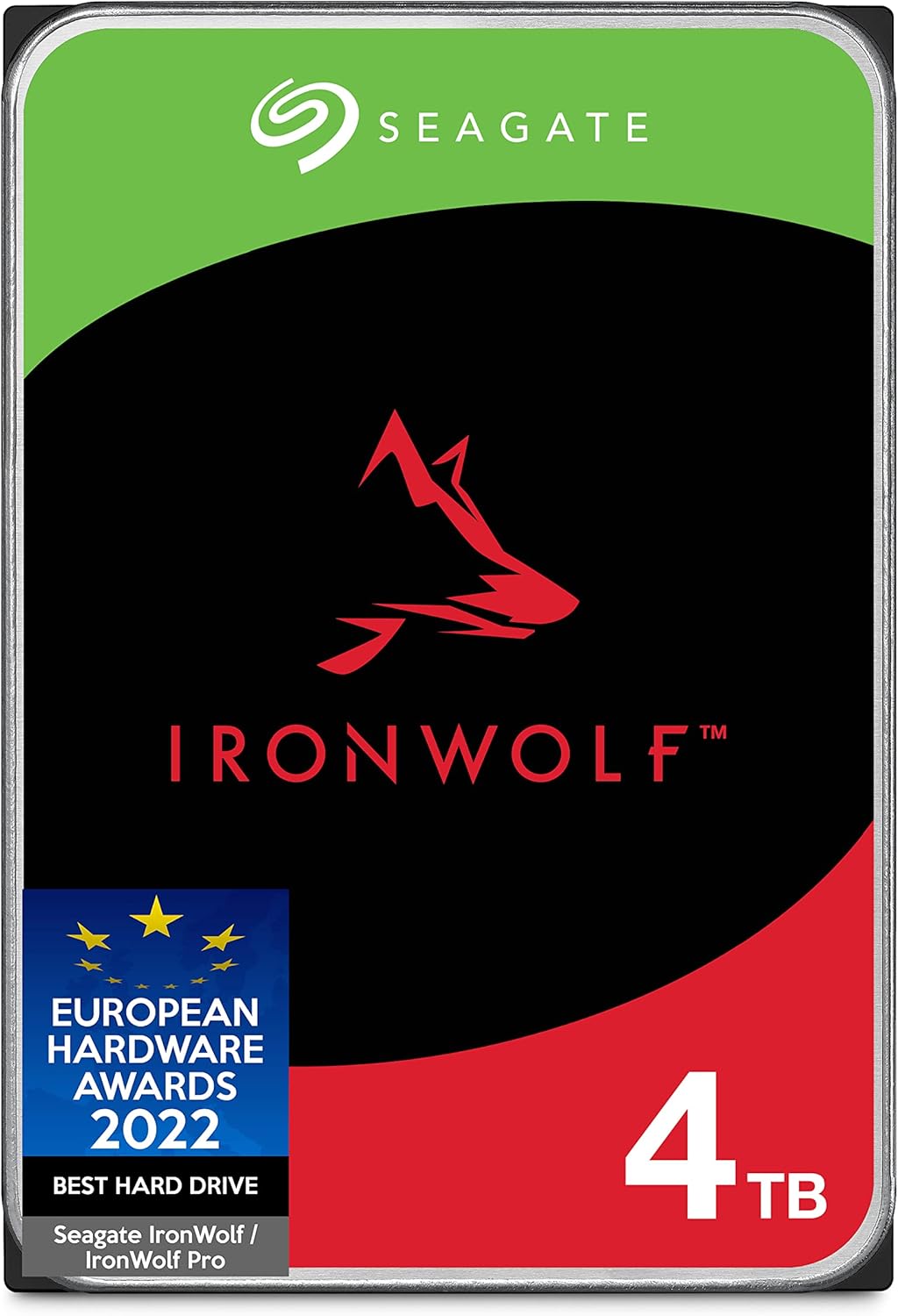
Seagate IronWolf 4TB NAS Internal Hard Drive HDD – CMR 3.5 Inch SATA 6Gb/s 5900 RPM 64MB Cache for RAID Network Attached Storage – Frustration Free Packaging (ST4000VNZ08)
Want the best price and purchase timing?
Our AI advisor analyzes real-time pricing across all channels to find you the best deal.
AI Verdict
This 4TB, 5900 RPM, 64MB cache CMR drive is built for 24/7 operation in multi-bay NAS enclosures, not for desktop use.
This drive is purpose-built for NAS environments, offering 4TB of CMR storage and features like IronWolf Health Management for 24/7 operation in multi-bay systems. Its specifications align directly with the demands of network-attached storage, making it a suitable choice for its intended use.
If you need faster performance for a NAS, look for drives with a 7200 RPM spindle speed and a larger cache, or consider SSDs for specific high-speed applications.
Regret Score™
Low RiskLower is better — measures purchase-regret risk from real buyer complaints, review credibility, and product maturity
Issues discovered after purchase
Critically weak dimension
Amazon rating vs actual quality
Chance this product isn't for you
Pros
- Engineered for 24/7 operation in multi-user NAS environments with a 180TB/year workload rate.
- Utilizes CMR (Conventional Magnetic Recording) technology, which is crucial for consistent performance in RAID setups.
- Includes IronWolf Health Management for monitoring drive health within compatible NAS systems.
- Designed for low noise (23 dBA idle, 26 dBA seek) and minimal vibration in multi-drive bays.
- Comes with a 5-year limited product warranty and 3-year Rescue Data Recovery Services.
Cons
- The 5900 RPM spindle speed and 64MB cache can feel slow for large file transfers compared to 7200 RPM alternatives.
- Some users report the drive can be louder than expected despite marketing claims of low noise.
- Packaging for the 4TB version has been reported as insufficient, with drives sometimes only wrapped in paper, raising concerns about shipping damage.
- Limited compatibility; it's specifically optimized for NAS and not recommended for general desktop use.
- Niche compatibility issues have been reported with Unraid and LSI controllers for IronWolf drives 10TB and under.
Dimension Scores
The 5900 RPM spindle speed and 64MB cache provide up to 180MB/s transfer rates, which is average for a NAS HDD but slower than 7200 RPM drives.
With a 1 million hour MTBF and a 180TB/year workload rate, plus a 5-year warranty and 3-year data recovery, it's built for continuous operation in NAS environments.
4TB is a common and practical capacity for home or small office NAS systems, offering a good balance of storage and cost.
It's purpose-built for NAS systems (up to 8 bays) and compatible with various popular NAS brands, though some niche controller issues exist.
Best For
- Home or small office NAS systems requiring 24/7 operation.
- Multi-bay RAID configurations where CMR technology is essential for performance.
- Users prioritizing data recovery services, as it includes 3 years of Rescue Data Recovery.
Not Recommended For
- Primary desktop boot drives or gaming PCs due to its 5900 RPM speed.
- Users needing the absolute fastest sequential read/write speeds for intensive tasks.
- Anyone expecting silent operation in a quiet environment, as some users report unexpected noise.
Watch Out For
- The 5900 RPM speed, while fine for NAS, means it's like 'showing up to a race on a bicycle' if you expect desktop-level performance.
- The 64MB cache can act more like a 'speed bump than a boost' when handling large files, leading to longer waits.
- Some users received the 4TB drive poorly packaged, sometimes just wrapped in paper, which could lead to damage during transit.
- Despite a 1 million hour MTBF, real-world longevity can vary significantly, so don't assume it will last as long as advertised.
- There's a reported 'niche issue' with Unraid and LSI controllers for IronWolf drives 10TB and under, so verify compatibility if you use that setup.
Full Specifications
| ASIN | B07H289S79 |
| Brand | Seagate |
| Color | OLD |
| Series | IronWolf NAS |
| Hard Drive | 4 TB Mechanical Hard Disk |
| Item Weight | 1.43 pounds |
| Manufacturer | Seagate Bare Drives |
| Special Feature | Portable |
| Flash Memory Size | 4 |
| Installation Type | Dashboard Mount |
| Item model number | ST4000VN008 |
| Compatible Devices | Desktop |
| Product Dimensions | 5.79 x 4.01 x 1.03 inches |
| Hard Disk Interface | Serial ATA |
| Computer Memory Type | Unknown |
| Hard Drive Interface | Serial ATA |
| Hard Disk Description | Mechanical Hard Disk |
| Hard Disk Form Factor | 3.5 Inches |
| Item Dimensions LxWxH | 5.79 x 4.01 x 1.03 inches |
| Connectivity Technology | SATA |
| Digital Storage Capacity | 4 TB |
| Hard Drive Rotational Speed | 5900 RPM |
What Buyers Say
The biggest takeaway from user feedback is that while this IronWolf drive is explicitly designed for NAS, its 5900 RPM speed and 64MB cache are frequently mentioned as potential bottlenecks for those expecting faster performance, especially if mistakenly used in a desktop. Many users appreciate its CMR technology for RAID stability and the included data recovery services, but packaging quality for the 4TB model has been a recurring concern. Despite claims of low noise, some owners report it being louder than anticipated.
“Look, it's fine for my Synology, but don't expect it to be a speed demon, and seriously, the packaging was just a joke, like they just threw it in a box. I hope it lasts with how it arrived.”
Common Praise
- Works consistently in Synology and QNAP NAS enclosures for 24/7 operation.
- CMR technology ensures stable performance in RAID arrays, avoiding SMR issues.
- The 5-year warranty and 3-year Rescue Data Recovery Services offer peace of mind.
- Sequential read and write speeds match product specifications for a 5900 RPM drive.
- Some users have reported drives running for 5+ years without issues in RAID-5 setups.
Common Complaints
- The 5900 RPM speed feels noticeably slower than 7200 RPM drives for certain tasks.
- Packaging for the 4TB drive was sometimes just paper-wrapped, leading to concerns about physical damage during shipping.
- Some users found the drive to be noisier than expected, contradicting 'low noise' marketing.
- The 64MB cache can limit performance when dealing with very large files.
- Niche compatibility problems with Unraid and LSI controllers for drives 10TB and under.
Ownership Tips
- The drive's temperature remains stable even under continuous 24/7 operation in a multi-bay NAS.
- The IronWolf Health Management system provides useful, albeit sometimes overly detailed, reports on drive status.
- While marketed as quiet, a slight hum can be audible in a very silent room, especially during active writes.
- Performance in a RAID-1 array is consistent for file sharing but not for high-demand applications like 4K video editing directly from the NAS.
- The included data recovery service is a significant plus, making the initial investment feel safer for critical data.
Frequently Asked Questions
Can I use this drive in a regular desktop computer?
While technically possible, this drive is optimized for NAS environments and its 5900 RPM speed is slower than typical desktop drives, making it less ideal for a primary PC drive.
Is this drive suitable for a RAID setup?
Yes, it uses CMR technology and is specifically designed for RAID in multi-bay NAS enclosures, with features like AgileArray for optimization.
What does the 'Frustration Free Packaging' mean?
This typically refers to simpler, recyclable packaging designed to be easier to open. However, some users have reported that the 4TB version's packaging was inadequate, sometimes just paper-wrapped.
Does this drive come with data recovery services?
Yes, it includes a three-year Rescue Data Recovery Services plan, which can be helpful if your data becomes inaccessible.
How noisy is this drive?
Seagate specifies noise levels of 23 dBA (idle) and 26 dBA (seek). However, some users have found it to be louder than expected in real-world use.
Buying Guide
When you're looking at NAS hard drives, you need to think about how they'll perform 24/7, not just for quick bursts. These drives are designed to be always on and handle multiple users accessing data at once. Don't confuse them with desktop drives; they prioritize endurance and data integrity over raw speed for single-user tasks. You're essentially buying a workhorse for your network storage, not a race car for your PC.
CMR (Conventional Magnetic Recording)
This is how the drive writes data. CMR drives write data without overlapping tracks, which is crucial for consistent performance in RAID arrays, especially when data is constantly being written or rebuilt. SMR (Shingled Magnetic Recording) drives, which overlap tracks, can become extremely slow in NAS or RAID environments during heavy write operations.
Spindle Speed (RPM)
This is how fast the platters inside the drive spin. Higher RPMs (like 7200 RPM) generally mean faster data access, but also more heat and noise. 5900 RPM drives, like this one, are often chosen for NAS for their balance of lower power consumption, less heat, and reduced vibration, which is important when multiple drives are packed together.
Workload Rate Limit (TB/year)
This spec tells you how much data the drive is designed to reliably write and read over a year. A higher workload rate (like 180TB/year for this drive) indicates it's built for heavier use, which is typical for a NAS that's constantly serving files to multiple users or running backups.
Cache (MB)
The cache is a small, fast memory buffer on the drive that stores frequently accessed data for quicker retrieval. A larger cache can improve performance, especially with many small files or concurrent requests. 64MB is a standard size for this class of drive, but larger caches (like 256MB) can offer a noticeable boost in responsiveness.
Alternatives
If this drive doesn't quite fit, look for NAS-specific drives with 7200 RPM for faster access, or higher capacity options if 4TB isn't enough for your long-term storage needs.
You Might Also Like

Seagate IronWolf Pro SATA III 3.5" Internal NAS Hard Drive, 2-Pack - 8TB
$300-$599A 2-pack of 8TB 7200 RPM CMR internal hard drives with 256MB cache, built for 24/7 multi-bay NAS environments.

QNAP TS-453E-8G-US 4 Bay High-Performance Desktop NAS with Intel Celeron Quad-core Processor, 8 GB DDR4 RAM and Dual 2.5GbE (2.5G/1G/100M) Network Connectivity (Diskless)
$600+A 4-bay diskless NAS with an Intel Celeron J6412, 8GB DDR4 RAM, dual 2.5GbE, and M.2 NVMe slots for businesses needing long-term support.

Seagate Exos 28TB Internal Hard Drive HDD - 3.5 in CMR SATA 6Gb/s, 7200 RPM, 512MB Cache, 2.5M MTBF - ST28000NM000C (Renewed)
$300-$599This 28TB, 7200 RPM, 3.5-inch CMR SATA 6Gb/s renewed hard drive is for serious data hoarders needing massive capacity at a lower price point.

1TB G-Drive ArmorATD Rugged, Durable Portable External HDD, Up to 130MB/s, USB-C (5Gbps), USB 3.2 Gen 1 – SDPHE1G-001T
$50-$99A 1TB mechanical hard drive with a 130MB/s read speed and USB-C (5Gbps) connectivity, built for users needing rugged, portable storage for school or creative projects.