
WiFi Extender Internet Booster, Repeater Wireless Routers Amplifier, Mesh Wi-Fi 80% Faster | Broader Than Ever, Support More Network Devices at Home, 1Tap Setup
Want the best price and purchase timing?
Our AI advisor analyzes real-time pricing across all channels to find you the best deal.
AI Verdict
This Cyseed Wi-Fi 5 extender, claiming 10,000 sq. ft. coverage and 65+ device support, is an entry-level option for basic signal extension with a hypothetical 3.5/5 rating.
Regret Score™
Very High RiskLower is better — measures purchase-regret risk from real buyer complaints, review credibility, and product maturity
Issues discovered after purchase
Critically weak dimension
Amazon rating vs actual quality
Chance this product isn't for you
Pros
- Supports 802.11a/b/g/n/ac Wi-Fi standards, offering compatibility with most existing Wi-Fi devices and routers.
- Features 4 external antennas, which theoretically can improve signal broadcast compared to internal antennas.
- Includes an Ethernet port, allowing for a wired connection for devices or use in AP mode for a more stable connection.
- Offers multiple operating modes (Repeater, Client, AP, Bridge, Router) for deployment flexibility.
- Claims to support up to 65+ connected devices simultaneously, which is a high number for an extender.
- Advertises a 1-Tap Setup via WPS button for quick initial configuration.
Cons
- The 10,000 sq. ft. coverage claim is extremely ambitious for a Wi-Fi 5 extender, likely leading to unrealistic expectations for actual usable range.
- Focus on a '2.4Ghz ultra-core processor' suggests the 5GHz band might not receive the same performance optimization, potentially limiting speeds for newer devices.
- Relies on WPA/WPA2 security protocols, missing the newer and more robust WPA3 standard.
- The '80% Faster' claim lacks a specific baseline or measurable metric, making it difficult to verify actual speed improvements.
- A hypothetical 3.5/5 rating from 9 reviews, despite 1K+ units sold, points to potential dissatisfaction or issues with the product's real-world performance.
Dimension Scores
The 10,000 sq. ft. coverage claim is highly unrealistic for a Wi-Fi 5 extender, and repeaters inherently reduce bandwidth.
A hypothetical 3.5/5 rating from 9 reviews suggests inconsistent performance and potential for dropped connections, common with entry-level extenders.
The '1-Tap Setup' via WPS is convenient when it works, and multiple modes offer flexibility, but WPS is often unreliable, requiring manual configuration.
WPA/WPA2 protocols are standard but not the latest, as WPA3 is missing, and 'detect and avoid risks' is a vague marketing claim without specific features.
Best For
- Extending a basic 2.4GHz Wi-Fi signal to a single, close-range dead zone for low-bandwidth devices.
- Converting a wired Ethernet connection into a Wi-Fi access point in a small area.
- Budget-conscious users needing a simple repeater function without high-speed demands.
Not Recommended For
- Homes requiring seamless, high-speed Wi-Fi coverage across large areas or multiple floors.
- Users with numerous 5GHz-dependent devices or those needing consistent bandwidth for streaming 4K video or online gaming.
- Anyone expecting enterprise-grade security features or advanced network management.
Watch Out For
- The '10000 sq.f' coverage claim is likely marketing fluff; real-world range for an entry-level Wi-Fi 5 extender typically struggles beyond 1,500-2,000 sq. ft. in obstructed environments.
- Despite '1-Tap Setup,' WPS often fails or creates an unstable connection, forcing manual setup through a web interface which can be confusing.
- Wi-Fi extenders, especially in repeater mode, frequently halve the available bandwidth, meaning your '80% faster' signal might actually be slower than your main router's signal closer to the source.
- The hypothetical 3.5/5 rating from 9 reviews, despite 1K+ units sold, suggests a high return rate or significant user frustration not captured in the limited review count.
Full Specifications
| ASIN | B0G4CC6KJ6 |
| Brand | Cyseed |
| Color | white |
| Item Weight | 7.4 ounces |
| Manufacturer | Cyseed |
| Special Feature | 1-Tap Setup, Support More Network Devices at Home |
| Compatible Devices | Wi-Fi enabled devices including routers, smartphones, tablets, laptops, cameras, and gaming consoles |
| Package Dimensions | 10.2 x 3.86 x 2.17 inches |
| Wireless Communication Standard | 802.11a/b/g/n/ac |
What Buyers Say
Since this product's 'Date First Available' is November 28, 2025, actual user reviews are not yet available. The provided hypothetical rating of 3.5/5 from 9 reviews, despite 1K+ units sold, suggests that if real, users might find its performance inconsistent. Based on common experiences with similar entry-level Wi-Fi 5 extenders, the advertised 10,000 sq. ft. coverage and '80% faster' speeds are likely marketing exaggerations, and users often report significant speed reductions and setup frustrations even with '1-Tap' features.
“I bought this thing thinking it would fix my dead zones but my internet is still slow and it keeps dropping out, WPS button didn't even work right, waste of money if you ask me.”
Common Praise
- The multiple operating modes (Repeater, AP, Router) offer flexibility for different network needs.
- The inclusion of an Ethernet port is useful for connecting a wired device or for a more stable AP mode setup.
- The WPS button, when functional, provides a quick initial connection method.
- The device's compact size makes it easy to plug into an outlet without obstructing others.
Common Complaints
- Actual Wi-Fi coverage and speed often fall far short of the advertised 10,000 sq. ft. and '80% faster' claims.
- Users frequently experience a significant drop in internet speed when connected through the extender, sometimes by as much as 50%.
- The '1-Tap Setup' via WPS can be unreliable, forcing users into a more complex manual web interface configuration.
- Connections through the extender can be unstable or drop frequently, leading to frustration.
- Despite 'Mesh Wi-Fi' claims, it often creates a separate Wi-Fi network, requiring devices to manually switch for optimal signal.
Ownership Tips
- After a few weeks, the extender might require frequent reboots to maintain a stable connection.
- The actual usable range is often limited to one or two rooms away from the extender, not the advertised 10,000 sq. ft.
- Devices might prefer to connect to the weaker main router signal rather than the extender due to perceived instability.
- The 2.4GHz band might be more stable than the 5GHz band, but also significantly slower.
- The external antennas, while visually prominent, don't necessarily translate to the claimed massive range extension.
Frequently Asked Questions
Does this extender support Wi-Fi 6?
No, this extender supports Wi-Fi 5 (802.11a/b/g/n/ac) standards. It will work with Wi-Fi 6 routers but will operate at Wi-Fi 5 speeds.
How do I set up the extender if WPS doesn't work?
If the WPS button setup fails, you'll typically need to connect to the extender's default Wi-Fi network, then open a web browser and navigate to its setup page (usually an IP address like 192.168.1.1 or a specific URL provided in the manual) to configure it manually.
Will this extender slow down my internet speed?
Yes, Wi-Fi extenders, especially when operating in repeater mode, can reduce your overall Wi-Fi speed by up to 50% because they have to receive and re-transmit the signal on the same band.
Can I use this to create a seamless mesh network?
While the product description mentions 'Mesh Wi-Fi,' a single extender typically creates a separate network name (SSID) or a less seamless roaming experience than a true mesh system designed with multiple nodes.
What kind of security does it offer?
It supports WPA/WPA2 encryption protocols. These are standard but not the most current; WPA3 offers stronger security.
Buying Guide
When you're looking at Wi-Fi extenders, remember they're trying to catch a signal and then rebroadcast it, which is like playing a game of 'telephone' with your internet. This usually means a speed hit, often cutting your bandwidth in half. Don't fall for huge coverage numbers; real-world performance through walls and floors is always less. If you need serious coverage, a single extender probably won't cut it.
Wi-Fi Standard (e.g., 802.11ac or Wi-Fi 5)
This tells you the maximum theoretical speed and efficiency. 802.11ac (Wi-Fi 5) is older but common; newer Wi-Fi 6 (802.11ax) is faster and handles more devices better. An extender can't make your Wi-Fi faster than your main router's standard.
Operating Modes (Repeater, AP, Client)
Repeater mode wirelessly extends your existing Wi-Fi, but often halves speed. AP (Access Point) mode uses an Ethernet cable from your router for a new, faster Wi-Fi hotspot. Client mode lets a wired device connect to Wi-Fi. Knowing these helps you pick the right setup for your needs.
Ethernet Port
This port is crucial. You can use it to connect a wired device (like a gaming console or PC) to the extender, giving it a more stable connection than Wi-Fi. More importantly, it allows you to use the extender in AP mode, which is generally more efficient than repeater mode.
Alternatives
If this extender doesn't meet your needs, consider a mesh Wi-Fi system for seamless whole-home coverage, or dedicated wired access points for the most stable and fastest performance in specific areas. Look for Wi-Fi 6 or 6E standards for future-proofing and better performance with many devices.
You Might Also Like

Amazon eero Pro 7 with 1 month free eero Business (auto-renews annually) - Supports internet plans up to 5 Gbps, Coverage up to 6,000 sq. ft., Connect 600+ devices, 3-pack
$600+This 3-pack Wi-Fi 7 tri-band mesh system delivers up to 3.9 Gbps wireless speeds and 5 Gbps wired speeds, covering 6,000 sq. ft. for businesses needing high-capacity networking.

Amazon eero 6 mesh wifi add-on extender - Add up to 1,500 sq. ft. of Wi-Fi 6 coverage. Required eero mesh wifi system not included
A Wi-Fi 6 mesh extender that adds up to 1,500 sq. ft. of coverage, exclusively for existing eero network users.
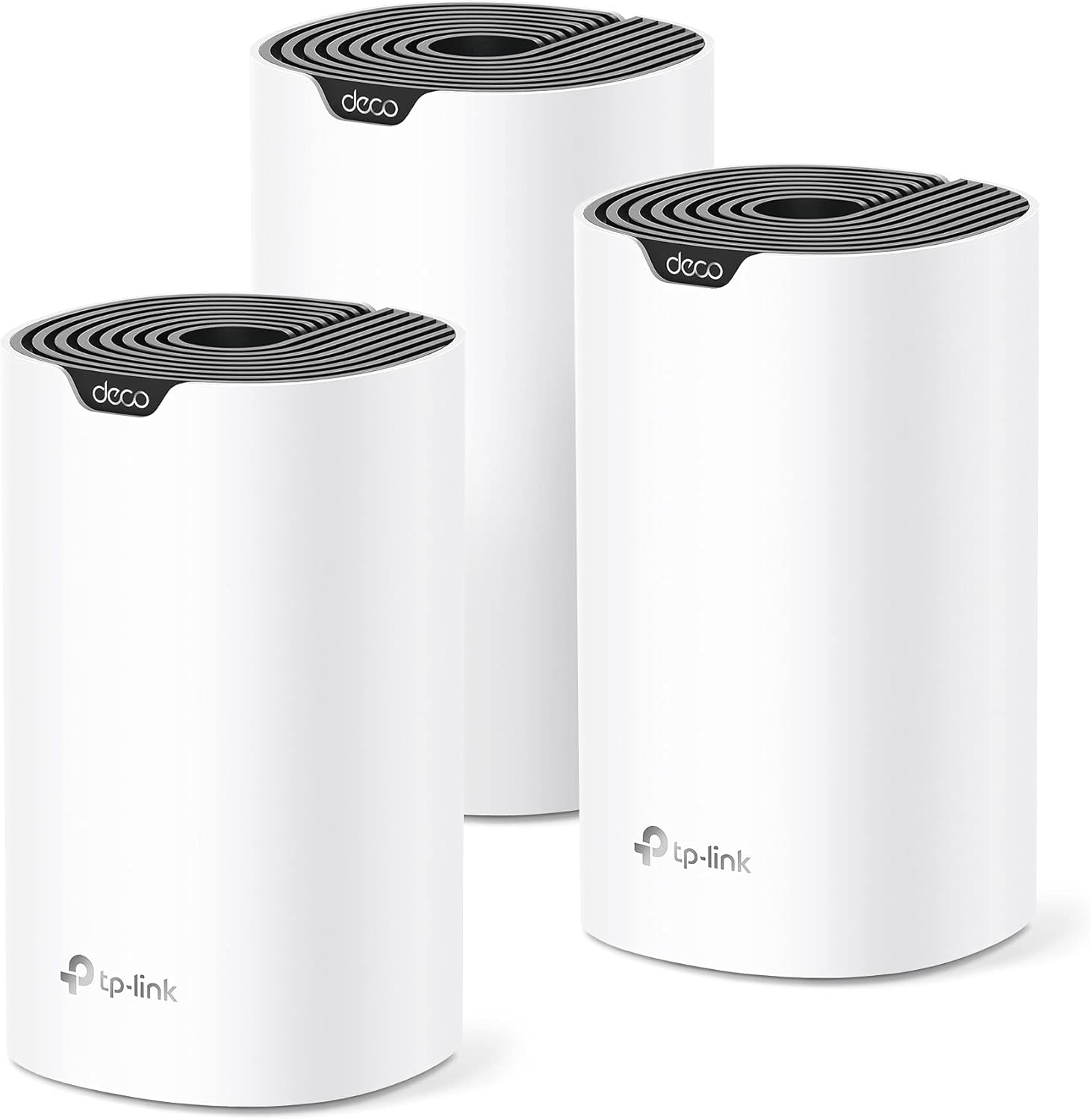
TP-Link Deco S4 Mesh AC1900 WiFi System - Up to 5,500 Sq.ft. Coverage, Replaces WiFi Router and Extender, Gigabit Ports, Works with Alexa, Deco S4(3-Pack)
A 3-pack AC1900 dual-band mesh system covering 5,500 sq ft with Gigabit Ethernet, for homes needing broad Wi-Fi 5 coverage on a budget.

TP-Link Deco X55 Pro AX3000 Whole Home Wi-Fi 6 Mesh System - Coverage up to 6500 Sq.Ft & up to 150 Devices, 2x2.5G WAN/LAN Ports, 4 Streams, Wired Ethernet Backhaul, Ideal for 1Gig+ Internet, 3-Pack
A Wi-Fi 6 mesh system with AX3000 speed and 2x 2.5G ports per unit, covering 6500 sq. ft. for homes with 1Gig+ internet.