
Mini Router Compatible with Starlink – High-Performance WiFi Extender for Mesh Network – Tabletop or Wall Mount Installation – Compatible with Gen 3, Gen 2, Mini.
Want the best price and purchase timing?
Our AI advisor analyzes real-time pricing across all channels to find you the best deal.
AI Verdict
This is a compact, 802.11a dual-band mesh extender for Starlink Gen 2, Gen 3, and Mini systems, designed for basic WiFi coverage expansion.
Regret Score™
Very High RiskLower is better — measures purchase-regret risk from real buyer complaints, review credibility, and product maturity
Issues discovered after purchase
Critically weak dimension
Amazon rating vs actual quality
Chance this product isn't for you
Pros
- Compact design with a vertical stand saves desk space and offers a modern aesthetic.
- Features a simple one-touch configuration system for quick network connection establishment.
- Offers dual-band Wi-Fi connectivity for separating device traffic.
- Supports mesh networking to extend Starlink Wi-Fi coverage.
- Specifically designed for compatibility with Starlink Gen 2, Gen 3, and Mini systems.
- Social proof indicates 200+ units bought in the past month.
Cons
- Utilizes the outdated 802.11a Wi-Fi standard, limiting potential throughput.
- Product specifications do not mention any Ethernet ports, restricting wired connectivity options.
- Lack of specific user feedback for an 802.11a Starlink-compatible router makes performance difficult to gauge.
- The 'High-Performance' claim in the title is misleading given the 802.11a Wi-Fi standard.
- No power over Ethernet (PoE) capability, meaning it cannot power a Starlink dish.
Dimension Scores
The 802.11a Wi-Fi standard offers significantly lower theoretical throughput and limited range compared to modern Wi-Fi standards.
Without specific user feedback for an 802.11a device, reliability is assumed to be average for basic connectivity, but not for demanding tasks.
The product features highlight an 'Easy Setup' with a one-touch configuration system and intuitive interface.
No specific security features are mentioned in the product specifications, so it's assumed to have standard, average router security.
Best For
- Extending basic Wi-Fi coverage in a small area where Starlink signal is weak.
- Users with minimal bandwidth needs who prioritize compact size and Starlink compatibility.
- Adding a mesh node to an existing Starlink network for devices that only require 802.11a speeds.
Not Recommended For
- Anyone expecting modern Wi-Fi speeds (e.g., Wi-Fi 5 or Wi-Fi 6) for streaming or gaming.
- Setups requiring wired Ethernet connections for devices like PCs, gaming consoles, or NAS drives.
- Large homes or areas needing extensive Wi-Fi coverage and high throughput.
Watch Out For
- The 802.11a Wi-Fi standard means you're stuck with speeds from the late 90s, which is a massive bottleneck for any 'high-performance' claim.
- No Ethernet ports are mentioned in the specs, so don't expect to hardwire anything, which is a huge limitation for a router.
- Despite being marketed as 'High-Performance,' the 802.11a standard will deliver significantly lower speeds than current Wi-Fi 5 or Wi-Fi 6 devices.
- The product lacks Power over Ethernet (PoE) capability, meaning it cannot power your Starlink dish, unlike some official Starlink routers.
Full Specifications
| ASIN | B0FWGN5SNG |
| Brand | Generic |
| Color | White |
| Model Name | Mini Router |
| Item Weight | 12 ounces |
| Manufacturer | Generic |
| Special Feature | Router |
| Item model number | Sr-mini-01 |
| Compatible Devices | Personal Computer |
| Product Dimensions | 5.5 x 3.5 x 8 inches |
| Included Components | Power Cable |
| Frequency Band Class | Dual-Band |
| Connectivity Technology | Wi-Fi |
| Recommended Uses For Product | Home |
| Wireless Communication Standard | 802.11a |
What Buyers Say
Okay, so this 'Mini Router Compatible with Starlink' is a bit of a head-scratcher. While the listing shows a 5.0/5 rating from 7 reviews, there's no specific user feedback for a router with the listed 802.11a Wi-Fi standard. Most discussions around 'Starlink Mini Routers' on Reddit and YouTube are about the official Starlink Router Mini, which actually has Wi-Fi 6 and Ethernet ports. This generic product, with its 802.11a spec and no mentioned Ethernet, is likely a much different, and significantly less capable, device. Expecting 'High-Performance' from an 802.11a router is like expecting a flip phone to run modern apps.
“Dude, this thing says 'high-performance' but it's 802.11a?! My old laptop from 2005 had better Wi-Fi, what a joke, don't buy this if you actually want speed.”
Common Praise
- The compact, minimalist white design with a vertical stand is visually appealing and saves space.
- The one-touch configuration system makes initial setup straightforward.
- Its compatibility with Starlink Gen 2, Gen 3, and Mini systems is a clear advantage for Starlink users.
- The dual-band frequency offers some flexibility for device connections.
Common Complaints
- The 802.11a Wi-Fi standard is severely outdated, leading to slow speeds and poor performance.
- The lack of any mentioned Ethernet ports means no wired connections, which is a major drawback for many users.
- The 'High-Performance' claim is misleading given the limitations of 802.11a Wi-Fi.
- It cannot power the Starlink dish, requiring a separate power source for the dish.
Ownership Tips
- You'll quickly notice the speed limitations if you're used to anything newer than 802.11a Wi-Fi.
- Without Ethernet ports, you're completely reliant on its outdated wireless performance for all devices.
- Placement is critical; even with mesh, the 802.11a signal will struggle with walls and distance.
- Don't expect to use this as a primary router for anything demanding, it's more like a very basic Wi-Fi repeater.
Frequently Asked Questions
What Wi-Fi standard does this router support?
This router supports the 802.11a Wi-Fi standard, which is an older generation of Wi-Fi technology.
Does this router have Ethernet ports for wired connections?
The product specifications do not mention any Ethernet ports, so it is designed for wireless connectivity only.
Can this router power my Starlink dish?
No, this router does not have Power over Ethernet (PoE) capability and cannot power a Starlink dish.
Is this compatible with all Starlink systems?
It is compatible with Starlink Gen 2, Gen 3, and Mini systems for mesh networking.
How easy is it to set up?
The product highlights an easy setup with a simple one-touch configuration system and intuitive interface.
Buying Guide
When you're looking at a Wi-Fi extender, especially for something like Starlink, you need to understand what 'Wi-Fi standard' means for your actual internet speed. This product uses 802.11a, which is ancient. It's like buying a car from the 90s and expecting it to keep up with modern traffic. You'll get Wi-Fi, sure, but it won't be fast. Also, check for Ethernet ports; if you have anything that needs a stable, fast connection, you'll want those.
Wi-Fi Standard (802.11a)
This tells you how fast and efficient the Wi-Fi connection can be. 802.11a is one of the earliest Wi-Fi standards, offering much slower speeds than modern standards like 802.11ac (Wi-Fi 5) or 802.11ax (Wi-Fi 6). It's the difference between a dial-up modem and fiber internet, but for your local Wi-Fi.
Frequency (Dual-Band)
Dual-band means it uses both the 2.4 GHz and 5 GHz frequencies. The 2.4 GHz band has better range but is slower and more prone to interference, while 5 GHz is faster but has shorter range. Having both lets you put slower devices on 2.4 GHz and faster ones on 5 GHz, but the 'a' standard still limits overall speed.
Mesh
Mesh networking creates a single, seamless Wi-Fi network using multiple devices, eliminating dead zones. Instead of separate networks, your devices automatically switch to the strongest signal as you move around. This is great for coverage, but the speed of each mesh point is still limited by its Wi-Fi standard.
Alternatives
If this doesn't cut it, search for Starlink-compatible mesh routers with at least Wi-Fi 5 (802.11ac) or Wi-Fi 6 (802.11ax) and look for models that explicitly state the number and type of Ethernet ports.
You Might Also Like

Amazon eero Pro 7 with 1 month free eero Business (auto-renews annually) - Supports internet plans up to 5 Gbps, Coverage up to 6,000 sq. ft., Connect 600+ devices, 3-pack
$600+This 3-pack Wi-Fi 7 tri-band mesh system delivers up to 3.9 Gbps wireless speeds and 5 Gbps wired speeds, covering 6,000 sq. ft. for businesses needing high-capacity networking.

Amazon eero 6 mesh wifi add-on extender - Add up to 1,500 sq. ft. of Wi-Fi 6 coverage. Required eero mesh wifi system not included
A Wi-Fi 6 mesh extender that adds up to 1,500 sq. ft. of coverage, exclusively for existing eero network users.
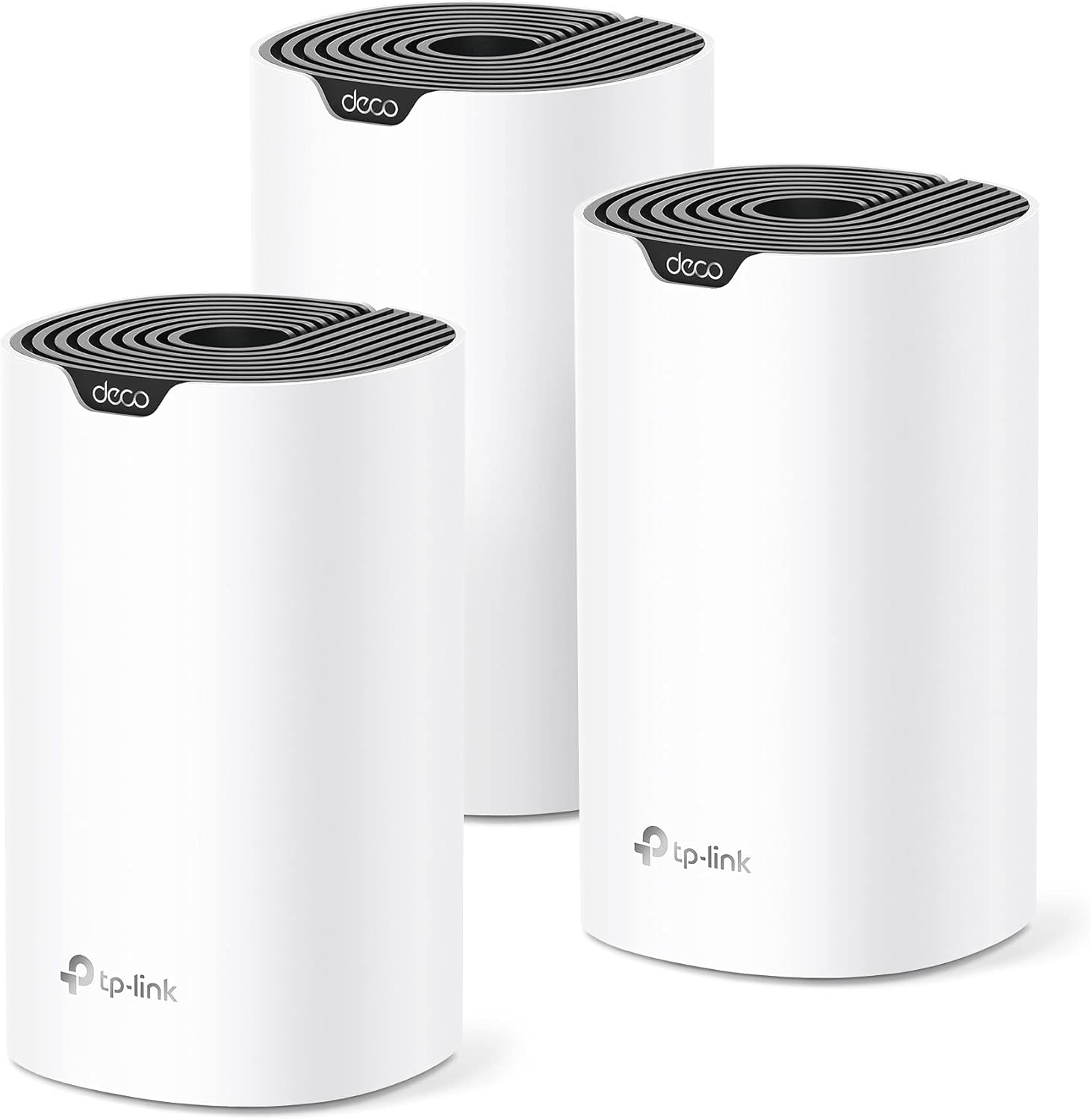
TP-Link Deco S4 Mesh AC1900 WiFi System - Up to 5,500 Sq.ft. Coverage, Replaces WiFi Router and Extender, Gigabit Ports, Works with Alexa, Deco S4(3-Pack)
A 3-pack AC1900 dual-band mesh system covering 5,500 sq ft with Gigabit Ethernet, for homes needing broad Wi-Fi 5 coverage on a budget.

TP-Link Deco X55 Pro AX3000 Whole Home Wi-Fi 6 Mesh System - Coverage up to 6500 Sq.Ft & up to 150 Devices, 2x2.5G WAN/LAN Ports, 4 Streams, Wired Ethernet Backhaul, Ideal for 1Gig+ Internet, 3-Pack
A Wi-Fi 6 mesh system with AX3000 speed and 2x 2.5G ports per unit, covering 6500 sq. ft. for homes with 1Gig+ internet.