
Router Mini
Want the best price and purchase timing?
Our AI advisor analyzes real-time pricing across all channels to find you the best deal.
AI Verdict
This is a compact, Wi-Fi 6, tri-band mesh node for existing Starlink systems, ideal for extending coverage in dead zones.
This router is a strong fit for Starlink users who need to extend their existing Wi-Fi coverage with a simple, compact mesh node. Its Wi-Fi 6 and tri-band capabilities ensure modern device compatibility and efficient spectrum use, but the limited physical ports and basic software mean it won't replace a full-featured router. Its small size is a plus for discreet placement.
If you need more wired connections or advanced network controls, look for a router with multiple Gigabit Ethernet ports and robust firmware options.
Regret Score™
High RiskLower is better — measures purchase-regret risk from real buyer complaints, review credibility, and product maturity
Issues discovered after purchase
Critically weak dimension
Amazon rating vs actual quality
Chance this product isn't for you
Pros
- Extends Wi-Fi coverage up to 1300 square feet per unit, based on customer surveys [cite: Product Data].
- Supports Wi-Fi 6 (802.11ax) and tri-band frequencies for modern device compatibility [cite: Product Data, 6].
- Functions as a mesh node, creating a seamless network with other Starlink routers [cite: Product Data, 2, 9].
- Very small form factor, described by users as being 'just as big as my iPhone'.
- Simple setup process via the Starlink app.
Cons
- Only includes one Latching Ethernet LAN port and one Latching Ethernet WAN port, limiting wired connections without an additional switch [cite: Product Data, 5].
- Lacks advanced configuration options like port forwarding, firewall rules, or static IP assignment.
- Does not have a USB port for external storage or other peripherals.
- Some users report it only meshes at 2.4GHz with the Starlink Mini, even when close.
- Does not support 3rd party mesh systems, limiting ecosystem flexibility [cite: Product Data].
Dimension Scores
Supports Wi-Fi 6 (802.11ax) and tri-band frequencies, with users reporting good speed and coverage up to 1300 square feet, and sometimes more [cite: Product Data, 2, 6].
Users generally report stable performance, though some experienced issues like low upload speeds when used wirelessly as an extender.
Setup is described as easy and simple via the Starlink app, with automatic pairing for mesh functionality.
Lacks advanced configuration options like custom firewall rules, which limits user control over security settings.
Best For
- Expanding Wi-Fi coverage in a Starlink-equipped home with dead spots.
- Users who need a simple, plug-and-play mesh extender for their Starlink network.
- Adding Wi-Fi to a small area like a detached garage or an upstairs office within a Starlink setup.
Not Recommended For
- Users requiring advanced network configuration features like port forwarding or custom firewall rules.
- Homes with many wired devices that need direct Ethernet connections without an additional switch.
- Those looking to integrate with non-Starlink mesh systems.
Watch Out For
- The price recently increased from $40 to $100, making it significantly less budget-friendly than its initial offering.
- Automatic frequency assignment (2.4GHz vs 5GHz) can lead to slower speeds for devices like computers that might be assigned to 2.4GHz.
- The design is described as 'rudimentary' and 'devoid of feature sets' by some users, indicating a very basic functionality focus.
- Does not have Power over Ethernet (PoE) functionality, requiring its own 15W wall adapter.
Full Specifications
| ASIN | B0FPTB5LV2 |
| Brand | Starlink |
| Color | White |
| Series | Router Mini |
| Model Name | Router Mini |
| Item Weight | 15.8 ounces |
| Manufacturer | STARLINK |
| Wireless Type | 802.11a, 802.11ac, 802.11ax |
| Special Feature | Internet Security |
| Operating System | ZyNOS |
| Item model number | 39006001 |
| Compatible Devices | Gaming Console, Personal Computer, Security Camera, Smart Television, Smartphone, Tablet |
| Package Dimensions | 8.31 x 6.69 x 2.44 inches |
| Included Components | Drywall Anchors (2x), Mini Router, Power Supply, Stand, Wood Screws (2x) |
| Frequency Band Class | Tri-Band |
| Connectivity Technology | Wi-Fi |
| Recommended Uses For Product | Business, Gaming, Home |
| Wireless Communication Standard | 802.11a, 802.11ac, 802.11ax |
What Buyers Say
Users were genuinely surprised by how tiny the Router Mini is, often comparing it to an iPhone, which makes it super easy to tuck away. It's mostly seen as a simple, effective way to kill Wi-Fi dead zones in a Starlink setup, especially for its original $40 price point. However, the recent jump to $100 has definitely made people question its value, especially since it's pretty basic on features like extra Ethernet ports or advanced network controls. Some folks also noticed it can be a bit finicky with which frequency (2.4GHz or 5GHz) it assigns devices, which can slow things down.
“Honestly, I grabbed this 'cause my Starlink Wi-Fi was dying in the back bedroom, and for forty bucks, it's a no-brainer to just plug it in and suddenly I've got signal everywhere, even if it's super basic.”
Common Praise
- Extremely small and compact form factor, making it easy to place discreetly.
- Simple and straightforward setup process using the Starlink app.
- Effectively extends Wi-Fi coverage and eliminates dead spots within a Starlink network.
- Provides seamless mesh Wi-Fi experience when paired with other Starlink routers.
- Offers Wi-Fi 6 and tri-band support for modern device connectivity [cite: Product Data, 6].
Common Complaints
- Very limited number of Ethernet ports (one LAN, one WAN) [cite: Product Data, 5].
- Absence of advanced network configuration options like port forwarding or static IP assignment.
- No USB port for connecting external devices.
- Automatic frequency band steering can sometimes connect devices to the slower 2.4GHz band.
- The recent price increase from $40 to $100 significantly impacts perceived value.
Ownership Tips
- The status LED on the bottom automatically shuts off after a couple of hours, which is nice for bedroom placement.
- You'll need a separate power outlet for each Router Mini, as it doesn't use PoE.
- It's best to place it about halfway between your main router and the dead zone for optimal wireless mesh performance.
- Don't expect to tweak much; the Starlink app keeps things super simple, which is either a blessing or a curse depending on what you need.
- Despite the 1300 sq ft rating, some users found it covered larger homes, but performance might drop at the edges.
Frequently Asked Questions
Can the Router Mini be used as a standalone router?
Yes, it can function as the main router for a Starlink Mini dish, but it's primarily designed to extend an existing Starlink network.
Is the Router Mini compatible with non-Starlink mesh systems?
No, the Router Mini is not compatible with 3rd party mesh systems and is designed to work within the Starlink ecosystem [cite: Product Data].
How many Ethernet ports does the Router Mini have?
It has one Latching Ethernet LAN port and one Latching Ethernet WAN port [cite: Product Data].
What Wi-Fi standard does the Router Mini support?
It supports Wi-Fi 6 (802.11ax) and operates on tri-band frequencies [cite: Product Data, 6].
What is the typical coverage area of the Router Mini?
It's rated for a coverage area of around 1300 square feet (120 square meters) per router, though actual range can vary [cite: Product Data, 2].
Buying Guide
When you're looking at a router like the Router Mini, you're mostly thinking about how well it spreads your internet signal around. Forget about crazy tech jargon; you need to know if it can reach all the corners of your house and if your devices will stay connected without a fuss. For a mesh system, the goal is one big, happy Wi-Fi bubble, not a bunch of separate networks you have to manually switch between.
Wi-Fi Standard (e.g., 802.11ax/Wi-Fi 6)
This is like the generation of your Wi-Fi. Wi-Fi 6 (802.11ax) is the latest and fastest, meaning your devices can talk to the router more efficiently, especially when you have a lot of gadgets connected at once. Older standards are slower, like trying to drive a modern car on an old dirt road.
Frequency (Tri-Band)
Think of Wi-Fi bands as lanes on a highway. Dual-band gives you two lanes (2.4GHz and 5GHz), and tri-band adds a third (another 5GHz or 6GHz). More lanes mean less traffic congestion for your devices, leading to smoother streaming and faster downloads, especially if you have many devices hogging bandwidth.
Mesh Capability
Mesh means multiple Wi-Fi points work together as one big network. Instead of having separate Wi-Fi names for an extender, a mesh system lets you roam your house and your device automatically connects to the strongest signal without you doing anything. It's like having one giant, invisible Wi-Fi blanket over your whole home.
Alternatives
If this doesn't cut it, look for routers with more than two Gigabit Ethernet ports for wired connections, or those with advanced firmware for granular control over network settings like QoS and VPNs.
You Might Also Like

Amazon eero Pro 7 with 1 month free eero Business (auto-renews annually) - Supports internet plans up to 5 Gbps, Coverage up to 6,000 sq. ft., Connect 600+ devices, 3-pack
$600+This 3-pack Wi-Fi 7 tri-band mesh system delivers up to 3.9 Gbps wireless speeds and 5 Gbps wired speeds, covering 6,000 sq. ft. for businesses needing high-capacity networking.

Amazon eero 6 mesh wifi add-on extender - Add up to 1,500 sq. ft. of Wi-Fi 6 coverage. Required eero mesh wifi system not included
A Wi-Fi 6 mesh extender that adds up to 1,500 sq. ft. of coverage, exclusively for existing eero network users.
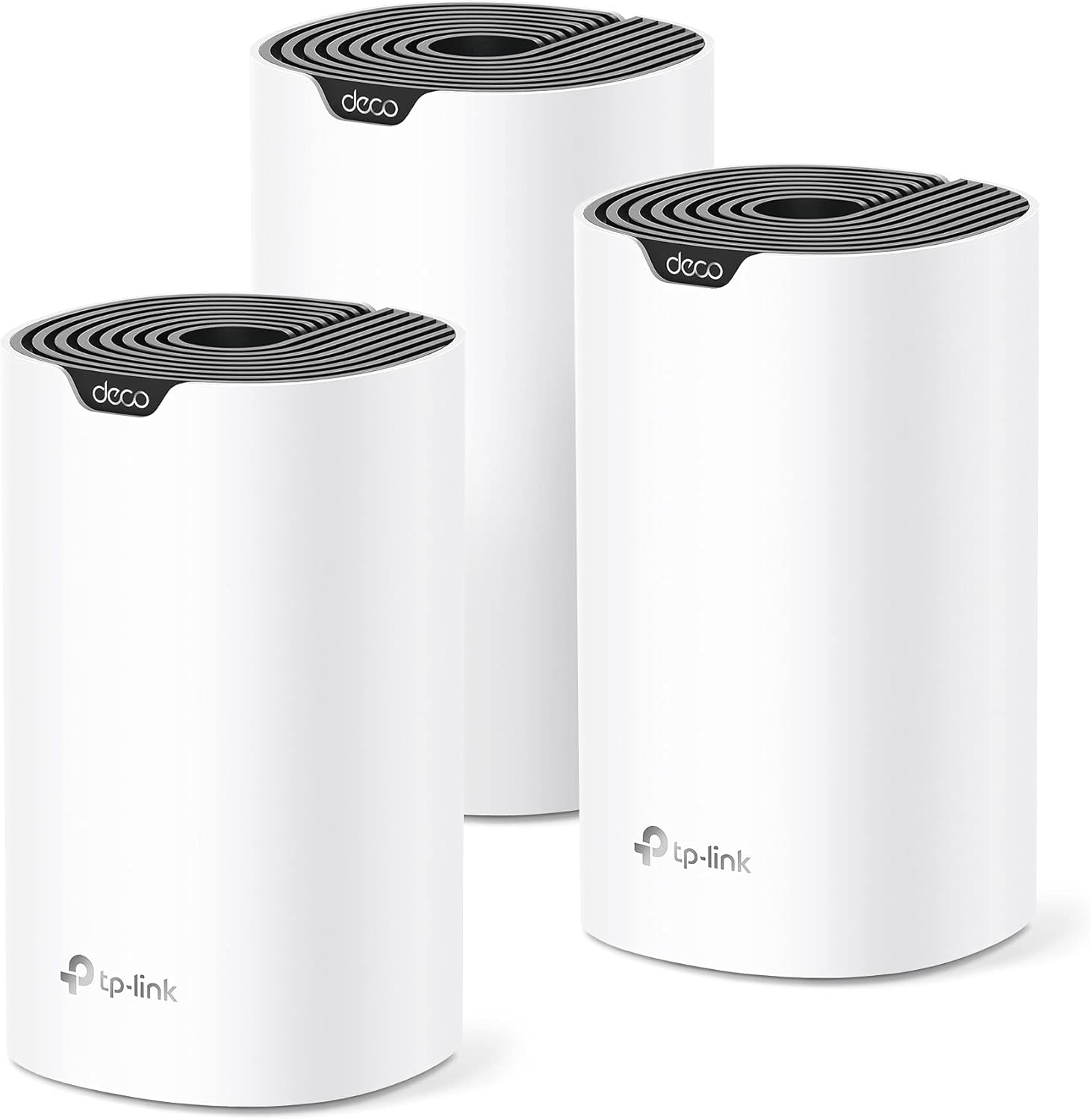
TP-Link Deco S4 Mesh AC1900 WiFi System - Up to 5,500 Sq.ft. Coverage, Replaces WiFi Router and Extender, Gigabit Ports, Works with Alexa, Deco S4(3-Pack)
A 3-pack AC1900 dual-band mesh system covering 5,500 sq ft with Gigabit Ethernet, for homes needing broad Wi-Fi 5 coverage on a budget.

TP-Link Deco X55 Pro AX3000 Whole Home Wi-Fi 6 Mesh System - Coverage up to 6500 Sq.Ft & up to 150 Devices, 2x2.5G WAN/LAN Ports, 4 Streams, Wired Ethernet Backhaul, Ideal for 1Gig+ Internet, 3-Pack
A Wi-Fi 6 mesh system with AX3000 speed and 2x 2.5G ports per unit, covering 6500 sq. ft. for homes with 1Gig+ internet.