
Ubiquiti Cloud Gateway Max - (UCG-Max) (512GB)
Want the best price and purchase timing?
Our AI advisor analyzes real-time pricing across all channels to find you the best deal.
AI Verdict
This is a compact 2.5GbE gateway with a 512GB NVMe SSD for NVR, managing 30 UniFi devices and 300 clients, designed for small UniFi ecosystems.
This gateway is a strong contender if your network is firmly within the UniFi ecosystem and your internet speeds don't exceed 2.5 Gbps. Its integrated UniFi application suite and 512GB NVR storage simplify management for smaller deployments. However, the lack of 10Gbps ports and PoE means you'll hit a ceiling if your needs grow beyond its 2.5GbE capabilities or if you plan extensive PoE device use.
If you anticipate 10Gbps internet or internal network demands, look for a gateway with SFP+ ports, like the Ubiquiti Cloud Gateway Fiber or UDM-SE.
Regret Score™
High RiskLower is better — measures purchase-regret risk from real buyer complaints, review credibility, and product maturity
Issues discovered after purchase
Critically weak dimension
Amazon rating vs actual quality
Chance this product isn't for you
Pros
- Includes the full UniFi application suite for managing Network, Protect, Talk, Access, and Connect without a separate console.
- Supports 2.3 Gbps routing with IDS/IPS enabled on UniFi OS 4.1+, exceeding its 1.5 Gbps spec.
- Features five 2.5GbE RJ45 ports, with one LAN port remappable for multi-WAN load balancing.
- Manages up to 30 UniFi devices and 300 client devices, suitable for many small to medium setups.
- Comes with a pre-installed 512GB NVMe SSD specifically for UniFi Protect NVR storage.
- Compact form factor, measuring 5.6 x 5 x 1.2 inches, and idles around 10W.
Cons
- Lacks 10Gbps ports, limiting future-proofing for faster internet connections or high-bandwidth internal networks.
- Does not include Power over Ethernet (PoE) ports, requiring separate PoE switches or injectors for UniFi access points.
- The 512GB NVMe SSD is exclusively for UniFi Protect NVR and cannot be used for general network-attached storage.
- OpenVPN routing performance is limited to 300-400 Mbps, significantly slower than WireGuard's 800-1000 Mbps.
- Operates at a higher temperature, around 70°C, compared to the UCG-Ultra's 50°C.
Dimension Scores
The gateway delivers 2.3 Gbps routing with IDS/IPS enabled and features five 2.5GbE ports, which is above average for its price band, but lacks 10Gbps.
Users report stable performance over several months with 1Gbps symmetrical connections and auto-updates, though some initial setup quirks and higher operating temperatures are noted.
The integrated UniFi application suite and Bluetooth setup via the UniFi app provide a streamlined and comprehensive management experience for UniFi devices.
It includes IDS/IPS with 2.3 Gbps throughput and supports WireGuard VPN at 800-1000 Mbps, offering robust security for its class.
Best For
- Homes or small businesses with sub-2.5 Gbps internet connections needing integrated UniFi management.
- Users wanting to run UniFi Protect for a few cameras without a separate NVR appliance.
- Existing UniFi users looking for a compact gateway to replace older models like the UDM (non-Pro).
- Environments requiring multi-WAN failover or load balancing with 2.5GbE connections.
Not Recommended For
- Networks requiring 10Gbps connectivity for WAN or internal devices.
- Users needing general-purpose network-attached storage from the integrated SSD.
- Deployments with many UniFi Protect cameras that might exceed the 512GB storage or processing capacity.
Watch Out For
- If you buy a version without the NVMe SSD, the necessary tray adapter for adding storage later is not included and must be purchased separately.
- Initial setup can be frustrating; some users reported the 0.96" LCM display incorrectly indicating no WAN connection despite a working cable.
- The device runs hotter, reaching 70°C, which might be a concern for long-term component longevity compared to cooler Ubiquiti alternatives.
- You cannot use a connected PC or external NAS for UniFi Protect NVR storage; it's limited to the onboard NVMe SSD or a dedicated Ubiquiti NVR.
Full Specifications
| ASIN | B0DFWN8L7V |
| Brand | Ubiquiti Networks |
| Item Weight | 2.33 pounds |
| Manufacturer | Ubiquiti Networks |
| Hard Disk Size | 1.0, 2.0 TB |
| Item model number | UCG-Max |
| Compatible Devices | Personal Computer |
| Product Dimensions | 8.66 x 7.2 x 3.11 inches |
| Connectivity Technology | Ethernet |
| Memory Storage Capacity | 512 GB |
What Buyers Say
Many users are surprised by the UCG-Max's ability to handle 1Gbps symmetrical internet with IDS/IPS without breaking a sweat, often exceeding its advertised 1.5 Gbps routing speed with real-world 2.3 Gbps performance. The compact size and inclusion of the full UniFi application suite in one box are frequently highlighted as major wins. However, the absence of 10Gbps ports and PoE is a recurring point of contention, pushing some users towards higher-end Ubiquiti gear or requiring additional equipment. The integrated 512GB NVMe SSD for UniFi Protect is a convenient feature, but its exclusivity to NVR functions disappoints those hoping for general network storage.
“Man, this thing is a lifesaver for my UniFi setup, finally got Protect running without another box, but seriously, no 10Gbps? And I gotta buy a PoE switch now? Still, it's pretty sweet for the price.”
Common Praise
- Handles 1Gbps symmetrical internet with IDS/IPS enabled without performance drops.
- Integrated UniFi Network, Protect, Talk, Access, and Connect applications simplify management.
- Compact desktop form factor saves space.
- Easy to configure and manage through the UniFi app and web interface.
- Low power consumption, typically idling around 10 watts.
- Offers multi-WAN capabilities by remapping a LAN port.
Common Complaints
- No 10Gbps ports, which limits future network expansion and high-speed internet utilization.
- Lacks Power over Ethernet (PoE) ports, necessitating separate PoE injectors or switches.
- The NVMe SSD is locked to UniFi Protect NVR and cannot be used for general network storage.
- OpenVPN performance is significantly slower than WireGuard, capping at 300-400 Mbps.
- Runs hotter than some other Ubiquiti gateways, reaching around 70°C.
- If bought without storage, the NVMe tray adapter is a separate purchase.
Ownership Tips
- The 0.96" LCM display is useful for quick status checks but can be misleading during initial WAN setup.
- Even with IDS/IPS active, the routing performance holds up well for typical home gigabit connections.
- The compact size makes it easy to tuck away, but ensure it has adequate ventilation due to its operating temperature.
- Updating UniFi OS and applications is straightforward and often happens automatically, keeping the device current.
Frequently Asked Questions
Does the UCG-Max support 10 Gigabit internet speeds?
No, the UCG-Max is equipped with 2.5GbE RJ45 ports, meaning its maximum port speed for WAN and LAN is 2.5 Gbps.
Can I use the included 512GB SSD for general file storage?
No, the 512GB NVMe SSD is dedicated solely for the UniFi Protect application, specifically for NVR camera footage storage. It cannot be used as a general network-attached storage drive.
Does this gateway have Power over Ethernet (PoE) ports?
The UCG-Max does not have any integrated PoE ports. You will need to use a separate PoE switch or individual PoE injectors to power UniFi access points or other PoE devices.
What is the actual routing throughput with security features enabled?
While specified at 1.5 Gbps, user testing shows the UCG-Max can achieve up to 2.3 Gbps routing with Intrusion Detection/Prevention System (IDS/IPS) enabled on UniFi OS 4.1 or newer.
Can I use a LAN port as a second WAN port for failover?
Yes, one of the four 2.5GbE LAN ports can be remapped to function as a second WAN port, allowing for multi-WAN load balancing or failover configurations.
Buying Guide
When you're looking at a network gateway like this, you're essentially buying the brain of your home or small business network. It's what connects you to the internet, manages all your devices, and handles security. You need to think about your current internet speed, how many devices you have, and if you plan on adding things like security cameras or advanced Wi-Fi access points. Don't just look at the raw speed number; consider how it performs with security features turned on, as that's often how you'll run it.
1.5 Gbps routing with IDS/IPS (actual 2.3 Gbps)
This tells you how fast your internet connection can actually be processed by the gateway, even with advanced security features like Intrusion Detection/Prevention System (IDS/IPS) actively scanning for threats. If your internet plan is 1 Gbps, this gateway won't bottleneck it, and even handles faster connections up to 2.3 Gbps with security enabled, which is like having a fast bouncer at the door who doesn't slow down the party.
Manages 30+ UniFi devices and 300+ clients
This indicates the scale of your network the gateway can comfortably handle. 'UniFi devices' are things like Ubiquiti access points or switches, while 'clients' are your phones, laptops, smart home gadgets. If you have a lot of smart devices or plan a comprehensive UniFi setup, this number tells you if the gateway has enough processing power to keep everything running smoothly without lag.
512GB NVMe SSD storage for NVR
This built-in storage is specifically for recording video from UniFi Protect cameras. Think of it as a dedicated hard drive for your security footage. If you're planning to use Ubiquiti cameras, this means you don't need a separate Network Video Recorder (NVR) appliance, simplifying your setup and saving space.
Five 2.5GbE RJ45 ports
These are the physical connections for your internet (WAN) and local network devices (LAN). 2.5 Gigabit Ethernet (2.5GbE) is faster than standard 1 Gigabit Ethernet, allowing for quicker data transfer between your gateway and compatible devices like high-speed switches or a fast internet modem. It's a step up, but not as fast as 10 Gigabit Ethernet.
Alternatives
If you need faster than 2.5 Gbps connectivity, look for gateways with SFP+ or 10GbE RJ45 ports. For extensive PoE requirements, prioritize models with integrated PoE ports or plan for a dedicated PoE switch.
You Might Also Like

Amazon eero Pro 7 with 1 month free eero Business (auto-renews annually) - Supports internet plans up to 5 Gbps, Coverage up to 6,000 sq. ft., Connect 600+ devices, 3-pack
$600+This 3-pack Wi-Fi 7 tri-band mesh system delivers up to 3.9 Gbps wireless speeds and 5 Gbps wired speeds, covering 6,000 sq. ft. for businesses needing high-capacity networking.

Amazon eero 6 mesh wifi add-on extender - Add up to 1,500 sq. ft. of Wi-Fi 6 coverage. Required eero mesh wifi system not included
A Wi-Fi 6 mesh extender that adds up to 1,500 sq. ft. of coverage, exclusively for existing eero network users.
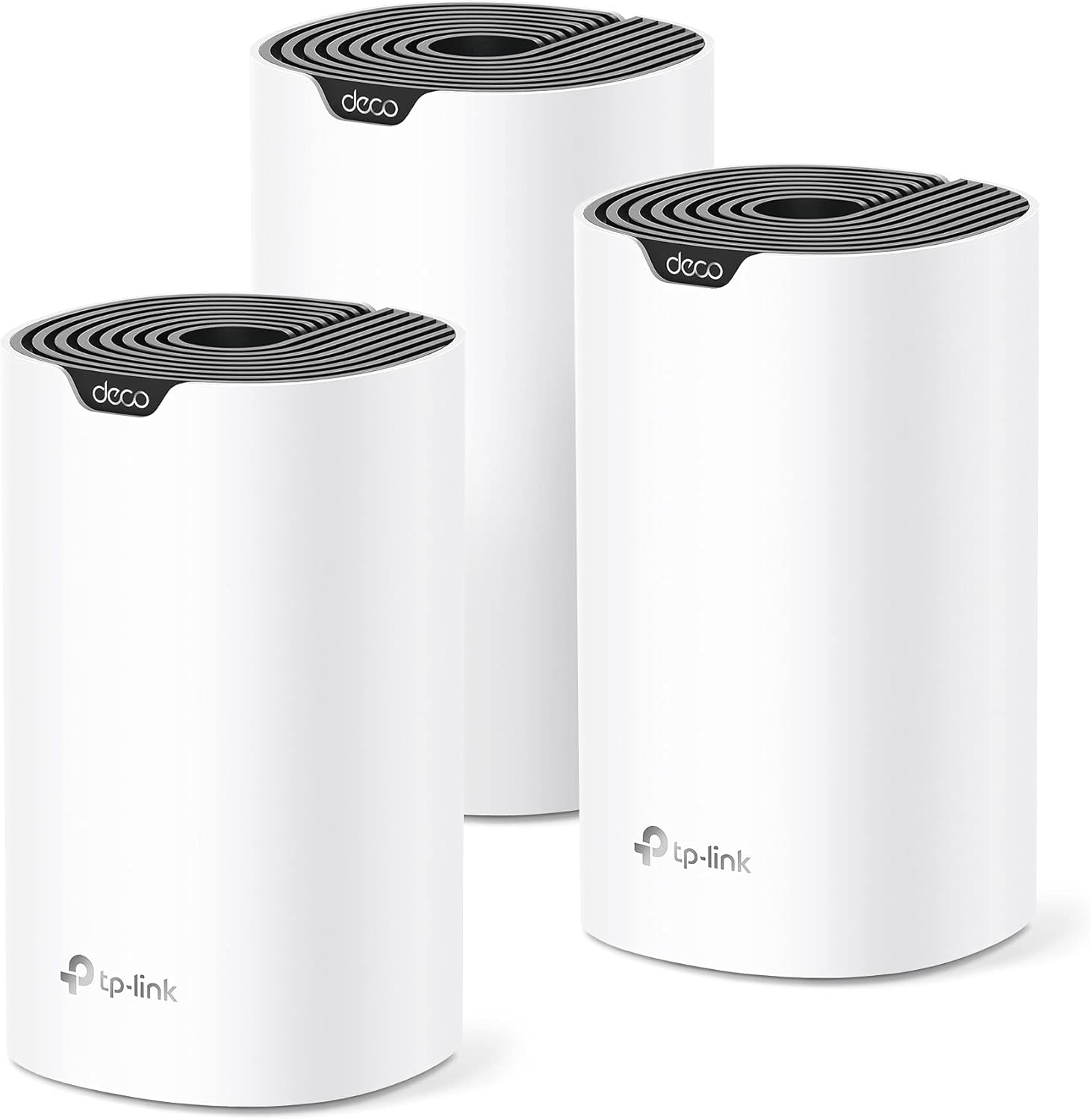
TP-Link Deco S4 Mesh AC1900 WiFi System - Up to 5,500 Sq.ft. Coverage, Replaces WiFi Router and Extender, Gigabit Ports, Works with Alexa, Deco S4(3-Pack)
A 3-pack AC1900 dual-band mesh system covering 5,500 sq ft with Gigabit Ethernet, for homes needing broad Wi-Fi 5 coverage on a budget.

TP-Link Deco X55 Pro AX3000 Whole Home Wi-Fi 6 Mesh System - Coverage up to 6500 Sq.Ft & up to 150 Devices, 2x2.5G WAN/LAN Ports, 4 Streams, Wired Ethernet Backhaul, Ideal for 1Gig+ Internet, 3-Pack
A Wi-Fi 6 mesh system with AX3000 speed and 2x 2.5G ports per unit, covering 6500 sq. ft. for homes with 1Gig+ internet.