
TP-Link Tri-Band BE19000 Wi-Fi 7 Gaming Router Archer GE800 | 12-Stream | 2×10G + 4×2.5G Ports, USB 3.0 | Turbo Acceleration, Dedicated Gaming Port & Panel, RGB Lighting, HomeShield, Free Expert Help
Want the best price and purchase timing?
Our AI advisor analyzes real-time pricing across all channels to find you the best deal.
AI Verdict
This is a Wi-Fi 7 tri-band router with 2x 10 Gbps and 4x 2.5 Gbps ports, built for gamers needing low latency and high throughput.
This router is a strong fit for serious gamers and tech enthusiasts who have Wi-Fi 7 compatible devices and multi-gigabit internet. Its 19 Gbps tri-band speed, 2x 10 Gbps and 4x 2.5 Gbps ports, and dedicated gaming acceleration features directly address the needs for low latency and high throughput in gaming scenarios.
If you need consistent multi-gigabit speeds across a very large home, look for a Wi-Fi 7 mesh system with multiple 10 Gbps backhaul options.
Regret Score™
Very Low RiskLower is better — measures purchase-regret risk from real buyer complaints, review credibility, and product maturity
Issues discovered after purchase
Critically weak dimension
Amazon rating vs actual quality
Chance this product isn't for you
Pros
- Achieves theoretical speeds up to 19 Gbps across three bands (11520 Mbps on 6 GHz, 5760 Mbps on 5 GHz, 1376 Mbps on 2.4 GHz).
- Features two 10 Gbps WAN/LAN ports and four 2.5 Gbps LAN ports for high-bandwidth wired connections.
- Offers 4x lower latency compared to Wi-Fi 6/6E routers, crucial for competitive gaming.
- Includes Turbo Game Acceleration with QoS, dedicated gaming port prioritization, and GPN server acceleration.
- Supports EasyMesh for seamless whole-home Wi-Fi expansion with compatible devices.
- The Tether app provides a well-made interface for network management and customization.
Cons
- Wi-Fi 7's 320 MHz channels and 4096-QAM benefits are primarily realized in close proximity to the router, with speeds dropping to Wi-Fi 6 levels further away.
- The two 10 Gbps ports cannot be configured concurrently as WAN ports.
- Power consumption and heat generation can be high.
- Range can be a limitation in larger homes without additional EasyMesh extenders.
- RGB lighting and animated panel might be considered a 'gimmick' by some users.
Dimension Scores
Offers up to 19 Gbps theoretical tri-band Wi-Fi 7 speeds and 320 MHz channels, providing exceptional throughput, though peak performance is proximity-dependent.
Features a quad-core processor with 2GB RAM and 4x lower latency than Wi-Fi 6/6E, contributing to stable connections and reduced lag.
Setup is managed via the intuitive Tether app or a web interface, with a dedicated game panel for real-time insights.
Includes TP-Link HomeShield for robust antivirus protection and network security for connected devices.
Best For
- Competitive online gamers requiring minimal latency and maximum bandwidth.
- Households with multiple high-bandwidth Wi-Fi 7 compatible devices in close proximity to the router.
- Users with multi-gigabit internet service providers (ISPs) utilizing the 10 Gbps WAN/LAN ports.
- Streamers and content creators who need dedicated network prioritization for their gaming rig.
Not Recommended For
- Budget-conscious users who don't require Wi-Fi 7 or multi-gigabit wired connections.
- Users in very large homes without plans to invest in EasyMesh extenders for full coverage.
- Individuals who prioritize discreet router aesthetics over 'gaming-style' RGB lighting.
Watch Out For
- Wi-Fi 7's peak performance, like 320 MHz channels, is often limited to short distances; expect speeds closer to Wi-Fi 6 at range.
- The router can consume significant power and generate noticeable heat during operation.
- You cannot use both 10 Gbps ports simultaneously as WAN connections.
- Achieving the advertised 19 Gbps theoretical speed requires Wi-Fi 7 clients that support Multi-Link Operation (MLO) and the 6 GHz band.
Full Specifications
| ASIN | B0D7MSQG4T |
| Brand | TP-Link |
| Color | Black |
| Model Name | BE19000 Wi-Fi 7 Gaming Router |
| Item Weight | 4.87 pounds |
| Manufacturer | TP-Link |
| Special Feature | Access Point Mode, Guest Mode, Internet Security, Parental Control, Remote Access |
| Item model number | Archer GE800 |
| Compatible Devices | Gaming Console, Personal Computer, Smart Television, Smartphone, Tablet |
| Package Dimensions | 14.17 x 11.02 x 10.63 inches |
| Frequency Band Class | Tri-Band |
| Connectivity Technology | Ethernet, Optical Fiber Port, USB, Wi-Fi |
| Recommended Uses For Product | Gaming |
| Wireless Communication Standard | 802.11.be, 802.11ac, 802.11ax, 802.11g, 802.11n |
What Buyers Say
Users report that this router can significantly reduce packet burst issues in games like MW2, indicating tangible improvements for competitive players. The Tether app is praised for its comprehensive features and ease of use, offering extensive customization options. While the router delivers 'borderline Ethernet' speeds when close, its range can be a limiting factor in larger homes, often necessitating EasyMesh extenders. Some Wi-Fi 7 benefits, like 320 MHz channels, are most pronounced at short distances, with performance tapering off further away.
“Dude, this thing actually fixed my lag spikes in Warzone, like, I'm actually hitting shots now, but yeah, you gotta be kinda close for the crazy speeds, and it gets a bit warm.”
Common Praise
- Eliminates packet burst issues in online games.
- Delivers extremely high speeds, approaching wired Ethernet performance when in close proximity.
- Tether app is well-designed and offers extensive network customization.
- Build quality feels very sturdy and premium.
- Noticeably lower latency compared to Wi-Fi 6 routers.
Common Complaints
- Wi-Fi 7's advanced features (320 MHz, 4096-QAM) only provide peak benefits at short ranges.
- Range can be an issue in larger houses, requiring additional mesh units.
- High power consumption and heat generation.
- The two 10 Gbps ports cannot both be used as WAN connections simultaneously.
- RGB lighting and 'gaming' aesthetics might be seen as unnecessary or 'gimmicky'.
Ownership Tips
- The router's physical size and 'gaming' design with RGB might not blend into all home aesthetics.
- You'll need Wi-Fi 7 compatible devices to fully leverage the router's advertised speeds and low latency features.
- Positioning is key to maximizing Wi-Fi 7's 320 MHz channel benefits; performance drops off with distance.
- The dedicated gaming port truly prioritizes traffic, making a difference when others are streaming 4K.
- The Tether app's detailed statistics on network health and gaming traffic are genuinely useful for optimization.
Frequently Asked Questions
What is the maximum theoretical speed of this router?
The Archer GE800 offers a theoretical maximum speed of 19 Gbps across its tri-bands (2.4 GHz, 5 GHz, and 6 GHz).
Does this router support Wi-Fi 7?
Yes, it is a Wi-Fi 7 (802.11be) router, featuring 320 MHz channels and Multi-Link Operation for enhanced performance.
How many 10 Gigabit Ethernet ports does it have?
It comes with two 10 Gbps WAN/LAN ports, alongside four 2.5 Gbps LAN ports, providing extensive wired connectivity.
Can I extend the Wi-Fi coverage with this router?
Yes, the Archer GE800 is EasyMesh compatible, allowing you to create a seamless whole-home mesh Wi-Fi system with other EasyMesh devices.
Does it have features to prioritize gaming traffic?
Absolutely. It includes Turbo Game Acceleration with QoS, a dedicated gaming port, and GPN server acceleration to prioritize and optimize gaming traffic.
Buying Guide
When you're looking at a router like this, don't just chase the biggest number. '19 Gbps' is a theoretical maximum, and you'll only see anything close to that if you have Wi-Fi 7 devices, a multi-gigabit internet plan, and you're practically sitting on top of the router. What really matters for gaming is the low latency and the dedicated features that prioritize your game traffic over everything else on your network.
Wi-Fi 7 (802.11be)
This is the latest Wi-Fi standard, offering features like 320 MHz channels and Multi-Link Operation (MLO) that can deliver higher speeds and lower latency than previous generations, especially when your devices support it.
Tri-Band (2.4 GHz, 5 GHz, 6 GHz)
Having three separate bands means less congestion. You can dedicate the 6 GHz band to your gaming PC or console for the fastest, least interfered connection, while other devices use the 2.4 GHz or 5 GHz bands.
2x 10 Gbps + 4x 2.5 Gbps Ports
These are super-fast wired connections. The 10 Gbps ports are for your internet service if you have a multi-gig plan, or for connecting a high-speed NAS or gaming PC. The 2.5 Gbps ports are still much faster than standard Gigabit Ethernet for other wired devices.
Turbo Game Acceleration
This isn't just marketing. Features like Quality of Service (QoS), dedicated gaming ports, and game server acceleration actively identify and prioritize your gaming data, reducing lag and ensuring your game gets the bandwidth it needs, even if someone else is streaming 4K.
Alternatives
If this router is overkill, look for a Wi-Fi 6E tri-band router with at least one 2.5 Gbps WAN/LAN port and QoS features. If you need broader coverage in a large home, consider a Wi-Fi 7 mesh system with multiple nodes.
You Might Also Like

Amazon eero Pro 7 with 1 month free eero Business (auto-renews annually) - Supports internet plans up to 5 Gbps, Coverage up to 6,000 sq. ft., Connect 600+ devices, 3-pack
$600+This 3-pack Wi-Fi 7 tri-band mesh system delivers up to 3.9 Gbps wireless speeds and 5 Gbps wired speeds, covering 6,000 sq. ft. for businesses needing high-capacity networking.

Amazon eero 6 mesh wifi add-on extender - Add up to 1,500 sq. ft. of Wi-Fi 6 coverage. Required eero mesh wifi system not included
A Wi-Fi 6 mesh extender that adds up to 1,500 sq. ft. of coverage, exclusively for existing eero network users.
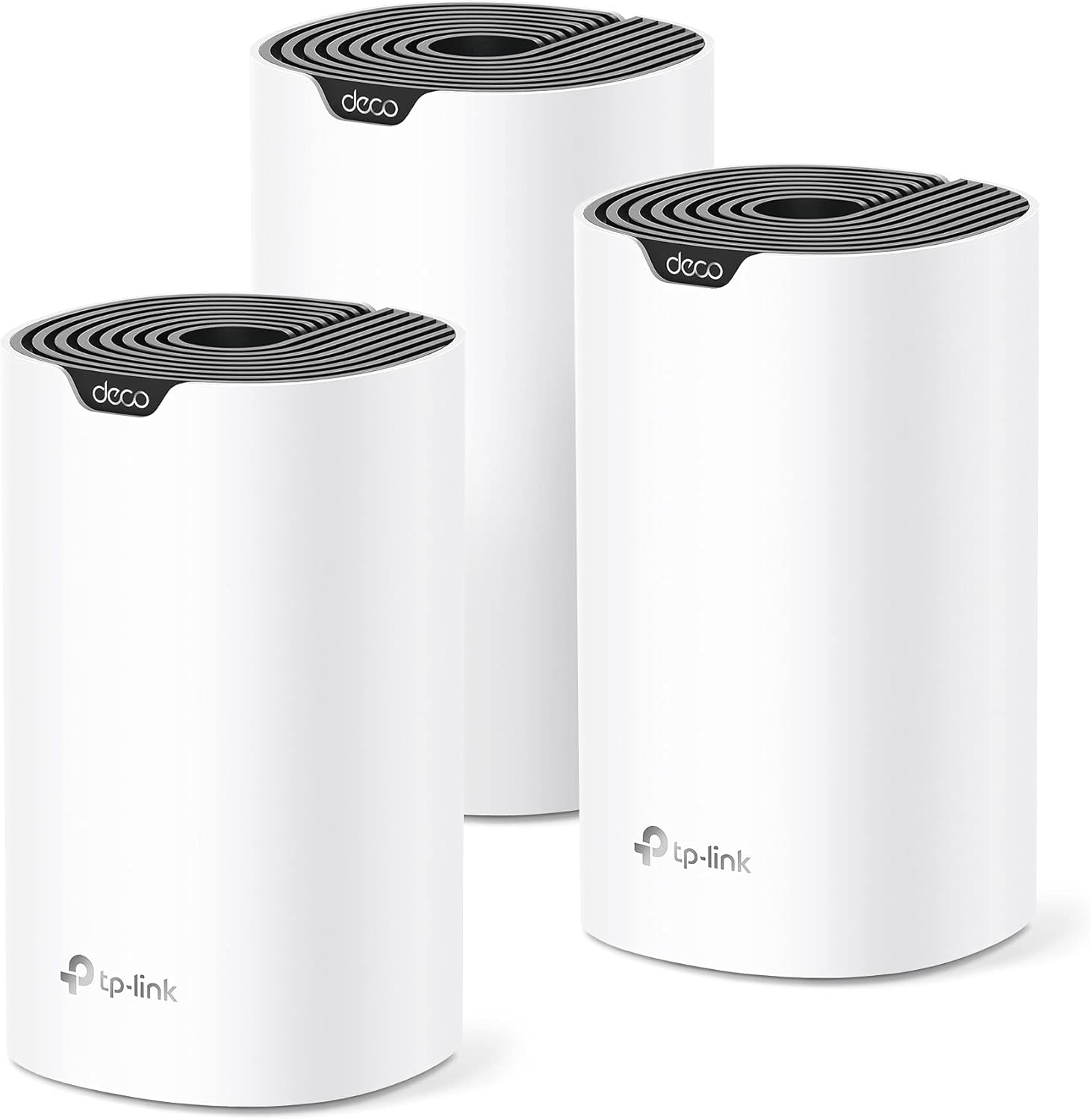
TP-Link Deco S4 Mesh AC1900 WiFi System - Up to 5,500 Sq.ft. Coverage, Replaces WiFi Router and Extender, Gigabit Ports, Works with Alexa, Deco S4(3-Pack)
A 3-pack AC1900 dual-band mesh system covering 5,500 sq ft with Gigabit Ethernet, for homes needing broad Wi-Fi 5 coverage on a budget.

TP-Link Deco X55 Pro AX3000 Whole Home Wi-Fi 6 Mesh System - Coverage up to 6500 Sq.Ft & up to 150 Devices, 2x2.5G WAN/LAN Ports, 4 Streams, Wired Ethernet Backhaul, Ideal for 1Gig+ Internet, 3-Pack
A Wi-Fi 6 mesh system with AX3000 speed and 2x 2.5G ports per unit, covering 6500 sq. ft. for homes with 1Gig+ internet.