
ASUS RT-BE82U Dual-Band WiFi 7 (802.11be) Smart AiMesh Extendable Router, 6500 Mbps, Five 2.5GbE Ports, 4096-QAM, Up to 3 SSIDs for IoT Devices, Parental Controls & VPNs, Advanced Network Security
Want the best price and purchase timing?
Our AI advisor analyzes real-time pricing across all channels to find you the best deal.
AI Verdict
This is a dual-band WiFi 7 router with 6500 Mbps speed and five 2.5GbE ports, ideal for homes with multiple high-bandwidth devices and a need for robust wired connectivity.
This router is a strong fit for users upgrading to Wi-Fi 7 who have high-bandwidth demands and a significant number of wired and wireless devices. Its 6500 Mbps speed, five 2.5GbE ports, and AiMesh compatibility address modern networking needs effectively. The robust security features and IoT network segmentation are also key advantages for smart homes.
If you absolutely need the 6 GHz band for future-proof performance with upcoming devices, look for a tri-band Wi-Fi 7 router that explicitly lists 6 GHz support.
Regret Score™
Very Low RiskLower is better — measures purchase-regret risk from real buyer complaints, review credibility, and product maturity
Issues discovered after purchase
Critically weak dimension
Amazon rating vs actual quality
Chance this product isn't for you
Pros
- Achieves up to 6500 Mbps WiFi 7 speeds with 4096-QAM, boosting single frequency band transmission by 1.2 times.
- Includes five 2.5GbE ports (one WAN, four LAN) for prioritizing and optimizing wired internet performance.
- Features Multi-link Operation (MLO) to combine or seamlessly switch between 2.4 GHz and 5 GHz bands for stable connections and efficient data transfers.
- Offers commercial-grade AiProtection Pro powered by Trend Micro for advanced network security, parental controls, and up to three SSIDs for IoT devices.
- Supports AiMesh extendable network for whole-home seamless roaming and extended coverage up to 2500 sq. ft..
- Powered by a quad-core 2.0 GHz CPU and 1 GB of RAM for efficient handling of demanding network tasks and numerous connected devices.
Cons
- Lacks a 6 GHz band, which limits peak performance with future devices that utilize this frequency.
- Some users reported sudden slowdowns on the 5 GHz band, dropping from 500 Mbit/s to as low as 5 Mbit/s after initial flawless operation.
- Port forwarding interface may be confusing, with users unable to enter port ranges in the internal section, only the external.
- Advanced features and settings can be overwhelming for non-tech-savvy users.
- Wi-Fi range was reported as poor by one user, with no reception in the backyard.
Dimension Scores
Offers ultrafast 6500 Mbps WiFi 7 speeds and 4096-QAM for increased transmission speed, with many users reporting strong coverage and elimination of dead spots.
Features Multi-link Operation (MLO) for stable connections and is powered by a 2.0 GHz quad-core CPU, though one user reported sudden 5 GHz slowdowns.
Users praise the easy setup via the intuitive ASUS Router app and user interface, with robust management features for devices and networks.
Includes commercial-grade AiProtection Pro, parental controls, and dedicated SSIDs for IoT devices, providing comprehensive network safeguarding.
Best For
- Households with multiple 4K streaming, gaming, and video calling devices simultaneously.
- Users with multi-gigabit internet connections who need to maximize wired and wireless speeds.
- Smart homes with numerous IoT devices requiring segmented and secure networks.
- Users seeking robust network security and comprehensive parental controls without additional subscriptions.
Not Recommended For
- Users prioritizing the 6 GHz band for cutting-edge Wi-Fi 7 performance with compatible devices.
- Those on a strict budget who might find the price a barrier, especially if needing multiple units for mesh.
- Individuals who prefer custom router firmware like Asuswrt-Merlin, as support is not indicated for this model.
Watch Out For
- The router does not support the 6 GHz band, which means you won't get the absolute fastest speeds or lowest interference with future Wi-Fi 7 devices that leverage this frequency.
- One user reported the 5 GHz band suddenly slowed from 500 Mbit/s to 60 Mbit/s or even 5 Mbit/s on multiple devices after a few days of use.
- Port forwarding setup can be tricky; a user found they could only enter port ranges in the external section, not the internal, causing confusion for game setups.
- A Reddit user experienced poor Wi-Fi range, specifically no reception in their backyard, despite having a 2GB internet plan.
- The advanced settings and features, while powerful, might be overwhelming for users who aren't comfortable with network configuration.
Full Specifications
| RAM | DDR5 |
| ASIN | B0D48GS6KB |
| Brand | ASUS |
| Color | Eclipse Gray |
| Series | RT-BE82U |
| Voltage | 120 Volts (AC) |
| Processor | 5.8 GHz core_i9 |
| Hard Drive | 4 TB SSD |
| Model Name | RT-BE82U |
| Item Weight | 1.1 pounds |
| Manufacturer | ASUS |
| Chipset Brand | NVIDIA |
| Wireless Type | 802.11.be, 802.11ac, 802.11ax, 802.11n |
| Processor Brand | Intel |
| Card Description | Dedicated |
| Operating System | Windows 11 Pro |
| Item model number | RT-BE82U |
| Screen Resolution | 2560 x 1600 pixels |
| Compatible Devices | Personal Computer, Smart Television, Smartphone, Tablet |
| Optical Drive Type | No Optical Drive |
| Product Dimensions | 13.94 x 0.89 x 10.39 inches |
| Included Components | Power adapter, Quick Start Guide, RJ-45 cable, RT-BE82U Router, Warranty card |
| Computer Memory Type | DDR5 RAM |
| Frequency Band Class | Dual-Band |
| Graphics Coprocessor | NVIDIA GeForce RTX 4060 |
| Hard Drive Interface | Solid State |
| Number of Processors | 24 |
| Max Screen Resolution | 2560x1600 Pixels |
| Item Dimensions LxWxH | 13.94 x 0.89 x 10.39 inches |
| Connectivity Technology | RJ-45 cable, Wi-Fi |
| Number of USB 3.0 Ports | 4 |
| Recommended Uses For Product | Business, Gaming, Home |
| Standing screen display size | 16 Inches |
| Wireless Communication Standard | 802.11.be, 802.11ac, 802.11ax, 802.11n |
What Buyers Say
This ASUS RT-BE82U router seems to be a hit with users looking for a serious upgrade, with many reporting a significant jump in internet speed and coverage, even eliminating dead spots they had before. The setup process gets a lot of praise for being straightforward, especially through the ASUS app, which is a big win for anyone tired of complicated router configurations. The ability to set up separate networks for IoT devices and the built-in security features are also frequently highlighted as major positives. However, it's not without its quirks; some users have hit snags with port forwarding and a few have even seen unexpected slowdowns on the 5 GHz band after a few days of use.
“Dude, this thing is FAST, like, my old router was a joke compared to this, but then the 5GHz just choked out for no reason after a week, what gives?!”
Common Praise
- Significant increase in internet speed and strong signal strength throughout the home.
- Easy and smooth setup process, often done via the intuitive ASUS Router mobile app.
- Ability to create separate SSIDs for IoT devices for better management and security.
- Effective AiProtection Pro security features and parental controls included without extra cost.
- Handles multiple devices streaming, gaming, and video calling simultaneously without lag.
- Five 2.5GbE ports provide robust and fast wired connectivity for demanding devices.
Common Complaints
- Absence of the 6 GHz band, which some users expect from a Wi-Fi 7 router for future compatibility.
- Sudden and unexplained slowdowns on the 5 GHz band, dropping to very low speeds for some users.
- Difficulty with port forwarding, specifically the inability to enter port ranges in the internal section.
- Reported poor Wi-Fi range, with one user noting no reception in their backyard.
- Advanced settings can be overwhelming for users who are not tech-savvy.
Ownership Tips
- The router's performance can be inconsistent, with some users experiencing sudden drops in 5 GHz speed after initial strong performance.
- While setup is generally easy, configuring specific network settings like port forwarding might require some troubleshooting due to interface limitations.
- The lack of a 6 GHz band means that while it's Wi-Fi 7, it's not the absolute bleeding edge for future devices that will utilize that frequency.
- The AiMesh system is flexible, allowing you to add other ASUS routers later for expanded coverage, which is a plus for growing homes.
- The included security features are comprehensive and don't require a subscription, which is a long-term cost saver.
Frequently Asked Questions
Does this router support Wi-Fi 6E?
No, this router supports Wi-Fi 7 (802.11be) and is dual-band (2.4 GHz and 5 GHz). It does not include the 6 GHz band found in Wi-Fi 6E or some higher-end Wi-Fi 7 models.
How many 2.5 Gigabit Ethernet ports does it have?
The ASUS RT-BE82U features five 2.5GbE ports: one for WAN (internet input) and four for LAN (connecting wired devices).
Can I use this router with other ASUS AiMesh devices?
Yes, it's an AiMesh extendable router, meaning it can be combined with other ASUS AiMesh compatible routers to create a seamless whole-home mesh Wi-Fi system.
Does it have parental controls and network security?
Yes, it includes commercial-grade AiProtection Pro powered by Trend Micro for network security, along with comprehensive parental controls and the ability to create up to three SSIDs for IoT devices.
Is the setup complicated?
Many users found the setup to be easy and intuitive, especially when using the ASUS Router mobile app. However, some advanced features might be overwhelming for less tech-savvy users.
Does this router support Multi-link Operation (MLO)?
Yes, the RT-BE82U supports Multi-link Operation (MLO), which allows it to link to multiple bands simultaneously for stable internet connections and efficient data transfers.
Buying Guide
When you're looking at a router like this, you're really buying into speed and capacity. The '6500 Mbps' isn't a single device speed, but the combined theoretical maximum across its bands. What matters more is how many devices you have, what they're doing (streaming 4K, gaming, video calls), and if you have a fast internet connection to begin with. The 2.5GbE ports are a big deal if you have devices like a network-attached storage (NAS) or a gaming PC that can actually use those speeds wired. Don't just chase the biggest number; think about your actual home network needs.
WiFi 7 (802.11be)
This is the latest Wi-Fi standard, offering faster speeds and better efficiency than previous generations. Think of it like upgrading from a two-lane road to a four-lane highway – more data can travel at once, reducing traffic jams for your devices.
6500 Mbps Speed
This is the theoretical maximum aggregate speed across both the 2.4 GHz and 5 GHz bands. It means the router has a high total capacity to handle many devices simultaneously, but no single device will hit this speed. It's like the total capacity of a water pipe system, not the flow from one faucet.
Five 2.5GbE Ports
These are faster Ethernet ports than the typical 1 Gigabit ports. If you have a multi-gigabit internet plan or devices that can utilize these speeds (like a high-end PC or NAS), these ports ensure your wired connections don't become a bottleneck. It's like having dedicated express lanes for your most important wired traffic.
Dual-Band
This router operates on two frequency bands: 2.4 GHz (better range, slower speed) and 5 GHz (faster speed, shorter range). It intelligently directs your devices to the best band for their needs, ensuring a balance of coverage and performance. Some newer routers are tri-band, adding a 6 GHz band for even more capacity.
Alternatives
If this router doesn't quite fit, look for models with tri-band support if you need the 6 GHz band for cutting-edge performance, or consider a more budget-friendly Wi-Fi 6E router if you want 6 GHz without the full Wi-Fi 7 price tag.
You Might Also Like

Amazon eero Pro 7 with 1 month free eero Business (auto-renews annually) - Supports internet plans up to 5 Gbps, Coverage up to 6,000 sq. ft., Connect 600+ devices, 3-pack
$600+This 3-pack Wi-Fi 7 tri-band mesh system delivers up to 3.9 Gbps wireless speeds and 5 Gbps wired speeds, covering 6,000 sq. ft. for businesses needing high-capacity networking.

Amazon eero 6 mesh wifi add-on extender - Add up to 1,500 sq. ft. of Wi-Fi 6 coverage. Required eero mesh wifi system not included
A Wi-Fi 6 mesh extender that adds up to 1,500 sq. ft. of coverage, exclusively for existing eero network users.
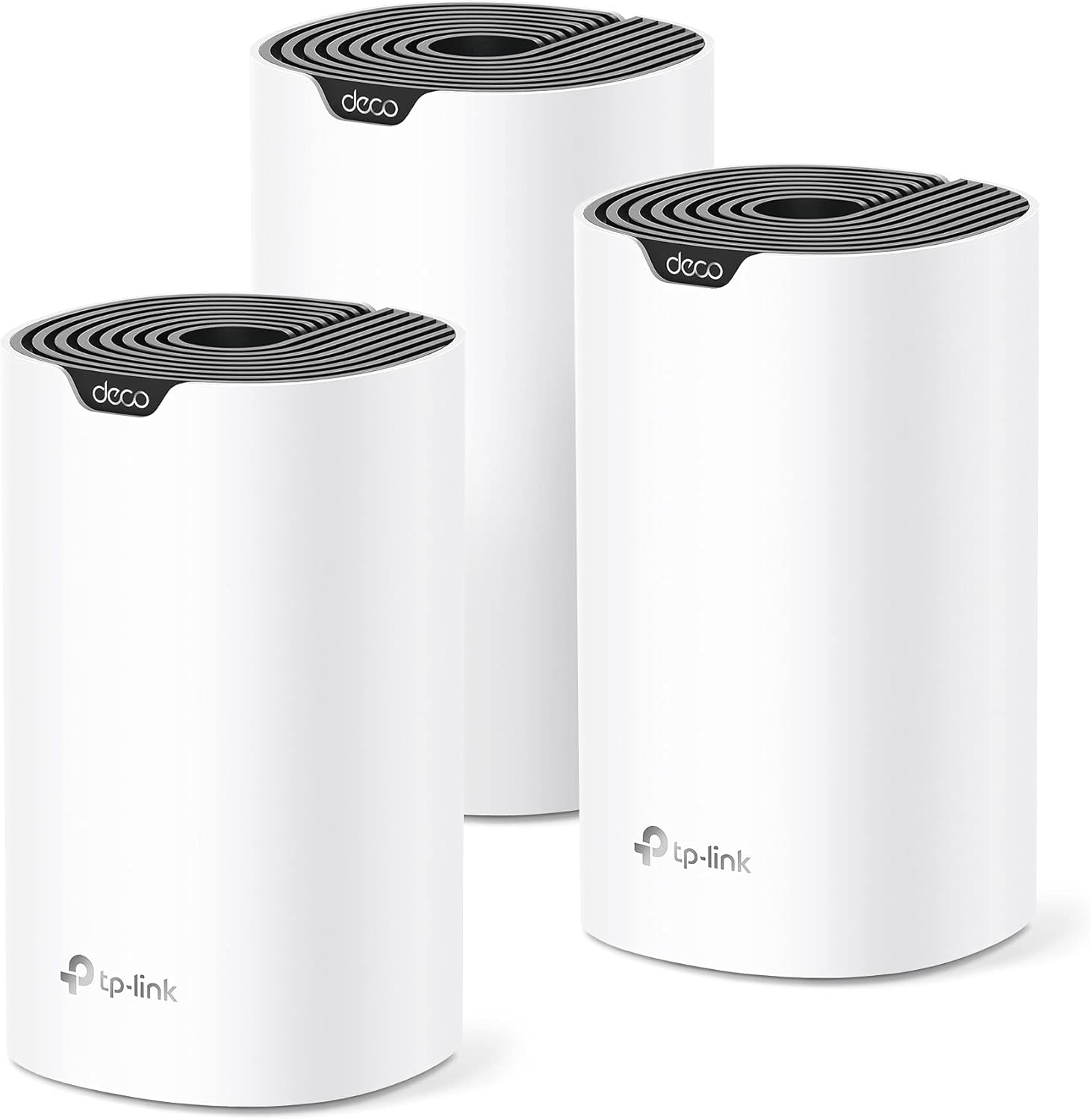
TP-Link Deco S4 Mesh AC1900 WiFi System - Up to 5,500 Sq.ft. Coverage, Replaces WiFi Router and Extender, Gigabit Ports, Works with Alexa, Deco S4(3-Pack)
A 3-pack AC1900 dual-band mesh system covering 5,500 sq ft with Gigabit Ethernet, for homes needing broad Wi-Fi 5 coverage on a budget.

TP-Link Deco X55 Pro AX3000 Whole Home Wi-Fi 6 Mesh System - Coverage up to 6500 Sq.Ft & up to 150 Devices, 2x2.5G WAN/LAN Ports, 4 Streams, Wired Ethernet Backhaul, Ideal for 1Gig+ Internet, 3-Pack
A Wi-Fi 6 mesh system with AX3000 speed and 2x 2.5G ports per unit, covering 6500 sq. ft. for homes with 1Gig+ internet.