
Amazon eero 7 with 1 month free eero Plus (auto-renews) - Supports internet plans up to 2.5 Gbps, Coverage up to 6,000 sq. ft., Connect 120+ devices, 3-pack
Want the best price and purchase timing?
Our AI advisor analyzes real-time pricing across all channels to find you the best deal.
AI Verdict
This 3-pack Wi-Fi 7 mesh system covers 6,000 sq. ft. with 2.5 Gbps wired ports, but lacks a 6GHz band and paywalls security features.
This eero 7 three-pack is a situational fit for homes up to 6,000 sq. ft. that need Wi-Fi 7 for 120+ devices and appreciate the 2.5 GbE wired ports. However, its dual-band nature means it skips the 6GHz band, which is a core part of Wi-Fi 7's speed benefits.
If you need the full speed and lower latency benefits of Wi-Fi 7's 6GHz band and 320MHz channels, look for a tri-band Wi-Fi 7 mesh system.
Regret Score™
Medium RiskLower is better — measures purchase-regret risk from real buyer complaints, review credibility, and product maturity
Issues discovered after purchase
Critically weak dimension
Amazon rating vs actual quality
Chance this product isn't for you
Pros
- Supports internet plans up to 2.5 Gbps with two 2.5 GbE ports per node for high-speed wired connections.
- Provides up to 6,000 sq. ft. of Wi-Fi 7 coverage with the three-pack, minimizing dead spots in large homes.
- Connects 120+ devices simultaneously, handling busy networks without significant slowdowns.
- Functions as a smart home hub, supporting Thread, Zigbee, and Matter devices with Alexa integration.
- Features Multi-Link Operation (MLO) and WPA3 encryption for enhanced performance and security.
- Setup is guided through the eero app, making initial configuration straightforward.
Cons
- Lacks a 6GHz band, which means it doesn't support 320MHz channels, limiting its full Wi-Fi 7 potential.
- Advanced security features, parental controls, and ad blocking are locked behind an optional eero Plus subscription.
- Does not include any USB ports for connecting external storage or other peripherals.
- Wireless speeds are capped at 1.8 Gbps, despite supporting 2.5 Gbps internet plans.
- Some users reported slower Wi-Fi speeds on 2.4 GHz and 5 GHz devices compared to older Wi-Fi 6E systems.
Dimension Scores
The 3-pack covers 6,000 sq. ft. and supports 2.5 Gbps internet plans with 2.5 GbE ports, but wireless speeds are limited to 1.8 Gbps and it lacks a 6GHz band for peak Wi-Fi 7 performance.
Users report consistent, stable performance even with many devices, though some experienced initial setup issues and occasional network 'jack-ups' with too many units.
The eero app guides setup in minutes and offers intuitive management, though some found multi-node placement and app timeouts frustrating.
It includes WPA3 encryption, but advanced digital security, parental controls, and ad blocking are locked behind a paid eero Plus subscription.
Best For
- Large homes up to 6,000 sq. ft. needing comprehensive Wi-Fi 7 coverage.
- Households with many connected smart home devices that use Thread, Zigbee, or Matter.
- Users with internet plans up to 2.5 Gbps who want to utilize wired backhaul or connect high-speed wired devices.
- Individuals prioritizing ease of setup and management through a mobile app.
Not Recommended For
- Users who require the absolute fastest Wi-Fi 7 speeds and 6GHz band support for cutting-edge devices.
- Anyone unwilling to pay an additional subscription for advanced network security and parental controls.
- Power users needing extensive customization options beyond basic network management.
Watch Out For
- The system's advanced security, parental controls, and ad blocking require an ongoing eero Plus subscription after the initial free month.
- Despite being a Wi-Fi 7 system, it operates only on 2.4 GHz and 5 GHz bands, missing the 6GHz band and 320MHz channels that offer higher potential throughput.
- Some users upgrading from Wi-Fi 6E systems reported seeing slower speeds on their 2.4 GHz and 5 GHz devices, sometimes dropping from 500+ Mbps to 250-500 Mbps.
- Initial setup for multiple nodes can be frustrating, with reports of app timeouts and needing to reposition units.
- In some large, multi-level homes or those with thick walls, a 3-pack might not provide sufficient coverage, especially if replacing an older 5-pack system.
What Buyers Say
Many users upgrading to the eero 7 from older Wi-Fi 6E systems were surprised to find their 2.4 GHz and 5 GHz device speeds actually decreased, sometimes significantly, despite the newer Wi-Fi 7 standard. The system is praised for its straightforward setup and ability to cover large areas, but the requirement for a paid subscription for core security features is a recurring point of contention. The absence of a 6GHz band also means it doesn't fully leverage Wi-Fi 7's potential, leading to some disappointment for those expecting cutting-edge performance.
“Honestly, I bought this for the Wi-Fi 7 hype, but my old 6E actually felt faster on my regular devices, and now I gotta pay extra for parental controls? Kinda feels like a bait and switch, not gonna lie.”
Common Praise
- The eero app makes initial setup and ongoing management very simple.
- The three-pack effectively eliminates Wi-Fi dead spots across 6,000 sq. ft. homes.
- The inclusion of two 2.5 GbE ports on each node allows for fast wired connections and backhaul.
- It functions as a smart home hub, integrating Thread, Zigbee, and Matter devices easily.
- The system maintains stable connections even with a high number of connected devices.
Common Complaints
- Security, parental controls, and ad blocking are only available through the paid eero Plus subscription.
- The lack of a 6GHz band means it doesn't support 320MHz channels, limiting its Wi-Fi 7 capabilities.
- Some users experienced slower 2.4 GHz and 5 GHz Wi-Fi speeds compared to previous Wi-Fi 6E setups.
- The setup process for multiple nodes can be frustrating, with reports of app timeouts.
- There are no USB ports for connecting external devices or storage.
Ownership Tips
- The physical design is discreet, without flashy LEDs or external antennas, blending into home decor.
- Wired backhaul significantly improves performance, especially in multi-level homes or those with challenging layouts.
- The system's 'TrueMesh' software proactively optimizes connections, which helps maintain stability even if raw speeds aren't top-tier.
- While it supports 2.5 Gbps internet, many devices won't hit those speeds wirelessly, especially without the 6GHz band.
- Mixing eero 7 with older eero models can sometimes lead to unexpected performance quirks or reduced coverage on certain bands.
Frequently Asked Questions
Does the eero 7 support the 6GHz Wi-Fi band?
No, the eero 7 is a dual-band system, operating on 2.4 GHz and 5 GHz. It does not include a 6GHz radio band, which means it also doesn't support 320MHz channels.
Are security features like parental controls included for free?
No, advanced digital security, parental controls, and ad blocking are part of an optional eero Plus subscription, which auto-renews after a one-month free trial.
What kind of internet speeds can I expect with the eero 7?
The system supports internet plans up to 2.5 Gbps and has two 2.5 GbE wired ports. Wireless speeds are rated up to 1.8 Gbps, with individual bands reaching up to 688Mbps on 2.4GHz and 4,324Mbps on 5GHz.
Can I use the eero 7 with my existing smart home devices?
Yes, the eero 7 acts as a smart home hub and supports Thread, Zigbee, and Matter-enabled devices, allowing for integration with Alexa.
How much area does the 3-pack cover?
The three-pack is designed to provide Wi-Fi coverage for homes up to 6,000 square feet, with each individual eero 7 node covering approximately 2,000 square feet.
Buying Guide
When you're looking at a mesh Wi-Fi system like the eero 7, you're buying coverage for your whole house, not just raw speed in one spot. Think about your home's size and layout – 6,000 sq. ft. is a lot, but thick walls or multiple floors can still mess with signal. Also, remember that 'Wi-Fi 7' here doesn't mean it has every single Wi-Fi 7 feature, specifically the 6GHz band, which is a big deal for future-proofing and speed. You'll also need to decide if you're okay with a subscription for security features.
Wi-Fi 7 (Dual-band)
This is the newest Wi-Fi standard, promising faster speeds and better efficiency. However, 'dual-band' means it uses 2.4 GHz and 5 GHz, skipping the even faster 6 GHz band that some Wi-Fi 7 devices can use, like a two-lane highway when a three-lane one exists.
2.5 GbE Ports
These are faster Ethernet ports. If your internet plan is over 1 Gbps, or you want to wire your mesh nodes together for maximum speed (called 'wired backhaul'), these ports are crucial. Think of them as wider pipes for your internet connection.
Coverage up to 6,000 sq. ft. (3-pack)
This tells you the maximum area the system can reliably cover. If your house is smaller, you might not need all three units, but for larger homes, this ensures signal reaches every corner, like having multiple small cell towers instead of one big one.
eero Plus Subscription
This is an optional paid service that adds features like advanced security, parental controls, and ad blocking. Without it, you get basic Wi-Fi, but these extra protections aren't included, similar to how a basic car comes without advanced driver-assist features.
Alternatives
If you need the full benefits of Wi-Fi 7, including the 6GHz band and 320MHz channels for maximum throughput, look for tri-band Wi-Fi 7 mesh systems. If integrated security and parental controls without a subscription are a priority, seek out mesh systems that include these features at no extra cost.
You Might Also Like

Amazon eero Pro 7 with 1 month free eero Business (auto-renews annually) - Supports internet plans up to 5 Gbps, Coverage up to 6,000 sq. ft., Connect 600+ devices, 3-pack
$600+This 3-pack Wi-Fi 7 tri-band mesh system delivers up to 3.9 Gbps wireless speeds and 5 Gbps wired speeds, covering 6,000 sq. ft. for businesses needing high-capacity networking.

Amazon eero 6 mesh wifi add-on extender - Add up to 1,500 sq. ft. of Wi-Fi 6 coverage. Required eero mesh wifi system not included
A Wi-Fi 6 mesh extender that adds up to 1,500 sq. ft. of coverage, exclusively for existing eero network users.
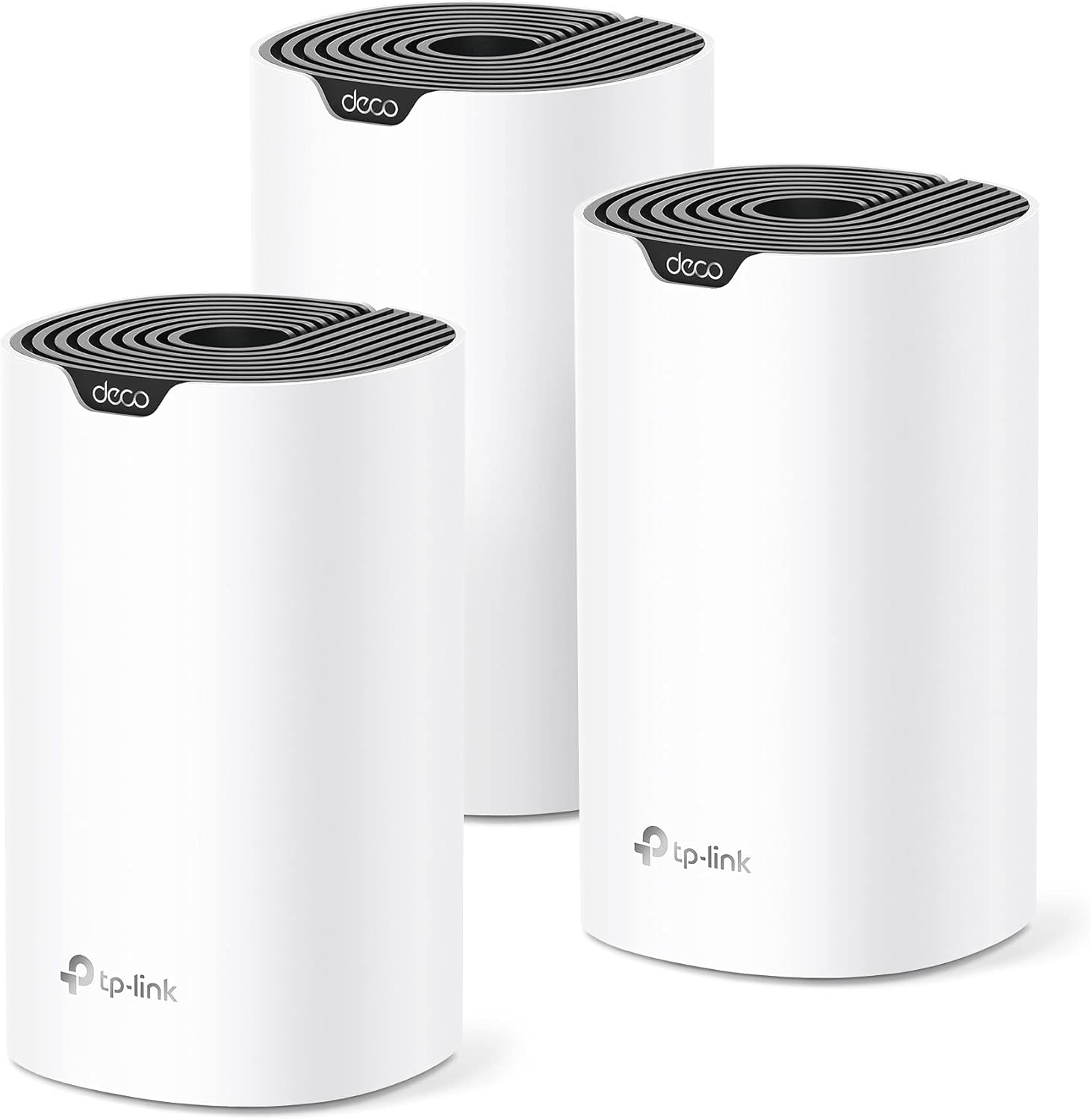
TP-Link Deco S4 Mesh AC1900 WiFi System - Up to 5,500 Sq.ft. Coverage, Replaces WiFi Router and Extender, Gigabit Ports, Works with Alexa, Deco S4(3-Pack)
A 3-pack AC1900 dual-band mesh system covering 5,500 sq ft with Gigabit Ethernet, for homes needing broad Wi-Fi 5 coverage on a budget.

TP-Link Deco X55 Pro AX3000 Whole Home Wi-Fi 6 Mesh System - Coverage up to 6500 Sq.Ft & up to 150 Devices, 2x2.5G WAN/LAN Ports, 4 Streams, Wired Ethernet Backhaul, Ideal for 1Gig+ Internet, 3-Pack
A Wi-Fi 6 mesh system with AX3000 speed and 2x 2.5G ports per unit, covering 6500 sq. ft. for homes with 1Gig+ internet.