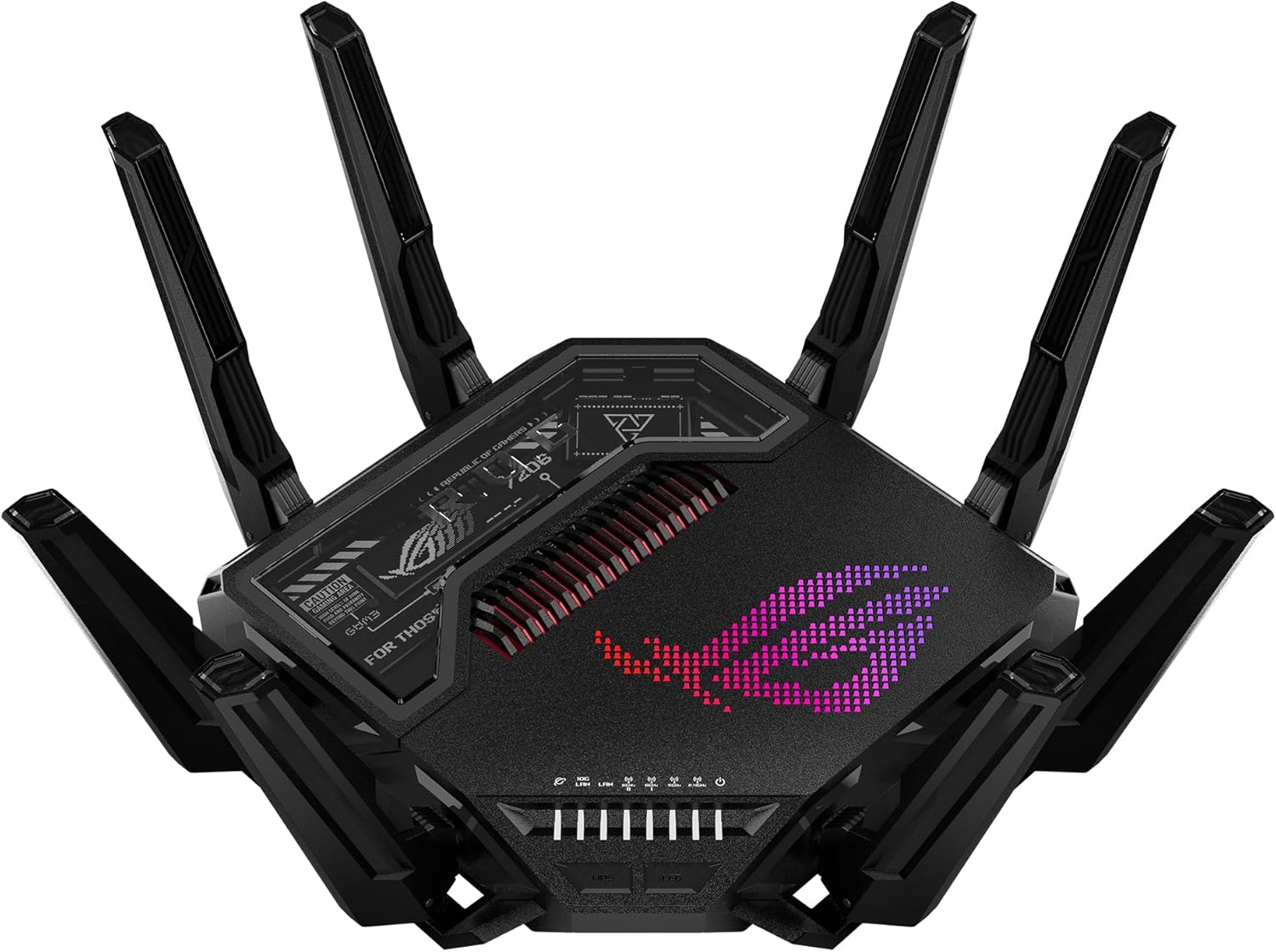
ASUS ROG Rapture GT-BE98 PRO First Quad-Band WiFi 7 Gaming Router supports 320MHz, Dual 10G Port, Triple-level Game Acceleration, Mobile Game Mode, Subscription-Free Security, AiMesh, and VPN features
Want the best price and purchase timing?
Our AI advisor analyzes real-time pricing across all channels to find you the best deal.
AI Verdict
A quad-band WiFi 7 router with 30 Gbps speed, dual 10G ports, and triple-level game acceleration, built for users demanding maximum wired and wireless throughput for gaming and high-bandwidth applicat
This router is a situational fit, offering cutting-edge WiFi 7 (802.11be) with 30 Gbps speed and extensive wired 10G/2.5G ports for users who can fully utilize these advanced hardware capabilities. However, reported software issues, including a non-intuitive UI and unstable 6GHz band, mean its full potential might not be realized by all users, especially those expecting a polished experience out of the box. Its high price point also makes it a significant investment for a potentially unoptimized experience.
If you need more consistent performance and a more refined software experience, look for routers with mature firmware and strong community support, even if they offer slightly lower theoretical maximum speeds.
Regret Score™
Medium RiskLower is better — measures purchase-regret risk from real buyer complaints, review credibility, and product maturity
Issues discovered after purchase
Critically weak dimension
Amazon rating vs actual quality
Chance this product isn't for you
Pros
- Achieves speeds up to 30 Gbps with WiFi 7 (802.11be) and new 320MHz channels in the 6 GHz band.
- Features maximized wired connectivity with dual 10G ports and quad 2.5G ports.
- Includes Triple-Level Game Acceleration to prioritize PC gaming traffic from the device to the game server.
- Offers Multi-link Operation for stable internet connections and efficient data transfers across multiple bands simultaneously.
- Provides enhanced signal strength and coverage through cutting-edge external dual-feeding antennas.
- Supports AiMesh for expanding network coverage and offers subscription-free network security and comprehensive VPN features.
Cons
- Users report poorly designed and non-intuitive admin UI and mobile app, lacking high-end configuration options for specific band SSIDs.
- Some users experienced effective WiFi speeds slower than cheaper alternatives, with devices barely cracking 500 Mbps on MLO compared to 800s on other routers.
- The 6GHz frequency band has been reported to cause random restarts and connection loss, with some users needing to disable it to maintain stability.
- VLAN support is reported as broken, not functioning correctly with downstream switches and creating network loops.
- The router runs hot, requiring placement in a well-ventilated area.
Dimension Scores
Offers theoretical 30 Gbps WiFi 7 speeds with 320MHz channels and dual 6GHz bands, and external dual-feeding antennas boost coverage, providing strong performance at short to medium distances.
Reports of 6GHz band instability causing random restarts and connection drops, along with broken VLAN support, indicate significant reliability issues for key features.
Initial setup is easy via app/web, but the admin UI and mobile app are described as poorly designed, non-intuitive, and lacking high-end configuration options for specific band SSIDs.
Includes subscription-free network security, comprehensive VPN features (WireGuard, OpenVPN, PPTP, IPSec), and AiProtection, offering a robust suite of protections.
Best For
- Hardcore gamers needing dedicated game acceleration and priority traffic routing to game servers.
- Households with multiple high-bandwidth devices requiring simultaneous stable connections and efficient data transfers via Multi-link Operation.
- Users with multi-gigabit internet connections and a need for extensive wired connectivity through dual 10G and quad 2.5G ports.
- Early adopters of WiFi 7 technology looking to leverage 320MHz channels and 4096-QAM for maximum throughput.
Not Recommended For
- Users expecting a seamless and intuitive software experience, especially with advanced configurations like specific SSID band assignments.
- Budget-conscious buyers, given its $600+ reference price range and reported performance issues compared to cheaper alternatives.
- Environments heavily reliant on VLAN functionality, as its implementation is reported to be broken.
Watch Out For
- The admin UI and mobile app are described as non-intuitive and lacking high-end configuration options for creating SSIDs that only offer 5GHz & 6Ghz with specific support.
- Effective WiFi speed for some devices was reported as slower than a cheaper TP-Link BE550, with OnePlus Open and iPhone 16 Pro Max barely reaching 500 Mbps on MLO compared to 800s.
- The 6GHz frequency band can cause random restarts and frequent connection loss, necessitating its disablement for network stability.
- VLAN support is problematic; it doesn't work with downstream switches and creates network loops, making it unusable for complex network setups.
- The router gets hot, requiring careful consideration for placement in a well-ventilated area to prevent potential performance issues or longevity concerns.
Full Specifications
| ASIN | B0CPQYSXCW |
| Brand | ASUS |
| Color | BLACK |
| Model Name | GT-BE98 PRO |
| Item Weight | 4.4 pounds |
| Manufacturer | ASUS |
| Special Feature | Access Point Mode, Guest Mode, Internet Security, Parental Control, QoS |
| Item model number | GT-BE98 |
| Compatible Devices | Gaming Console, Personal Computer, Smart Television, Smartphone, Tablet |
| Product Dimensions | 13.7 x 8.6 x 13.7 inches |
| Included Components | GT-BE98 Pro quad-band gaming router, Power adapter, Quick start guide, RJ-45 cable, Warranty card |
| Frequency Band Class | Quad-Band |
| Connectivity Technology | Ethernet, USB, Wi-Fi |
| Recommended Uses For Product | Business, Gaming, Home |
| Wireless Communication Standard | 802.11.be |
What Buyers Say
The most surprising finding is that despite its cutting-edge WiFi 7 hardware and high price, several users reported the router's effective WiFi speed was slower than much cheaper alternatives, like the TP-Link BE550, for their devices. The 6GHz band, a key selling point, frequently causes random restarts and connection loss, forcing some to disable it entirely. The software experience, both the admin UI and mobile app, is consistently criticized for being non-intuitive and lacking advanced configuration options.
“Man, I dropped a ton of cash on this thing expecting blazing fast, rock-solid WiFi 7, but my phone barely hits 500Mbps and the 6GHz band keeps dropping out. Seriously, for this price, the software should be way better, not this clunky mess. I'm so disappointed, might just send it back.”
Common Praise
- Achieves higher than rated internet speeds, with one user reporting 1.6 Gbps when subscribed to 1.3 Gbps.
- Provides strong signal strength and good range, reaching areas like a security gate in the front yard.
- Offers extensive wired connectivity with dual 10G and quad 2.5G ports that work as intended.
- Initial setup is straightforward and easy to complete through the app or web interface.
- The ASUS firmware provides a wide array of features like port forwarding, DDNS, and VPN built-in.
- Future-proof with WiFi 7 technology, ensuring relevance for upcoming devices.
Common Complaints
- Poorly designed and non-intuitive admin UI and mobile app, lacking advanced configuration options.
- Effective WiFi speeds were slower than expected, with some devices performing worse than on cheaper routers.
- The 6GHz frequency band causes random restarts and frequent disconnections, often requiring it to be disabled.
- VLAN support is broken and creates network loops when used with downstream switches.
- The router runs hot and requires a well-ventilated area for placement.
- The physical design is large and can be considered 'obnoxious' with its lighting, though lighting can be turned off.
Ownership Tips
- After a few weeks, some users found that early adopter issues, particularly with mesh setups, became rock solid after firmware updates, provided certain features like guest or IoT networks were avoided.
- The router's large size and 'arachnid' design are noticeable in person, and the RGB lighting, while configurable, can be distracting.
- Despite the high theoretical speeds, real-world performance for some devices might not show significant improvement over previous generation routers, especially if the 6GHz band is unstable.
- The heat generated by the router is a consistent observation, suggesting that proper ventilation is not just a recommendation but a necessity for long-term stability.
- The comprehensive VPN features are a strong point, allowing easy setup for all or selected devices, which is a benefit discovered after extended use.
Frequently Asked Questions
Does this router truly deliver 30 Gbps speeds?
The ASUS ROG Rapture GT-BE98 Pro has a theoretical maximum speed of 30 Gbps, leveraging WiFi 7 (802.11be) with 320MHz channels and 4096-QAM. Actual data throughput will vary significantly based on network conditions, environmental factors, and client device capabilities.
Are the 10G ports useful for gaming?
Yes, the router includes dual 10G ports, with one configurable as a dedicated gaming port, prioritizing traffic for connected gaming devices. This, combined with Triple-Level Game Acceleration, aims to reduce ping and boost gaming traffic.
Is the 6GHz band stable on this router?
Some users have reported instability with the 6GHz band, experiencing random restarts and connection loss, to the point of needing to disable it. Firmware updates may address these issues, but it's a reported concern.
Does it support mesh networking?
Yes, the router supports AiMesh, allowing you to expand your network coverage by adding compatible ASUS mesh access points. Users have successfully integrated it into mesh setups for broader coverage.
Is the setup process complicated?
Initial setup is generally reported as easy through the app or web interface. However, advanced options and configurations, particularly those related to gaming or specific network settings, can be non-intuitive due to the UI design.
Buying Guide
When you're looking at a router like this, you're not just buying faster Wi-Fi numbers; you're investing in the ecosystem and the specific features it offers. You need to consider if your current devices can even use Wi-Fi 7, and if your internet plan can actually push enough data to justify the multi-gigabit ports. Don't just look at the 'up to X Gbps' number; think about the real-world speeds your devices will see and if the software experience matches the hardware's promise.
WiFi 7 (802.11be) with 320MHz channels and 4096-QAM
This is the latest Wi-Fi standard, offering significantly increased network capacity and throughput. Think of 320MHz channels as wider lanes on a highway, allowing more data to flow at once, and 4096-QAM as packing more data into each 'car' on that highway, leading to theoretical speeds up to 30 Gbps.
Quad-Band (including dual 6 GHz bands)
Most routers are dual-band (2.4GHz, 5GHz) or tri-band (2.4GHz, two 5GHz). Quad-band, especially with two 6GHz bands, means more dedicated 'airwaves' for your devices, reducing congestion. The 6GHz band is less crowded and offers higher speeds over shorter distances, perfect for nearby gaming PCs or VR headsets.
Dual 10G ports and Quad 2.5G ports
These are your super-fast wired connections. A 10G port is ten times faster than a standard gigabit (1G) port, crucial for connecting to a multi-gig internet modem, a high-speed NAS, or a gaming PC for zero-latency wired gaming. The 2.5G ports are also faster than standard gigabit, great for other high-bandwidth wired devices.
Triple-Level Game Acceleration
This isn't just marketing; it's a set of features designed to prioritize your gaming traffic. It means the router actively works to ensure your game data gets preferential treatment from your PC, through the router, and all the way to the game server, aiming to reduce lag and ping.
Alternatives
If this router doesn't fit, look for a tri-band WiFi 6E router with at least one 2.5G WAN/LAN port and a more established software ecosystem if you prioritize stability and a polished user experience over bleeding-edge, potentially buggy, WiFi 7 features.
You Might Also Like

Amazon eero Pro 7 with 1 month free eero Business (auto-renews annually) - Supports internet plans up to 5 Gbps, Coverage up to 6,000 sq. ft., Connect 600+ devices, 3-pack
$600+This 3-pack Wi-Fi 7 tri-band mesh system delivers up to 3.9 Gbps wireless speeds and 5 Gbps wired speeds, covering 6,000 sq. ft. for businesses needing high-capacity networking.

Amazon eero 6 mesh wifi add-on extender - Add up to 1,500 sq. ft. of Wi-Fi 6 coverage. Required eero mesh wifi system not included
A Wi-Fi 6 mesh extender that adds up to 1,500 sq. ft. of coverage, exclusively for existing eero network users.
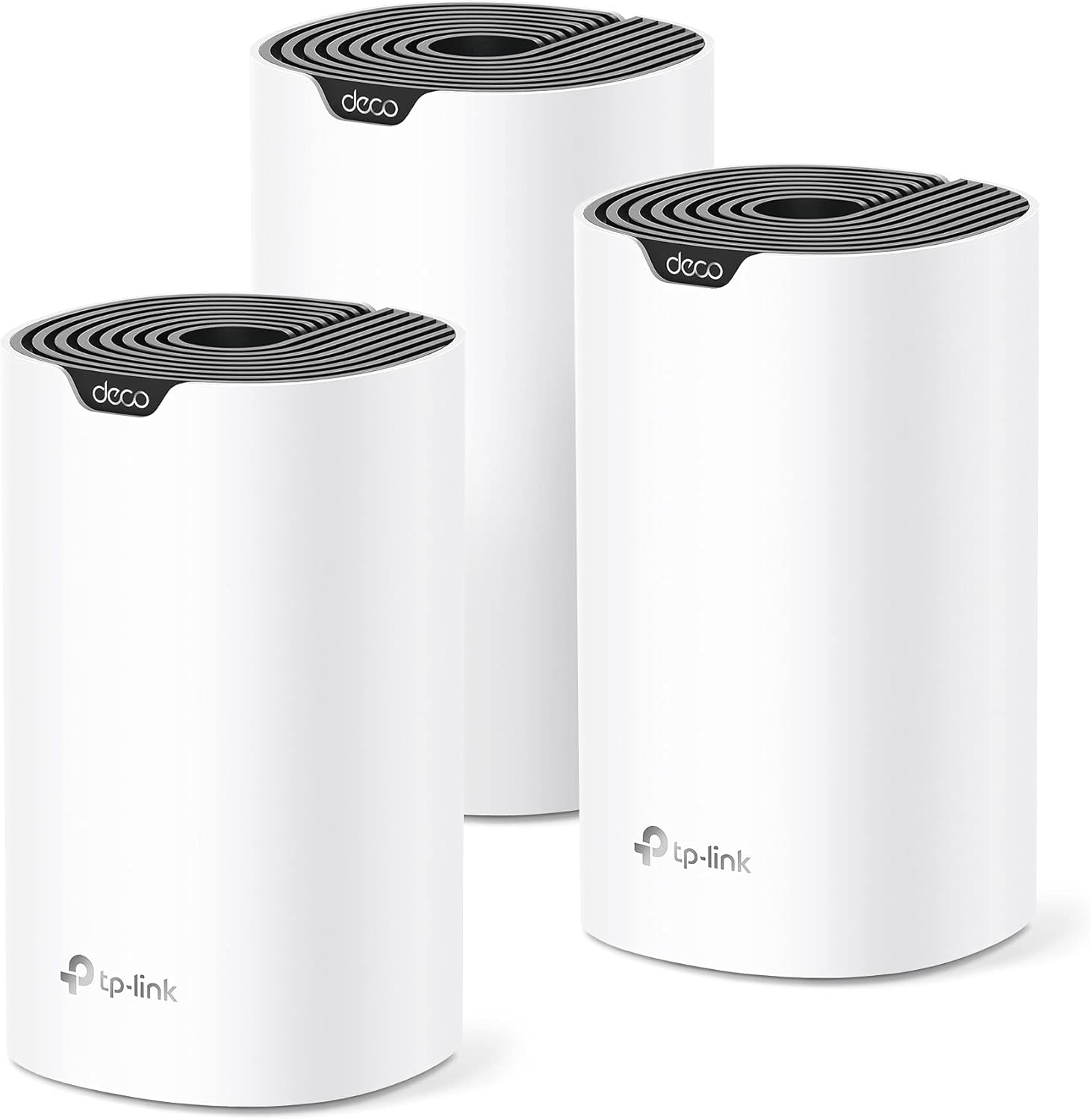
TP-Link Deco S4 Mesh AC1900 WiFi System - Up to 5,500 Sq.ft. Coverage, Replaces WiFi Router and Extender, Gigabit Ports, Works with Alexa, Deco S4(3-Pack)
A 3-pack AC1900 dual-band mesh system covering 5,500 sq ft with Gigabit Ethernet, for homes needing broad Wi-Fi 5 coverage on a budget.

TP-Link Deco X55 Pro AX3000 Whole Home Wi-Fi 6 Mesh System - Coverage up to 6500 Sq.Ft & up to 150 Devices, 2x2.5G WAN/LAN Ports, 4 Streams, Wired Ethernet Backhaul, Ideal for 1Gig+ Internet, 3-Pack
A Wi-Fi 6 mesh system with AX3000 speed and 2x 2.5G ports per unit, covering 6500 sq. ft. for homes with 1Gig+ internet.