
Nest WiFi Router with 1 Point - Mesh for Wireless Internet Wi-Fi Extender Smart Speaker Works and Google Home Systems Snow
Want the best price and purchase timing?
Our AI advisor analyzes real-time pricing across all channels to find you the best deal.
AI Verdict
A dual-band 802.11ac mesh Wi-Fi system with integrated Google Assistant speakers, covering up to 3800 square feet, for homes prioritizing smart home integration over Wi-Fi 6 speeds.
This system offers broad 802.11ac mesh coverage up to 3800 square feet and integrates Google Assistant speakers into its points, which is a unique feature. However, its reliance on the older Wi-Fi 5 standard and lack of Ethernet on points means it won't deliver top-tier speeds or advanced networking capabilities.
If you need faster speeds or Wi-Fi 6/6E support, look for mesh systems explicitly stating Wi-Fi 6 or Wi-Fi 6E compatibility and tri-band frequency.
Regret Score™
Medium RiskLower is better — measures purchase-regret risk from real buyer complaints, review credibility, and product maturity
Issues discovered after purchase
Critically weak dimension
Amazon rating vs actual quality
Chance this product isn't for you
Pros
- Covers up to 3800 square feet with one router and one point, effectively eliminating dead zones.
- Each point includes a smart speaker with Google Assistant built-in, allowing voice control and music playback.
- Handles up to 100 connected devices and multiple 4K streams simultaneously.
- The router unit features two Ethernet ports for wired connections.
- Setup and management are straightforward and handled through the Google Home app.
- Scalable and flexible mesh system, compatible with existing Google Wifi devices.
Cons
- Uses the older 802.11ac (Wi-Fi 5) standard, lacking Wi-Fi 6 or 6E support for newer devices and faster speeds.
- Nest Wifi Points do not have Ethernet ports, limiting options for wired backhaul or connecting wired devices at extender locations.
- Performance can drop significantly at range when devices connect to a Point compared to the main router.
- Not ideal for internet connections exceeding 500 Mbps, as the system may not fully utilize the bandwidth.
- Some users report random disconnections of points or devices, requiring restarts.
Dimension Scores
It offers coverage up to 3800 square feet, but throughput can drop significantly at range, and it uses the older Wi-Fi 5 standard, limiting top speeds.
While designed for stable connections, some users report random disconnections of points and devices, impacting consistent performance.
Setup is described as easy and fast through the Google Home app, which also provides integrated management for the network and smart home devices.
The product specifications do not highlight specific advanced security features beyond standard Wi-Fi encryption, placing it at an average level for consumer routers.
Best For
- Homes up to 3800 square feet needing expanded Wi-Fi coverage and dead zone elimination.
- Users deeply integrated into the Google Assistant ecosystem wanting smart speakers throughout their home.
- Households with many connected devices (up to 100) and multiple 4K streaming needs.
Not Recommended For
- Users requiring the latest Wi-Fi 6 or 6E standards for future-proofing or very high speeds.
- Homes with internet connections exceeding 500 Mbps, as the system may not fully utilize the bandwidth.
- Users who prefer wired backhaul for all mesh points due to the lack of Ethernet on points.
Watch Out For
- The Wi-Fi 5 (802.11ac) standard means newer Wi-Fi 6/6E devices won't reach their full potential speeds.
- Nest Wifi Points lack Ethernet ports, preventing wired backhaul for improved performance at extender locations or connecting wired devices.
- Reported speed drops to as low as 49 Mbps on the top floor when connecting to a point, compared to 475 Mbps near the router.
- Some users report random disconnections of points or devices, requiring restarts to restore connectivity.
- The 5 GHz network can lack decent range, and the 2.4 GHz network can be too slow for some users' expectations.
Full Specifications
| ASIN | B084D5PDJT |
| Brand | |
| Color | Snow |
| Department | Unisex-Adult |
| Item Weight | 1.61 pounds |
| Manufacturer | |
| Special Feature | WPS |
| Item model number | H2E and H2D |
| Compatible Devices | Personal Computer |
| Product Dimensions | 4.33 x 4.33 x 3.56 inches |
| Included Components | Ethernet Cable (6.5ft), Nest Wifi Point, Nest Wifi Router, Two 15W Power Adapter |
| Frequency Band Class | Dual-Band |
| Connectivity Technology | Ethernet, Wi-Fi |
| Recommended Uses For Product | Home |
| Wireless Communication Standard | 802.11ac |
What Buyers Say
Many users appreciate the integrated Google Assistant speakers in the Nest Wifi Points, a feature not found in newer Google mesh systems. However, the system's Wi-Fi 5 standard and the lack of Ethernet ports on the points are frequent points of contention, especially for those with faster internet plans or who prefer wired backhaul. Some users also experience inconsistent connections and speed drops, particularly when connecting to the mesh points at a distance.
“I bought this to fix my dead zones but my Fire Stick still drops connection sometimes, and the speeds on the upstairs point are way slower than the main router, what gives? At least the speaker works.”
Common Praise
- Easy setup process using the Google Home app.
- Integrated Google Assistant smart speakers in the points.
- Eliminates Wi-Fi dead zones across homes up to 3800 square feet.
- Aesthetically pleasing design that blends into home decor.
- Handles many connected devices (up to 100) and multiple 4K streams without buffering.
Common Complaints
- Points lack Ethernet ports, preventing wired connections for devices or backhaul.
- Uses older Wi-Fi 5 (802.11ac) standard, not Wi-Fi 6 or 6E.
- Significant speed degradation when connecting to a point compared to the main router.
- Random disconnections of mesh points or devices, requiring restarts.
- Not suitable for internet speeds above 500 Mbps.
Ownership Tips
- The router unit is 4x4 MIMO, while the points are 2x2 MIMO, meaning the router generally offers better range and performance.
- The system works best when the Nest Wifi Router is the primary unit, especially if integrating with older Google Wifi pucks.
- The Google Home app, while easy for setup, can feel cluttered for managing detailed network settings.
- The 5 GHz band, while faster, can have surprisingly limited range compared to the 2.4 GHz band in some home environments.
- The system may not fully utilize internet connections faster than 500 Mbps, even if your ISP provides them.
Frequently Asked Questions
Does Nest Wifi support Wi-Fi 6?
No, the Nest Wifi uses the 802.11ac (Wi-Fi 5) standard, not Wi-Fi 6 or 6E.
Can I use the Nest Wifi Points as just smart speakers without extending Wi-Fi?
Yes, you can configure the Nest Wifi Points to function solely as Google Assistant speakers without acting as Wi-Fi extenders.
How many Ethernet ports does the system have?
The Nest Wifi Router has two Ethernet ports, one for the modem and one spare, but the Nest Wifi Points do not have any Ethernet ports.
Is it compatible with older Google Wifi devices?
Yes, the Nest Wifi system is compatible with Google Wifi devices, allowing you to expand an existing Google Wifi network.
What is the maximum internet speed this system can handle?
The Nest Wifi is suitable for internet connections up to approximately 500 Mbps; it may not fully utilize faster connections.
How easy is the setup process?
Setup is straightforward and managed through the Google Home app, which guides you through connecting the router and points.
Buying Guide
When picking a mesh Wi-Fi system, you're essentially buying multiple access points to spread your internet signal around your home, eliminating dead spots. Think about your home's size and layout, as thick walls or multiple floors can impact signal strength. Also, consider how many devices you have and what you use your internet for – streaming 4K movies and gaming demand more from your network.
wifi_standard (802.11ac)
frequency (Dual-Band)
mesh (Mesh)
coverage (up to 3800 square feet)
Alternatives
If you need Wi-Fi 6 or 6E for faster speeds and future compatibility, look for mesh systems with those standards explicitly listed, preferably with tri-band support and Ethernet ports on all access points for wired backhaul.
You Might Also Like

Amazon eero Pro 7 with 1 month free eero Business (auto-renews annually) - Supports internet plans up to 5 Gbps, Coverage up to 6,000 sq. ft., Connect 600+ devices, 3-pack
$600+This 3-pack Wi-Fi 7 tri-band mesh system delivers up to 3.9 Gbps wireless speeds and 5 Gbps wired speeds, covering 6,000 sq. ft. for businesses needing high-capacity networking.

Amazon eero 6 mesh wifi add-on extender - Add up to 1,500 sq. ft. of Wi-Fi 6 coverage. Required eero mesh wifi system not included
A Wi-Fi 6 mesh extender that adds up to 1,500 sq. ft. of coverage, exclusively for existing eero network users.
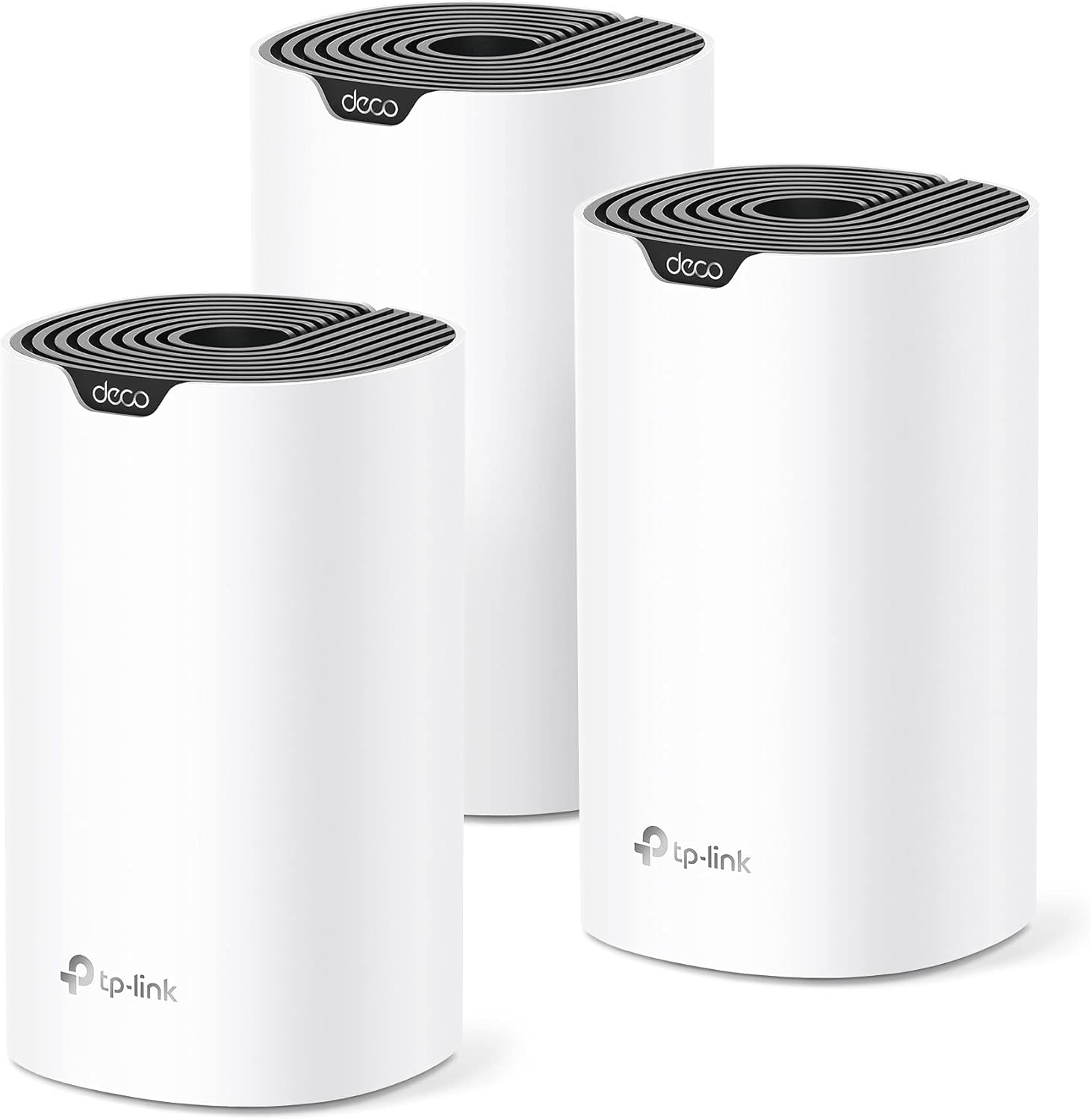
TP-Link Deco S4 Mesh AC1900 WiFi System - Up to 5,500 Sq.ft. Coverage, Replaces WiFi Router and Extender, Gigabit Ports, Works with Alexa, Deco S4(3-Pack)
A 3-pack AC1900 dual-band mesh system covering 5,500 sq ft with Gigabit Ethernet, for homes needing broad Wi-Fi 5 coverage on a budget.

TP-Link Deco X55 Pro AX3000 Whole Home Wi-Fi 6 Mesh System - Coverage up to 6500 Sq.Ft & up to 150 Devices, 2x2.5G WAN/LAN Ports, 4 Streams, Wired Ethernet Backhaul, Ideal for 1Gig+ Internet, 3-Pack
A Wi-Fi 6 mesh system with AX3000 speed and 2x 2.5G ports per unit, covering 6500 sq. ft. for homes with 1Gig+ internet.