
CORSAIR Vengeance SODIMM DDR5 RAM 32GB (1x32GB) 5600MHz CL48 Intel XMP iCUE Compatible Computer Memory - Black (CMSX32GX5M1A5600C48)
Want the best price and purchase timing?
Our AI advisor analyzes real-time pricing across all channels to find you the best deal.
AI Verdict
A single 32GB DDR5 SODIMM module running at 5600MHz CL48, designed for easy installation and automatic speed configuration in compatible Intel and AMD laptops.
This 32GB 5600MHz CL48 SODIMM is a solid capacity upgrade for many DDR5-compatible laptops and small-form-factor PCs, especially with its automatic speed setting. However, its single-stick configuration means you'll miss out on dual-channel performance unless you buy two, and some user reports indicate potential stability challenges with Corsair DDR5 at advertised speeds.
If you need guaranteed dual-channel performance and maximum stability, look for a 2x16GB kit with a lower CAS Latency (e.g., CL40 or lower) and verify it's on your system's QVL list.
Regret Score™
Medium RiskLower is better — measures purchase-regret risk from real buyer complaints, review credibility, and product maturity
Issues discovered after purchase
Critically weak dimension
Amazon rating vs actual quality
Chance this product isn't for you
Pros
- Delivers 5600MHz DDR5 speeds, which is a significant upgrade over DDR4 modules
- 32GB capacity in a single stick allows for high memory configurations in systems with limited SODIMM slots
- Automatically sets to its maximum speed on compatible systems without requiring BIOS adjustments
- Compatible with a wide range of Intel and AMD gaming/performance laptops, small-form-factor PCs, and Intel NUC kits
- Installation is straightforward, typically only requiring a screwdriver for most laptops
- Rigorous screening and testing ensure performance and reliability
Cons
- Being a single 32GB module, it will operate in single-channel mode unless a second identical stick is added, potentially limiting performance in some workloads
- CL48 latency is on the higher side for DDR5, which can impact responsiveness compared to lower latency kits
- Some users have reported stability issues and crashes with Corsair DDR5 when enabling XMP profiles, particularly at higher speeds
- The 1.1 Volts operating voltage is standard, offering little room for manual voltage adjustments for performance tuning
Dimension Scores
The 5600MHz speed is a strong mid-range for DDR5 SODIMM, offering a significant boost over DDR4, though the CL48 latency is not the tightest available.
This module boasts wide compatibility with Intel XMP and a broad range of Intel and AMD laptops, small-form-factor PCs, and Intel NUC kits.
While it automatically sets to its maximum speed, the CL48 latency and focus on 'no BIOS configuration required' suggest it's not designed for extensive manual overclocking or pushing beyond its rated XMP profile.
Corsair states rigorous screening and testing for reliability, and many users report out-of-the-box functionality; however, some user reports indicate potential stability issues with Corsair DDR5 at advertised speeds.
Best For
- Upgrading a laptop or small-form-factor PC from DDR4 to DDR5 for increased bandwidth
- Users needing a single 32GB module to expand memory in a system with only one available SODIMM slot
- Laptops and mini-PCs where ease of installation and automatic speed configuration are priorities
- Workloads that benefit from large memory capacity over raw low-latency performance
Not Recommended For
- Users prioritizing the absolute lowest latency DDR5 for competitive gaming or highly sensitive applications
- Systems that require dual-channel memory performance out of the box without purchasing a second module
- Enthusiasts looking for extensive manual overclocking potential beyond XMP profiles
- Users who have experienced stability issues with Corsair DDR5 in the past
Watch Out For
- Some users on Reddit have reported blue screens and crashes when trying to run Corsair DDR5 at advertised XMP speeds, suggesting potential stability issues with certain system configurations
- A repair technician noted that Corsair RAM kits were the only ones causing problems on QVL lists they encountered
- While it automatically sets to maximum speed, some users with higher-speed Corsair DDR5 kits have mentioned needing to configure timings in iCUE or BIOS for stability, even with XMP enabled
- The 1x32GB configuration means you'll be running in single-channel mode if you only buy one, which can halve theoretical memory bandwidth compared to two sticks in dual-channel.
Full Specifications
| RAM | 32 GB DDR5 |
| ASIN | B0D33THVDL |
| Brand | Corsair |
| Color | Black |
| Series | VENGEANCE SODIMM DDR5 |
| Voltage | 1.1 Volts |
| Item Weight | 0.352 ounces |
| Manufacturer | Corsair |
| Memory Speed | 5600 MHz |
| Item model number | CMSX32GX5M1A5600C48 |
| Compatible Devices | Laptop |
| Product Dimensions | 2.76 x 1.18 x 0.12 inches |
| Computer Memory Size | 32 GB |
| Computer Memory Type | DDR5 SDRAM |
| RAM Memory Technology | DDR5 |
| Item Dimensions LxWxH | 2.76 x 1.18 x 0.12 inches |
What Buyers Say
While many users report this RAM works perfectly right out of the box, some Reddit discussions highlight potential stability issues with Corsair DDR5, particularly when enabling XMP profiles at higher speeds, leading to blue screens and crashes. The automatic speed setting is a plus for ease of use, but the single 32GB stick means you'll be in single-channel mode unless you buy another. It's generally seen as a straightforward upgrade for capacity, but the latency isn't top-tier.
“Dude, I just slapped this in my laptop and it just worked, no messing with BIOS or anything. My NUC doesn't choke anymore with a million tabs open, but I kinda wish I got two for dual channel, didn't even think about that.”
Common Praise
- Works immediately upon installation without any issues
- Provides a noticeable performance boost for laptops and NUCs
- Simple installation process, just click and go
- Automatically configures to 5600MHz without manual BIOS changes
- High capacity in a single module is useful for limited slots
Common Complaints
- Some users experienced system instability, blue screens, or crashes when running Corsair DDR5 at advertised XMP speeds
- A repair tech noted Corsair kits as the source of RAM problems on QVL lists
- The CL48 latency is higher compared to some other DDR5 options, which can affect performance in latency-sensitive tasks
- Being a single stick, it doesn't offer dual-channel performance unless a second module is purchased.
Ownership Tips
- The 'automatic speed boost' really does mean you don't have to touch BIOS, which is a relief if you're not into tweaking.
- If your laptop only has one SODIMM slot, this 32GB stick is a lifesaver for maxing out capacity.
- You might not notice the CL48 latency in everyday use, but if you're doing heavy video editing or gaming, a lower CL kit would probably feel snappier.
- Keep an eye on system stability, especially if you're pushing your laptop hard; some users have had issues with Corsair DDR5 and XMP.
Frequently Asked Questions
Is this RAM compatible with my laptop?
This SODIMM module is designed for a wide range of Intel and AMD gaming and performance laptops, small-form-factor PCs, and Intel NUC kits that support DDR5 memory. You should always check your laptop manufacturer's specifications or QVL (Qualified Vendor List) to confirm compatibility with 5600MHz DDR5 SODIMM modules.
Do I need to change BIOS settings for this RAM to run at 5600MHz?
No, the CORSAIR VENGEANCE SODIMM is designed to automatically set to its maximum speed on compatible systems. You shouldn't need to configure anything in the BIOS to achieve the 5600MHz speed.
Can I use this with my existing DDR4 RAM?
No, DDR5 memory is not backward compatible with DDR4 slots. Your system must specifically support DDR5 SODIMM memory to use this module.
What does 'CL48' mean?
'CL' stands for CAS Latency, which is a measure of how many clock cycles it takes for the RAM to respond to a request from the CPU. A lower CL number generally indicates faster responsiveness. CL48 is a common latency for 5600MHz DDR5 SODIMM modules.
Will this 1x32GB stick perform as well as a 2x16GB kit?
A single 32GB stick will operate in single-channel mode, which can limit memory bandwidth compared to a 2x16GB kit running in dual-channel mode. For most everyday tasks, the difference might not be noticeable, but for demanding applications or gaming, dual-channel memory generally offers better performance.
Buying Guide
When you're looking at laptop memory like this, you're mostly trying to figure out if it'll fit, if your system supports the speed, and if you need one stick or two. 'SODIMM' just means it's the smaller size for laptops. 'DDR5' is the newest generation, so make sure your laptop actually uses DDR5, not DDR4. The 'MHz' is how fast it is, and 'CL' is how quickly it responds; higher MHz and lower CL are generally better. You want to match what your system can handle.
Capacity (32GB)
This is how much data your computer can hold in active use. Think of it like your desk space: more GB means more programs and files can be open at once without your computer slowing down to shuffle things to slower storage.
Speed (5600MHz)
This is how fast the memory can transfer data. Imagine it as the speed limit on a highway; a higher MHz means data can travel faster, leading to quicker loading times and smoother performance in demanding applications.
Type (DDR5 SODIMM)
This specifies the generation and physical size. DDR5 is the latest, offering more bandwidth than DDR4. SODIMM means it's the compact form factor for laptops and small devices, like a smaller candy bar compared to a full-size chocolate bar for desktops.
CAS Latency (CL48)
This measures the delay between when the CPU requests data from the RAM and when the RAM actually delivers it. It's like the time it takes for a waiter to bring your food after you order; a lower CL number means less waiting time.
Alternatives
If this 1x32GB stick isn't enough, look for a 2x16GB or 2x32GB DDR5 SODIMM kit with a lower CAS Latency (e.g., CL40 or lower) and potentially higher speeds (e.g., 6000MHz) to maximize dual-channel performance and responsiveness.
You Might Also Like

Crucial 32GB DDR4 RAM Kit (2x16GB), 3200MHz (PC4-25600) CL22 Laptop Memory, SODIMM 260-Pin, Downclockable to 2933/2666MHz, Compatible with 13th Gen Intel Core and AMD Ryzen 7000 - CT2K16G4SFRA32A
A 32GB (2x16GB) DDR4 3200MHz CL22 SODIMM kit operating at 1.2V, designed for laptops needing a significant boost in multitasking and system responsiveness.
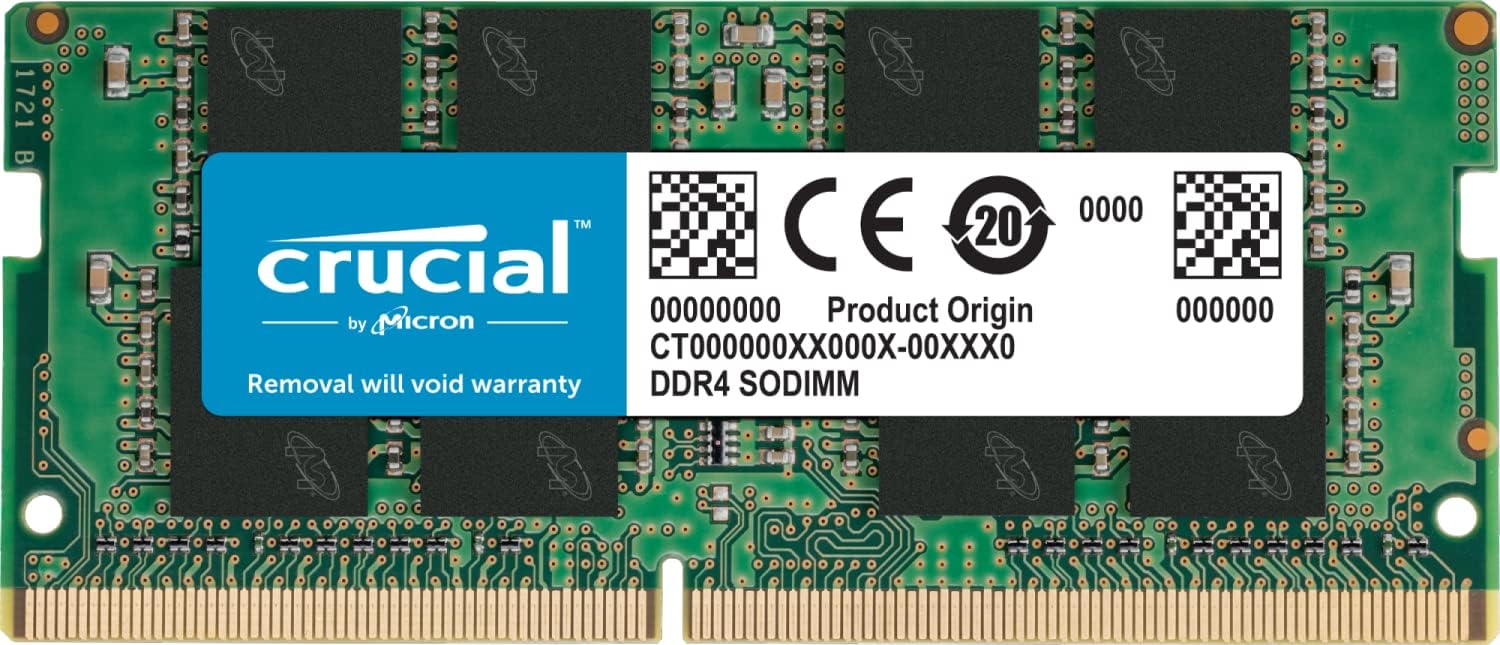
Crucial 16GB DDR4 RAM, 3200MHz CL22 (or 2933MHz or 2666MHz) Laptop Memory, SODIMM 260-Pin, Compatible with 13th Gen Intel Core and AMD Ryzen 7000 - CT16G4SFRA32A
This 16GB DDR4 SODIMM 260-pin module at 3200MHz CL22 is for laptop owners needing a straightforward performance boost for multitasking and application loading.

Corsair Vengeance LPX DDR4 RAM 16GB (2x8GB) 3200MHz CL16-18-18-36 1.35V Intel AMD Desktop Computer Memory - Black (CMK16GX4M2B3200C16)
This 16GB (2x8GB) DDR4 3200MHz CL16 RAM kit offers 1.35V operation and a 34mm low-profile design for most Intel and AMD desktop builds.

Crucial 8GB DDR4 RAM 3200MHz (PC4-25600), Downclockable to 2933/2666MHz Laptop Memory, SODIMM 260-Pin CL22, Compatible with 13th Gen Intel Core and AMD Ryzen 7000 - CT8G4SFRA32A
This 8GB DDR4 3200MHz CL22 SODIMM is a budget-friendly upgrade for laptops needing a performance bump for everyday tasks and light multitasking.