
Kingston Technology Fury Impact 16GB 5600MT/s DDR5 CL40 Laptop Memory Single Module | Lower Power Comsumption | Intel XMP 3.0 | Plug N Play | KF556S40IB-16
Want the best price and purchase timing?
Our AI advisor analyzes real-time pricing across all channels to find you the best deal.
AI Verdict
A 16GB 5600MT/s DDR5 CL40 SODIMM module for laptops needing a low-voltage, automatically overclocking memory upgrade.
This 16GB 5600MT/s DDR5 CL40 module is a strong upgrade for many compatible laptops, offering lower 1.1V power consumption and automatic overclocking. However, its 'situational_fit' comes from the fact that not all laptops will run it at its full 5600MT/s speed, with some systems limiting it to 5200MHz due to CPU or motherboard constraints.
If your system consistently limits memory speed, look for modules explicitly tested and verified for your specific laptop model, or consider a module with a lower base speed that your system is guaranteed to support.
Regret Score™
Low RiskLower is better — measures purchase-regret risk from real buyer complaints, review credibility, and product maturity
Issues discovered after purchase
Critically weak dimension
Amazon rating vs actual quality
Chance this product isn't for you
Pros
- Operates at 1.1 Volts, contributing to lower power consumption and increased thermal efficiency in laptops.
- Features Plug N Play automatic overclocking, allowing the module to adjust to the highest supported speed without manual BIOS configuration.
- Intel XMP 3.0 Certified, enabling users to select optimized performance profiles in compatible BIOS settings for speeds up to 6400MT/s.
- Includes On-Die ECC for improved data integrity and system stability.
- Offers a significant performance uplift compared to older DDR4 modules, enhancing multitasking and application responsiveness.
Cons
- Actual operating speed can be limited by the laptop's CPU or motherboard, potentially running at 5200MHz even if rated for 5600MT/s.
- Initial boot after installation may result in a temporary black screen as the BIOS configures the new memory settings.
- Some specific laptop models, particularly with certain AMD CPUs, have reported compatibility quirks like BSODs or sleep issues, requiring reversion to original modules.
- Achieving the full advertised speed or XMP profiles might necessitate a BIOS update or manual adjustments in some systems.
Dimension Scores
The 5600MT/s speed and CL40 latency are competitive for DDR5 SODIMM, but actual performance can be capped at 5200MHz by some laptop systems.
While broadly compatible with DDR5 laptops, specific reports of instability with certain AMD-based systems and potential speed limitations prevent a higher score.
Features Plug N Play automatic overclocking and Intel XMP 3.0 certification, offering easy performance boosts up to 5600MT/s or higher with XMP profiles.
Includes On-Die ECC for improved data integrity and operates at a low 1.1V for stability, though isolated reports of system instability exist for specific laptop models.
Best For
- Laptop users upgrading from DDR4 to DDR5 for a performance boost in resource-intensive applications.
- Owners of newer laptops with DDR5 support seeking a single 16GB module for increased memory capacity or speed.
- Users who prefer automatic memory configuration without deep BIOS tweaking, leveraging Plug N Play functionality.
Not Recommended For
- Laptops that only support DDR4 memory, as this is a DDR5 module.
- Users with systems known to have strict memory compatibility or limited BIOS options for XMP profiles.
Watch Out For
- Your laptop's CPU or motherboard might cap the speed at 5200MHz, even though the module is rated for 5600MT/s, preventing you from reaching the full advertised speed.
- Expect a longer initial boot time (a 'black screen' period) right after installation as the system's BIOS detects and configures the new memory.
- Specific laptop models, like some Lenovo Legions with AMD CPUs, have shown instability (BSODs, sleep issues) with this RAM, even if Memtest passes.
- You might need to update your laptop's BIOS to ensure proper recognition and optimal speed settings, especially for XMP profiles.
Full Specifications
| RAM | 16 GB DDR5 |
| ASIN | B0BRTJ88B7 |
| Brand | Kingston |
| Color | Black |
| Series | Kingston Technology FURY Impact module de mémoire 16 Go 1 x 16 Go DDR5 5600 MHz |
| Voltage | 1.1 Volts |
| Language | Italian |
| Batteries | 1 AAAA batteries required. |
| Hard Drive | 80 HDD |
| Item Weight | 0.282 ounces |
| Manufacturer | Kingston Technology Company, Inc |
| Memory Speed | 5600 MHz |
| Processor Brand | Intel |
| Card Description | Dedicated |
| Operating System | Windows 11 |
| Flash Memory Size | 8 GB |
| Item model number | KF556S40IB-16 |
| Compatible Devices | Laptop |
| Optical Drive Type | BD-R |
| Product Dimensions | 2.74 x 0.15 x 1.18 inches |
| Computer Memory Size | 16 GB |
| Computer Memory Type | DDR5 SDRAM |
| Hard Drive Interface | ATA-4 |
| RAM Memory Technology | DDR5 |
| Item Dimensions LxWxH | 2.74 x 0.15 x 1.18 inches |
| Number of USB 2.0 Ports | 1 |
| Number of USB 3.0 Ports | 1 |
| Standing screen display size | 75 |
What Buyers Say
Many users upgrading to this Kingston FURY Impact DDR5 module report a noticeable boost in system responsiveness, with programs opening faster and smoother multitasking, especially when coming from DDR4. However, a recurring theme is that while the module is rated for 5600MT/s, some laptops, particularly those with certain AMD CPUs, might only run it at 5200MHz, which can be a bit of a letdown if you're expecting the full speed. There are also mentions of a 'black screen' during the first boot after installation, which is just the BIOS configuring the new RAM, but it can be alarming.
“Man, I dropped this 16GB stick in my gaming laptop, and while it didn't hit the full 5600MHz, it still feels way snappier than my old RAM, but that black screen on first boot almost gave me a heart attack!”
Common Praise
- Programs open faster and video editing is smoother after installation.
- System feels more responsive with improved multitasking capabilities.
- The 1.1V operating voltage helps keep the laptop cooler and more power-efficient.
- Plug N Play functionality often makes installation straightforward without complex BIOS changes.
- Games show clear benefits from the additional and faster RAM.
Common Complaints
- My laptop's CPU limited the RAM speed to 5200MHz, not the advertised 5600MT/s.
- Experienced a 'black screen' for a few minutes on first boot after installing the RAM.
- Had BSODs and sleep issues with my Lenovo Legion, which stopped after I put the original RAM back in.
- Needed to update my BIOS to get the memory recognized correctly or to enable XMP.
Ownership Tips
- The first boot after installing new RAM can take several minutes with a blank screen as the system's BIOS adjusts to the new module.
- Even if your system doesn't hit the full 5600MT/s, the DDR5 architecture still provides a noticeable upgrade over DDR4 in most scenarios.
- Check your laptop manufacturer's support forums for verified compatible memory and any known issues with higher speed DDR5 modules before buying.
- Some systems might run the RAM at a slightly lower speed (e.g., 5200MHz) but with tighter timings (e.g., CL38), which can still offer good performance.
Frequently Asked Questions
Will this 5600MT/s RAM actually run at 5600MT/s in my laptop?
It depends on your laptop's CPU and motherboard. While the module is rated for 5600MT/s, some systems might limit the speed to 5200MHz or lower, even with XMP enabled.
Do I need to change any settings in my BIOS for this memory?
The Plug N Play feature should automatically set the highest supported speed. However, some systems might require a BIOS update or manual selection of an Intel XMP 3.0 profile to achieve optimal performance.
Is this memory compatible with all DDR5 laptops?
It's designed for DDR5 laptops, but specific system compatibility can vary. Some users have reported issues with certain laptop models, particularly those with AMD CPUs, experiencing instability.
What does 'Lower Power Consumption' mean for my laptop?
Operating at 1.1 Volts, this memory consumes less power than some other modules. This can lead to increased battery efficiency and potentially cooler operating temperatures for your laptop.
What is On-Die ECC?
On-Die ECC (Error-Correcting Code) is a feature built directly into the memory chips that helps detect and correct internal data errors, improving the overall stability and reliability of the system.
Buying Guide
When you're looking at laptop memory like this, you need to know that just because the RAM is rated for a certain speed, your laptop might not actually run it that fast. Your CPU and motherboard have their own limitations, so always check what your specific laptop model officially supports. The 'Plug N Play' and 'XMP' features are designed to make it easier to get the best speed, but they aren't magic bullets if your hardware has a hard limit.
DDR5
This is the newest generation of RAM, like upgrading from a regular road to a highway. It's faster and more efficient than DDR4, but your laptop needs to be built to support DDR5, just like your car needs to be able to drive on the highway.
5600MT/s (Speed)
This number, measured in megatransfers per second, tells you how fast the memory can move data. A higher number means quicker data access, which translates to snappier application loading and smoother multitasking, like a faster conveyor belt moving items in a factory.
CL40 (CAS Latency)
CAS Latency is the delay between when the memory controller asks for data and when the data is actually available. A lower CL number is better, meaning less delay. Think of it as how quickly a librarian can find the book you requested – a lower number means they're faster.
1.1 Volts (Voltage)
This is the power required to run the memory. A lower voltage, like 1.1V, means the RAM uses less energy, which can help your laptop's battery last longer and generate less heat, similar to an energy-efficient light bulb.
Alternatives
If this module doesn't fit your needs, search for DDR5 SODIMM memory with a lower MT/s speed if your laptop has known limitations, or a lower CL (CAS Latency) number if you prioritize quicker response times over raw speed, ensuring it's still compatible with your system's voltage requirements.
You Might Also Like

Crucial 32GB DDR4 RAM Kit (2x16GB), 3200MHz (PC4-25600) CL22 Laptop Memory, SODIMM 260-Pin, Downclockable to 2933/2666MHz, Compatible with 13th Gen Intel Core and AMD Ryzen 7000 - CT2K16G4SFRA32A
A 32GB (2x16GB) DDR4 3200MHz CL22 SODIMM kit operating at 1.2V, designed for laptops needing a significant boost in multitasking and system responsiveness.
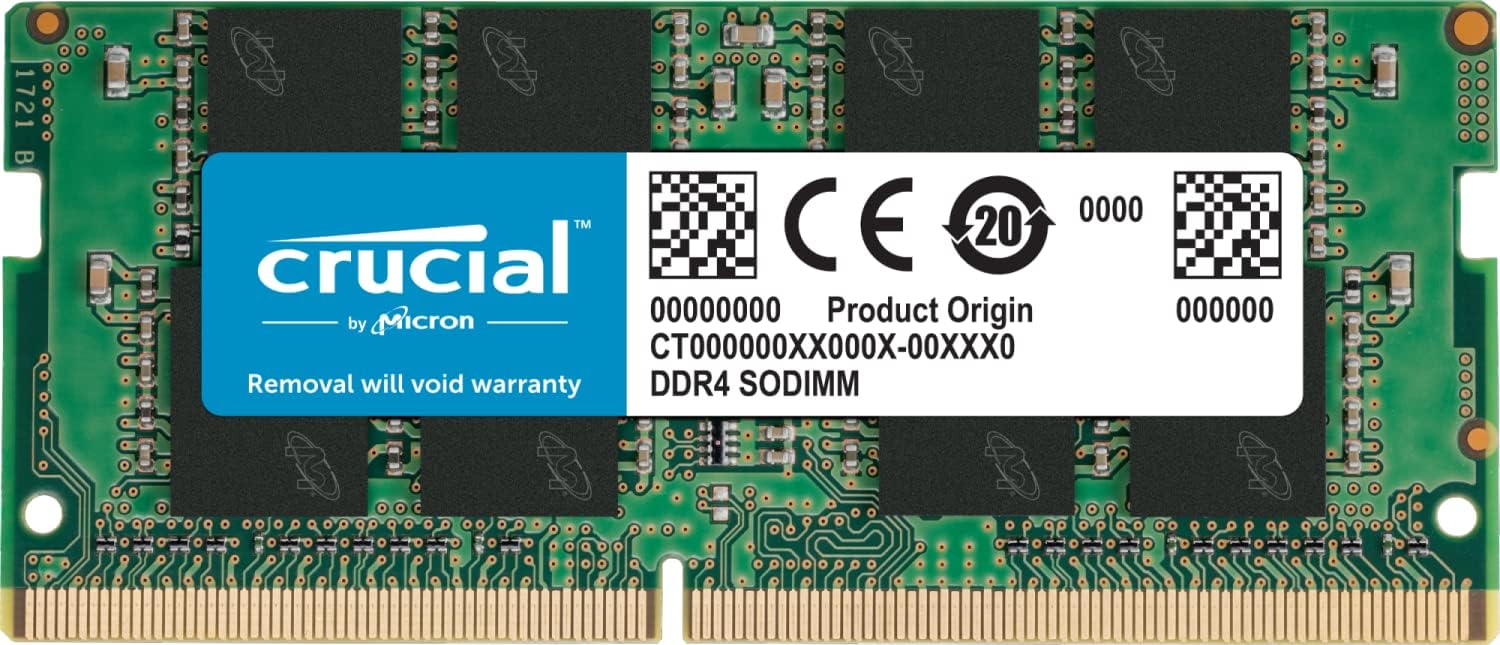
Crucial 16GB DDR4 RAM, 3200MHz CL22 (or 2933MHz or 2666MHz) Laptop Memory, SODIMM 260-Pin, Compatible with 13th Gen Intel Core and AMD Ryzen 7000 - CT16G4SFRA32A
This 16GB DDR4 SODIMM 260-pin module at 3200MHz CL22 is for laptop owners needing a straightforward performance boost for multitasking and application loading.

Corsair Vengeance LPX DDR4 RAM 16GB (2x8GB) 3200MHz CL16-18-18-36 1.35V Intel AMD Desktop Computer Memory - Black (CMK16GX4M2B3200C16)
This 16GB (2x8GB) DDR4 3200MHz CL16 RAM kit offers 1.35V operation and a 34mm low-profile design for most Intel and AMD desktop builds.

Crucial 8GB DDR4 RAM 3200MHz (PC4-25600), Downclockable to 2933/2666MHz Laptop Memory, SODIMM 260-Pin CL22, Compatible with 13th Gen Intel Core and AMD Ryzen 7000 - CT8G4SFRA32A
This 8GB DDR4 3200MHz CL22 SODIMM is a budget-friendly upgrade for laptops needing a performance bump for everyday tasks and light multitasking.