
A-Tech 16GB DDR5 4800MHz PC5-38400 CL40 SODIMM 1.1V Non-ECC Unbuffered SO-DIMM 262-Pin Laptop Computer RAM Memory Upgrade Module
Want the best price and purchase timing?
Our AI advisor analyzes real-time pricing across all channels to find you the best deal.
AI Verdict
This 16GB DDR5 4800MHz CL40 SO-DIMM module provides a standard JEDEC speed upgrade for compatible laptops needing more memory resources.
This 16GB DDR5 4800MHz SO-DIMM is a direct fit for laptops requiring a standard JEDEC DDR5 memory upgrade, offering increased capacity and the baseline speed of the DDR5 generation. Its 1.1V operation aligns with DDR5's power efficiency improvements.
If 4800MHz is not enough, look for DDR5 SO-DIMM modules with higher speeds like 5600MHz, but verify your laptop's CPU and chipset support those frequencies.
Regret Score™
Medium RiskLower is better — measures purchase-regret risk from real buyer complaints, review credibility, and product maturity
Issues discovered after purchase
Critically weak dimension
Amazon rating vs actual quality
Chance this product isn't for you
Pros
- Operates at 4800MHz, delivering 50% faster data transfer than DDR4 at launch.
- Functions at 1.1 Volts, contributing to improved power efficiency compared to DDR4's 1.2V.
- Features on-die ECC (ODECC) at the component level for enhanced long-term stability.
- Designed for quick and easy installation in compatible laptops, notebooks, mini PCs, and AIO computers.
- Backed by a lifetime manufacturer's warranty.
Cons
- Lacks XMP/EXPO profiles for easy performance tuning beyond JEDEC specifications.
- Fixed CL40 latency, which is standard for 4800MHz DDR5 but not the lowest available.
- Single module configuration means no immediate dual-channel benefit without purchasing a second module.
Dimension Scores
The 4800MHz speed is the JEDEC baseline for DDR5, offering a 50% increase in data transfer over DDR4 at launch, with a standard CL40 latency.
Designed for select DDR5 laptops, notebooks, mini PCs, and AIO computers, but requires user verification of specific system support for DDR5 SO-DIMM.
As a standard JEDEC 1.1V module, it lacks XMP/EXPO profiles, and laptop BIOS typically do not allow manual speed or timing adjustments.
Each module is built and tested for performance and reliability, and DDR5 includes on-die ECC for long-term stability.
Best For
- Laptops with 8GB DDR5 RAM experiencing performance bottlenecks in applications like gaming or video editing.
- Users needing a straightforward memory capacity increase for a compatible DDR5 laptop.
- Systems where the existing DDR5 RAM is 4800MHz and a capacity upgrade is the primary goal.
Not Recommended For
- Laptops that do not support DDR5 SO-DIMM memory.
- Users seeking to manually overclock RAM frequencies or timings in their laptop BIOS.
- Systems requiring higher speed DDR5 modules (e.g., 5600MHz or faster) for specific workloads.
Watch Out For
- Laptop BIOS might not allow manual adjustment of RAM speed, potentially limiting the module to a lower frequency if not natively supported.
- Compatibility issues can arise if the laptop's motherboard chipset or CPU does not fully support 4800MHz DDR5.
- Some laptops may downscale RAM speed if higher capacity modules are installed, even if the module itself is rated for 4800MHz.
Full Specifications
| RAM | 16 GB DDR5 |
| ASIN | B0B17GXPWH |
| Brand | A-Tech |
| Color | Multicolor |
| Voltage | 1.1 Volts |
| Item Weight | 0.45 ounces |
| Manufacturer | A-Tech |
| Memory Speed | 4800 MHz |
| Item model number | AT16G1D5S4800NA0N11V |
| Compatible Devices | Laptop |
| Product Dimensions | 2.74 x 1.18 x 0.15 inches |
| Computer Memory Size | 16 GB |
| Computer Memory Type | DDR5 SDRAM |
| RAM Memory Technology | DDR5 |
| Item Dimensions LxWxH | 2.74 x 1.18 x 0.15 inches |
What Buyers Say
Users considering this A-Tech 16GB DDR5 4800MHz module are often looking to address performance issues in laptops with insufficient RAM, particularly for gaming. Many reports indicate that upgrading from 8GB to 16GB or 32GB DDR5 significantly reduces application crashes and lag. The installation process is frequently described as straightforward, making it accessible for those new to hardware upgrades. While specific complaints about this exact module are not prevalent, the general discussion around laptop RAM upgrades highlights the importance of checking system compatibility and BIOS limitations on memory speed.
“My laptop was choking on 8GB, especially with games. Popped this in, and now everything feels way smoother, no more random crashes. Wish I did it sooner!”
Common Praise
- Laptop performance noticeably improves after upgrading from lower capacity RAM.
- Installation is simple and does not require specialized knowledge.
- Module operates at the advertised 4800MHz speed in compatible systems.
- System stability is maintained after the memory upgrade.
Common Complaints
- Some users are unsure if their laptop BIOS supports XMP/EXPO for higher speeds.
- Concern about whether the laptop will actually run the RAM at its rated speed or downscale it.
- Difficulty determining exact laptop compatibility without opening the device or consulting specific documentation.
Ownership Tips
- Verify your laptop's existing RAM type and speed before purchase to ensure compatibility.
- Check if your laptop has an accessible SO-DIMM slot for upgrade, as some models have soldered RAM.
- After installation, confirm the new RAM is recognized and running at the correct speed in your system's BIOS or operating system.
- Consider purchasing two modules for dual-channel performance if your laptop supports it and has two slots.
Frequently Asked Questions
Will this RAM work in my DDR4 laptop?
No, this is a DDR5 module and is not backward compatible with DDR4 slots. You need to ensure your laptop specifically supports DDR5 SO-DIMM memory.
Is this a single stick or a kit?
This product is a single 16GB RAM module. If you need dual-channel memory, you would need to purchase two modules.
Do I need any special tools to install this RAM?
Installation is generally quick and easy, often requiring only a small Phillips head screwdriver to open your laptop's back panel. No expertise is required.
Will this RAM improve my gaming performance?
Increasing RAM from 8GB to 16GB or more can reduce lag and crashes in memory-intensive games. However, the GPU and CPU also significantly impact gaming performance.
What does 'Non-ECC Unbuffered' mean?
Non-ECC means it does not have Error-Correcting Code, which is typical for consumer-grade laptop RAM. Unbuffered means data goes directly to the memory controller, which is standard for SO-DIMM.
Buying Guide
When buying laptop RAM, you're essentially giving your computer more workspace to run programs simultaneously without slowing down. It's not about making individual programs run faster, but about handling more tasks at once. You need to match the RAM type (DDR5), form factor (SO-DIMM), and ensure your laptop's CPU and motherboard support the speed (4800MHz) for optimal results. Don't just assume it'll work; check your laptop's specs.
Capacity (16GB)
This is how much data your computer can actively work with. Think of it like the size of your desk; more capacity means you can have more applications open and switch between them without your computer needing to constantly put things away and pull them back out from slower storage.
Type (DDR5)
This refers to the generation of memory technology. DDR5 is newer and faster than DDR4, but it's not interchangeable. Your laptop must be designed for DDR5 memory; it won't fit or work in a DDR4 slot.
Speed (4800MHz)
This indicates how quickly the RAM can transfer data. Higher speeds generally mean faster processing, but your laptop's CPU and motherboard have a maximum speed they can utilize. Installing faster RAM than your system supports won't necessarily make it run faster.
Voltage (1.1V)
This is the power required to operate the memory. DDR5 typically runs at a lower voltage (1.1V) than DDR4 (1.2V), which contributes to better power efficiency and less heat generation in your laptop.
Alternatives
If this module doesn't fit your needs, search for DDR5 SO-DIMM with higher capacities like 32GB or 64GB, or faster speeds such as 5600MHz or 6000MHz, always verifying compatibility with your specific laptop model.
You Might Also Like

Crucial 32GB DDR4 RAM Kit (2x16GB), 3200MHz (PC4-25600) CL22 Laptop Memory, SODIMM 260-Pin, Downclockable to 2933/2666MHz, Compatible with 13th Gen Intel Core and AMD Ryzen 7000 - CT2K16G4SFRA32A
A 32GB (2x16GB) DDR4 3200MHz CL22 SODIMM kit operating at 1.2V, designed for laptops needing a significant boost in multitasking and system responsiveness.
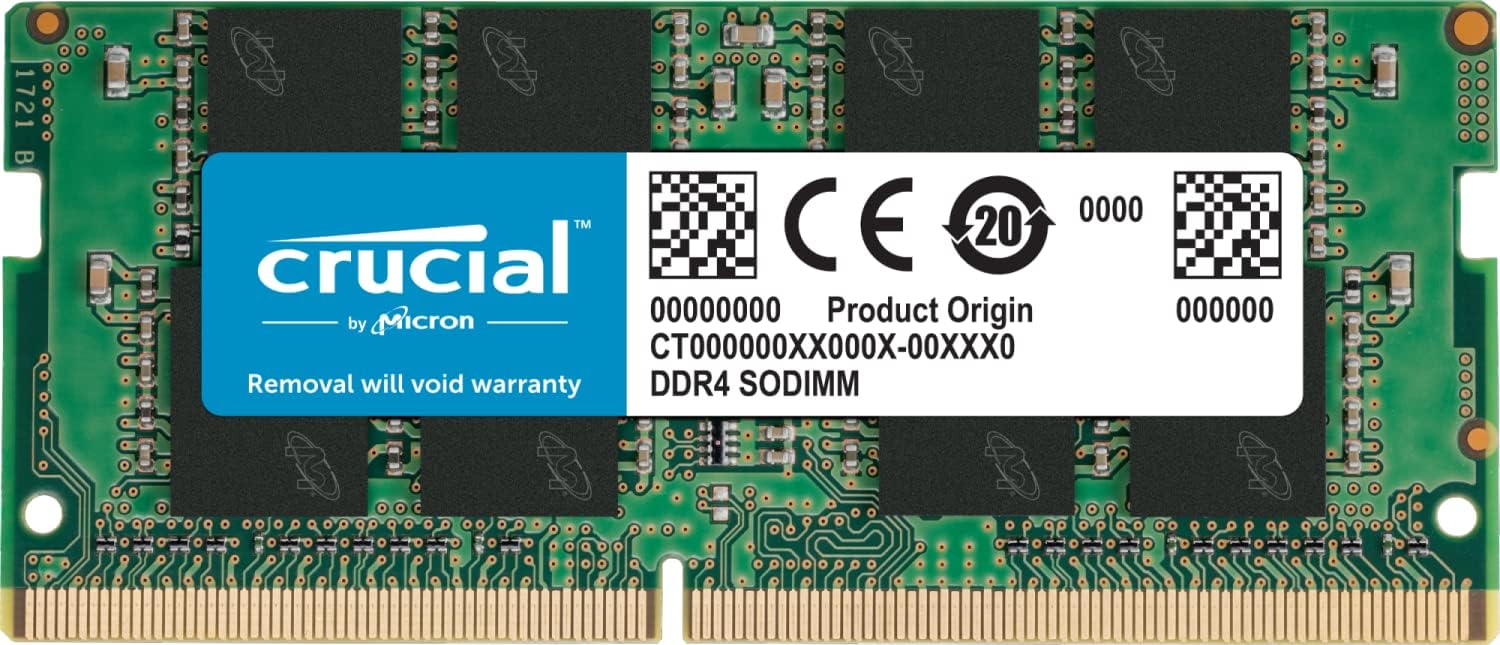
Crucial 16GB DDR4 RAM, 3200MHz CL22 (or 2933MHz or 2666MHz) Laptop Memory, SODIMM 260-Pin, Compatible with 13th Gen Intel Core and AMD Ryzen 7000 - CT16G4SFRA32A
This 16GB DDR4 SODIMM 260-pin module at 3200MHz CL22 is for laptop owners needing a straightforward performance boost for multitasking and application loading.

Corsair Vengeance LPX DDR4 RAM 16GB (2x8GB) 3200MHz CL16-18-18-36 1.35V Intel AMD Desktop Computer Memory - Black (CMK16GX4M2B3200C16)
This 16GB (2x8GB) DDR4 3200MHz CL16 RAM kit offers 1.35V operation and a 34mm low-profile design for most Intel and AMD desktop builds.

Crucial 8GB DDR4 RAM 3200MHz (PC4-25600), Downclockable to 2933/2666MHz Laptop Memory, SODIMM 260-Pin CL22, Compatible with 13th Gen Intel Core and AMD Ryzen 7000 - CT8G4SFRA32A
This 8GB DDR4 3200MHz CL22 SODIMM is a budget-friendly upgrade for laptops needing a performance bump for everyday tasks and light multitasking.