
Kingston FURY Beast 16GB 5200MHz DDR5 CL40 Desktop Memory Single Module KF552C40BB-16
Want the best price and purchase timing?
Our AI advisor analyzes real-time pricing across all channels to find you the best deal.
AI Verdict
This 16GB 5200MT/s CL40 DDR5 module is for desktop builders prioritizing a low-profile heat spreader and Intel XMP 3.0 compatibility over cutting-edge speed or tight timings.
This 16GB 5200MT/s CL40 DDR5 module is a situational fit because its 5200MT/s speed and CL40 latency are entry-level for DDR5, making it suitable for basic builds or those with strict budget constraints. The low-profile heat spreader is a specific advantage for systems with limited clearance, but its performance won't impress users seeking top-tier speed or aggressive overclocking.
If this module doesn't cut it, look for DDR5 modules with speeds of 6000MT/s or higher and a CAS Latency (CL) of 30 or lower for a noticeable performance boost.
Regret Score™
High RiskLower is better — measures purchase-regret risk from real buyer complaints, review credibility, and product maturity
Issues discovered after purchase
Critically weak dimension
Amazon rating vs actual quality
Chance this product isn't for you
Pros
- Features a low-profile heat spreader design, which helps with clearance in compact builds or with large CPU coolers.
- Supports Intel XMP 3.0 profiles, allowing for easier configuration to its advertised 5200MT/s speed.
- Includes on-die ECC for improved stability, a feature of DDR5 memory.
- Qualified by leading motherboard manufacturers, suggesting broad compatibility.
- Operates at 1.25 Volts, which is standard for DDR5 at this speed.
- Uses Micron's MT60B2G8HB-48B (D8BNJ) integrated circuits.
Cons
- The CL40 latency is considered high compared to other DDR5 modules available, potentially impacting performance in latency-sensitive applications.
- Users have reported struggles achieving advertised speeds even with XMP enabled, sometimes settling for lower performance.
- Some users experienced system instability when attempting to run the memory at its advertised speeds.
- Manual overclocking headroom is limited; achieving timings lower than 36-37-37-78 at 1.4V often results in instability.
- Performance is not exceptional, with reviews noting it doesn't 'shine in any category' compared to faster or lower-latency alternatives.
Dimension Scores
The 5200MT/s speed is entry-level for DDR5, and the CL40 latency is on the higher side compared to many available DDR5 modules, placing it at category average for basic functionality but not performance.
As a DDR5 module, it's compatible with modern DDR5-enabled desktop motherboards and supports Intel XMP 3.0, though some users report specific motherboard compatibility issues.
While it supports XMP 3.0, manual overclocking beyond its rated speed or tightening timings significantly often results in instability, limiting its appeal for enthusiasts.
Kingston is a reputable brand, and the module includes on-die ECC for stability, but user reports of instability at advertised speeds and occasional quality control issues prevent a higher score.
Best For
- Desktop systems where CPU cooler clearance is a concern due to the low-profile heat spreader.
- New DDR5 builds where a single 16GB module is sufficient for initial needs.
- Users who prefer a 'set it and forget it' approach with Intel XMP 3.0 profiles.
- Budget-conscious builders needing a basic DDR5 module for general computing.
Not Recommended For
- Enthusiasts seeking the absolute lowest latency or highest speeds for competitive gaming or benchmarks.
- Overclockers expecting significant manual tuning potential beyond basic XMP profiles.
- Users requiring guaranteed stability at advertised speeds without any troubleshooting.
- Anyone needing more than 16GB of RAM in a single stick for demanding professional workloads.
Watch Out For
- The CL40 latency is a frequent point of contention, with users noting it's higher than many competing DDR5 modules, potentially affecting responsiveness.
- Some users report difficulty getting the module to run stably at its advertised 5200MT/s speed, even with XMP enabled, leading to crashes.
- Overclocking potential is limited; attempts to tighten timings beyond 36-37-37-78 at 1.4V often lead to system instability.
- There have been reports of quality control issues, including defective modules or incorrect DDR4 labeling, though these seem less common for this specific SKU.
Full Specifications
| RAM | 16 GB DDR5 |
| ASIN | B09KCM59ZK |
| Brand | Kingston |
| Color | Black |
| Series | Kingston FURY Beast DDR5 |
| Voltage | 1.25 Volts |
| Language | English, English, English, English, English |
| Batteries | 1 AAAA batteries required. |
| Item Weight | 1.38 ounces |
| Manufacturer | Kingston Technology Company, Inc. |
| Memory Speed | 5200 MT/s |
| Operating System | Intel XMP |
| Item model number | KF552C40BB-16 |
| Compatible Devices | Desktop |
| Product Dimensions | 5.25 x 0.26 x 1.37 inches |
| Computer Memory Size | 16 GB |
| Computer Memory Type | DDR5 SDRAM |
| RAM Memory Technology | DDR5 |
| Item Dimensions LxWxH | 5.25 x 0.26 x 1.37 inches |
What Buyers Say
Many users find this Kingston FURY Beast module to be a straightforward DDR5 option, but its CL40 latency is a recurring point of concern, with some wishing for tighter timings. While it generally works as expected when XMP is enabled, a segment of users reports struggles with stability at the advertised 5200MT/s speed, leading to system crashes. The low-profile heat spreader is a practical advantage for builds with limited space, but the overall performance isn't considered groundbreaking compared to other DDR5 options.
“Man, I just needed some DDR5 that would fit under my giant CPU cooler without breaking the bank, and this does that, but I wish it was a little snappier, CL40 feels kinda slow sometimes.”
Common Praise
- Plugs in and works as expected after enabling XMP in the BIOS.
- The low-profile heat spreader design helps with clearance around large CPU coolers.
- Black PCB and aluminum heat spreader offer a clean, understated aesthetic.
- Faster than stock DDR5-4800 modules.
Common Complaints
- The CL40 latency is perceived as high, with users noting better-performing alternatives at similar price points.
- Some users experience system instability or crashes when trying to run at the advertised 5200MT/s speed, even with XMP enabled.
- Limited manual overclocking potential; attempts to push timings further often lead to instability.
- Performance is not considered exceptional or 'wow-worthy' compared to other DDR5 options.
- Reports of compatibility issues with specific motherboards, despite being listed as compatible.
Ownership Tips
- After a few weeks, some users notice that while it runs, the system doesn't feel as 'snappy' as expected due to the CL40 latency.
- The low-profile design proves genuinely useful for builds where larger RAM sticks would interfere with air coolers.
- Enabling XMP is often necessary to hit the advertised 5200MT/s, and some users find they need to manually adjust settings to ensure stability.
- The heat spreader, while low-profile, doesn't seem to have any thermal issues even under sustained load.
Frequently Asked Questions
Is this RAM compatible with my motherboard?
This is a DDR5 desktop memory module, so it's compatible with motherboards that support DDR5 RAM. Always check your motherboard's QVL (Qualified Vendor List) for specific compatibility with this Kingston FURY Beast module to avoid issues.
What does CL40 mean for performance?
CL40 refers to the CAS Latency, which is the delay between when the memory controller requests data and when the data is available. A lower CL number generally means faster response times, so CL40 is considered a higher latency for DDR5 memory.
Can I overclock this memory?
The module supports Intel XMP 3.0 for easy setup to its advertised 5200MT/s speed. While some manual overclocking is possible, users report limited headroom, with attempts to significantly tighten timings often leading to instability.
Does this come as a single stick or a kit?
This specific product (KF552C40BB-16) is a single 16GB module. If you need 32GB, you would need to purchase two of these or a 32GB kit.
Is the heat spreader removable?
The heat spreader is designed to dissipate heat and is generally not intended to be removed. Attempting to remove it could damage the module and void your warranty.
Buying Guide
When you're looking at RAM, especially DDR5, you're basically balancing speed (MT/s) and how quickly it can access data (latency, or CL). Higher MT/s numbers look better, but a high CL can negate some of that speed. Think of it like a highway: a higher speed limit (MT/s) is great, but if there's a long toll booth delay (CL) every time you get on, your actual travel time might not be as fast as you'd hope. For gaming and general use, a good balance is key. Also, make sure your motherboard actually supports the DDR5 standard, as older boards only take DDR4.
Capacity (16GB)
This is how much temporary workspace your computer has. For most modern gaming and general use, 16GB is a good starting point, allowing you to run multiple applications and games without constantly swapping data to slower storage. Think of it as the size of your desk; a bigger desk lets you have more things open at once.
Speed (5200 MT/s)
This indicates how many million transfers per second the memory can perform. Higher numbers mean faster data transfer, which can translate to quicker loading times and smoother performance in applications that demand a lot from your memory. It's like the speed limit on that highway – faster is generally better, but only if the latency isn't holding it back.
CAS Latency (CL40)
This is the delay, measured in clock cycles, between when the CPU asks for data from the RAM and when the RAM actually delivers it. A lower CL number means less delay and quicker access to data. For DDR5, CL40 is on the higher side, meaning there's a slightly longer wait for data compared to modules with CL30 or CL36. It's that toll booth delay – you want it as short as possible.
Voltage (1.25 Volts)
This is the electrical power required to operate the memory. DDR5 generally operates at lower voltages than DDR4, which can contribute to less heat generation and better power efficiency. 1.25V is standard for DDR5 at this speed.
Alternatives
If this module doesn't meet your performance expectations, search for DDR5 memory with a speed of 6000MT/s or higher and a CAS Latency (CL) of 30 or 32 for a more responsive system, especially in gaming or demanding applications.
You Might Also Like

Crucial 32GB DDR4 RAM Kit (2x16GB), 3200MHz (PC4-25600) CL22 Laptop Memory, SODIMM 260-Pin, Downclockable to 2933/2666MHz, Compatible with 13th Gen Intel Core and AMD Ryzen 7000 - CT2K16G4SFRA32A
A 32GB (2x16GB) DDR4 3200MHz CL22 SODIMM kit operating at 1.2V, designed for laptops needing a significant boost in multitasking and system responsiveness.
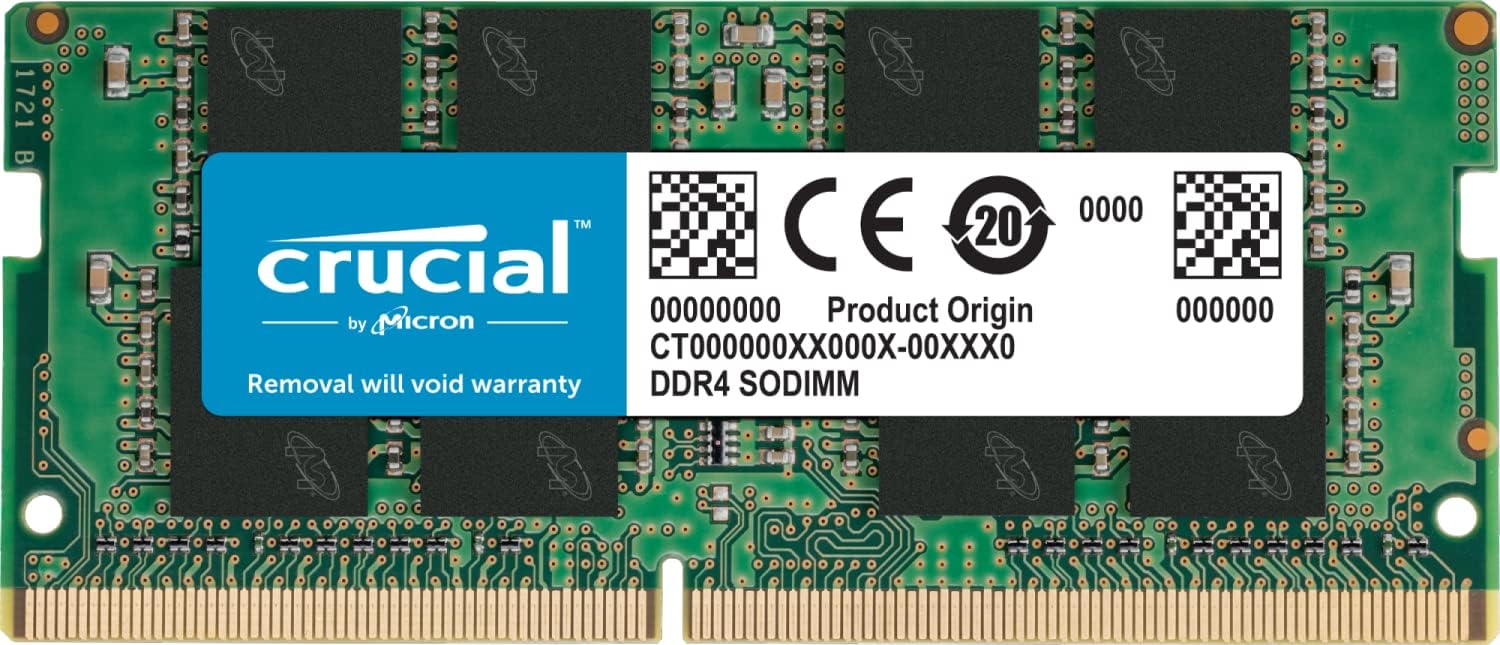
Crucial 16GB DDR4 RAM, 3200MHz CL22 (or 2933MHz or 2666MHz) Laptop Memory, SODIMM 260-Pin, Compatible with 13th Gen Intel Core and AMD Ryzen 7000 - CT16G4SFRA32A
This 16GB DDR4 SODIMM 260-pin module at 3200MHz CL22 is for laptop owners needing a straightforward performance boost for multitasking and application loading.

Corsair Vengeance LPX DDR4 RAM 16GB (2x8GB) 3200MHz CL16-18-18-36 1.35V Intel AMD Desktop Computer Memory - Black (CMK16GX4M2B3200C16)
This 16GB (2x8GB) DDR4 3200MHz CL16 RAM kit offers 1.35V operation and a 34mm low-profile design for most Intel and AMD desktop builds.

Crucial 8GB DDR4 RAM 3200MHz (PC4-25600), Downclockable to 2933/2666MHz Laptop Memory, SODIMM 260-Pin CL22, Compatible with 13th Gen Intel Core and AMD Ryzen 7000 - CT8G4SFRA32A
This 8GB DDR4 3200MHz CL22 SODIMM is a budget-friendly upgrade for laptops needing a performance bump for everyday tasks and light multitasking.