
A-Tech 4GB DDR4 2400 MHz UDIMM PC4-19200 (PC4-2400T) CL17 DIMM Non-ECC Desktop RAM Memory Module
Want the best price and purchase timing?
Our AI advisor analyzes real-time pricing across all channels to find you the best deal.
AI Verdict
This is a 4GB DDR4 2400 MHz CL17 UDIMM, suitable for basic desktop upgrades or replacing a failed module in an older system.
This 4GB 2400 MHz DDR4 module is a situational fit because its specifications are entry-level for DDR4. It works for very basic computing needs or as a direct replacement, but its capacity and speed will bottleneck modern systems.
If you need more performance, look for DDR4 modules with at least 8GB capacity and speeds of 3200 MHz or higher, ideally in a dual-channel kit.
Regret Score™
High RiskLower is better — measures purchase-regret risk from real buyer complaints, review credibility, and product maturity
Issues discovered after purchase
Critically weak dimension
Amazon rating vs actual quality
Chance this product isn't for you
Pros
- Compatible with a wide range of select DDR4 desktop computers and workstations.
- Features a standard 1.2V operating voltage, adhering to JEDEC DDR4 specifications.
- Backed by A-Tech's Lifetime Warranty, providing long-term support.
- Non-ECC Unbuffered design is standard for most consumer desktop motherboards.
Cons
- 4GB capacity is restrictive for modern operating systems and applications, especially for multitasking.
- 2400 MHz speed is on the lower end for DDR4, potentially limiting system performance compared to faster modules.
- CL17 latency, while typical for 2400 MHz, isn't optimized for performance-critical tasks.
- Single module configuration means no dual-channel performance benefits without purchasing a second module.
Dimension Scores
At 2400 MHz CL17, this module is on the lower end of DDR4 speeds and latencies available in the market today.
This module adheres to JEDEC DDR4 standards and is listed as compatible with a broad range of desktop and workstation brands.
As a standard JEDEC 1.2V module without XMP profiles, it offers virtually no overclocking potential.
A-Tech backs this module with a lifetime warranty, suggesting confidence in its long-term reliability.
Best For
- Upgrading an older desktop with a single 4GB stick of 2400 MHz DDR4 RAM.
- Replacing a failed 4GB 2400 MHz DDR4 module in a compatible system.
- Adding a small amount of RAM to a system used for light web browsing and document editing.
- Budget-constrained builds where only minimal RAM is required.
Not Recommended For
- Gaming PCs or systems running demanding applications that require 16GB or more RAM.
- Users seeking high-performance memory for overclocking or competitive gaming.
- New PC builds aiming for optimal performance with modern CPUs and motherboards.
Watch Out For
- Systems with only one RAM slot will be limited to 4GB total, which can cause slowdowns with multiple browser tabs or applications open.
- Mixing this 2400 MHz module with faster RAM can force all modules to run at 2400 MHz, negating the speed benefit of the faster sticks.
- Some users might experience compatibility issues if their motherboard or CPU memory controller is particularly finicky, though the module adheres to JEDEC standards.
Full Specifications
| RAM | 4 GB DDR4 |
| ASIN | B07KGKZL8P |
| Brand | A-Tech |
| Color | 1 Pack (1x) |
| Voltage | 1.2 Volts |
| Item Weight | 0.634 ounces |
| Manufacturer | A-Tech Components |
| Memory Speed | 2400 MHz |
| Item model number | AT4G1D4D2400NA0N12V |
| Compatible Devices | Desktop, Workstation |
| Product Dimensions | 5.25 x 1.23 x 0.15 inches |
| Computer Memory Size | 4 GB |
| Computer Memory Type | DDR4 SDRAM |
| RAM Memory Technology | DDR4 |
| Item Dimensions LxWxH | 5.25 x 1.23 x 0.15 inches |
| Is Discontinued By Manufacturer | No |
What Buyers Say
While direct complaints for this specific A-Tech module are hard to pinpoint, the general sentiment around 4GB 2400MHz DDR4 is that it's a bare minimum for today's computing. Users often find themselves needing more capacity and faster speeds for anything beyond basic tasks. The module's adherence to standard specifications and a lifetime warranty are frequently mentioned positives for those who do purchase it.
“I bought this to replace a dead stick in my old Dell, and it just worked, no fuss. But man, 4GB is barely enough to open Chrome these days, I should've just bought an 8GB.”
Common Praise
- Works as a direct replacement for existing 2400 MHz DDR4 modules.
- Easy to install in compatible desktop systems.
- Lifetime warranty provides peace of mind.
- Functions without issues for basic computing needs.
Common Complaints
- 4GB capacity is quickly outgrown by modern software and operating systems.
- 2400 MHz speed can be a bottleneck for systems with faster CPUs.
- No specific performance-enhancing features like XMP profiles.
- Not suitable for high-performance gaming or intensive multitasking.
Ownership Tips
- The 4GB capacity fills up quickly, even with just a few browser tabs and a basic application open.
- System performance feels noticeably snappier if upgrading from 2GB or a failing module, but not if adding to an already decent amount of RAM.
- No heat spreader, but at 1.2V and 2400 MHz, it doesn't generate much heat anyway.
- It's a 'set it and forget it' kind of component, assuming it's compatible and meets your minimal needs.
Frequently Asked Questions
Is this RAM compatible with my laptop?
No, this is a UDIMM (Unbuffered DIMM) module designed for desktop computers and workstations, not laptops. Laptops typically use SODIMM (Small Outline DIMM) memory.
Can I use this with my existing 8GB 3200 MHz RAM?
You can, but it's not recommended. All your RAM will likely run at the slowest speed and highest latency of the installed modules, which would be 2400 MHz CL17 in this case, reducing the performance of your faster 8GB stick.
What does 'Non-ECC Unbuffered' mean?
'Non-ECC' means it does not have Error-Correcting Code, which is standard for consumer-grade desktop memory. 'Unbuffered' means it communicates directly with the memory controller, also typical for desktops, unlike 'Registered' or 'Buffered' memory used in servers.
Will this improve my gaming performance?
If your current system has less than 4GB of RAM, adding this module might offer a slight improvement by preventing memory bottlenecks. However, for modern gaming, 4GB is generally insufficient, and faster, higher-capacity RAM (like 16GB or 32GB at 3200MHz+) is usually needed for a noticeable impact.
Is 2400 MHz fast enough for a new PC build?
For a new PC build in 2024, 2400 MHz DDR4 is considered slow. Most modern CPUs benefit significantly from DDR4 RAM running at 3200 MHz or 3600 MHz for optimal performance, especially in gaming and productivity tasks.
Buying Guide
When you're looking at RAM, you're essentially buying temporary storage for your computer's brain (the CPU). More RAM means your computer can juggle more tasks and data at once without slowing down. The speed (MHz) and latency (CL) affect how quickly that data can be accessed. For most people, getting enough capacity is more important than chasing the absolute fastest speeds, but a balance is key.
Capacity (4GB)
This is how much data the RAM can hold. Think of it like your desk space; a 4GB desk is tiny, you can only have a few papers out at once. For today's computers, 8GB is a small desk, 16GB is a comfortable desk, and 32GB is a huge desk.
Speed (2400 MHz)
This is how fast the RAM can transfer data to and from the CPU. Imagine how quickly you can grab papers from your desk. 2400 MHz is like moving at a casual walk; faster speeds (like 3200 MHz or 3600 MHz) are like jogging or sprinting, getting data to your CPU quicker.
Latency (CL17)
This is the delay before the RAM starts responding to a request. It's like the time it takes you to react after someone asks for a paper on your desk. Lower CL numbers are better, meaning less delay. CL17 for 2400 MHz is pretty standard.
Alternatives
If this 4GB 2400 MHz module isn't enough, you should look for DDR4 RAM with at least 8GB or 16GB capacity, and speeds of 3200 MHz or 3600 MHz, ideally sold as a matched pair for dual-channel performance.
You Might Also Like

Crucial 32GB DDR4 RAM Kit (2x16GB), 3200MHz (PC4-25600) CL22 Laptop Memory, SODIMM 260-Pin, Downclockable to 2933/2666MHz, Compatible with 13th Gen Intel Core and AMD Ryzen 7000 - CT2K16G4SFRA32A
A 32GB (2x16GB) DDR4 3200MHz CL22 SODIMM kit operating at 1.2V, designed for laptops needing a significant boost in multitasking and system responsiveness.
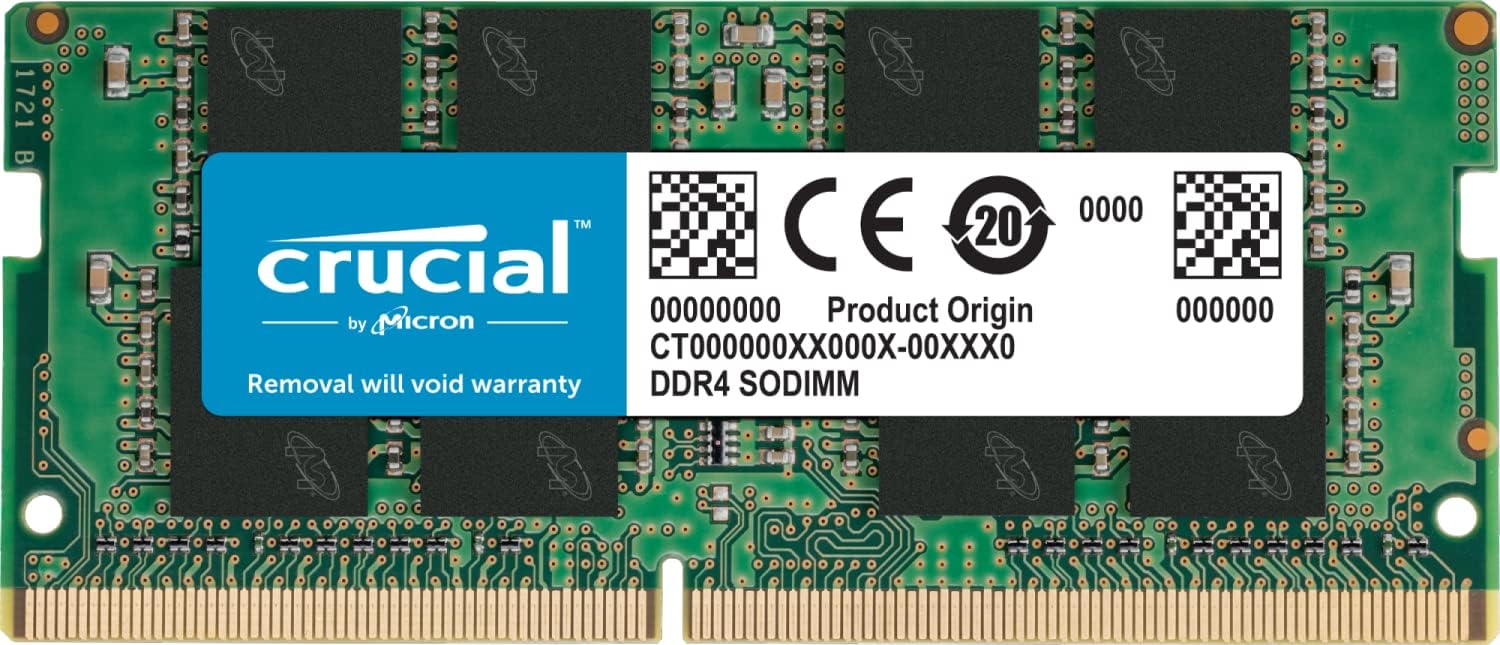
Crucial 16GB DDR4 RAM, 3200MHz CL22 (or 2933MHz or 2666MHz) Laptop Memory, SODIMM 260-Pin, Compatible with 13th Gen Intel Core and AMD Ryzen 7000 - CT16G4SFRA32A
This 16GB DDR4 SODIMM 260-pin module at 3200MHz CL22 is for laptop owners needing a straightforward performance boost for multitasking and application loading.

Corsair Vengeance LPX DDR4 RAM 16GB (2x8GB) 3200MHz CL16-18-18-36 1.35V Intel AMD Desktop Computer Memory - Black (CMK16GX4M2B3200C16)
This 16GB (2x8GB) DDR4 3200MHz CL16 RAM kit offers 1.35V operation and a 34mm low-profile design for most Intel and AMD desktop builds.

Crucial 8GB DDR4 RAM 3200MHz (PC4-25600), Downclockable to 2933/2666MHz Laptop Memory, SODIMM 260-Pin CL22, Compatible with 13th Gen Intel Core and AMD Ryzen 7000 - CT8G4SFRA32A
This 8GB DDR4 3200MHz CL22 SODIMM is a budget-friendly upgrade for laptops needing a performance bump for everyday tasks and light multitasking.