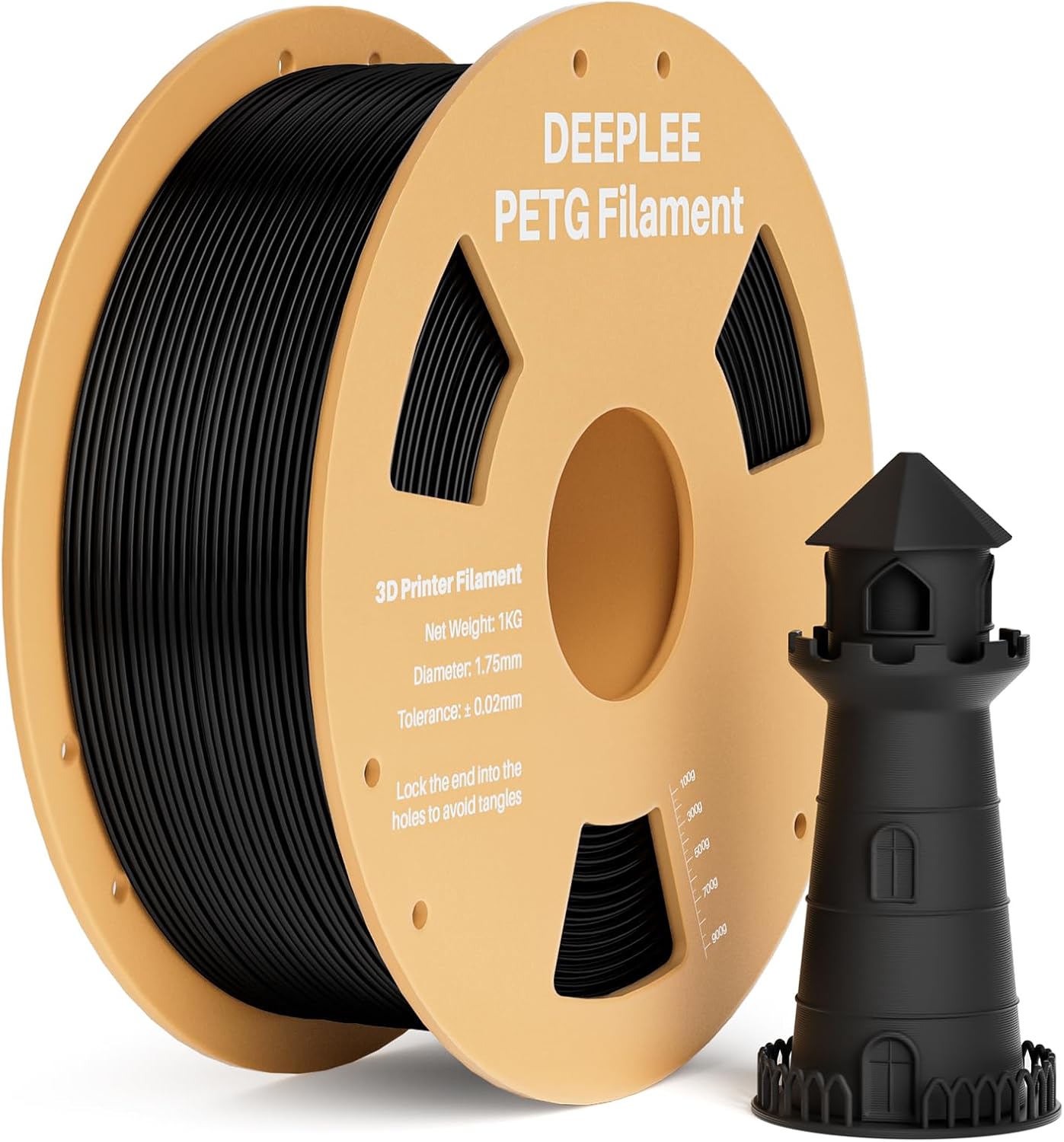
DEEPLEE PETG 3D Printer Filament 1.75mm 1KG, Dimensional Accuracy +/- 0.02 mm, High Toughness & Impact Resistance PETG Filament Fits FDM 3D Printers, Black
Want the best price and purchase timing?
Our AI advisor analyzes real-time pricing across all channels to find you the best deal.
AI Verdict
This is a 1.75mm black PETG filament with a ±0.02mm dimensional accuracy, designed for FDM printers needing high toughness and impact resistance.
This Deeplee PETG filament is a situational fit for users needing a material with high toughness and impact resistance, offering a precise 1.75mm diameter and minimal warpage for FDM printers. Its suitability depends on the user's willingness to fine-tune PETG settings and the specific mechanical requirements of their prints.
If you need even higher temperature resistance or UV stability for outdoor parts, look for ASA filament, which offers superior performance in those areas.
Regret Score™
Medium RiskLower is better — measures purchase-regret risk from real buyer complaints, review credibility, and product maturity
Issues discovered after purchase
Critically weak dimension
Amazon rating vs actual quality
Chance this product isn't for you
Pros
- Offers high toughness and impact resistance for durable prints.
- Maintains a consistent 1.75mm diameter with a tight ±0.02mm dimensional accuracy, promoting smooth feeding.
- Engineered for minimal warpage and shrinkage, which helps with stable printing.
- Features excellent interlayer adhesion for strong model structures and precise details.
- Comes neatly wound to reduce tangles and snap issues during printing.
- Compatible with common 1.75mm FDM 3D printers, including Neptune, Ender, and Kobra series.
Cons
- Specific user feedback for this exact ASIN (B0DS4BB39T) is limited due to its recent availability, making long-term performance difficult to assess.
- PETG can be more prone to stringing than PLA if printer settings aren't dialed in correctly.
- Requires higher printing temperatures than PLA, which might be a consideration for some entry-level printers.
- The product data incorrectly lists the material as Polylactic Acid, which could cause confusion for buyers.
Dimension Scores
The filament boasts a tight ±0.02mm dimensional accuracy and claims minimal warpage and excellent interlayer adhesion, which are key indicators of print quality.
While Deeplee claims smooth feeding and minimal tangles, PETG generally requires more careful temperature and retraction tuning than PLA for optimal results, placing it at an average ease of use for the material type.
PETG is more versatile than PLA due to its higher toughness, impact resistance, and chemical stability, suitable for a wider range of functional applications.
The filament is highlighted for its high toughness, impact resistance, and chemical stability, contributing to the durability of printed parts.
Best For
- Printing functional parts that require high impact resistance and toughness.
- Outdoor or chemically exposed applications due to its waterproof, weather-resistant, and chemically stable properties.
- Users who need precise dimensional accuracy for interlocking components or detailed models.
- FDM 3D printer owners using 1.75mm filament on compatible machines like Neptune, Ender, or Kobra series.
Not Recommended For
- Beginners looking for the easiest-to-print filament, as PETG can require more tuning than PLA.
- Applications where extreme heat resistance (beyond PETG's moderate tolerance) is critical.
- Users prioritizing the lowest possible cost, as PETG is generally priced higher than standard PLA.
Watch Out For
- Specific user complaints for ASIN B0DS4BB39T are not widely available, so potential issues like inconsistent diameter or winding problems (despite claims) cannot be confirmed from user reports.
- While advertised as having minimal warpage, PETG can still be sensitive to cooling and bed adhesion, potentially leading to lifting on large prints if settings aren't optimized.
- The 'material: Polylactic Acid' listed in the product data is incorrect; the filament is PETG, which could lead to incorrect printer settings if users rely solely on the erroneous data.
Full Specifications
| ASIN | B0DS4BB39T |
| Size | PETG |
| Brand | Deeplee |
| Color | 1*black |
| Material | Polylactic Acid |
| Item Weight | 2.2 pounds |
| Manufacturer | DEEPLEE |
| Item Diameter | 1.75 Millimeters |
| Material Type | Polylactic Acid |
| Number of Items | 1 |
| Item model number | US-SO-DP-PG001 |
| Product Dimensions | 8.27 x 8.27 x 2.76 inches |
| Manufacturer Part Number | US-SO-DP-PG001 |
What Buyers Say
Specific user feedback for this particular Deeplee PETG filament (ASIN B0DS4BB39T) is not widely available yet, likely due to its recent release. However, Deeplee's general filament offerings, including other PETG and PLA variants, often highlight consistent diameter and good winding. This black PETG is marketed for its high toughness, impact resistance, and precise 1.75mm diameter, suggesting it aims for reliable prints with strong mechanical properties. The brand emphasizes minimal warpage and strong layer adhesion, which are crucial for successful PETG printing.
“Just got this Deeplee PETG, and it looks pretty standard, the winding seems tight and the diameter feels consistent, hoping it prints as tough as they say for my drone parts.”
Common Praise
- Consistent 1.75mm diameter with ±0.02mm accuracy helps prevent extrusion issues.
- Filament is neatly wound, reducing the chance of tangles during printing.
- High toughness and impact resistance make prints more robust.
- Minimal warpage and shrinkage contribute to stable and successful prints.
- Good interlayer adhesion results in strong final models.
Common Complaints
- No specific user complaints for this ASIN were found in the available search results.
- General PETG printing challenges like stringing or oozing can occur if retraction settings aren't optimized.
- Adhesion to certain build plates can sometimes be tricky without proper preparation.
Ownership Tips
- PETG can absorb moisture, so proper storage in a dry environment is important to maintain print quality over time.
- Finding the optimal print temperature and retraction settings for PETG often requires a few test prints on a new machine or with a new brand.
- A clean print bed with appropriate adhesive (like a glue stick or specific PETG bed surface) can significantly improve first-layer adhesion and prevent warping.
Frequently Asked Questions
What material is this filament made from?
Despite some conflicting product data, this filament is made from PETG (Polyethylene terephthalate glycol-modified), as indicated by the product title and feature descriptions.
Is this filament compatible with my 3D printer?
Yes, it's designed for common 1.75mm FDM 3D printers, including popular models from Neptune, Ender, and Kobra series.
What is the dimensional accuracy of this filament?
The filament has a dimensional accuracy of ±0.02mm, ensuring a consistent 1.75mm diameter for reliable extrusion.
Does this PETG filament tangle easily?
Deeplee states the filament undergoes full mechanical winding and strict manual inspection to ensure it's neatly wound, aiming to reduce tangles and snap issues.
What are the main benefits of using PETG over PLA?
PETG offers higher toughness, impact resistance, and better temperature and chemical resistance compared to PLA, making it suitable for more demanding functional parts.
Buying Guide
When you're looking at 3D printer filament, especially PETG, you need to think about what you're actually making. If your prints need to take a beating, like drone frames or tool handles, PETG is a solid choice because it's tough and resists impacts. You'll also want to pay attention to the diameter consistency, because a wobbly filament diameter means inconsistent extrusion and failed prints. Don't forget about how it's wound on the spool; a messy spool is a headache waiting to happen.
Dimensional Accuracy (e.g., ±0.02mm)
This tells you how consistent the filament's thickness is. A tight tolerance like ±0.02mm means your printer gets a steady flow of plastic, which is like having a consistent water pressure for your garden hose – it makes for smoother, more accurate prints and fewer clogs.
High Toughness & Impact Resistance
This is about how much abuse your printed parts can take before breaking. High toughness means it's less brittle than something like standard PLA, so if you drop your print or it gets knocked around, it's more likely to bend or deform rather than shatter.
Minimal Warpage & Shrinkage
When plastic cools, it shrinks. Warpage is when parts of your print lift off the build plate because of this shrinkage. 'Minimal warpage' means your prints are more likely to stay flat and stick to the bed, especially for larger objects, which saves you from frustrating print failures.
Alternatives
If you need easier printing with less stringing and don't require high impact resistance, look for PLA filament. If you need extreme heat resistance and UV stability for outdoor use, search for ASA filament.
You Might Also Like

xTool F2 Ultra UV Laser Engraver, 5W UV Laser, 3D Inner and Fine Glass Engraving, Dual 48MP Cameras, 15,000 mm/s High Speed, AI Powered 2D-to-3D Software, Ultra-Precise Detail on Glass Plastic Acrylic
$600+A 5W UV laser engraver with <10μm spot size for 3D inner glass engraving and cold processing heat-sensitive materials.
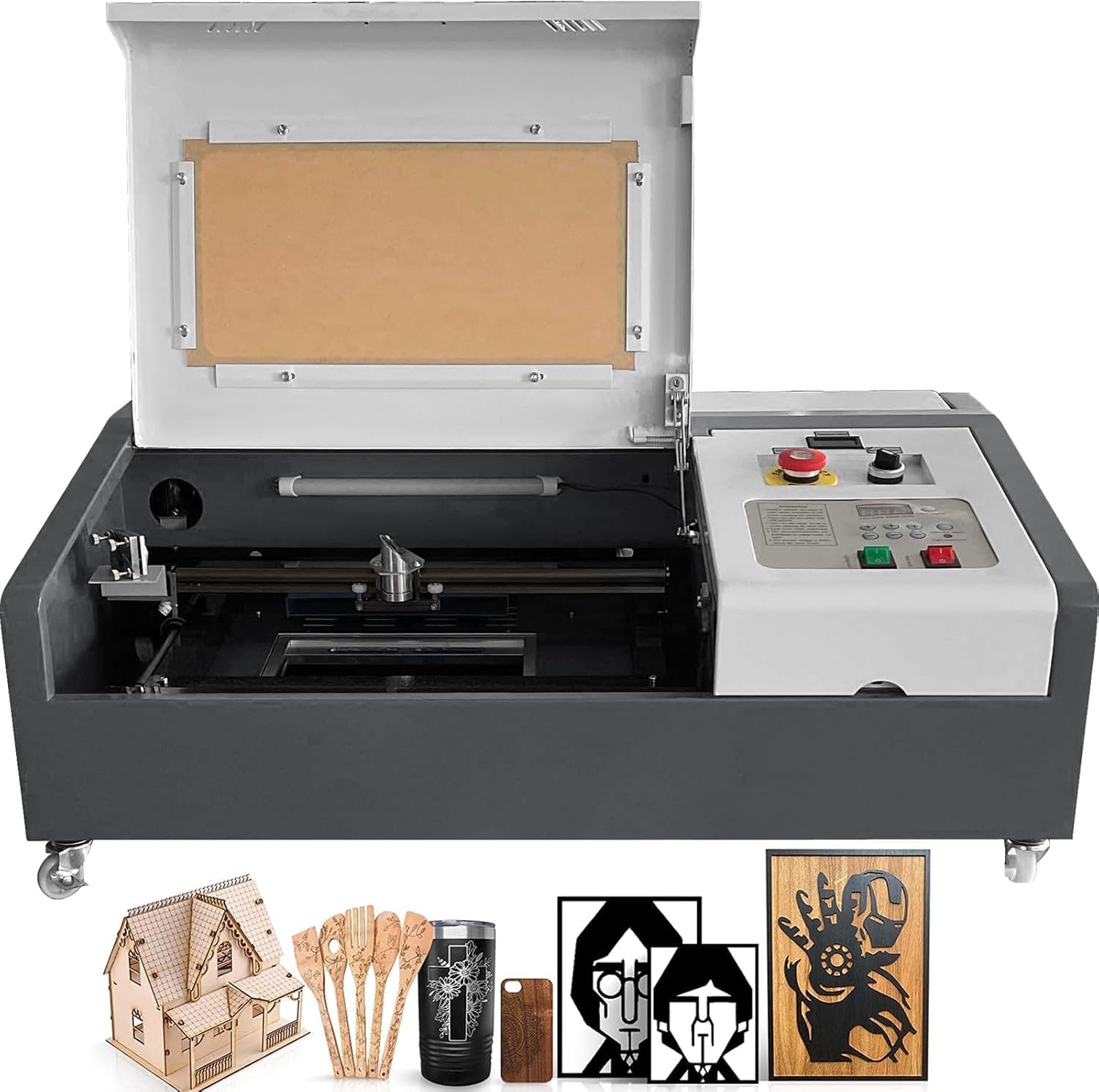
50W CO2 Laser Engraver, 16x16 inch Desktop Laser Cutter and Engraving Machine Compatible with CorelDRAW, Windows XP 7 8 10, EMF, JPG, PLT, WMF for Wood Acrylic Fabric (16"x16")
$600+This is a 50-60W CO2 laser engraver with a 300x200mm engraving area and 0.01mm positioning accuracy, designed for hobbyists and small businesses working with non-metallic materials.

LaserPecker LP5 Smart Dual 20W Fiber + Diode Laser Engraver Cutter with Rotary Extension, Slide Extension & Air Purifier, 3D Embossing, Color Engraving, Ideal for On-site Customization
$600+A dual 20W Fiber and 20W Diode laser engraver with 10,000mm/s speed, ideal for on-site customization across nearly all materials.

WIZMAKER 12W Laser Engraver Machine, Portable Carving Machine, 300x300mm Carving Area, 0.1mm High-Precision DIY Production, Suitable for Wood, Metal, Acrylic and Other Materials
$150-$299This is a 12W laser engraver with a 300x300mm carving area and 0.1mm precision, designed for DIY production on various materials.