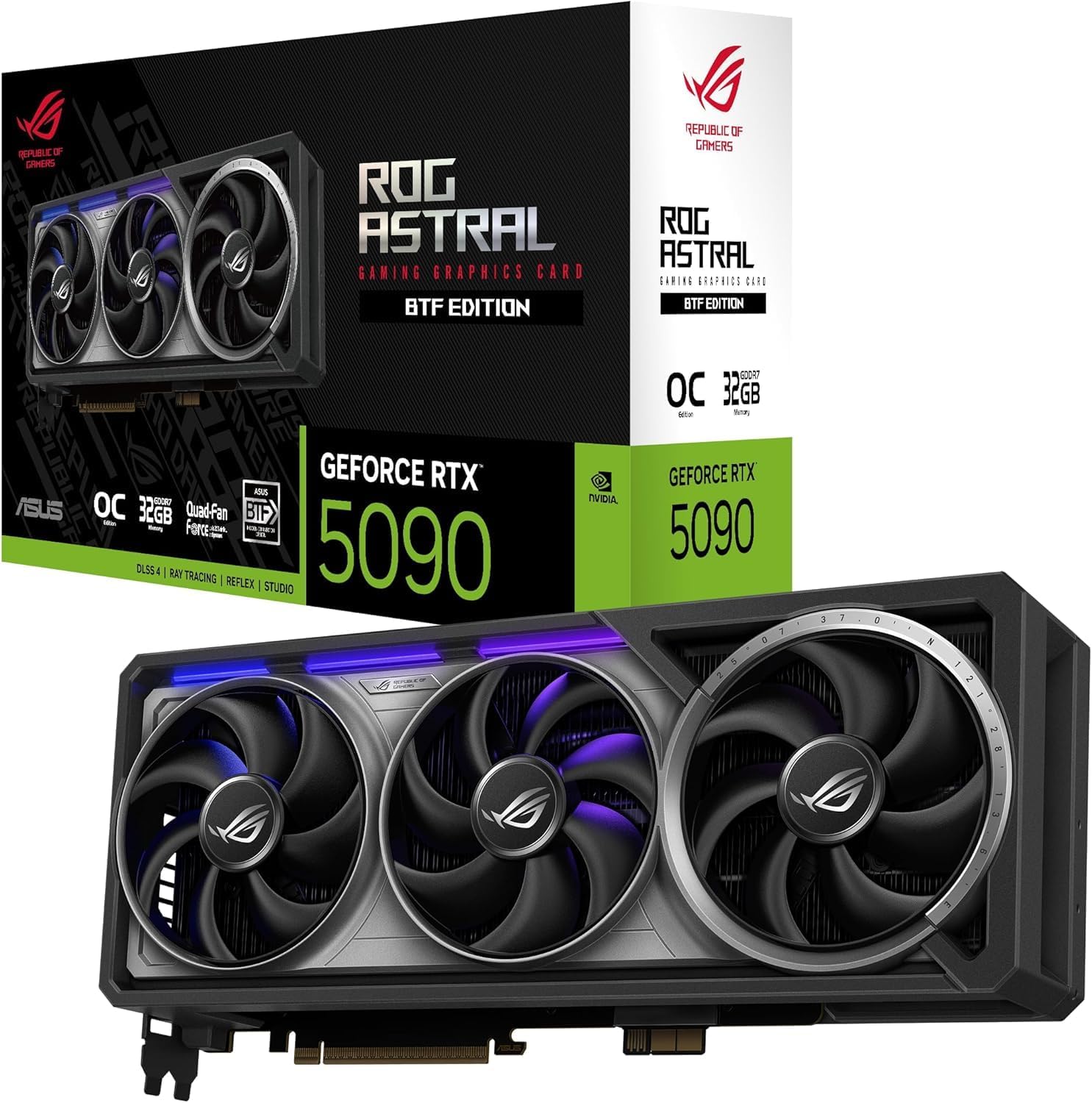
ASUS ROG Astral GeForce RTX 5090 BTF OC Edition, 32GB GDDR7, 3.8-Slot, 1000W Support
Want the best price and purchase timing?
Our AI advisor analyzes real-time pricing across all channels to find you the best deal.
AI Verdict
This is a 3.8-slot, quad-fan NVIDIA GeForce RTX 5090 with 32GB GDDR7 and a 2610 MHz OC clock, designed for high-end gaming and AI workloads with BTF motherboard compatibility.
This GPU is a strong fit for users demanding the absolute highest performance for gaming and AI, especially those integrating with ASUS BTF motherboards. Its 32GB GDDR7 and 2610 MHz OC clock are top-tier specifications for current and future demanding applications. The quad-fan cooling and 1000W power support are designed to handle extreme loads.
If this card's performance isn't enough, look for future generations of NVIDIA GPUs with even higher AI TOPS and VRAM capacity, or consider a liquid-cooled variant for sustained peak performance.
Regret Score™
Medium RiskLower is better — measures purchase-regret risk from real buyer complaints, review credibility, and product maturity
Issues discovered after purchase
Critically weak dimension
Amazon rating vs actual quality
Chance this product isn't for you
Pros
- Features 32GB GDDR7 VRAM, providing substantial memory capacity for demanding applications and high-resolution gaming.
- Offers a 2610 MHz OC mode clock speed, which is a factory overclock above the 2410 MHz reference, potentially delivering higher performance out of the box.
- Equipped with a quad-fan cooling system and a patented vapor chamber, boosting airflow and pressure by up to 20% for thermal management.
- Includes a detachable GC-HPWR adapter that supports up to 1000 watts, designed for compatibility with both standard and BTF motherboards.
- Features 80-amp MOSFETs, enhancing power delivery for improved stability and overclocking potential.
- Comes with two HDMI and three DisplayPort outputs, offering more display connectivity options than some reference designs.
Cons
- The card's massive 3.8-slot design and weight (over 3 kilograms) can make installation challenging and may require a GPU support bracket.
- Users have reported the back fan can be noisy, potentially impacting acoustic comfort during operation.
- The 12V-2x6 power connector, while monitored by ASUS, has been a point of concern for some users regarding potential issues.
- Despite its advanced cooling, some users undervolt the card to reduce power draw, indicating high default power consumption.
- The 'astronomical premium' pricing is a significant barrier, with some reviews calling it a 'terrible price for a mediocre product.'
Dimension Scores
With an NVIDIA GeForce RTX 5090 chipset, 32GB GDDR7, and a 2610 MHz OC clock, this card represents the pinnacle of gaming performance.
The quad-fan design, vapor chamber, and increased heatsink fin density are advanced cooling features, but some users have reported the back fan can be noisy.
The card supports up to 1000 watts and uses 80-amp MOSFETs, indicating high power consumption, though undervolting can reduce it.
With 32GB of GDDR7 VRAM, this card offers the maximum available memory capacity for current-generation GPUs, crucial for 4K gaming and AI tasks.
Best For
- Enthusiasts building a top-tier gaming PC for 4K or higher resolution gameplay.
- Professionals requiring high AI performance with 3593 AI TOPS for demanding AI workloads and home labs.
- Users specifically building with ASUS BTF motherboards to utilize the hidden power connector design.
Not Recommended For
- Budget-conscious builders, due to its 'astronomical premium' price point.
- Small form factor PC builds, given its massive 3.8-slot design and weight.
- Users sensitive to fan noise, as the back fan has been noted to be noisy.
Watch Out For
- The card's physical size is substantial, occupying 3.8 slots and weighing over 3 kilograms, which could cause sag and compatibility issues in smaller cases.
- Some users have noted the back fan can be noisy, which might be a concern for those seeking a quiet system.
- The price point is described as an 'astronomical premium,' making it significantly more expensive than even other high-end GPUs.
- Availability can be inconsistent, with users reporting difficulty finding the BTF version in stock on major retailers like Amazon.
- While ASUS provides per-pin current monitoring for the 12V-2x6 cable, the connector type itself has been a source of past user concern regarding potential melting issues.
Full Specifications
| ASIN | B0GNRL1HSB |
| Brand | SHUNTU |
| Item Weight | 10.6 ounces |
| Manufacturer | ASUS |
| GPU Clock Speed | 2580 MHz |
| Graphics Ram Size | 32 GB |
| Package Dimensions | 2.5 x 2.5 x 2.5 inches |
| Graphics Coprocessor | NVIDIA GeForce RTX 5090 |
| Video Output Interface | DisplayPort, HDMI |
What Buyers Say
The ASUS ROG Astral RTX 5090 is consistently highlighted for its 'astronomical premium' price, which is a major point of contention among potential buyers. Despite the high cost, users acknowledge its top-tier performance for both gaming and AI workloads, often comparing it to the Founders Edition. The unique BTF design with its hidden power connector is a draw for specific builds, though finding the BTF version in stock can be a challenge. While the cooling solution is robust, some feedback points to potential noise from the back fan and the sheer physical size of the card as practical considerations.
“Man, this card is a beast, but seriously, the price tag is just insane. Like, I get it's fast, but my wallet is crying. And that back fan? A little louder than I hoped for this much cash.”
Common Praise
- Exceptional performance in 4K benchmarks for games like Cyberpunk and Black Ops 6.
- The per-pin current monitoring for the 12V-2x6 cable is a valuable safety feature.
- The BTF design offers a clean aesthetic by hiding power cables.
- Robust cooling solution with a quad-fan design and vapor chamber keeps temperatures low.
- Offers two HDMI and three DisplayPort outputs, providing flexible display connectivity.
Common Complaints
- The 'astronomical premium' price makes it significantly more expensive than other high-end GPUs.
- The back fan can be noisy, which is a concern for quiet operation.
- Its massive 3.8-slot size and weight require careful case selection and potentially a support bracket.
- Availability of the BTF version can be inconsistent on major retail platforms.
- High power draw, with some users opting to undervolt to manage consumption.
Ownership Tips
- You'll probably need a 1200W power supply to handle the transient power spikes, even if the card is rated for 1000W.
- Consider installing GPU Tweak III for per-pin power monitoring, it's actually useful for checking cable health.
- If you're not into extreme overclocking, undervolting can significantly reduce power consumption with minimal FPS loss.
- The card is seriously heavy; plan for a GPU support bracket to prevent sag over time.
- The BTF connector is cool for aesthetics, but make sure your motherboard actually supports it for the full benefit.
Frequently Asked Questions
What is the benefit of the BTF design?
The BTF (Back To Future) design uses a detachable GC-HPWR adapter that allows for a hidden power connector, making for a cleaner build aesthetic and potentially improved cable management.
How much power does this graphics card consume?
The GC-HPWR adapter can withstand up to 1000 watts, and the card features 80-amp MOSFETs for power delivery. Some users have reported undervolting to reduce full load power draw from 600W to 450W.
Will this card fit in my PC case?
This is a massive 3.8-slot card, weighing over 3 kilograms. You'll need a large PC case with ample clearance for both its thickness and length.
Does this GPU have good cooling?
Yes, it features a quad-fan design, a patented vapor chamber, increased heatsink fin density, and a phase-change GPU thermal pad, designed for enhanced cooling performance.
What kind of display outputs does it have?
The card is equipped with two HDMI ports and three DisplayPort outputs, allowing for multiple monitor setups.
Buying Guide
When you're looking at a card like this, you're buying into the absolute top-tier of performance. Don't just look at the raw speed; consider your entire system. This isn't a casual upgrade; it's the foundation of a high-end build. You need a powerful CPU, a robust power supply, and a case that can actually fit this monster. Think about what you're actually going to *do* with this much power – 4K gaming at max settings, heavy AI work, or just bragging rights.
chipset: NVIDIA GeForce RTX 5090
This is the core processing unit of the graphics card. The RTX 5090 is NVIDIA's flagship, meaning it's designed for the highest possible performance in games and professional applications, like having the most powerful engine in a sports car.
vram: 32 GB GDDR7
VRAM (Video Random Access Memory) is where the card stores data it needs to render images. 32GB of GDDR7 is an immense amount, crucial for playing games at 4K or 8K resolutions with ultra settings, or for handling massive datasets in AI and content creation, like having a huge, super-fast hard drive dedicated just to your graphics.
clock_speed: 2610 MHz (OC mode)
This is how fast the GPU's processor runs. A higher clock speed generally means more calculations per second, leading to better performance. The 'OC mode' means it's factory-tuned to run faster than the standard speed, giving you extra frames per second or faster computations right out of the box.
3.8-Slot, 1000W Support
The '3.8-Slot' refers to how many expansion slots it occupies in your PC case, indicating its physical thickness. '1000W Support' means the card can draw up to 1000 watts of power, so your power supply needs to be capable of delivering that, plus power for all your other components, like a high-performance engine needing a massive fuel tank.
Alternatives
If this card is too expensive or too large, look for a 5090 variant with a smaller form factor (e.g., 3-slot design) or a slightly lower factory overclock. If the BTF feature isn't a priority, consider other 5090 models that use traditional power connectors.
You Might Also Like

HP NVIDIA GeForce RTX 3070 8GB OEM Graphics Card (Renewed)
$150-$299This is a renewed HP OEM NVIDIA GeForce RTX 3070 with 8GB VRAM, a gamble for budget-conscious 1440p gamers who understand the risks of refurbished hardware.

ZOTAC Gaming GeForce RTX 5070 Twin Edge OC DLSS 4 12GB GDDR7 192-bit 28 Gbps PCIE 5.0 Gaming Graphics Card, IceStorm 2.0 Cooling, SFF-Ready, ZT-B50700H-10A
$600+This is a 2-slot, SFF-ready NVIDIA RTX 5070 with 12GB GDDR7 and a 2542 MHz boost clock, built for compact gaming rigs needing high 1440p performance.

ZOTAC Gaming GeForce RTX 5080 Solid CORE OC DLSS 4 16GB GDDR7 256-bit 30 Gbps PCIE 5.0 Gaming Graphics Card, IceStorm 3.0 Advanced Cooling, Spectra RGB Lighting, ZT-B50800J2-10A
$600+This ZOTAC RTX 5080 with 16GB GDDR7 and a 2640 GHz clock speed is built for high-end 4K gaming and content creation on the NVIDIA Blackwell architecture.
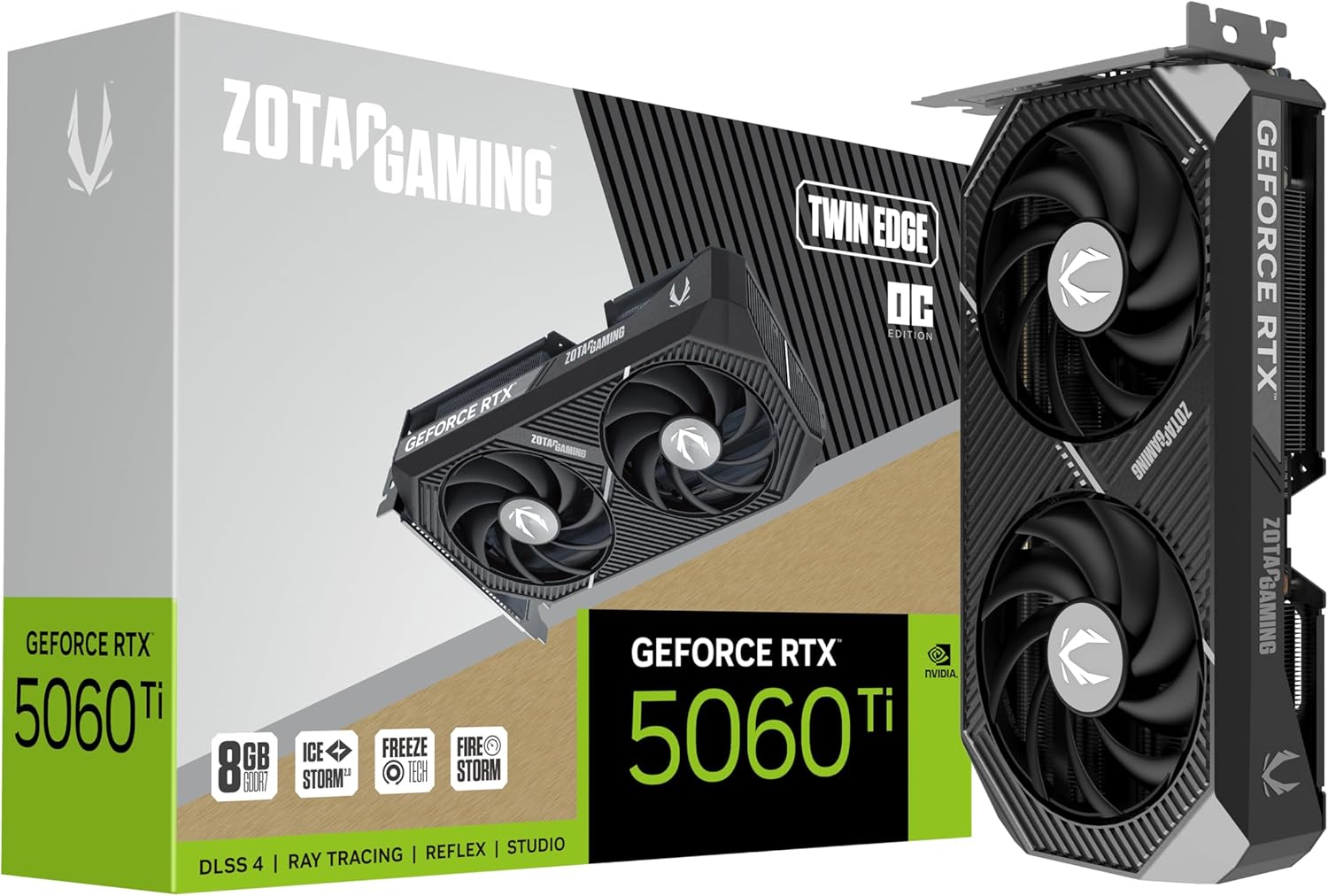
ZOTAC Gaming GeForce RTX 5060 Ti 8GB Twin Edge OC DLSS 4 8GB GDDR7 128-bit 28 Gbps PCIE 5.0 Gaming Graphics Card, IceStorm 2.0 Cooling, SFF-Ready, ZT-B50610H-10A
$300-$599This is a compact, 2-slot RTX 5060 Ti with 8GB GDDR7 and a 2602 MHz clock, built for SFF gaming rigs.