
XFX AMD Radeon AI Pro R9700 32GB GDDR6 4xDP, AMD RDNA 4 RX-97XPROAIY
Want the best price and purchase timing?
Our AI advisor analyzes real-time pricing across all channels to find you the best deal.
AI Verdict
This is a 32GB GDDR6 RDNA 4 GPU with a 2920 MHz boost clock, purpose-built for local AI workloads and 4K gaming with FSR.
This GPU is a situational fit because its 32GB GDDR6 VRAM and RDNA 4 AI accelerators are highly beneficial for local AI model inferencing and development, especially for larger models. However, its gaming performance, while capable at 4K, isn't class-leading for ray tracing, and its blower cooler can be noisy under heavy AI loads.
If you need more raw gaming performance, especially with ray tracing, or broader professional software support, look for GPUs with higher memory bandwidth and established ecosystem support.
Regret Score™
High RiskLower is better — measures purchase-regret risk from real buyer complaints, review credibility, and product maturity
Issues discovered after purchase
Critically weak dimension
Amazon rating vs actual quality
Chance this product isn't for you
Pros
- Features 32GB GDDR6 VRAM, enabling handling of 30b/32b LLM models with large context lengths.
- Offers performance comparable to an RTX 5070 Ti or Radeon 9070 XT for 4K gaming without ray tracing.
- Equipped with 2nd-gen AI Accelerators, delivering up to 2x better AI performance compared to the previous generation.
- Has official ROCm support, with ROCm 7.2 showing significant maturity and improvements.
- Its 267mm length and blower-style cooler make it suitable for Small Form Factor PC (SFFPC) builds.
- Includes ECC memory support, beneficial for professional AI applications.
Cons
- The blower-style cooler can be loud under heavy AI workloads.
- Memory bandwidth is 640 GB/s, which is lower than some competing NVIDIA cards like the RTX 5070 (672 GB/s) and RTX 3090 (936 GB/sec).
- Professional software support is not as broad as NVIDIA, with some applications lacking AMD support.
- Gaming performance with ray tracing enabled at 4K/120Hz often requires FSR and/or frame generation.
- Raw compute performance in some Vulkan professional workloads can be slower than the 7900 XTX.
Dimension Scores
It offers 4K gaming performance on par with an RTX 5070 Ti or Radeon 9070 XT, though 4K/120Hz with ray tracing often requires FSR.
While it can stay around 60C and be quiet during gaming, the blower cooler is reported to be loud under heavy AI workloads.
The card pulls 300W, which is a moderate power draw for a high-VRAM GPU, but it's not the most power-efficient for raw compute performance compared to some alternatives.
With 32GB GDDR6, it provides a substantial amount of VRAM, making it highly capable for large AI models and memory-intensive tasks.
Best For
- AI hobbyists running 30b/32b LLM models locally with large context lengths.
- Users needing a single GPU for both 4K gaming (without heavy ray tracing) and AI development.
- Small Form Factor PC (SFFPC) builds due to its 267mm card length.
- Developers leveraging ROCm for AI acceleration on Linux.
Not Recommended For
- Gamers prioritizing top-tier ray tracing performance at 4K/120Hz without upscaling.
- Users requiring broad professional software compatibility that is currently NVIDIA-centric.
- Those sensitive to fan noise during sustained, compute-intensive tasks.
Watch Out For
- The blower cooler gets loud when running compute-heavy AI tasks, making it noticeable.
- Memory bandwidth is 640 GB/s, which is less than some older or competing cards, potentially impacting token generation speed in LLMs.
- Some professional applications, like OctaneBench and V-Ray, do not support AMD cards, limiting its use in those specific workflows.
- The Amazon listing for this ASIN (B0FXTRGHL9) appears to have been affected by review hijacking, making the single 2.0/5 rating unreliable.
Full Specifications
| ASIN | B0FXTRGHL9 |
| Brand | XFX |
| Item Weight | 4 pounds |
| Manufacturer | XFX |
| GPU Clock Speed | 1620 MHz |
| Graphics Ram Size | 32 GB |
| Item model number | RX-97XPROAIY |
| Product Dimensions | 18 x 8 x 0.1 inches |
| Graphics Coprocessor | AI Pro R9700 |
| Video Output Interface | DisplayPort |
What Buyers Say
There are no reliable Amazon reviews for this specific ASIN due to indications of review hijacking. However, discussions on Reddit highlight its strong appeal for AI enthusiasts, particularly for running large language models due to its 32GB VRAM. Users also note its capability for 4K gaming, though ray tracing performance requires upscaling. A recurring point is the noise from its blower cooler during intense AI tasks.
“Look, if you're into local AI stuff and need that 32GB VRAM, this card is actually pretty sweet for the money, even if the fan sounds like a jet engine when it's really working hard. For gaming, it's fine, but don't expect miracles with ray tracing.”
Common Praise
- The 32GB GDDR6 VRAM is a significant advantage for running 30b/32b LLM models and other memory-intensive AI tasks.
- Offers competent 4K gaming performance, especially without ray tracing.
- ROCm support has matured considerably, making it more viable for AI development on Linux.
- Its compact 267mm length and blower design are suitable for SFFPC builds.
- Considered a strong value proposition for its VRAM capacity compared to NVIDIA alternatives.
Common Complaints
- The blower-style cooler generates significant noise during demanding AI workloads.
- Memory bandwidth (640 GB/s) is lower than some competing cards, which can affect performance in certain AI tasks.
- Professional software support is not as extensive as NVIDIA's ecosystem.
- Ray tracing performance at 4K/120Hz often necessitates the use of FSR or frame generation.
Ownership Tips
- ROCm drivers have improved a lot since launch, making the AI experience much smoother now.
- The card's physical size makes it a good option if you're trying to build a smaller system.
- You'll want to manage fan curves or consider your case's airflow if you're pushing heavy AI loads, because that blower can get loud.
- It's a 'pro' card, so don't expect the same gaming driver optimizations as a consumer-focused GPU.
Frequently Asked Questions
What kind of AI performance can I expect from the R9700?
The R9700 features 2nd-gen AI Accelerators and RDNA 4 Architecture, delivering up to 2x better AI performance compared to the previous generation. It's particularly suited for running 30b/32b LLM models locally due to its 32GB VRAM.
Is the XFX AMD Radeon AI Pro R9700 good for gaming?
For gaming, it performs comparably to an RTX 5070 Ti or Radeon 9070 XT. It handles 4K gaming well without ray tracing, but for 4K/120Hz with ray tracing, you'll likely need to use FSR or frame generation.
Does this GPU support ROCm?
Yes, the AMD Radeon AI Pro R9700 has official ROCm support. Users report that ROCm has matured significantly, with version 7.2 showing considerable improvements since the card's launch.
How loud is the R9700 under load?
When running intensive AI workloads, the blower-style cooler can be loud. However, some users report it being quiet during gaming, with temperatures staying around 60C.
What are the dimensions of this card?
The card measures approximately 26.7 cm (10.51 inches) in length, 9.9 cm (3.9 inches) in width, and 3.5 cm (1.38 inches) in height, making it suitable for SFFPC builds.
Buying Guide
When you're looking at GPUs like this, especially for AI, the amount of VRAM (video memory) is a huge deal. More VRAM means you can load bigger AI models or process larger datasets without hitting memory limits. Clock speed matters for raw processing power, but for AI, memory capacity often dictates what you can even run. Also, consider the cooling system; a blower design like this pushes hot air out of your case, which is good for multi-GPU setups or smaller cases, but it can be noisier than open-air coolers.
VRAM (32GB GDDR6)
This is your GPU's dedicated memory. For AI, especially large language models, having 32GB means you can run much bigger models or process more data at once compared to cards with less VRAM. Think of it like RAM for your CPU, but specifically for the graphics card's tasks.
Chipset (AI Pro R9700, RDNA 4)
This tells you the core technology. RDNA 4 is AMD's latest architecture, and 'AI Pro' means it has dedicated hardware accelerators designed to speed up AI calculations. It's like having specialized tools for a specific job, making those tasks much faster.
Boost Clock (Up to 2920 MHz)
This is the maximum speed the GPU's processing core can reach under ideal conditions. A higher boost clock generally means faster performance in games and compute tasks, but real-world speeds can vary based on temperature and power limits.
Output (4x DisplayPort)
This specifies the types and number of display connections. Four DisplayPort outputs give you flexibility for multi-monitor setups, which is common in professional or enthusiast workstations.
Alternatives
If this card doesn't quite fit, look for GPUs with at least 24GB VRAM if AI is a priority, or higher memory bandwidth if your workloads are sensitive to that. For purely gaming-focused alternatives, prioritize higher clock speeds and advanced ray tracing cores.
You Might Also Like

HP NVIDIA GeForce RTX 3070 8GB OEM Graphics Card (Renewed)
$150-$299This is a renewed HP OEM NVIDIA GeForce RTX 3070 with 8GB VRAM, a gamble for budget-conscious 1440p gamers who understand the risks of refurbished hardware.

ZOTAC Gaming GeForce RTX 5070 Twin Edge OC DLSS 4 12GB GDDR7 192-bit 28 Gbps PCIE 5.0 Gaming Graphics Card, IceStorm 2.0 Cooling, SFF-Ready, ZT-B50700H-10A
$600+This is a 2-slot, SFF-ready NVIDIA RTX 5070 with 12GB GDDR7 and a 2542 MHz boost clock, built for compact gaming rigs needing high 1440p performance.

ZOTAC Gaming GeForce RTX 5080 Solid CORE OC DLSS 4 16GB GDDR7 256-bit 30 Gbps PCIE 5.0 Gaming Graphics Card, IceStorm 3.0 Advanced Cooling, Spectra RGB Lighting, ZT-B50800J2-10A
$600+This ZOTAC RTX 5080 with 16GB GDDR7 and a 2640 GHz clock speed is built for high-end 4K gaming and content creation on the NVIDIA Blackwell architecture.
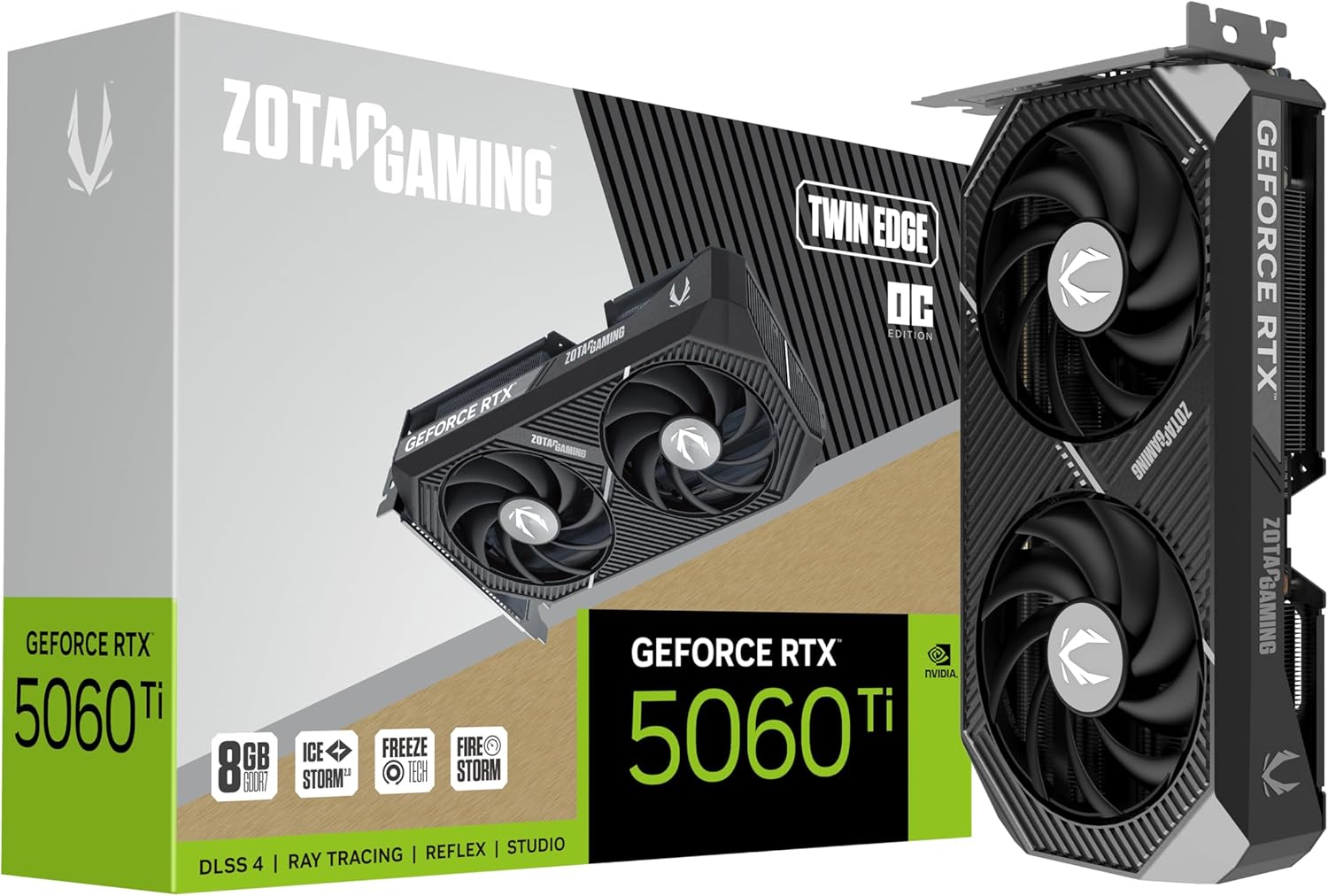
ZOTAC Gaming GeForce RTX 5060 Ti 8GB Twin Edge OC DLSS 4 8GB GDDR7 128-bit 28 Gbps PCIE 5.0 Gaming Graphics Card, IceStorm 2.0 Cooling, SFF-Ready, ZT-B50610H-10A
$300-$599This is a compact, 2-slot RTX 5060 Ti with 8GB GDDR7 and a 2602 MHz clock, built for SFF gaming rigs.