
NVIDIA Jetson Thor Developer Kit
Want the best price and purchase timing?
Our AI advisor analyzes real-time pricing across all channels to find you the best deal.
AI Verdict
This is a 2560-core NVIDIA Blackwell GPU with 128GB unified LPDDR5X memory, specifically engineered for real-time generative AI on robotics and edge devices.
The NVIDIA Jetson Thor Developer Kit is a strong fit for its intended purpose, offering a 2560-core Blackwell GPU and 128GB of unified LPDDR5X memory, specifically designed for real-time generative AI in robotics and edge computing. Its 2070 TFLOPS AI performance and robust I/O directly address the needs of advanced AI development and deployment in specialized scenarios.
If 128GB of unified memory isn't enough for your specific large model training needs, consider cloud-based GPU instances with even larger memory pools.
Regret Score™
Very High RiskLower is better — measures purchase-regret risk from real buyer complaints, review credibility, and product maturity
Issues discovered after purchase
Critically weak dimension
Amazon rating vs actual quality
Chance this product isn't for you
Pros
- Features a 2560-core NVIDIA Blackwell architecture GPU with 96 fifth-gen Tensor Cores for advanced AI processing.
- Offers 128 GB of unified LPDDR5X memory with 273 GB/s bandwidth, accessible by both CPU and GPU, preventing memory bottlenecks for complex AI models.
- Achieves 2070 TFLOPS (FP4 precision) for AI performance, providing a 7.5x performance advantage over the previous generation in specific workloads.
- Includes robust I/O with USB C, USB A (Gen 3.2), 5GbE, HDMI 2.1, Wi-Fi 6E, Bluetooth, Gigabit Ethernet, and a 100GbE port for diverse connectivity needs.
- Supports Multi-Instance GPU (MIG) allowing the GPU to be partitioned into up to seven isolated slices for running multiple models simultaneously without context-switching overhead.
- Comes with 1TB of onboard storage, identified as a WD/SanDisk SN5000S M.2 SSD, providing ample space for models and data.
Cons
- The developer kit is physically larger than previous Jetson AGX Orin models, potentially impacting integration into compact robotics designs.
- Power draw can be substantial, with an AC adapter rated for 240 Watts and a 130W peak power consumption, which may challenge battery-powered systems.
- The premium price point of $3,499.99 makes it a significant investment for individual developers or smaller projects.
- While powerful, some users express a desire for even more VRAM, questioning the 128GB limit for certain large language models.
- Software support, while robust, is still evolving, with some reviewers noting that updates will be needed to unlock its full potential.
Dimension Scores
This developer kit is not designed for gaming; its Blackwell GPU and Tensor Cores are optimized for AI workloads, not consumer gaming graphics.
The device features a large cooling solution that occupies an entire side of the chassis, indicating effective thermal management for its 130W peak power draw.
With a 240W AC adapter and 130W peak power consumption, the device's power draw is substantial for an embedded system, potentially limiting battery-powered deployments.
The 128GB of unified LPDDR5X memory is exceptionally high for an embedded AI platform, allowing for the execution of very large AI models.
Best For
- Developing and deploying generative AI models on physical robots in real-time.
- Edge AI applications requiring high compute density and unified memory for complex workloads.
- Research labs focused on reward model training and Reinforcement Learning-based finetuning with 3B models or larger.
- Prototyping and testing advanced computer vision and language models in an embedded environment.
Not Recommended For
- General-purpose desktop computing or gaming due to its specialized architecture and focus on AI acceleration.
- Budget-constrained hobbyists or students looking for an entry-level embedded AI platform.
- Applications that do not require the extensive I/O and high-performance AI capabilities of the Blackwell architecture.
Watch Out For
- The $3,499.99 price tag is a significant barrier, with some Reddit users expressing sticker shock at $3,697.
- Despite 128GB of unified memory, some users on Reddit questioned the memory capacity, stating 'Why why why are they limiting these to 128GB?' for large LLMs.
- The 130W peak power draw and 240W AC adapter rating mean this isn't a low-power device, potentially limiting battery-operated deployments.
- While capable, running very large LLMs (70B+ parameters) on the device yields speeds in the 'low 10s of tokens/second' for Llama 3.3 70B, which might be slow for some applications.
- The physical size is 'much larger than the AGX Orin development box,' which could be an issue for space-constrained projects.
Full Specifications
| ASIN | B0FTM2LXSF |
| Brand | NVIDIA |
| Item Weight | 6.49 pounds |
| Manufacturer | NVIDIA Corporation |
| GPU Clock Speed | 1.57 GHz |
| Graphics Ram Size | 128 GB |
| Item model number | 945-14070-0080-000 |
| Package Dimensions | 14.25 x 8.58 x 6.77 inches |
| Graphics Coprocessor | NVIDIA Blackwell GPU |
| Video Output Interface | DisplayPort, HDMI |
What Buyers Say
The NVIDIA Jetson Thor Developer Kit is consistently praised for its substantial AI performance, particularly in handling large language models and robotics applications. Reviewers frequently highlight the 128GB of unified LPDDR5X memory as a key advantage, allowing both the CPU and GPU to access a single, large pool of data without partitioning. While its $3,499.99 price point is a common point of discussion, the consensus is that its capabilities for edge AI and robotics development are unparalleled. Some users on Reddit, however, expressed concerns about the 128GB memory limit for extremely large LLMs and the overall cost.
“Man, this thing is pricey, but if you're serious about robotics and AI at the edge, the 128GB unified memory and Blackwell GPU are just insane for what it can do, even if it's a bit chunky.”
Common Praise
- Exceptional AI performance with 2070 TFLOPS (FP4) for demanding edge applications.
- Unified 128GB LPDDR5X memory eliminates memory bottlenecks for complex AI models.
- Robust set of I/O ports, including 100GbE, for diverse developer tasks and connectivity.
- Significant performance gains over the previous Jetson AGX Orin, especially with larger models.
- Designed specifically for real-time generative AI on physical robots, making it ideal for advanced robotics projects.
- Comes with 1TB of fast onboard storage (WD/SanDisk SN5000S M.2 SSD).
Common Complaints
- The $3,499.99 price is a significant investment, making it inaccessible for many.
- Its physical size is considerably larger than previous Jetson models, which can be a challenge for integration.
- The 130W peak power draw can be a concern for battery-powered or thermally constrained environments.
- Some users on Reddit felt 128GB of memory might still be limiting for the largest LLMs.
- Software support, while good, is still expected to mature to unlock the platform's full potential.
Ownership Tips
- Expect to spend time optimizing software and drivers, as the platform's full potential often requires specific configurations and updates.
- The large cooling solution, while effective, means it's not a silent device, especially under heavy load.
- Integrating the extensive I/O, particularly the 100GbE port, might require specialized networking equipment and expertise.
- The power requirements necessitate a robust power supply and careful consideration for portable deployments.
- The developer kit is a stepping stone; for production, you'd likely transition to the standalone Jetson T5000 module with a custom carrier board.
Frequently Asked Questions
Can the NVIDIA Jetson Thor Developer Kit run large language models (LLMs)?
Yes, it can run LLMs. It has been tested to achieve 149.1 tokens per second on Llama 3.1 8B, and for Llama 3.3 70B, it can achieve speeds in the low 10s of tokens per second.
What is the memory architecture of the Jetson Thor?
The Jetson Thor features 128GB of unified LPDDR5X memory, meaning the entire memory pool is available to both the CPU and GPU without static partitioning, similar to Apple Silicon.
Is the Jetson Thor suitable for robotics applications?
Absolutely. It was designed from the ground up for running generative AI models on physical robots in real time and serves as the reference compute platform for Isaac GR00T.
How does the Jetson Thor compare to the Jetson AGX Orin?
The Thor consistently outperforms the Orin, especially with larger and more demanding models, showing nearly five times the performance for Qwen 3 32B inference.
What operating system does the Jetson Thor use?
The AGX Thor runs JetPack 7, which is based on Ubuntu 24.04 LTS, providing updated package versions for AI frameworks.
Buying Guide
When looking at a developer kit like the Jetson Thor, you're not just buying a GPU; you're investing in a complete embedded AI platform. You need to consider its ability to handle complex AI models directly on the device, its connectivity for sensors and other hardware, and the software ecosystem that supports your development. This isn't for casual use; it's for serious AI and robotics projects where processing power at the 'edge' is critical.
Blackwell GPU with Tensor Cores
This is the brain for AI. The Blackwell architecture is NVIDIA's latest, and Tensor Cores are specialized processors that dramatically speed up the calculations needed for AI and machine learning, making your models run much faster than on a standard GPU.
128 GB Unified LPDDR5X Memory
Think of this as a massive, shared workspace for both the main processor (CPU) and the AI processor (GPU). With 128GB, you can load very large AI models and datasets directly onto the device without constantly swapping data, which is crucial for real-time performance in robotics.
2070 TFLOPS AI Performance (FP4)
TFLOPS (Tera Floating-point Operations Per Second) is a measure of how many calculations the GPU can do for AI. 2070 TFLOPS, especially at FP4 precision, means this kit can crunch an enormous amount of AI data very quickly, enabling highly complex and responsive AI behaviors.
Robust I/O (e.g., 100GbE, multiple USB)
This refers to all the ports and connections. For robotics and edge AI, you need to connect many sensors, cameras, and other devices. Extensive I/O, like a 100 Gigabit Ethernet port, ensures you can handle high-bandwidth data streams from multiple sources simultaneously.
Alternatives
If this kit is too powerful or expensive, look for embedded AI platforms with lower TFLOPS, less unified memory (e.g., 16GB or 32GB), and fewer high-speed I/O options, which will be more suitable for simpler AI tasks or projects with tighter budget constraints.
You Might Also Like

HP NVIDIA GeForce RTX 3070 8GB OEM Graphics Card (Renewed)
$150-$299This is a renewed HP OEM NVIDIA GeForce RTX 3070 with 8GB VRAM, a gamble for budget-conscious 1440p gamers who understand the risks of refurbished hardware.

ZOTAC Gaming GeForce RTX 5070 Twin Edge OC DLSS 4 12GB GDDR7 192-bit 28 Gbps PCIE 5.0 Gaming Graphics Card, IceStorm 2.0 Cooling, SFF-Ready, ZT-B50700H-10A
$600+This is a 2-slot, SFF-ready NVIDIA RTX 5070 with 12GB GDDR7 and a 2542 MHz boost clock, built for compact gaming rigs needing high 1440p performance.

ZOTAC Gaming GeForce RTX 5080 Solid CORE OC DLSS 4 16GB GDDR7 256-bit 30 Gbps PCIE 5.0 Gaming Graphics Card, IceStorm 3.0 Advanced Cooling, Spectra RGB Lighting, ZT-B50800J2-10A
$600+This ZOTAC RTX 5080 with 16GB GDDR7 and a 2640 GHz clock speed is built for high-end 4K gaming and content creation on the NVIDIA Blackwell architecture.
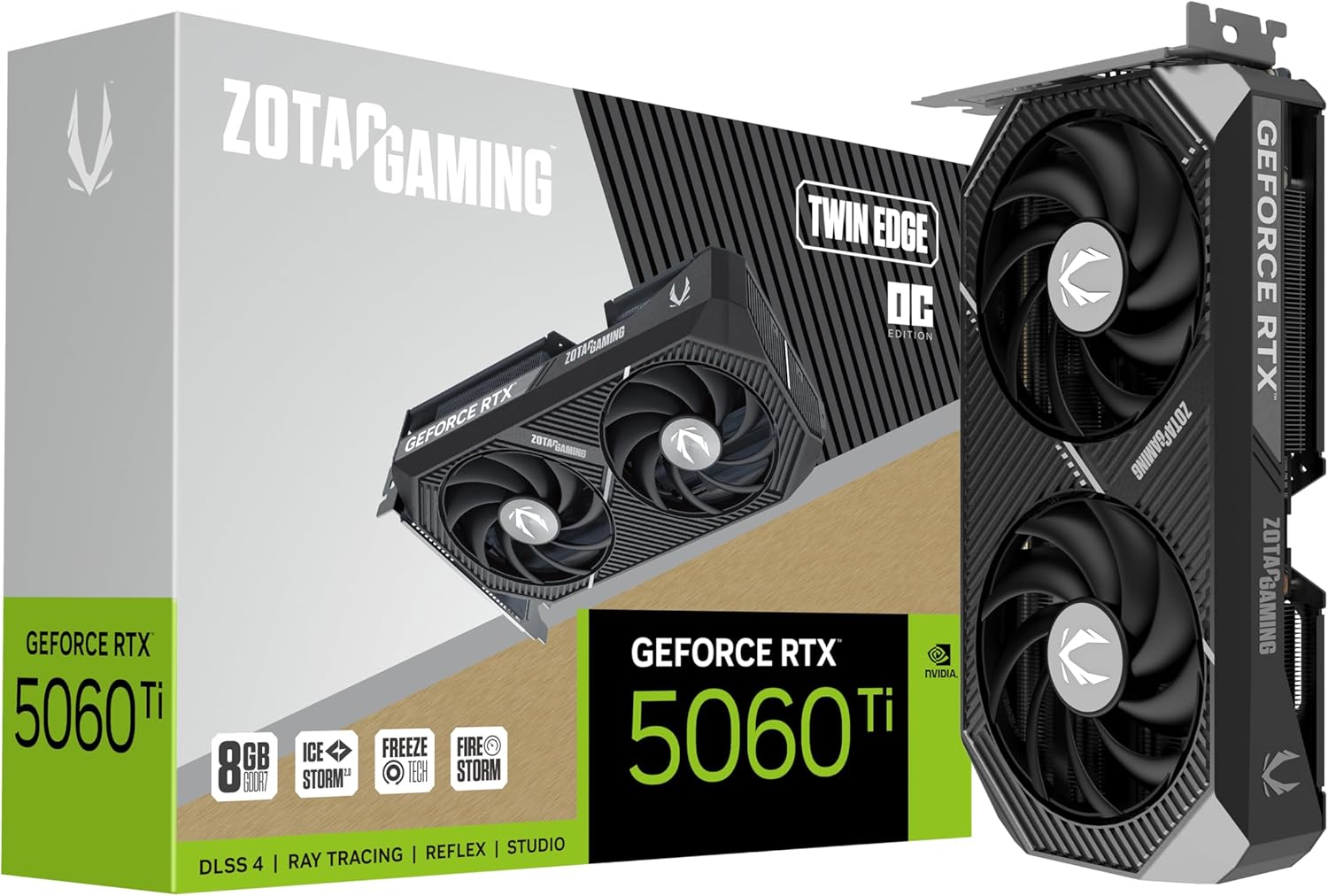
ZOTAC Gaming GeForce RTX 5060 Ti 8GB Twin Edge OC DLSS 4 8GB GDDR7 128-bit 28 Gbps PCIE 5.0 Gaming Graphics Card, IceStorm 2.0 Cooling, SFF-Ready, ZT-B50610H-10A
$300-$599This is a compact, 2-slot RTX 5060 Ti with 8GB GDDR7 and a 2602 MHz clock, built for SFF gaming rigs.